• Home
  • Completed Costumes/Impressions
  • Emma and Her Dresses
  • Free Patterns and Instructions

Kitty Calash

~ Confessions of a Known Bonnet-Wearer

Kitty Calash

Tag Archives: Museums

Sweet Danish!

28 Thursday Feb 2013

Posted by kittycalash in Clothing, Museums

≈ 1 Comment

Tags

dress, Museums, National Museum of Denmark, patterns, Research, resources, Tidens Toj

That dress!

You know the fabulous 1797 wedding gown from the Danish Museum? It turns up on blogs as the Tidens Toj gown. Many of the links to the pattern and the gown are broken now, but fear not, it only moved. Wouldn’t know anything about museum website links changing…

You may know this already, but it’s here now. The National Museum of Denmark has a nice set of Pinterest boards,  which is how I found the dress. The PDF is still available from the catalog record, and has a link here.

English Dress, 1780

The Fashion History- Future Clothing exhibit is still up, and many of the garments have PDF patterns. There is a pretty post-RevWar era “English Dress,” which also has a pattern. The translation that Google provides is a trifle (no, actually, quite) hilarious. Don’t trust it…you’ll end up with sweaters and wrinkles instead of Brunswicks and pleats.

Share this:

  • Share on Facebook (Opens in new window) Facebook
  • Share on Pinterest (Opens in new window) Pinterest
  • Email a link to a friend (Opens in new window) Email
  • Share on X (Opens in new window) X
Like Loading...

Shoe Envy

21 Thursday Feb 2013

Posted by kittycalash in Clothing, Making Things

≈ 3 Comments

Tags

1914-1918, Clothing, Edwardian, Essex Steam Train, fashion, Making Things, Museums, Research, sewing, shoes

Suit, 1914-1918. MMA

Suit, 1914-1918. MMA

Yes, I am as shallow as stereotypes might suggest: I see shoes, I often want shoes. Even my current co-workers know about the red leather Cuban-heeledAdrienne Vittadini pumps I passed up when they were on post-Christmas sale at Marshall Field’s way back in the Dark Ages. They would have gone nicely with this red wool suit from the Met.

There’s a Steam Railway in Essex, CT and when we went on Staff Day, we were told the train car was from 1914, an excellent year for fashion–at least before that August. It seemed like a great plan: make 1914 clothes and ride the train again next fall, possibly carrying vintage luggage or a basket with a delicious picnic. Really, who’s in? Let’s book it!

The World War I era has fascinated me for a long time, from Vera Brittain to Siegfried Sassoon,  from Wobblies (perhaps because I grew up in Chicago) to war memorials, so the Steam Train Outing in Period Dress was particularly tempting, and I started a board for early 20th century costume. Downton Abbey fans will enjoy it, too, and while I tired of Swedish murders and finally caved to Downton’s charms, my film choice for the period is Testament of Youth.

Libby Hall Dog Photo from flickr

When I saw the American Duchess pre-order for Gibson shoes, I was sorely tempted. (They’re quite similar to what the lady on the right is wearing.) Fortunately, I am saved by my pedal extremities, for which my size is not yet available.

But what really holds me back is the thought of sewing the corset. It’s like the hip surgery I don’t want to have: I know how painful it is, and how inescapable. There is no way to properly dress in the past unless you do it from the skin out. But shoes–and those fantastic Edwardian hats–might just get me to make that corset. Shallow, isn’t it?

Share this:

  • Share on Facebook (Opens in new window) Facebook
  • Share on Pinterest (Opens in new window) Pinterest
  • Email a link to a friend (Opens in new window) Email
  • Share on X (Opens in new window) X
Like Loading...

A Visit with the Ladies

25 Friday Jan 2013

Posted by cyclokitty in Clothing, History, Museums

≈ 6 Comments

Tags

1940s, Clothing, family, fashion, history, Museums, personal

The apple never falls far from the tree, my mother used to say, of me and my grandmother, her mother, Elsa. Elsa went to a woman’s college, majored in botany, graduated in the mid-twenties, and went back to western New York State, where she opened an eponymous dress shop.
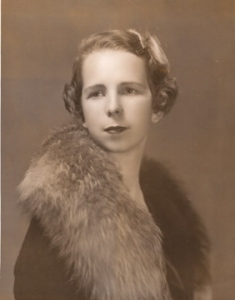
Elsa, Studio Portait ca 1935

Elsa, Studio portrait ca 1935

Elsa managed that shop for more than 50 years, dressed most of the women in town (or at least the type of woman who knew how to dress, and be dressed), and even dressed a woman who later became a donor to the architectural collection I managed in St. Louis.

She was a controlling woman, no doubt, and carefully managed and cared about her appearance. She was also a lady of a steely, ladder-climbing type native to the 1940s and 1950s, full of the foibles and desires of the daughter of immigrants who spoke Swedish at home. The stories they told about her would make a cat laugh: the day the local radio station called and Elsa answered the phone (on air? That part was never clear) to find out that the household had won a month’s supply of white bread.

“Oh no,” she said. “I don’t believe we care for that,” and hung up.

Not of the quality to which she had become accustomed, you see: she insisted on some picky particular white sandwich bread for fancy lunches, and otherwise ate the limpa rye the cook or  Ingeborg made. All the household help was Swedish, as were the women who did alterations at the shop.

Elsa married late, at 35, and her husband moved into the house she shared with my great-aunt and their father, August, known as Morfar after my mother was born. Buying trips to New York for her store resulted in the delivery of boxes from Saks Fifth Avenue, deliveries that came so often, in such quantity that my grandfather questioned her.

“I don’t know,” she said. “They just keep sending them.”
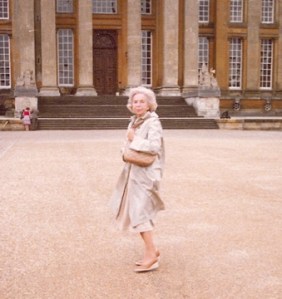
Elsa in Italy ca. 1980

Elsa in Italy ca. 1980

They were boxes of shoes, spectators and sling backs, pumps, court shoes, Cuban heels, stilettos, peep toes, sandals, every kind of shoe you can imagine, and all in brown, tan, beige, ecru, off-white, cream, none of them black or red or blue or green. Beige: that was her signature color, beiges and browns with occasional accents of coral or green or gold. She assigned blue to her younger sister, my great-aunt Gladys, and when Gladys once dared to buy a beige dress she liked, Elsa had a temper tantrum. A quiet one, but effective.

She died before she could meet my husband, died before I was married, and I am sorry about that. But I remembered her this week when I went with my friend (and Registrar) to visit two older ladies, sisters, on the East Side. We picked up a collection of clothing worn when the two ladies (now in their early 90s and late 80s) were babies, the wedding dress their mother wore in 1918, the dress one wore in 1939 that her daughter wore again in 1970, with quite the wrong black moccasins, at a Christmas Eve party in Georgetown.

The sisters reminded me of my grandmother and aunt, and the clothes reminded me of what my grandmother sold and boxed and wrapped in her store. Sitting at the mahogany table for lunch, drinking tea and eating a slightly stale roll, I missed Elsa and Gladys terribly, but was glad for all they’d taught me about how to behave and what the world was like for independent women in the 1940s and 1950s

Share this:

  • Share on Facebook (Opens in new window) Facebook
  • Share on Pinterest (Opens in new window) Pinterest
  • Email a link to a friend (Opens in new window) Email
  • Share on X (Opens in new window) X
Like Loading...

Weekend at the Farm

21 Monday Jan 2013

Posted by kittycalash in Clothing, Events, Living History

≈ 2 Comments

Tags

18th century, Coggeshall Farm Museum, food, Historical Sew Fortnightly, living history, Museums, Rhode Island, weekend

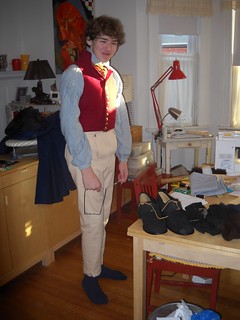
The Young Mr in his new clothes

Fourteen year old boys don’t like to get up early, but we managed to rouse the beast on Saturday, and get him dressed, with only minor hostilities. He’s wearing all new clothes, except for the shirt, which I hope will not have to be replaced before the end of the summer. (I have now guaranteed that his arms will grow several inches in the next week.)

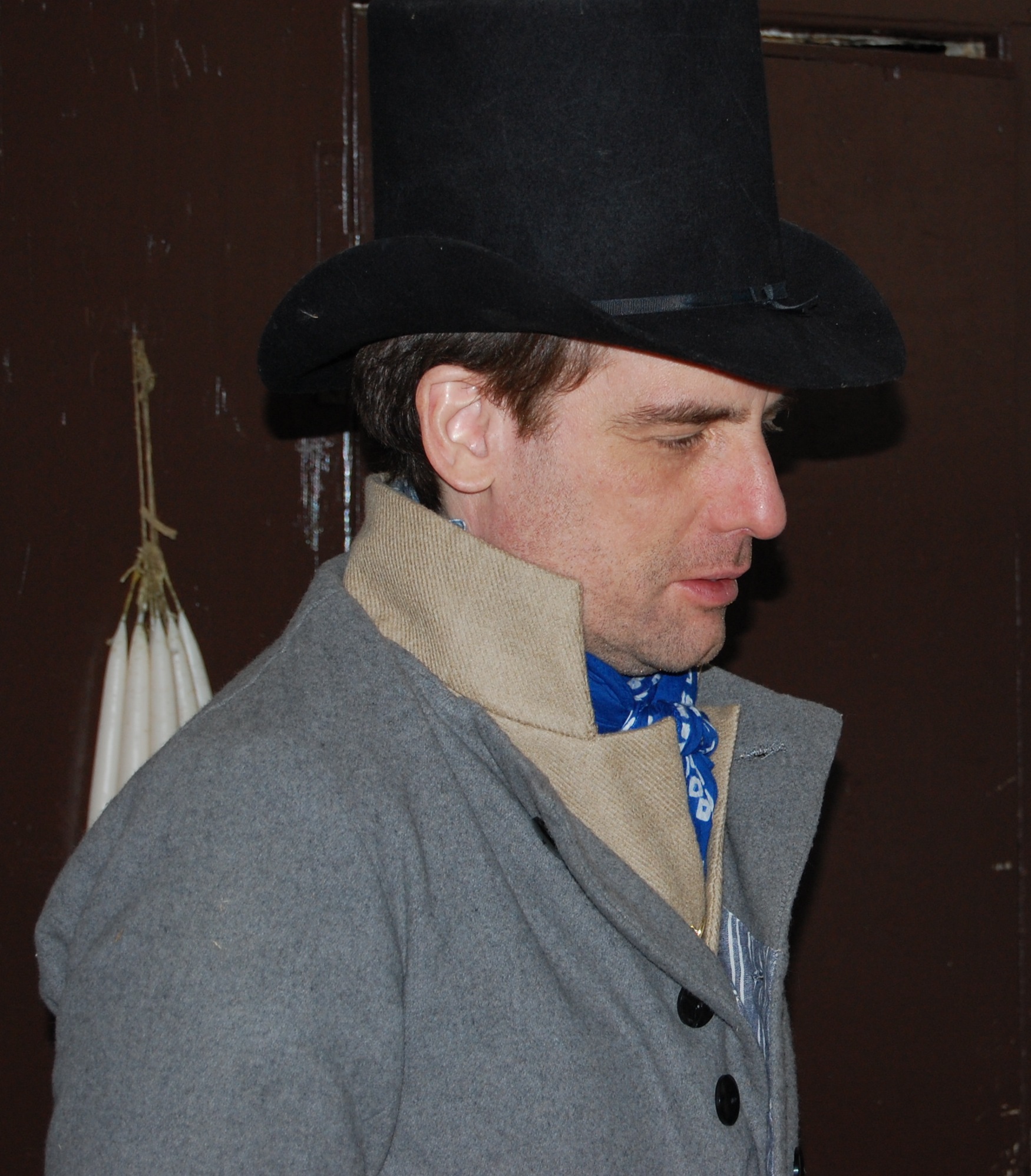
Mr S wore his new waistcoat but it’s hard to see under his jacket. He also got his new hat from Mr B, so he could upgrade from his knitted cap.

New hat, new waistcoat

New hat, new waistcoat

There are more photos here, including a fabulous stuffed leg of lamb. For mid-day Saturday, we ate a meat pie (pork and apples), sugar cakes, coriander biscuits, bread and molasses bread, all brought from home, along with hat from the farm boiled with parsnips, potatoes, carrots and onions and a carrot pudding. We also made a potato-apple-onion pie for the evening meal, though Mr S, the Young Mr and I did not stay. There is a limit to what the child will tolerate.

Sunday, we arrived in time for Mr S to make more fence pegs, while I joined the kitchen to make soup with ham, squash, parsnips, and onions, which we ate with bread and cheese, and the last of the sugar cakes, for lunch. All the while, a leg of lamb was cooking, masterfully prepared by Mrs B, and stuffed with cubed bread, onion, ham, sage and onion. To go with it, we made a rice pudding with apples, wilted greens, salad, squash pudding, and stewed apples. The sauce for the lamb was particularly fine, with drippings, minced onions, what we think was whiskey, butter and cream. I learn so much cooking with Mrs B!

waiting, wanting, hoping

The cats wanted, but were disappointed. They were calmer on Sunday, though extremely attentive kitchen assistants both days. Pity they don’t do dishes. There were plenty to wash. 1799 was definitely greasy. Even the striped cat feels a little greasy, but that could be because he’s handy to wipe your hands on.

Now it’s on to sewing for something else, though whether that will be wool trousers or clothes for Washington’s Birthday, I don’t really know.

Share this:

  • Share on Facebook (Opens in new window) Facebook
  • Share on Pinterest (Opens in new window) Pinterest
  • Email a link to a friend (Opens in new window) Email
  • Share on X (Opens in new window) X
Like Loading...

Sandby’s Women

11 Friday Jan 2013

Posted by kittycalash in Clothing, History, Museums

≈ 3 Comments

Tags

18th century, 18th century clothes, common dress, Costume, dress, fashion, fashion plates, museum collections, Museums, Paul Sandby, Research, resources, watercolors, Yale Center for British Art

20130109-061710.jpgSara Hough’s date of ca. 1805 piqued my curiosity and Cassidy was suspicious, too. So I went looking into Paul Sandby a little bit more.

Many of us know him for the sketches and watercolors of working people in mid-18th century England. They’re oft-used references for people doing Rev War reenacting as they’re full of the kinds of details seen in the watercolor of Sara Hough. I hadn’t thought of Sandby for later 18th century references, which shows how little I was thinking.

Sandby: Figure with Lute & Tamourine, YCBA

Sandby: Figure with Lute & Tamourine, YCBA

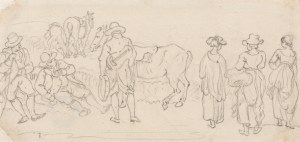
Thanks to the 18th Century Material Culture Resource Center, I found the Sandby “People and Places” presentation, which led me back to the Yale Center for British Art, and this image of musicians, horses and women. There’s no date in the record, though the presentation calls it ca. 1785. There seems to be a series or portfolio of Sandby sketches similar in size and type from about 1785, so it’s a reasonable assumption…with the usual caveat about assumptions, but no aspersions on the compiler of the presentation.

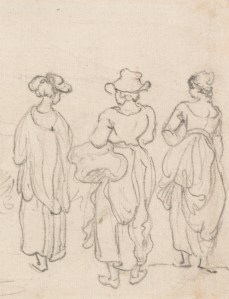
Sandby, detail, YCBA

Sandby, detail, YCBA

Sandby: Two Women and a Basket, YCBA

Sandby: Two Women and a Basket, ca. 1759 YCBA

Let’s look at a detail of the women in the drawing. Their waists are higher than we see in earlier Sandby drawings, and their profile slimmer, more classical, particularly the figure on the far right. Her bodice looks to me like a late 18th-century bodices.

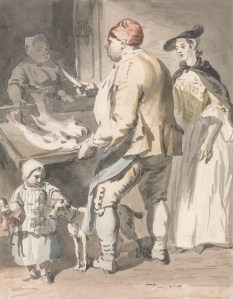
Sandby: A Fishmonger, YCBA

Sandby: A Fishmonger, ca. 1759 YCBA

Sandby had the skill to depict clothing with minimal gestures, as he does below in A Fishmonger, part of the London Cries series.

It’s that circa that gets you. I believe it for the ca. 1759, all the way. The figures fit into the visual continuum of Sandby’s mid-century work as I know it. (You’ll just have to trust me that I have a visual memory, and that, for once, the years of art school matter.)

And I kept wondering if he really had worked late into the 18th century, and then I found this:

Sandby: Family in Hyde Park, YCBA

Sandby: Family in Hyde Park, YCBA

Again, no date, but there are distinctive markers to tell us this is post-1780, even inching to the early 1790s. The waistcoats on the adolescent boys are shorter and double-breasted. The shape of the boy’s hats has changed: these aren’t cocked hats, and they’re not soft round hats. But look even closer and you’ll see the ties at the knees of their breeches, very typical and fashionable for the 1790s. All this before we’ve even gotten to the woman! Look at what she’s wearing: that’s certainly a plausible ensemble for 1794, isn’t it? The waist has moved up, the skirts are lighter, likely mull or muslin, and the skirt of what I interpret as an open robe, much like Sara Hough‘s, is trained on the ground. If this is a Sandby drawing, which I don’t doubt, then I think we definitely see him working into the mid-1790s.

And just for one final kick, I checked the Met again, where they have a Paul Sandby drawing dated 1798-1799. I wonder…but the coat collar and waistcoat might have it.

Sandby, Group of 4 Children and a Dog, MMA

I’m still not sold on ca. 1805 for Sara Hough (why no ‘h’ on Sara when the drawing is inscribed by Sandby, “Sarah Hough…”?) but I’d endorse 1795. The tricky part, as always, is the circa: so much depends on how a museum interprets ‘circa.’ For some, it’s 5 years either side of the date; for others, it’s 10. When I see a circa date, I get skeptical, and start doing math.

Share this:

  • Share on Facebook (Opens in new window) Facebook
  • Share on Pinterest (Opens in new window) Pinterest
  • Email a link to a friend (Opens in new window) Email
  • Share on X (Opens in new window) X
Like Loading...
← Older posts
Newer posts →

Archives

wordpress statistics

Creative Commons License
Kitty Calash blog by Kirsten Hammerstrom is licensed under a Creative Commons Attribution-NonCommercial-ShareAlike 4.0 International License.

Website Built with WordPress.com.

  • Subscribe Subscribed
    • Kitty Calash
    • Join 621 other subscribers
    • Already have a WordPress.com account? Log in now.
    • Kitty Calash
    • Subscribe Subscribed
    • Sign up
    • Log in
    • Report this content
    • View site in Reader
    • Manage subscriptions
    • Collapse this bar
 

Loading Comments...
 

    %d