• Home
  • Completed Costumes/Impressions
  • Emma and Her Dresses
  • Free Patterns and Instructions

Kitty Calash

~ Confessions of a Known Bonnet-Wearer

Kitty Calash

Tag Archives: paintings

Visual Illiteracy

23 Wednesday Apr 2014

Posted by kittycalash in Art Rant, Clothing, Fail, Research, Snark, TV Review

≈ 4 Comments

Tags

art, Banastre Tarleton, Captain Tallmadge, Colonel Tarleton, dragoons, helmets, light, museum collections, National Gallery, paintings, Research, Revolutionary War, Turn

Banastre Tarlteon by Joshua Reynolds

Portrait of Sir Banastre Tarleton (1754-1833) by Joshua Reynolds, 1782. National Gallery (UK)


See update below!

By 9:00 on Sunday, I was asleep and missed “Turn,” which Mr S wasn’t even watching because, as he declared, “It’s just a bad show.” On Monday evening, I made it through the opening of the show and gave up for good. But those minutes made me think of the Banastre Tarleton portrait by Sir Joshua Reynolds, and the suggestion on Twitter that “Turn” had no historical consultant.

It occurred to me, as I stared at the rather curious headgear worn by Captain Tallmadge (I think it’s stretch lycra over a “Roman” gladiator costume helmet glued to a baseball cap visor and edge-taped with gold foil) that perhaps the people doing the costumes simply lacked visual literacy. This could explain the refugees from Fort Lee who looked like they stepped out of an Emma Lazarus poem, and it could explain the very unfortunate helmet.

Tarleton_notes

Let us look at Banastre Tarleton, hunky bad boy of the British dragoons: he came to mind on Monday night, and what visual relief he is.

Note the light edge of the visor: this is a highlight. The leading edge of a polished surface will shine, and helmets, even of leather, will be reflective. Over time, the edges will polished by wear if not on purpose. I cannot speak to the helmet habits of the horse-mounted, but I know from paintings, and that edge is a highlight.

The Boys last July. Look, shiny, not-taped visor edges.

The Boys last July. Look, shiny, not-taped visor edges.

Reynolds painted what he saw, and just as the Young Mr’s cheekbones are reflecting light off the underside of his visor and Mr S’s helmet edge is shining in the direct light, so too is Colonel Tarleton’s helmet edge shining.

(Yes, there are both mounted and unmounted dragoons within a unit; but I just can’t help feeling that an officer would be mounted more often than he has appeared to be thus far.)

ETA: Heather has graciously pointed out a very nice blog on Turn, which is doing a far more even-handed and informed job of watching and commenting on the show. Thank you, Heather!

Share this:

  • Click to share on Facebook (Opens in new window) Facebook
  • Click to share on Pinterest (Opens in new window) Pinterest
  • Click to email a link to a friend (Opens in new window) Email
  • Click to share on X (Opens in new window) X
Like Loading...

What Snow Day?

13 Thursday Feb 2014

Posted by kittycalash in History

≈ Comments Off on What Snow Day?

Tags

art history, George Morland, ice, paintings, snow, snow day, weather, Yale Center for British Art

Benjamin West, 1738-1820, American, active in Britain (from 1763), Page Boy Asleep, undated, Brown wash with pen and brown ink on medium, slightly textured, cream laid paper, Yale Center for British Art, Paul Mellon Collection.B1975.4.786

Just because the Young Mr had a snow day and slept in didn’t mean the rest of us did.  So what did we do?

We went to work, just as they would have in the 18th century. We joke that the streets in our town are better after ice and snow, because the potholes are filled in and the ride is smoother.  You can see the principle at work here, in a watercolor by Benjamin Henry Latrobe.  Sleighs and sleds will run more smoothly on snow-packed roads, and sometimes I think a sled would be better than a Subaru in the city of Providence.

Still, I’m grateful for furry boots and buckets of salt, central heat and an electric tea kettle. Every winter, one or more of us falls on the ice, and when I went out to salt the paths this morning, I could see where Mr S had slipped on snow-covered ice.

In the Morland below, the scene revolves around the central figures, a man who has fallen on the ice despite his stick, the woman, black bonnet thrown back, who has witnessed his fall. We haven’t reached this point yet, and snow has become sleet that will freeze later, with more snow to come, so our vista is not nearly as attractive. But it’s clear that we, as humans, have never enjoyed snow and ice very much, and I think the donkeys are unimpressed as well.

George Morland, 1763-1804, British, Winter Landscape with Figures, ca. 1785, Oil on canvas, Yale Center for British Art, Paul Mellon Collection, B1993.30.23

Share this:

  • Click to share on Facebook (Opens in new window) Facebook
  • Click to share on Pinterest (Opens in new window) Pinterest
  • Click to email a link to a friend (Opens in new window) Email
  • Click to share on X (Opens in new window) X
Like Loading...

Taking Tea

04 Tuesday Feb 2014

Posted by kittycalash in Events, History, Living History, Museums, Research

≈ 5 Comments

Tags

Henry Sargent, historic interiors, interpretation, John Brown House Museum, Museum of Fine Art Boston, Museums, paintings, Research, social life and customs, tea party, The Tea Party

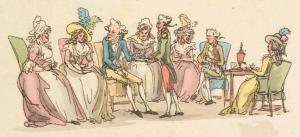
Detail, Picturesque studies and scenes of everyday life watercolor by Thomas Rowlandson, 1790. Royal Collection Trust. RCIN 810396

Detail, Picturesque studies and scenes of everyday life. Handcolored etching by Thomas Rowlandson, 1790. Royal Collection Trust. RCIN 810396

Hat tip to Jane Austen’s World for the image at left, which helped me start visualizing another program I’m involved with, this time ‘at home’ in Providence.

When we started reinterpreting the house museum, we began going back through primary sources to figure out how rooms might have been used, and furniture arranged (we don’t have inventories, so we read the house and diaries and letters– but that’s for another post).

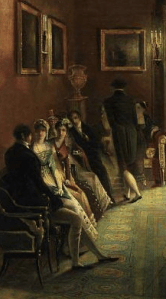
Detail, The Tea Party. Oil on canvas by Henry Sargent, 1824. MFA Boston, 19.12

Detail, The Tea Party. Oil on canvas by Henry Sargent, 1824. MFA Boston, 19.12

One of the things I remember most vividly was the description of the uncomfortable tea parties Providence women gave, where the guests sat in chairs against the walls of the rooms, balancing a tea cup in one hand and plate in another. Several hard drives later, I’m not sure where that primary source is (the hunt begins tomorrow) but it conjured images of every hostess in Providence a Hyacinth Bucket, and every guest a quivering Elizabeth Next Door.

Detail, The Tea Party. Oil on Canvas by Henry Sargent, 1824. MFA Boston, 19.12

Detail, The Tea Party. Oil on Canvas by Henry Sargent, 1824. MFA Boston, 19.12

Surely that couldn’t be true? I thought I must be making it up, but then the Rowlandson turns up on the interwebs and there they are, in a row. More famously and closer to home, Henry Sargent’s painting of a Boston tea party in 1824. (The catalog description is rather nice.)

Here’s an 1824 tea party in Boston. While this is later than the tea party we’ve planned at work, it is still full of useful hints about how early, formal tea parties were conducted. We think– or I do, anyway– of ladies in frilly hats seated a tables with cakes heaped on stands and floral tea pots. I hear “tea party” and I think “doilies,” but this is not your grandmother’s tea party. It’s a different kind of social occasion, both more formal and more relaxed.

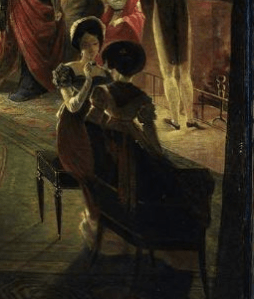
Detail, The Tea Party, oil on canvas by Henry Sargent, 1824. MFA Boston, 19.12

Detail, The Tea Party, oil on canvas by Henry Sargent, 1824. MFA Boston, 19.12

There’s not a central table to sit around, but instead chairs lined up against the wall, groups of guests, chatting. Others guests stand close to the fireplace, and a pair of ladies have taken a settee and a stool for their close conversation. We can just make out the tiny tea cup in the lady’s gloved hand.

In many ways, this depiction reminds me more of contemporary cocktail parties or open houses with the guests in small, changing groups, and no place to put your cup. Of course, most of us don’t have waiters (that’s who you see in the detail above with his back to us) or fabulous houses on the Tontine Crescent in Boston.

In so many ways, the social customs, habits and mores of the past are lost to us, and as we try to recreate them, the we excavate them from a combination of unlikely sources. Accounts, paintings, diaries, and etiquette manuals serve as sources, but it’s easier to recreate the economics of tea than the structure of a tea party. And once we do have an approximation, will it be a party anyone wants to go to?

Share this:

  • Click to share on Facebook (Opens in new window) Facebook
  • Click to share on Pinterest (Opens in new window) Pinterest
  • Click to email a link to a friend (Opens in new window) Email
  • Click to share on X (Opens in new window) X
Like Loading...

To the Right Face!

15 Wednesday May 2013

Posted by kittycalash in Clothing, History, Research

≈ Comments Off on To the Right Face!

Tags

18th century, boots, British Army, dogs, kit, knapsack, National Army Museum London, officers, overalls, paintings, stockings, uniforms

Capt. John Clayton Cowell, 1st Battalion, 1st (or the Royal) Reg't of Foot, ca. 1796. NAM. 1963-11-133-1

Capt. John Clayton Cowell, 1st Battalion, 1st (or the Royal) Reg’t of Foot, ca. 1796. NAM. 1963-11-133-1

That’s Captain Cowell’s right, if you were wondering. You can learn more about his biography here, from the National Army Museum London website (where my very dear friend is lucky I have not begged, implored and entreated her to go, since she is vacationing in London, basically at the very instant you are reading this.)

Clocks!

Clocks!

What I am interested in is what the painting shows us. Like The Drowsy Dame, there’s fun the details quite aside from the those slouchy boots. Inside those boots are silk stockings with clocks, a lovely detail that that shows you what class level should be wearing clocked silk stockings in perfect repair in the British Army. Anyone else not of the class that could afford a commission might want to think about having second-hand silk stockings…and, since we’re at the floor level, nice dog. I think he wants walkies, Captain.

The 18th-century fit is clear, too. Those arms may look sheathed in lycra, but they’re in wool; since the Captain served on St. Thomas, it is probably not just very fine but also lightweight. Portraits are idealized, so the Captain may not have been so very superman looking, but the fit of his breeches and coat probably served to accentuate, if not create, his graceful and refined form.  And then there’s the soldier.

Detail of soldier, NAM. 1963-11-133-1

Detail of soldier, NAM. 1963-11-133-1

What caught my eye first on the soldier were his overalls, since I’m so frequently stuck with them in my sewing basket. These fit him closely, too, and are probably shaped much like these at the Met. There are six buttons on the placket at the ankle, and the strap under the instep is forward of the placket. The soldier’s feet look small (not unlike some regiments I know…) but the tongue of the overalls fits perfectly over his foot. It’s easier to do in paint than in linen, but I’ve seen them fitted this well, and the gentle cyma curve of the outseam is what you want.

On his back, the soldier has a knapsack that’s clearly made of a goat. I don’t know why they’re goatskin (this is not my army) but it’s startlingly goat-like. Other regiments carried them (see here for Troiani on the 33rd Reg’t of Foot), but I suppose the goatskin made a natural pouch shape and was water resistant (after you’d eaten the goat?). What you see on reenactors are mostly the square skin knapsacks, but when we go to Monmouth I will have to keep my eye out for the goat-shaped packs.

The large sack he’s carrying is also intriguing. The material looks to be striped, or woven with a purposeful variegation, which raises questions beyond linen-or-wool. Why trouble to die the material? Are the colors significant? On a practical level, the bag or sack probably contains any extra clothing and his blanket; it looks too light to contain much else. We can’t see his haversack,but we can see his cartridge box (the shiny black square under the goatskin) and his bayonet. But where’s his musket?

The more I look at and think about this painting, the more I wonder not just about the quotidian details we can pick up, but about the symbolism and the meaning. It has the look of “job well done, headed home” as the soldier carries his kit away, and the Captain sheaths his sword. Maybe that’s what we’re shown: tour of duty over, the Captain Cowell and troops head home, and the dog will finally get his walkies.

For a look at earlier British ‘dogs of war’ let slip in America, you might want to read Don Hagist at All Things Liberty, as well as Hugh T. Harrington, for dogs on the other side.

Share this:

  • Click to share on Facebook (Opens in new window) Facebook
  • Click to share on Pinterest (Opens in new window) Pinterest
  • Click to email a link to a friend (Opens in new window) Email
  • Click to share on X (Opens in new window) X
Like Loading...

Mary Adams

22 Friday Mar 2013

Posted by kittycalash in Clothing, History, Museums

≈ Comments Off on Mary Adams

Tags

18th century clothes, authenticity, details, dress, fashion, lacings, Mary Adams, paintings, Research, resources, spectacles, stomachers, Yale Center for British Art

Mary Adams, 1754, YCBA

Meet Mary Adams, painted in 1754. She looks to be a certain age, does she not? But she’s still rocking some style. I like black, and wore black clothes almost exclusively for years from high school on, despite the relentless taunts of  feral sixth-grade boys. (My nickname was Boots. Costuming and living history is but another episode of dressing funny…)

But I digress.

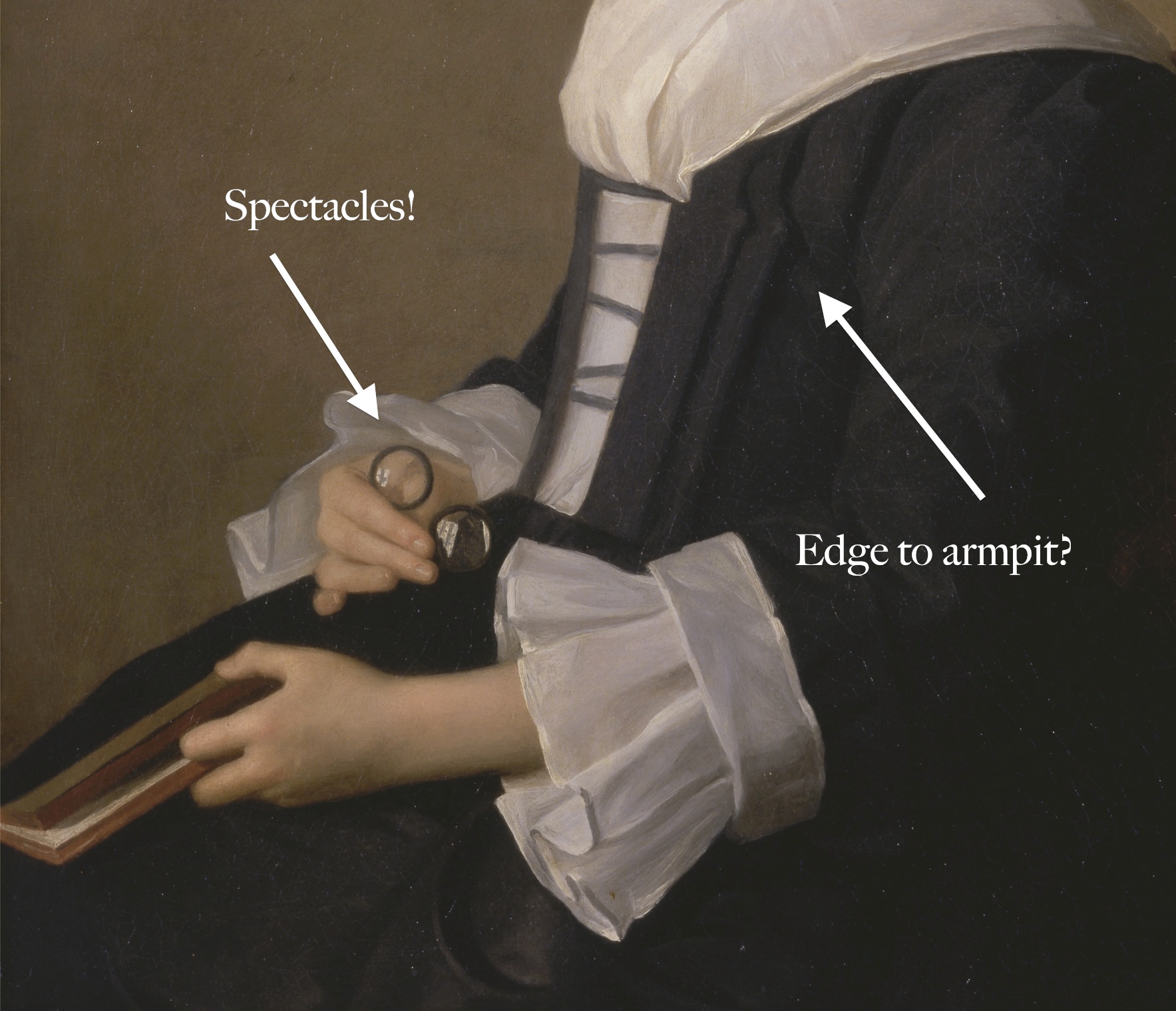
Mary was a happy find this morning, because I knew I’d seen this little detail somewhere…and here it is:

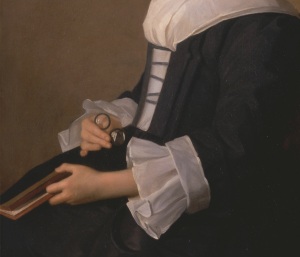
Detail, Mary Adams, 1754,B1981.25.513, YCBA

Detail, Mary Adams, 1754,B1981.25.513, YCBA

Did you catch that? It looks remarkably like Mary has laced her gown over her kerchief, and not over a stomacher. I’m doing a little dance, thankyouverymuch, because that is how I roll. Or lace, as the case may be. Look, too, at the top of the lacing: her gown is pulling. Yes. Imperfections, how I adore thee.

Snark aside, it’s a kind of relief. Looking at Copley and Feke and all their sleek silken women is like flipping through Vogue in the doctor’s office waiting room: after a while, I start to feel woefully inadequate in all ways. From the Richard III gown’s wiggly seams to my inability to pin my dresses straight, and heck, the generally asymmetrical rumpled-ness of my presentations… you can get to feeling very low, as Thompson and Thomson observe in Prisoners of the Sun.

Details!

Details!

So among the things  I note in the painting is the depth of the pull at the top of the gown.  Hmm. I feel better about how my flesh and gown relate in the armpit area now.

But if the pull line starts over beyond the robings, that helps a costumer figure out where to put the lace holes and how to arrange the gown. I also like the asymmetry of blue lace zig-zagging down the kerchief. When I work that out on Richard III, and alter my red calico gown, I’ll use Mary’s portrait as a reference.

Finally, and perhaps best, of all, Mary can read. And she need spectacles. That wonderful pair in her hand look like they are cousins of this pair. All in all, a happy find this morning.

Share this:

  • Click to share on Facebook (Opens in new window) Facebook
  • Click to share on Pinterest (Opens in new window) Pinterest
  • Click to email a link to a friend (Opens in new window) Email
  • Click to share on X (Opens in new window) X
Like Loading...
← Older posts
Newer posts →

Archives

wordpress statistics

Creative Commons License
Kitty Calash blog by Kirsten Hammerstrom is licensed under a Creative Commons Attribution-NonCommercial-ShareAlike 4.0 International License.

Website Built with WordPress.com.

  • Subscribe Subscribed
    • Kitty Calash
    • Join 621 other subscribers
    • Already have a WordPress.com account? Log in now.
    • Kitty Calash
    • Subscribe Subscribed
    • Sign up
    • Log in
    • Report this content
    • View site in Reader
    • Manage subscriptions
    • Collapse this bar
 

Loading Comments...
 

    %d