• Home
  • Completed Costumes/Impressions
  • Emma and Her Dresses
  • Free Patterns and Instructions

Kitty Calash

~ Confessions of a Known Bonnet-Wearer

Kitty Calash

Tag Archives: patterns

Trouser Saturday

12 Saturday Jan 2013

Posted by kittycalash in Clothing, Making Things

≈ 5 Comments

Tags

18th century, Clothing, common dress, Making Things, patterns, sewing, weekend

Cutting out makes me think of freeing mastodons from glaciers

If this is Saturday, I must be sewing trousers. I’ve managed overalls in a day from cutting out to made up, lacking only buttons and buttonholes, so I have hope for the trousers. It is true I am starting a new pattern, and so I am considering adapting the pattern I already use for breeches and overalls…. except that the style is 20 years out of date for where these are going. At least the first pair is for the kid, for whom oddly-fitted clothes are the norm now because of his size and personality, and would have been then, since he’s not the son of gentry.

He’s got shoes, though, and they fit! His feet stopped at size 12 in fall 2011, and the 12.5 Fugawee straight-lasted Ligonier shoes fit him over his winter socks. His feet are just too big not to put into better shoes–no one can help noticing them, and there are no gaiters to hide them under.

We’ll see how leather-soled shoes go. Expect slipping and falling.
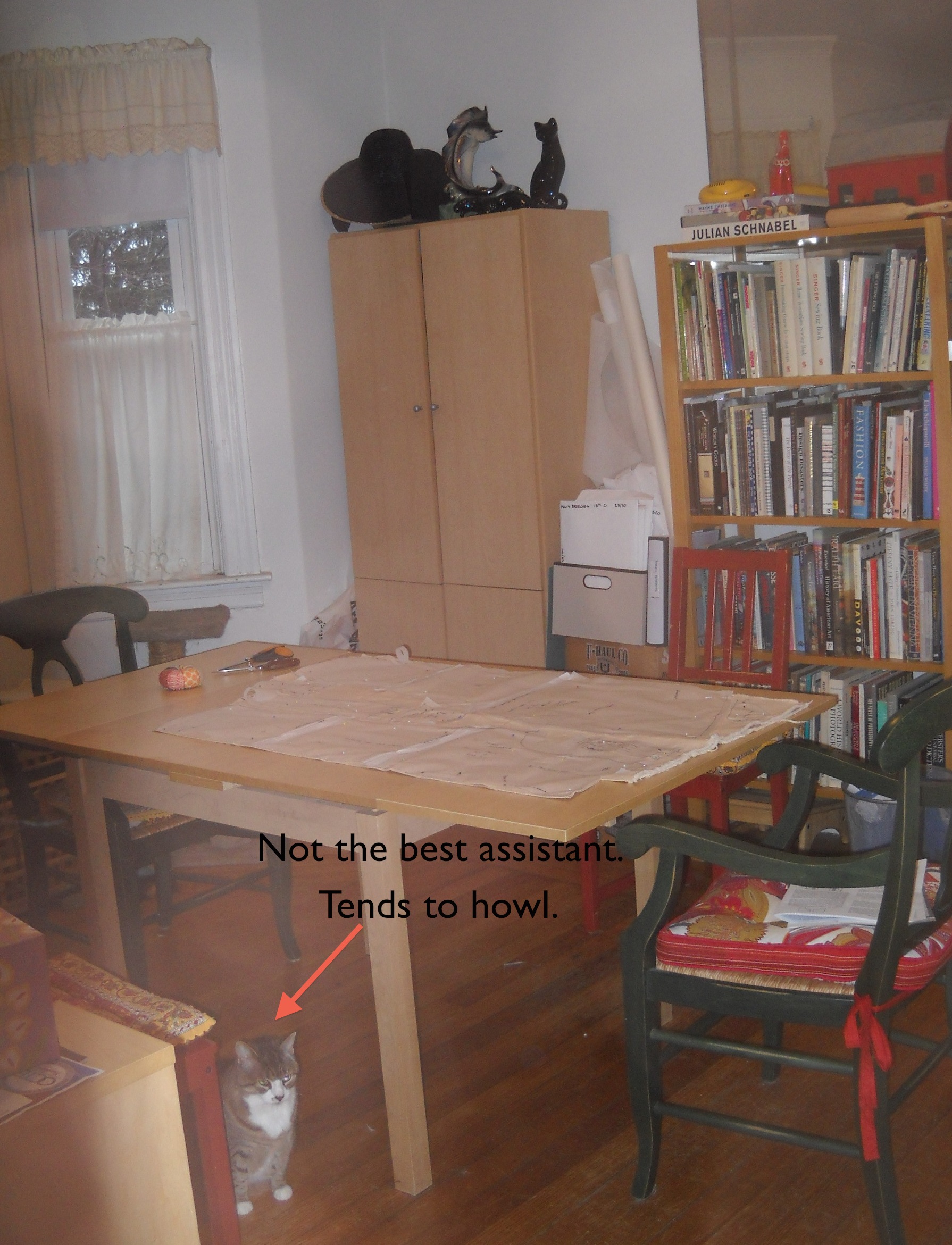
Dining/sewing/library room with "assistant"

Dining/sewing/library room with “assistant”

My plan is to knock out the trousers today to the point of finishing work, and then finish the waistcoat tomorrow (it lacks only buttons and buttonholes). Having spent Tuesday on costume research scrutinizing seams, and blinking at buttonholes from 1788-1800, I feel better (and less self-conscious) about my sewing skills. They’re not as awful as I think they are, and the worst part of the tan waistcoat was the placement of the buttonholes, not their actual execution. Of course, the placement is the part I can’t fix…

On another note, on Tuesday I also looked at a number of ways to do pockets in breeches and jackets. Some were chamois lined, and then I wondered, how do we know what kind of leather the pockets are lined in? Aren’t they more likely to be deerskin than actual chamois? It doesn’t take long before you’re down the rabbit hole of historical wonderings.

Share this:

  • Share on Facebook (Opens in new window) Facebook
  • Share on Pinterest (Opens in new window) Pinterest
  • Email a link to a friend (Opens in new window) Email
  • Share on X (Opens in new window) X
Like Loading...

Stays, Nearly Mastered

10 Saturday Nov 2012

Posted by kittycalash in Clothing, Making Things

≈ 1 Comment

Tags

Clothing, common dress, Costume, patterns, sewing

That is to say, alterations are complete to the first pair of early 19th century stays, and now they work: I can sit down, and the dresses look the way they should. Click here for a Pinterest board of stays for visual references for mid- to late-18th and early 19th century stays.

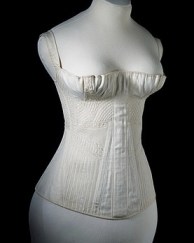
The first pair of early 19th century stays I tried to make using Past Patterns’ Transition Stay pattern, all by hand. They were beautiful, but beyond redemption and failed to fit despite muslins and multiple alterations. The pattern is based on the  Connecticut Historical Society stays at left; search for 1963.42.4 in the CHS online catalog.

V&A, T.57-1948

I sent the sad remains of the transition stays to Johnston, and made a muslin from the Past Patterns’ Corded Stay pattern, which is very similar to these stays at the V&A. I do recommend using a sewing machine for speed, and a long hook for pulling the cording, though your mileage may vary.

While the finished stays looked good and appeared to fit, there were certain… idiosyncrasies… that concerned me. Among them was the tendency of the busk to pop up and attempt to greet my chin whenever I sat down. In general, even laced up snug, the garment seemed determined to ride up with wear.

So I tried them on again yesterday with a different, shorter busk slipped in between the the shift and the stays: the busk stayed put. While the stays were about 15″ long, my lap-to-bust length when seated is about 13″. So I undid the binding top and bottom, shortened the cup gussets, shortened the bottom edge, tacked it down, re-bound the stays, and, when Mr S got home,  handed him the busk to cut down.  I tried the whole contraption on again: Success! The busk stayed  down, the breasts stayed up, and we seem to have a winner. It was thanks to the Oregon Regency Society’s page on fitting stays that I reached the conclusion that I needed to reduce the gusset length. I knew from comparing my stays to my friend’s stays that I needed to reduce overall length, because she has to add at least 1.5 to 2 inches to patterns I use…and her stays were the same length as mine. So if they were the right length for her, they were wrong, so wrong, for me.

Next up: the red dress, no train.

Where did I screw up? Probably in not testing the muslin with a busk, and in not testing the muslin by sitting down with the busk. As long as I remained standing, the unaltered stays were fine. So, however you plan to wear your garment, test your muslin. We’re not dress forms: we move and lift, push and pull, crawl under and over things. You will need to test your muslin out by moving, not just standing in front of the mirror. This will be more challenging for some (Going to plow in stays? Maybe you need to push a chair around the house in a muslin) but at least sit down, bend over, and test a muslin the way you would a pair of jeans in a dressing room. If you do already, good for you! If not, you’ve been warned. Failure to squirm will eventually catch up with you.

Share this:

  • Share on Facebook (Opens in new window) Facebook
  • Share on Pinterest (Opens in new window) Pinterest
  • Email a link to a friend (Opens in new window) Email
  • Share on X (Opens in new window) X
Like Loading...

Black Bonnet Miscellany

14 Friday Sep 2012

Posted by kittycalash in Clothing, Making Things

≈ Comments Off on Black Bonnet Miscellany

Tags

Clothing, Costumes, exhibits, patterns, sewing

Lot 102
AMERICAN OR ENGLISH SCHOOL LATE 18TH / EARLY 19TH CENTURY
LADY IN BLACK BONNET
In the original giltwood frames and glass, on original wood backing.
Pastel on paper
22 by 18 inches

The Sotheby’s Americana catalog arrived at work, and I had a pleasant walk browsing the sale lots as I walked from one building to another. This lovely lady is offered with her mate, a gentleman in a blue coat with brass buttons. They’re of a school of portraits made as the centuries turned, pastels rather than oils, less expensive and perhaps easier to drag about for an itinerant artist. She’s lovely, in her frothy white ruff, with that well-made bonnet. That’s a bonnet I’d like to try making…eventually.

For now, the most brilliant thing I can recommend is Hallie Larkin’s blog post on 18th century buttonholes. Needless to say, I have not been doing them right. Read, learn, and look forward to better buttonholes. Brilliant. Did I mention brilliant? The photos from Neal Hurst at B&T are especially helpful, and honestly, I am so glad I didn’t tackle the green coat’s buttonholes yet. Or a spencer. See? Value in procrastination, distraction, or whatever you want to call it. Better buttonholes…it’s like salvation!

More on the quilting process later, when I manage to download the photos I took of the stencil process, and when I take some of the sandwich and frame situation. And then there’s more documentation…along with a couple of meetings, mailing my mother’s birthday package, I forgot breakfast, and pitching the boiler repair to my boss–and finishing the new cap I started. And this is an easy day!

Share this:

  • Share on Facebook (Opens in new window) Facebook
  • Share on Pinterest (Opens in new window) Pinterest
  • Email a link to a friend (Opens in new window) Email
  • Share on X (Opens in new window) X
Like Loading...

Feeling Shifty

09 Thursday Aug 2012

Posted by kittycalash in Clothing, Making Things

≈ Comments Off on Feeling Shifty

Tags

Clothing, Costume, Making Things, patterns, Research, resources

It’s clean now, but in the photo you can see some of the abuse a shift takes in a day or two of real wearing. This shift was made from the Kannik’s Korner pattern. The first shift I made is now on a mannequin at work; I used Mara Riley’s Instructions, and they worked, mostly, with some operator error. I’m tall, and that means that proportions for my clothes sometimes have to be adjusted. The third shift I made was a late-18th century version, adjusted for the change in style and my height, and it is by far the best one yet.

So now I know I need to make another mid-18th century shift, what will I do? The first place I’ll start is with Sharon Burnston’s awesome article, The Cognitive Shift. This is one of the best pieces I’ve read on costume history and the logical, methodical approach is one that not only explains her process, clarifying objects and construction, but also sets a standard for how other garments could be considered.

Among the points Sharon has made over time is the lack of decent linen available for making shifts and shirts. What we can get today is too heavy, too coarse–it lacks the hand of the linen items made in the period we’re reenacting, and not just because the objects have been washed. The fabric is simply different, and unavailable. What  I think I’ll try (having exhausted whatever shift linen I bought from a sutler) is this light weight linen, not softened. I have some that was used for a cap, and so far seems to be working out. Once it is washed, it seems to have a decent drape and appearance.

My impression is not of a fine lady, and that is at least a saving grace. I don’t want to go all the way down the social ladder to wearing an oznabrig shift, but I do want to be as accurate as I can be–and as comfortable.

Share this:

  • Share on Facebook (Opens in new window) Facebook
  • Share on Pinterest (Opens in new window) Pinterest
  • Email a link to a friend (Opens in new window) Email
  • Share on X (Opens in new window) X
Like Loading...

Hot Mess

09 Monday Jul 2012

Posted by kittycalash in Clothing, Reenacting

≈ Comments Off on Hot Mess

Tags

2nd Rhode Island, Clothing, Making Things, patterns, Revolutionary War, sewing

Hand sewn, except for basting for fitting

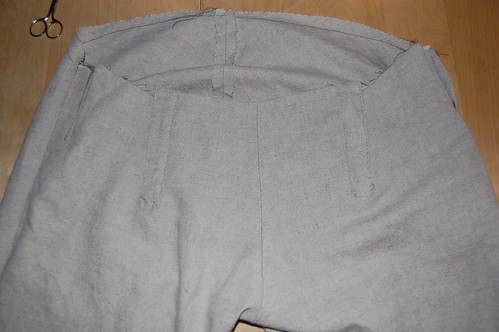
Overalls: the devil’s clothing item, even more evil than the worst multi-part replica sleeve  (that’s right sleeves, I mean you!). First there are the fiddly fall bits. Then there is the question of overall inseam length, then the shape of the leg must match the contours of the wearer, and lest we forget, the evil tongue. All of this is followed by 15-20 buttonholes.

Why did Mr. S not join a kilted regiment? Pleats and hems, easy-peasy. Overalls, not so much. The current overall score is Overalls 1, KittyCalash, 0, Draw, 1. The current pair have conquered me, but I may yet prevail but turning them into breeches with a swift amputation of the lower extremity. The first pair I made were finally overcome last fall with a new tongue piece, but they are too baggy to be correct. We’ll call that a draw.

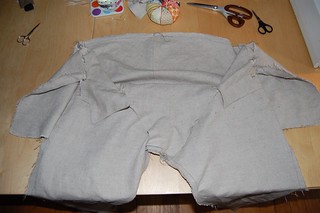
Many moving parts

Fitting the beasts is awful, because so much sewing has to be done up at the waist, but somehow I will have to come up with a muslin and drape the legs to the subject. Once that is done, I can make a more permanent pattern that accounts for shorter than average femurs, larger than average calves, long shins, high arches, and small feet. (Most of the 2nd Helping Regiment guys have very small feet. The Young Mr is the exception, with his 12s. Obviously, his shoes will be the first to be eaten on a march to Quebec: more leather, better broth.)

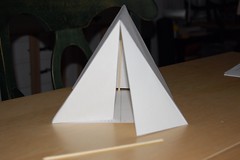
Then there is the question of a tent. Locally, a very fine hemp linen “other ranks” tent has been made, with ash tent pegs and hewn tent poles. The Young Mr and I made up a scale model last night (sans bell) to test the dimensions we worked out using math, Once school is out, all math must be real-world tested. From this, I began calculating yardage requirements, based on 57″ wide hemp linen available from a few sources. At $17/yard, it looks like $187 for a tent without a floor or mudflaps or a bell. 11 yards! That is a lot of fabric, and a lot of sewing.

Tiny little tent!

Perhaps tonight we’ll try out a slightly smaller version, with a bell. If we start this fall, we might have a tent done for next season…if the guys would only learn to sew!

Share this:

  • Share on Facebook (Opens in new window) Facebook
  • Share on Pinterest (Opens in new window) Pinterest
  • Email a link to a friend (Opens in new window) Email
  • Share on X (Opens in new window) X
Like Loading...
← Older posts
Newer posts →

Archives

wordpress statistics

Creative Commons License
Kitty Calash blog by Kirsten Hammerstrom is licensed under a Creative Commons Attribution-NonCommercial-ShareAlike 4.0 International License.

Website Built with WordPress.com.

  • Subscribe Subscribed
    • Kitty Calash
    • Join 621 other subscribers
    • Already have a WordPress.com account? Log in now.
    • Kitty Calash
    • Subscribe Subscribed
    • Sign up
    • Log in
    • Report this content
    • View site in Reader
    • Manage subscriptions
    • Collapse this bar
 

Loading Comments...
 

    %d