• Home
  • Completed Costumes/Impressions
  • Emma and Her Dresses
  • Free Patterns and Instructions

Kitty Calash

~ Confessions of a Known Bonnet-Wearer

Kitty Calash

Tag Archives: Reenacting

Camp Followers or Women of the Army?

22 Wednesday Jan 2014

Posted by kittycalash in History, Laundry, Living History, Reenacting, Research

≈ 2 Comments

Tags

10th Massachusetts, 2nd Rhode Island, common people, common soldier, living history, Reenacting, Research, Revolutionary War, women, women's history

Soldiers and Camp Followers Resting from a March. Jean-Baptiste Pater, 1730. private collection. used from Wikimedia Commons.

I prefer woman belonging to the army, or “regimental woman,” which sounds like Mick Jagger or Roy Orbison could sing it, but one could have a pretty lively discussion of which term to use. Camp followers has a connotation–prostitute–that doesn’t reflect the full reality of army life for women in either the British or the Continental armies.

Were there prostitutes who took advantage of the proximity of a large customer base? Yes, undoubtedly. In the John Robinson Waterman Papers there is an unusual letter from Col. William Battey dated October 28, 1812 with a sketch of the army camp near Albany and a description of camp life. This description includes the treatment of a woman accused of prostitution and summarily banished from camp. I think she was beaten and half-drowned, so the army took the no-prostitutes-whatsoever dictum very seriously.

As far as cooking goes, a commenter elsewhere explained that women would have been cooking, at least for themselves. Typically, they did not cook for the soldiers’ mess, unless they were being paid to. This must have been a difficult situation for the Continental Army: when women were present, it made excellent sense to assign them all possible non-combatant tasks to ensure the maximum fighting force. But could discipline be maintained? Not always, given Bridget’s temper.

A soldier and his girl. Henry Bunbury, ca. 1794. Lewis Walpole Library, Drawings B87 no. 8

A soldier and his girl. Henry Bunbury, ca. 1794. Lewis Walpole Library, Drawings B87 no. 8

Rolling back a bit and trying to consider the army’s structure and camp layout, what are the mechanics of handling rations for women with the army? How are they fed? And did it vary, unit by unit? There is probably far more variation than we credit, that will only be illuminated by careful attention to the documentary record. That means finding as many victualing rolls and returns as possible, looking for women. It means reading all the orderly books that can be found, looking for women.

The best secondary source I know for the Continental Army’s women is with Holly Mayer’s book, Belonging to the Army. (And I’ll admit I haven’t read it in two years, so it’s time to re-read it.) If you’re British, I’m not in a position to help you as much, but there is Don Hagist’s work on Women of the British Army. For a more granular understanding of women in all armies, you have to turn to primary sources, and what’s available varies from unit to unit, state to state. There is a handy index of orderly books,  and while these vary in their utility, they are a good place to start. In fact, the whole RevWar 75 site is useful (though it is not loading at the time of this writing).

Soldiers’ diaries and accounts are also useful. Jeremiah Greenman of the 2nd Rhode Island Regiment recorded his experiences throughout the entire war, starting in 1775, when he joined Arnold’s expedition to Quebec. There were two women on that expedition, attached to two different companies. While there is not a plethora of detail about the women, it is clear that they were strong and able, and in one case, more able than her husband.

Share this:

  • Share on Facebook (Opens in new window) Facebook
  • Share on Pinterest (Opens in new window) Pinterest
  • Email a link to a friend (Opens in new window) Email
  • Share on X (Opens in new window) X
Like Loading...

Camp Life

21 Tuesday Jan 2014

Posted by kittycalash in Laundry, Living History, Reenacting, Research

≈ 4 Comments

Tags

10th Massachusetts, authenticity, camp life, common people, common soldier, laundry, living history, Reenacting, Research

The Jolly Landlady in Hyde Park. Paul Sandby, 1780. British Museum 1904,0819.622

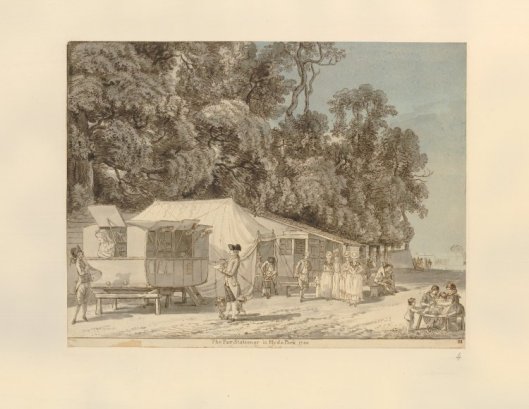
The Fair Stationer in Hyde Park, 1780. Outline engraving by Paul Sandby. British Museum 1880,1113.1915

The Fair Stationer in Hyde Park, 1780. Outline engraving by Paul Sandby. British Museum 1880,1113.1915

Still wondering what to do in camp that’s not cooking or sewing? Technically, you shouldn’t be cooking if you’re a woman: that was a soldier’s job, though I recall seeing a reference to women cooking when all the men were pulled into the line during an engagement. A card file would help me, but for now, all I have is my scattered memory.

But if you’re tired of mending and making shirts (one of the most boring tasks, I find– all straight seams and very predictable), there’s more to do than laundry.

If the event represents a longer encampment, you could run a traveling coffee house or tavern. There’s the Widow Black in the Mid West, but I haven’t encountered this yet in New England. You could be a Jolly Landlady, or as the British Museum has it,  “a voluptuous lady stands in foreground to left, holding up a glass to a soldier on horseback.”

The Fair Stationer in Hyde Park 1780. Outline etching with watercolor, Paul Sandby. British Museum 1904,0819.576

The Fair Stationer in Hyde Park 1780. Outline etching with watercolor, Paul Sandby. British Museum 1904,0819.576

The Fair Stationer shows us Lloyd’s Coffee House and what looks like a carriage body on blocks, converted to a news stand. You could sell newspapers and writing paper, pamphlets and poem and songs. It’s an impression that would take a lot of thinking and research for the American colonies, but could be very interesting. the transmission of news and information and the transport of mail and packages presented challenges. How were they overcome?

I’m also struck by the number of dogs in Sandby’s images. If it’s not the same dog, over and over, I would guess that in the 18th century as in the 20th, soldiers had pets that traveled with them, both common soldiers with common curs and officers with hunting dogs. The camps must have been disastrously messy, with fatigue details to clean them.  We can’t have dogs at reenactments, but we could have more outraged sergeants. It’s hard, though, because to do these things well, you have to know and trust the people you’re doing them with (and that includes yourself).

Share this:

  • Share on Facebook (Opens in new window) Facebook
  • Share on Pinterest (Opens in new window) Pinterest
  • Email a link to a friend (Opens in new window) Email
  • Share on X (Opens in new window) X
Like Loading...

Finding Bridget Connor

16 Thursday Jan 2014

Posted by kittycalash in History, Laundry, Living History, Reenacting, Research

≈ 8 Comments

Tags

10th Massachusetts, Brigade of the American Revolution, common people, living history, Reenacting, Research, Revolutionary War

Two washerwomen, one of the sketches made in Edinburgh and the neighbourhood after the rebellion of 1745 Pen and black ink and grey wash, over graphite. Paul Sandby, British Museum Nn,6.10.+

Regimental Orders, July 23rd 1782
At a Regimental Court Martial whereof Capt Francis is president, Briget Conner a Woman Belonging to the 10th Massachusetts Regiment was tried for purchesing a publick Shurt from a Soldier in Sd. Regiment found Guilty and Sentanced to Return the Shurt to the person from whom she purshest it and loos what She gav for the Shurt.
The Colo approves the opinion of the Court and orders it to take place Immediately

Regimental orders July 25th 1782
Bridget Conner a woman Belonging to the 10th Massachusetts Regiment is Directed to Leave Camp Between this and to Morrow Morning at Roal Call for her Insolence to the officers of sd Regiment on pane of Being Treated with Severity

The entries above are from the orderly book kept by Captain Stephen Abbot who served under Colonel Benjamin Tupper of the 10th Massachusetts Regiment. (This is a Continental Regiment, so the entry for the book in the holding library’s catalog is, um, confusing.)

The entries were sent to me by Mr Cooke as a place to start working on Bridget Connor (name confusion, it is Connor). I checked the Massachusetts Soldiers and Sailors of the Revolutionary War, and what did I find? Francis Connor.

Francis Connor. Where did he come from?

Francis Connor, in the middle. Where did he come from?

Francis Connor was in Benjamin Tupper’s (10th) Regiment. He enlisted on December 25, 1781, and was reported deserted on July 25, 1782, the same day Bridget is directed to leave camp. Do you think Bridget might be Francis’s wife? I think she might be, and I am inordinately pleased about it.

It is a sad but true thing that it is easier to find a man in the 18th century records than it is to find a woman. (See Jill Lepore’s new book about Jane Franklin Mecom.) But with a husband to look for, maybe I can find more about Bridget. And if I can find more about Bridget (and even if I don’t) I can start asking the questions that create a more engaging impression or interpretation.

  • Where did Bridget live before they joined the 10th?
  • Where was she born?
  • How old was she?
  • What did Francis (if he was her husband) do for a living?
  • Did Bridget work? (Probably- but at what?)
  • Why did she join Francis in the Army?
  • Did she have previous run-ins with authority?

I have guesses about Bridget and Francis, and even if I can find no more than what I’ve found, I can create plausible stories about their lives to make the past more real. For history, though, I prefer telling truths to making up stories.

Share this:

  • Share on Facebook (Opens in new window) Facebook
  • Share on Pinterest (Opens in new window) Pinterest
  • Email a link to a friend (Opens in new window) Email
  • Share on X (Opens in new window) X
Like Loading...

The View from Ft Lee

25 Monday Nov 2013

Posted by kittycalash in Events, Living History, Reenacting

≈ 2 Comments

Tags

10th Massachusetts, 2nd Rhode Island, Brigade of the American Revolution, common soldier, Events, Reenacting, Revolutionary War, The Public

To the South.

Silver and shimmering, there’s Manhattan Island: you can hear the train whistles from the New Jersey shore, this century always intruding on the past. To be honest, this event makes me as nuts as it makes me happy (the 32 pound gun did, finally, go off after four tries). There’s something slap-dash about it, this last event of the season (or the first of next, as the BAR commander would have it). The range and quality of impressions is astonishing but it’s a small, manageable event that’s good for trying things out, and for first-time-users.

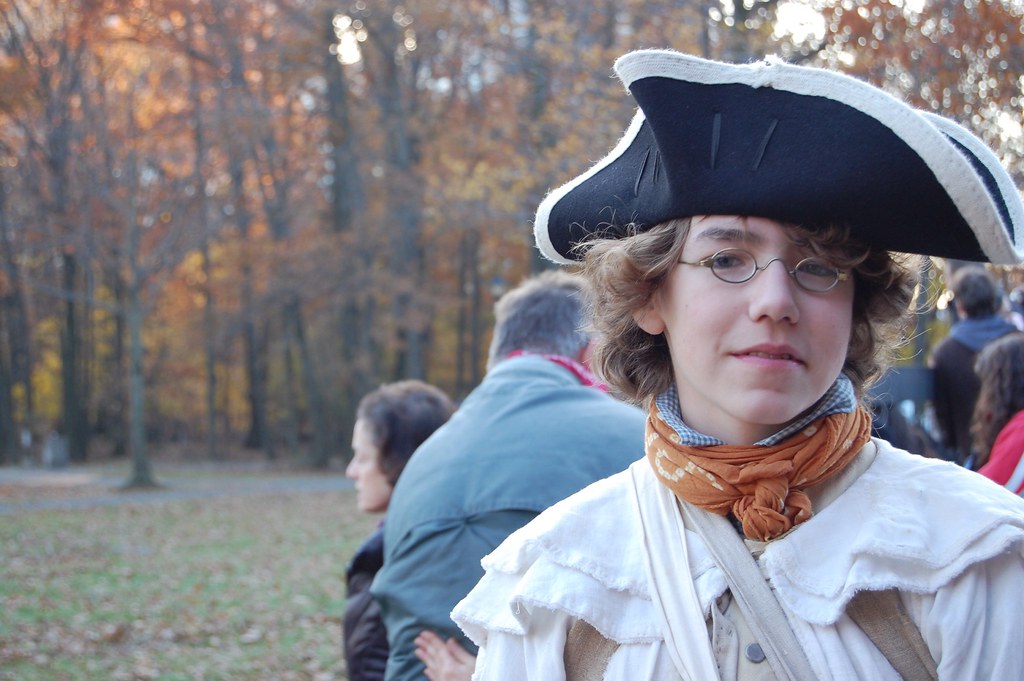
Which could bring me to the highlight of the day for someone close to me, but suffice it to say that what happens in the blockhouse stays in the blockhouse and I haven’t seen a particular teenage boy that excited, like, ever. He stayed excited, too, until he finally fell asleep somewhere on I-95 northbound.

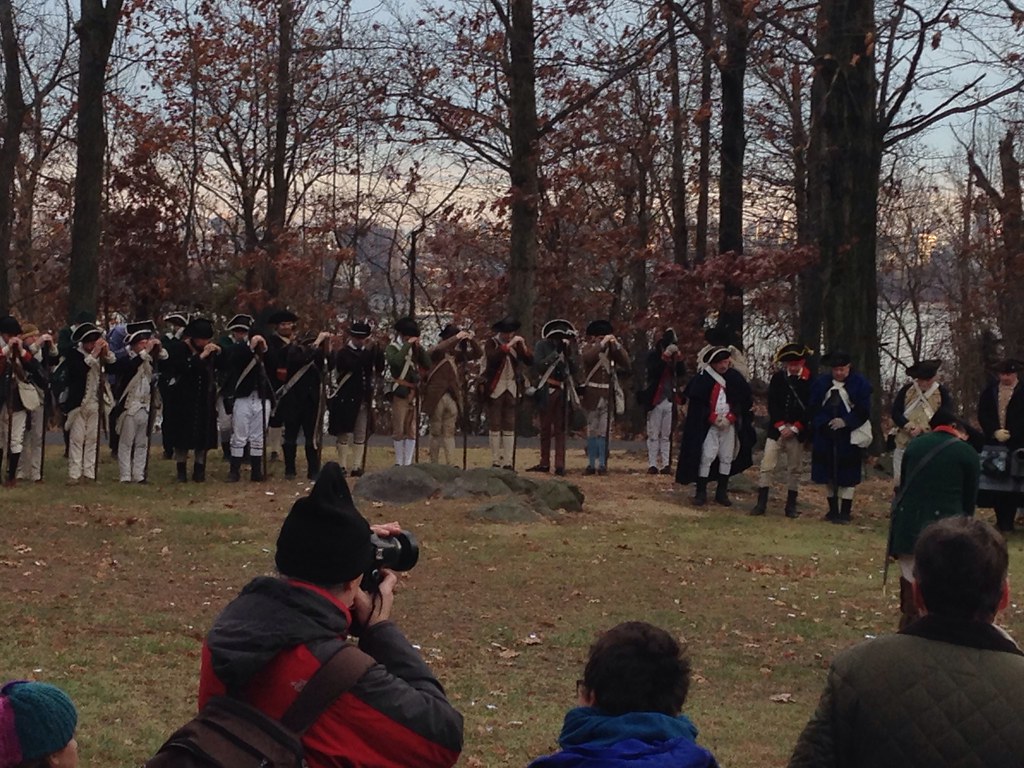
Mourn Arms at the end of the Day.

I like the predictable ritual of Fort Lee: it’s always cold, the sun fades around noon and the light is always pale by the afternoon, the guns are always fired, and the blockhouse is always lost. There’s a ceremony up in the town and the square always smells delicious, the kettles are always full of mysterious stew with some charcoal bits mixed in and the kid always has three bowls full.

There are always a lot of photographers stalking the ‘wily and elusive reenactor’ at this event; there’s a Fort Lee photo club and they come every year. Unlike Tower Park, there’s no touching, just long-lens stalking. It’s a little weird and I try not to laugh but the lengths they go to do are funny, somehow, though it’s just someone else’s hobby and obsession.

The comments in the public are always revealing. This year’s prize goes the gentleman who told his son muskets are slow to fire and hard to use because they’re breech loading. I think few people have much experience with the physical world, and we would be well-rewarded for spending some time thinking about larger themes in our interpretations, as I’m not convinced people come with much context for what they’re told or what they see.

The Four in Brown, portraying Colonel Moses Little’s 12th Continental Regiment.

Mr S could not remember the name of the regiment they were portraying when I asked him to remind me: the best he could do was “Colonel Sanders’ Regiment,” which was thankfully taken in good spirits when confessed, but you have to know that a man who has managed to get potato on his hat is, well, let’s call it befuddled with hunger. We were probably all a little punchy with cold when the conversation turned to the overheard remark that there would be parakeet [parapet] firing. I asked how many parakeets it took for a four pound gun: four. And then we were off on a flight of fancy noting that loading the guns with the birds would clean the barrels on the way down, and that a parrot, beak forward and in flight, had a fine and aerodynamic profile, but it is damned hard to load the birds tail-first. [Insert squawking noises and some broadcloth-sleeved arm flapping.] After this, we had a demonstration of a simple rapid-fire musket exchange principle which I believe may have been employed to some good effect in the blockhouse.

On the way down, we had spotted a woman driving with a small parrot on her shoulder, loose in her small car, with a cage in the back, so the day really began on a parrot and parakeet theme, though the Free Men of the Sea were parading in Plymouth. All in all, a very typical, slightly surreal Fort Lee.

Share this:

  • Share on Facebook (Opens in new window) Facebook
  • Share on Pinterest (Opens in new window) Pinterest
  • Email a link to a friend (Opens in new window) Email
  • Share on X (Opens in new window) X
Like Loading...

Headed for the Hudson

22 Friday Nov 2013

Posted by kittycalash in Events, Reenacting

≈ Comments Off on Headed for the Hudson

Tags

10th Massachusetts, 2nd Rhode Island, authenticity, Brigade of the American Revolution, common soldier, Fort Lee, living history, Reenacting, Revolutionary War

Fort Lee: It’s a mixed bag.

Fort Lee is a mixed bag: the site is very urban, authenticity levels vary, the activities sometimes get off schedule, and I don’t think anyone knows for certain what goes into the stew pot. Still, it’s an easy there-and-back dash, and all of us are going now that Sunday’s swim meet is cancelled.

After all, the Young Mr has an agenda. After being told at the Fort that “they didn’t have grapeshot then,” we found a reference in the Jeremiah Greenman diary to grapeshot being fired on the Continental troops at Fort Mifflin in 1777. He’s fastened on this and looks forward to moving that conversation forward…

And I’m just happy to have a day outside to look forward to. It’s a little dull without a fire and tent, but the event has its quirky charms, and I can always bring a book or work on shirts.

Share this:

  • Share on Facebook (Opens in new window) Facebook
  • Share on Pinterest (Opens in new window) Pinterest
  • Email a link to a friend (Opens in new window) Email
  • Share on X (Opens in new window) X
Like Loading...
← Older posts
Newer posts →

Archives

wordpress statistics

Creative Commons License
Kitty Calash blog by Kirsten Hammerstrom is licensed under a Creative Commons Attribution-NonCommercial-ShareAlike 4.0 International License.

Website Built with WordPress.com.

  • Subscribe Subscribed
    • Kitty Calash
    • Join 621 other subscribers
    • Already have a WordPress.com account? Log in now.
    • Kitty Calash
    • Subscribe Subscribed
    • Sign up
    • Log in
    • Report this content
    • View site in Reader
    • Manage subscriptions
    • Collapse this bar
 

Loading Comments...
 

    %d