• Home
  • Completed Costumes/Impressions
  • Emma and Her Dresses
  • Free Patterns and Instructions

Kitty Calash

~ Confessions of a Known Bonnet-Wearer

Kitty Calash

Tag Archives: Research

Saturday to Saturday

02 Wednesday Oct 2013

Posted by kittycalash in 1763 Project, Clothing, Events, Living History, Museums, Reenacting, Research

≈ 6 Comments

Tags

18th century clothes, common dress, John Brown House Museum, living history, Museums, Research, What Cheer Day

Demonstration at the Old State House

Demonstration at the Old State House

That’s last Saturday, outside the Old State House, for the “People of 1763” event. Sew 18th Century and I provided a material culture/ladies’ clothing presentation in the Hands on History room. The guys drilled outside, had their photos taken, and represented the militia. The Bostonian Society had over 1200 people in the museum last Saturday, which is a pretty respectable number for a small place. It can also leave you feeling somewhat overrun. (All my photos turned out fuzzy: all I had was a shaky hand and my phone. Chalk it up to needing more sleep.)

Gossip!

Gossip!

This coming Saturday is What Cheer Day at the John Brown House Museum, and my sewing and research and house prep continues, if not apace, at a steady pace. Mannequins have been put away, furniture moved, and the accents practiced. By the time we were trying to say, “These are not the droids you’re looking for” with 18th century Maine vowels, we knew it was time to go home. Why this and not “I’ll put the kettle on to boil,” I do not know.

It’s still hard for me to get a handle on my character, and not so much her background as her attitude. I’m not very good at being servile or lady-like, which is why, if I’m still working for the Browns, I must be a relative of some kind.

My husband’s dead; he died in 1788, not long after the Browns moved into their new house; wounded in the Revolution, he never quite recovered and despite the best ministrations of Dr Bowen, Mr S succumbed at last. My son, now 18, was born not long after Mr S returned from the war (Mr S enlisted ‘for 3 years or the war’). Curiously, the chaplain of his regiment is also the pastor at the Congregational church in Providence.

I am a nearly non-observant Anglican, but I recognize Reverend Hitchcock, and know the work he has done in support of free public education. Mr Brown and his brother disagree on many things, but they have at least agreed upon the importance of free public education. My son and I can read, but if Tom had been better educated, perhaps he would not have gone away to sea.

Next I have to think about my cousin from Newport, and the Brown women, and what I think about them.

And there’s still the small matter of sewing two hems, three buttons and three button loops and hoping the whole business will fit properly. At least my friend finished my cap for me. I get just so far, and then I hate caps.
Share this:

  • Share on Facebook (Opens in new window) Facebook
  • Share on Pinterest (Opens in new window) Pinterest
  • Email a link to a friend (Opens in new window) Email
  • Share on X (Opens in new window) X
Like Loading...

See You in Saratoga

20 Friday Sep 2013

Posted by kittycalash in Events, History, Living History

≈ Comments Off on See You in Saratoga

Tags

10th Massachusetts, Brigade of the American Revolution, Events, living history, Research, Revolutionary War, Saratoga

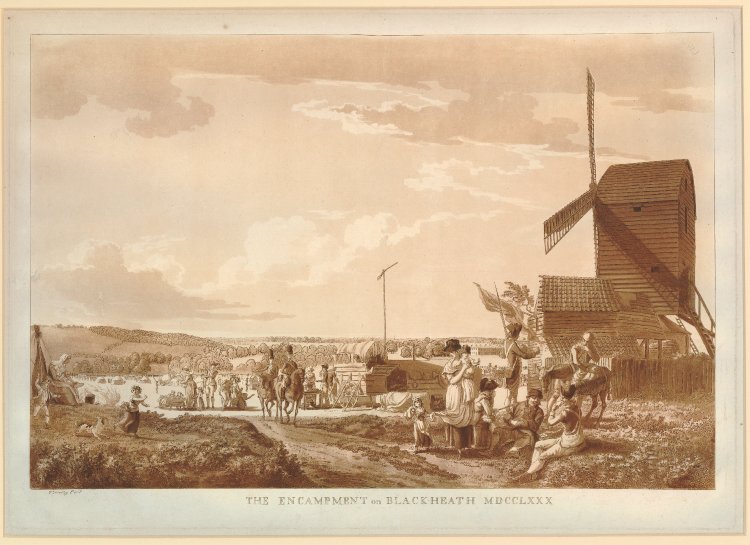
AN00176337_001_lNot quite what our camp will look like, but one can hope.

Baking nearly done, Mr S has gone to draw fresh meat and flour.

We’ll be packing as light as we can except for the kid’s supremely heavy biology textbook, but at least he’s game for a weekend of reenacting mixed with homework. Mr S looks forward to sporting his new coat, and I’m looking forward to camp cooking and meeting people In Real Life.

Fingers crossed for the lightest of traffic and rain…

Share this:

  • Share on Facebook (Opens in new window) Facebook
  • Share on Pinterest (Opens in new window) Pinterest
  • Email a link to a friend (Opens in new window) Email
  • Share on X (Opens in new window) X
Like Loading...

You are What You Wear

01 Sunday Sep 2013

Posted by kittycalash in Clothing, Events, History, Living History, Museums, Research

≈ Comments Off on You are What You Wear

Tags

18th century clothing, authenticity, Clothing, common dress, Events, fashion, living history, Museums, Research

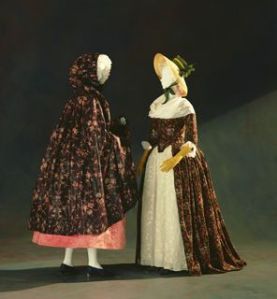
Kyoto Costume Institute. Right: Robe a l'anglaise, 1790-95, England.

Kyoto Costume Institute. Right: Robe a l’anglaise, 1790-95, England. AC5065 85-3-1

(Part one of a series)
Or do you wear what you are?

Both statements seem true, but what I know is this: dressing for the October 5 event has me stymied.

I am stuck on fabric. Sharon Burnston’s advice last Saturday was very helpful: Think Ralph Earl. She’s right: Earl’s iconic images give you the shape and accessories of southeastern New England dress in the last decades of the 18th century.

The tricky part for me is that Earl’s portraits don’t show you the maid or the housekeeper.

The character I’m playing is interesting to me: she’s invisible but powerful, respectable but not refined, loyal but detached. We don’t need to get into my familiarity with any of these paradoxes, but this might be a comfortable discomfort. What could this have to do with fabric? A great deal, as it happens.

_JDK4293

The first thing I thought I should do was to figure out the “when and why” of my character’s style choices. After talking with Sharon, I thought I understood our characters’ relationship better, and at the very least, what her character would expect of mine. And let me tell you, it is much harder to imagine being a naughty maid when you like and respect your mistress!

But I like my work to be playful: authenticity does not preclude wit, and in the late 18th century, I would argue that authenticity, at some levels, requires wit. So, how does one visually signal respect for one’s employer and playfulness?

Good lord, when is she going to talk about fabric? Right now, that’s when!

With fabric, and with style and fit, that’s how you can signal the respectful/playful combination.

And fabric is where I’ve been stuck. The gown in the photo (aside from some interesting odors and a few unidentifiable splotches) is made of a sober and suitable wool fabric. The sleeves are partially lined with an Indian block print fabric to provide a non-itchy surface and a little contrast. But I think the gown’s style is a little forward for my character as I understand her in relationship to Sharon’s character. It was also made short for working at the farm, and needs a pressing.

Potential yellow linen petticoat with potential block print cotton round gown.

Still, an earlier style in a solid light-weight wool feels a little too sober to me. It feels more like the Fortnightly Dances, and less like me or my character. A possible compromise? Style like Ralph Earl, fabric like the KCI gown.

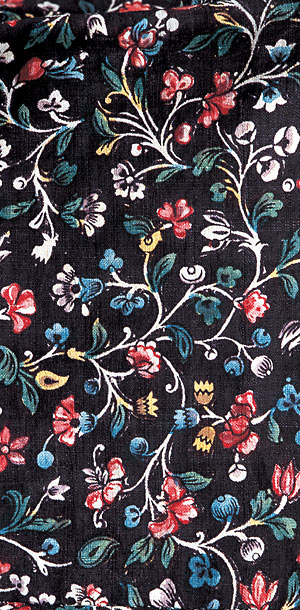
Thanks to the Strategic Fabric Reserve, I have some black cotton block print yardage and in looking for that, I rediscovered the yellow linen.

BLOCK-PRINTED COTTON British, ca. 1780–90. Cora Ginsburg.

BLOCK-PRINTED COTTON
British, ca. 1780–90. Cora Ginsburg.

Why this particular fabric? Aside from my whimsy and the KCI inspiration, dark grounds come into fashion in the late 1780s, and as a servant, I will lag a bit, style-wise. Could I have a cheaper version of the fabric at left (a child’s dress, 1780-1790, at Cora Ginsburg)? Barbara Johnson’s book at the V&A contains samples of dark ground prints from 1787 on; they’re different the vine-like print at left, but floral prints on black or dark brown are popular in these last decades.

I’m not committed to the black ground gown for this event. I’ve ordered swatches of Burnley & Trowbridge’s new light-weight wools, and we’ll see. Color and hand could convince me, and I can always line the lower part of the sleeves with a cotton print.

Share this:

  • Share on Facebook (Opens in new window) Facebook
  • Share on Pinterest (Opens in new window) Pinterest
  • Email a link to a friend (Opens in new window) Email
  • Share on X (Opens in new window) X
Like Loading...

Documenting Mr S

16 Friday Aug 2013

Posted by kittycalash in Clothing, Events, Research

≈ 7 Comments

Tags

18th century, 18th century clothes, authenticity, Clothing, common dress, common people, Costume, Events, fashion, living history, menswear, Reenacting, Research, sewing

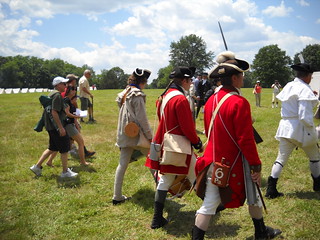
The guys are usually easy: they wear what the sergeant tells ’em to wear, and they like it, because that’s what soldiers do.

Mr S in Cambridge

Sergeant’s not a sergeant in quite the same way in 1774-1775: he’s a militia sergeant, and while we can still get up to tricks that get us yelled at, the clothing we wear is more personal. Mr S’s clothes seemed, at first, to be completely undocumentable.

Really? Yes, I have been known to have some anxiety issues over small matters. So I calmed down, re-read the standards, and looked again.

The shirt is checked linen, see here for details. The stockings, which will be replaced by hand-knit blue stockings, are also documented to Rhode Island.  But wait! That’s 1777, can it count for 1775? How long do stockings last, anyway?

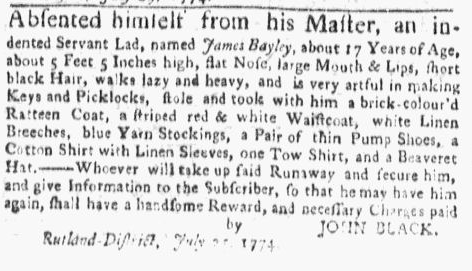
I’ll own up to having been described as “literal and precise,” and I’m taking that comment to heart. Reader: literal is where one gets into trouble when one is precise. Literal interpretations can lead you, almost hubristically, into creating replicas of runaway ads  or extant garments that don’t reflect who you are, or what time you are portraying, not really.

bluestockings_whitebreeches

Boston Post Boy, 7/25/1774

But not to worry, I dug up the blue stockings. This is from the Boston Post Boy, July 25, 1774. “White Linen Breeches, blue yarn stockings.” This is not too bad: Mr S has got his basic extremities covered now. It’s hard not to be distracted by the Cotton Shirt with Linen Sleeves, which reminds me of women’s shifts with finer sleeves, or sleeves to pin on.

browncamblet Waistcoat 7-4-1772 providence

Providence Gazette, 7/4/1772.

Keeping focused, let’s get Mr S more fully dressed, more proper, and warmer, since this is late August. You can’t see his waistcoat under the green jacket, but here you can. I know this broadcloth fabric, and its color, are from the acceptable palette for the last quarter of the 18th century, but can I find one in Providence or Massachusetts? Just about. The waistcoat described in this ad is camblet. There’s no goat or camel in Mr S’s camel-colored waistcoat, but I think we’ll call it found and be grateful that Mr S has not taken any action despite the numerous photos I have posted of him in various “poofy shirts” and “funny outfits,” as some of my friends describe them.

What’s left? There’s John Appleton’s ad in the Essex Gazette of May 17, 1774 for “blue, green and cloth colored bandannoes,” which pretty much takes care of the neck cloth; we’ve a brownish one, and a blue one; the Young Mr likes the orangey one, but I think we have those documented.

1774_greenJacket

Essex Gazette, 12/6/1774

1774_Prov_greenJacket

Providence Gazette, 1/29/1774

The green jacket, that’s what’s left. In the Essex Gazette of December 6, 1774, we find a “green jacket, light breeches, and yard Stockings,” much like what Mr S is wearing.  Nice! Multiple sources of documentation for items are always welcome chez Calash.

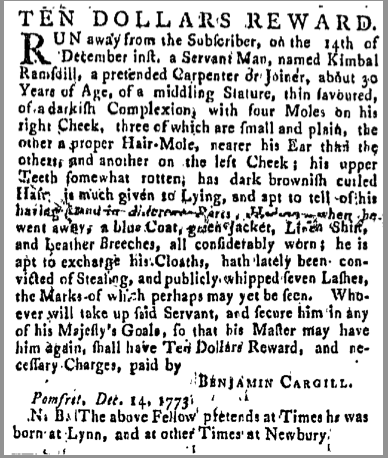
And, knowing that, you will not be surprised that I have found another jacket, closer to home. In the Providence Gazette of January 29, 1774, the man with the “proper hair mole” runs away in a green jacket. He’s also got leather breeches, and they’re on my wish list, though other things must come first, given their expense–things like tires, and allergy drops for the Young Mr.

Share this:

  • Share on Facebook (Opens in new window) Facebook
  • Share on Pinterest (Opens in new window) Pinterest
  • Email a link to a friend (Opens in new window) Email
  • Share on X (Opens in new window) X
Like Loading...

Authenticity, Reenacting, and the Mobile Museum

15 Thursday Aug 2013

Posted by kittycalash in Living History, Museums, Reenacting

≈ 10 Comments

Tags

American Alliance of Museums, authenticity, Brigade of the American Revolution, British Brigade, Continental Line, living history, Museums, Public Trust, Reenacting, Research, The Public

No stanchion here: the public marches with the exhibits

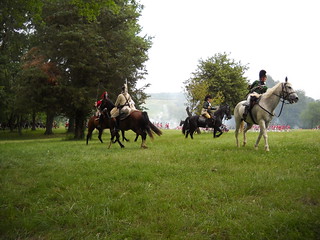
The more I think about issues of authenticity in re-enacting, the more I think about museums. Reenactments can be seen, as scholars have suggested, as “mobile monuments,” part of a culture of memorialization and commemoration of the past. “Recreated” battles, or battles staged on historic sites are not just the tactical weapons demonstrations they’re billed as, but rather ritual performances that commemorate notable events and connect practitioners with the past. They’re almost priests of the past, those men in uniform: they wear special robes, carry special equipment, and engage in practices arcane and exclusive–and denied to most women. (Indeed, the practice of women fielding reminds me of the history of women as deacons and eventually priests and bishops in the Episcopal church, but more about women in this hobby another time.)

Dragoon battles are highly staged, for safety

That’s just the battles, though they are also museum theatre, vivid, smoky demonstrations of the ways of the past: what about the rest of the event?

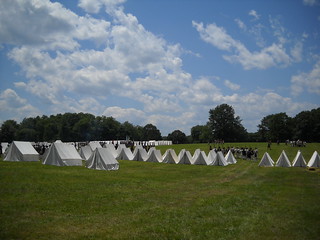
Reenactments, with their ranks of tents, kitchens, and varied participants, are in many ways mobile museums that set up at sites and provide “this weekend only!” semi-immersive experiences for visitors. There’s often a gift shop: the sutlers are there, and the site itself may have a shop, and push re-enactment themed items.

Each vignette or camp is like a gallery or object within a museum. Not all appeal to every visitor, some like Rangers, some like Redcoats, some like Rebels.

Continental camp at Monmouth

But in a world where museums and libraries are among the most trusted sources of information (online and otherwise), there are repercussions for the “mobile museums” of reenactments. If we accept a museum-like role, and see ourselves as custodians and practitioners of the past, we will need to also accept high(er) standards for material culture and presentation. That does not mean first-person interpretation by everyone at all events and it does not mean carrying actual 18th century goods into the field. That’s not good cultural stewardship.

It does mean doing the same hard work that museums do, researching and presenting oneself and one’s chattel with as much thought and care as possible. Who are you? Why do you have what you have? Where did you get it? Why does it look like that?

It means making one’s clothes and kit and accouterments as near to original as possible. The things we carry into the field, onto the stage of the mobile museum, should not look old. They should look used, but they will lack the patina of 235-year-old objects. They’ll represent the prelapsarian past of the objects, a time before they were painted with latex paint.

Can we, all of us, reach the highest levels of presentation? No. There are as many kinds of reenacting units as there are museums. Some are the Met, and have their owned branded truck. Some are your local historic site. Resources vary.

But just as most museums look to national accrediting organizations like the American Alliance of Museums for information on ethics, standards, and professional development, so too can the reenacting groups look to the umbrella organizations like the Brigade of the American Revolution, the British Brigade, and the Continental Line (the Big Three of 18th century reenacting). The BAR has an inspector, and unit inspection and re-inspection has a function similar to AAM accreditation.

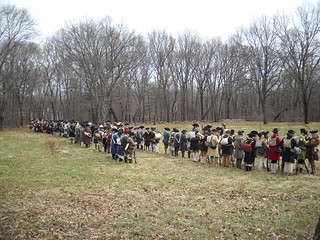
At Battle Road 2013

It’s not easy to become an accredited museum, but each museum that goes through the process learns, improves, and becomes stronger for having gone through the process of self-examination and, often, improvement. They meet standards. And like AAM, umbrella organizations can and do have standards, and the individual units have standards. Those are often online, and as individuals and other units strive to improve their impressions, following others’ well-researched and documented standards helps improve the entire field.

Peer-to-peer learning, public distribution of information, detailed and published standards of appearance, presentation and behavior: these exist, but not systematically, in the reenacting community. The more the Big Three can do to function the way the AAM does, the more I suspect we will see authenticity increase in the field.

Because it does matter: if museums and reenactors are trusted sources of information, we owe it to the public and our pride to create the best representation of the past that we can.

Share this:

  • Share on Facebook (Opens in new window) Facebook
  • Share on Pinterest (Opens in new window) Pinterest
  • Email a link to a friend (Opens in new window) Email
  • Share on X (Opens in new window) X
Like Loading...
← Older posts
Newer posts →

Archives

wordpress statistics

Creative Commons License
Kitty Calash blog by Kirsten Hammerstrom is licensed under a Creative Commons Attribution-NonCommercial-ShareAlike 4.0 International License.

Website Built with WordPress.com.

  • Subscribe Subscribed
    • Kitty Calash
    • Join 621 other subscribers
    • Already have a WordPress.com account? Log in now.
    • Kitty Calash
    • Subscribe Subscribed
    • Sign up
    • Log in
    • Report this content
    • View site in Reader
    • Manage subscriptions
    • Collapse this bar
 

Loading Comments...
 

    %d