• Home
  • Completed Costumes/Impressions
  • Emma and Her Dresses
  • Free Patterns and Instructions

Kitty Calash

~ Confessions of a Known Bonnet-Wearer

Kitty Calash

Tag Archives: Research

Aspirational Shopping

11 Saturday May 2013

Posted by kittycalash in History

≈ Comments Off on Aspirational Shopping

Tags

18th century, 18th century clothes, advertising, common dress, consumer culture, historical myths, history, newspapers, Providence, Research, resources, Rhode

So, I always thought that window shopping was a product of the late 19th or early 20th century, the plate glass windows of the Bon Ton, and The Lady’s Paradise.

Providence Gazette and Country Journal, 4-18-1772

Providence Gazette and Country Journal, 4-18-1772

I was wrong.  Check out the last line in this ad from the Providence Gazette and Country Journal of April, 1772:

“Any Person not wanting to purchase, but having a Mind to see the greatest Pennyworths, shall be waited on with great Chearfulness, by their very humble Servant, PAUL ALLEN.”

In case we forget, the past is there to remind us that the consumer culture started much, much earlier than we think it did. Stop blaming Don Draper: I give you Paul Allen.

Share this:

  • Share on Facebook (Opens in new window) Facebook
  • Share on Pinterest (Opens in new window) Pinterest
  • Email a link to a friend (Opens in new window) Email
  • Share on X (Opens in new window) X
Like Loading...

Sampler Resources

08 Wednesday May 2013

Posted by kittycalash in History, Research

≈ 2 Comments

Tags

18th century, auctions, embroidery, Museums, Research, resources, Rhode Island, Sampler Archive Project, Sampler Consortium, samplers, Sotheby's

Sew 18th Century had a fun post recently about “Which State House is it?”

Sotheby's Sale N08832, Lot 563: The Sarah Waterman sampler

Sotheby’s Sale N08832, Lot 563: The Sarah Waterman sampler

I’m not usually a sampler fan (you know this is not an area in which I shine), but I have learned a lot more about samplers through work than I ever expected to. And what do you know? Some of it stuck!

I thought I would pass along some helpful resources for sampler fans. Last year, one of the (if not THE) premier sampler collections was sold at auction by Sotheby’s. Through the magic of the interwebs, you can see the catalog online:

Important American Schoolgirl Embroideries: The Landmark Collection of Betty Ring 

Even I say “Yum!” to all those pictures. I like color and texture, but sometimes samplers make me feel like all the air has been sucked out of the room. Walker Evans has the same effect. But when you look at them like this–or arrayed on a worktable–they turn into pictures, and those I enjoy. You page through the catalog and see what Betty Ring had, and whimper a little about these going in to private and not public hands. I know we whimpered…how I covet a green-background sampler!

But wait–there’s more! Be sure to check out  American Needlework Treasures, and Girlhood Embroidery Volumes I & Volume II which are available as full-text PDFs with images. In Girlhood Embroidery, you can read more about the Mary Balch School.

If you like samplers, and want to learn more or support sampler work, visit The Sampler Consortium website. You can become a lifetime member free of charge, and enjoy email updates with sampler news. The Consortium is connected to The Sampler Archive Project, which is funded by the NEH. We’re pleased to be part of the SAP’s first phase, and I am pleased to have learned so much just by cataloging.

Share this:

  • Share on Facebook (Opens in new window) Facebook
  • Share on Pinterest (Opens in new window) Pinterest
  • Email a link to a friend (Opens in new window) Email
  • Share on X (Opens in new window) X
Like Loading...

In the Grip of La Grippe

07 Tuesday May 2013

Posted by kittycalash in History

≈ 2 Comments

Tags

18th century, catarrh, contagion, illness, la grippe, newspapers, Research, resources

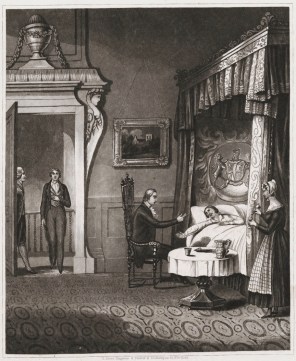
lwlpr13377

The Life of a Nobleman: the sick room, LWL call no.
830.00.00.73+

I had a cold this week past, and quite miserable it made me, too. It got me thinking about illness, and historical perceptions of illness.

I love words, and old words are best, and one of my favorites has long been catarrh. It sounds just like what it is. The Times (another one of my loves) has a hilarious column on the subject, originally published in 1865. It makes me want to write a chapbook, “Letters on Cattarh.” The first known use of the word is in the 15th century, so chances are good it turns up in 18th century usage. In fact, it turns up in the Boston Post Boy of Jan 1 1736 not as a cause of death, but as the reason for the state of George Bethune’s lungs.

Scanning America’s Historical Newspapers (yes, I do this for fun) turns up more than 1,400 hits before 1783 alone for “illness,” most resulting in death, though some are described as past, and disfiguring. My money’s on smallpox for those.

Providence Gazette and Country Journal, 1768.

Providence Gazette and Country Journal, 1768.

Catarrh turns up 27 times. Here it is in the Providence Gazette and Country Journal of 1768. It’s from an extract of the minutes of the American Society, held at Philadelphia, for Promoting Useful Knowledge. I can imagine the gentlemen sitting with pipes and punch bowl, grumbling to each other, “We can send a ship to Suriname, but we can’t cure the common catarrh.” Or perhaps it is the ladies who say it, as the gentlemen come stumbling home from the meeting to Promote Useful Knowledge.

La Grippe

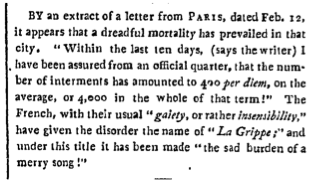
La Grippe, as experienced by poor Adelaide, is influenza. The etymology suggests a 1770-80 French origin, from gripper, to seize suddenly. That’s pretty descriptive, if you’ve ever had flu. La Grippe turns up in the index of the Philadelphia Repository and Weekly Register, January 1, 1803, as “prevalent at Paris,” and on April 9, 1803, we can read the little article about it.

On April 11, 1803, in the Alexandria Advertiser and Commercial Intelligencer there appears an “Extract of a private letter” describing interments of 400 per day, and 4000 in a ten-day period. This was serious, serious stuff. Facing illness today, we’re so much better off than people were in 1803, or even 1903. Germ theory is only 150 years old at the most, and really, thank goodness for it.

For more on the various diseases and epidemics of the past, I give you the Contagion database from Harvard. It’s an excellent collection of articles and links to additional reading, from smallpox to influenza. I feel better already.

Share this:

  • Share on Facebook (Opens in new window) Facebook
  • Share on Pinterest (Opens in new window) Pinterest
  • Email a link to a friend (Opens in new window) Email
  • Share on X (Opens in new window) X
Like Loading...

Details. All in the Details.

04 Saturday May 2013

Posted by kittycalash in Clothing, History, Living History, Making Things, Museums

≈ 4 Comments

Tags

18th century, authenticity, embroidery, muse, pockets, Research, Rhode Island, sewing project

Detail, pair of pockets. Gallery of Costume, Platt Hall, Manchester City Galleries. MCAG.1922.2150

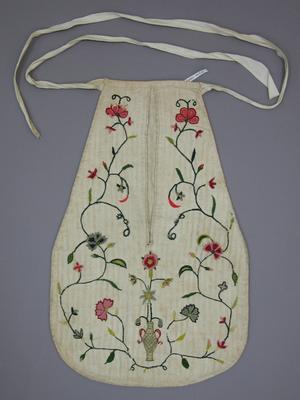
This image is from the fantastic VADS site‘s  gallery of pockets. I need new pockets, or a pocket update and overhaul, so I went looking for inspiration.

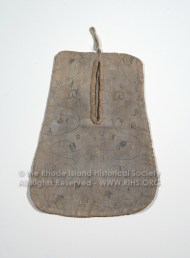
Child's Pocket, 1720-1760. RIHS 1985.1.9.

Child’s Pocket, 1720-1760. RIHS 1985.1.9.

This is a dangerous path to go down if you are as unskilled with a crewel needle as I am.

Sew18thCentury can do it– so, sew, lovely. Me…well, everything I knew about embroidery I learned as a child, and promptly forgot with puberty. So my skills remain appropriate for reproducing this, from a Rhode Island collection. The pocket is child-sized, at 14 inches, and the embroidery has a crabbed, angry look, as if the girl would much rather have been outside, chasing her dog or brother.  I can relate, at least to the dog part.

My copy, on the clearance-bin frame.

My copy, on the clearance-bin frame.

I  made a pattern of the embroidery, traced it onto linen, and started working on dredging up those long-forgotten skills. As a child, I had a sewing or embroidery book, but what I remember most about the projects I made was how far their finished form was from what I had envisioned.

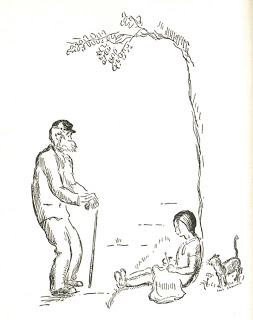
Jane, and the Oldest Inhabitant

Jane, and the Oldest Inhabitant

This is not an uncommon experience for children; my son has certainly experienced this, and even adults are subject to it. I think the best rendition of it, sewing-wise, is Eleanor Estes’ portrayal in The Middle Moffat of Jane Moffat attempting to make a “brocated bag” for Mama’s Christmas present.

The image of Jane sewing or crocheting under a tree while talking to Cranbury’s Oldest Inhabitant, a Civil War veteran, sums up every reenactment I’ve ever been part of… but I digress.

DSC_0283

A detail. Sigh. I know, practice, but…

My embroidery stitches lack a lot, but most of what they lack is practice–and that’s what makes reproducing that RIHS pocket a perfect project for me. Pockets were “sampler” projects, and suitable for girls to learn on. This combines plain sewing with embroidery, and ends up as something useful and authentic, so what more can I ask?

Pocket, single, embroidered. Snowshill Costume Collection, National Trust (UK). mid 1700s. SNO1452

Pocket, single, embroidered. Snowshill Costume Collection, National Trust (UK). mid 1700s. SNO1452

The VADS site has tons of images to inspire me, and with practice, someday I could manage something as beautiful as this. I need only make sure that it fits my time period and station–and for some events it will, but for most, the plain pocket or the crabbed-stitch embroidered pocket, are probably far more appropriate.

Share this:

  • Share on Facebook (Opens in new window) Facebook
  • Share on Pinterest (Opens in new window) Pinterest
  • Email a link to a friend (Opens in new window) Email
  • Share on X (Opens in new window) X
Like Loading...

Townspeople, 1763

24 Wednesday Apr 2013

Posted by kittycalash in Clothing, Events, History, Reenacting

≈ 5 Comments

Tags

1763, 18th century, 18th century clothes, Costume, dress, fashion, Reenacting, Research, Thomas Marshall's Boston Militia

I have this friend, DC: I can call him a friend now, but when we worked together, he was more of a nemesis, mostly because of his OCD tendencies, intense perfectionism, and complete inability to meet deadlines. It was a classic example of Mr Failure-to-Plan working poorly with Miss Contingency-Plan-Required. We literally knocked heads installing an exhibition, and I can still feel the hollow ringing pain. But it’s been six years, and with that distance, friendship is possible.

I'm only in this for the cannon.

I’m only in this for the artillery.

But he’s got this idea.  In August 1763, Boston celebrated the Treaty of Peace ending the Seven Years War (known here as the French and Indian War). There are fantastic descriptions of the celebrations and Thanksgiving Proclamations issued by the colonies, and you can read more about it in the Boston Gazette 8-15-1763.

My friend’s idea is to re-create this celebration, complete with cannons and volleys, and to that end he has enlisted local re-enactors, including a unit he didn’t realize I was part of when he asked me if I had a 1763 impression. True to form, we are asking questions he’s not yet prepared to answer… including, what sort of people do you want these townspeople to be? With the calendar as packed as it is, stitching up militia and my own clothes needs to start now, what with the regular regimental requirements due in June and again in August, and oh yes, actually maintaining life and a tolerable standard of cleanliness in the home.  (DC is moving to Europe in the Fall. After this event, when he leaves North America, I expect we’ll be better friends.)

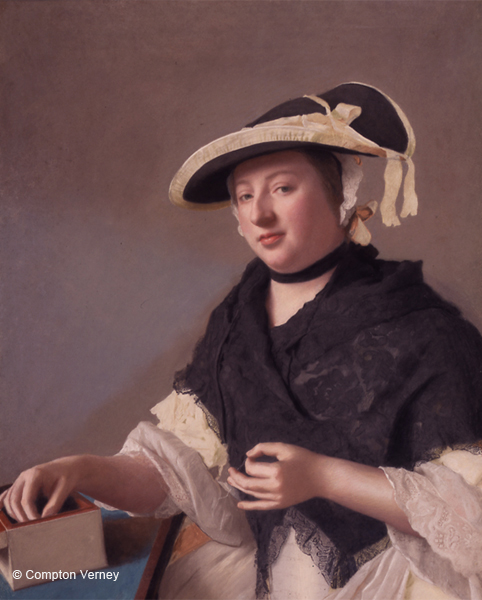
Jean-Etienne Liotard (1702-1789) Portrait of a Woman called Lady Fawkener circa 1760

Jean-Etienne Liotard (1702-1789) Portrait of a Woman called Lady Fawkener circa 1760

The reason I want an answer now is simple: I want a hat. After steaming and cramming The Hat onto Mr S’s head, I deeply desire my own Hat. I don’t covet much, really, and a hand-made piece of headwear made by someone you know and respect seems a very innocent thing to covet, even if coveting is wrong.  But to give the Favorite Hatmaker time to create a hat like the one at left, and me time to trim same, I need to know rather soon if I should be a lady or a cherry-seller.

I started a Pinterest board (when all else fails, collect images) of 1763 ideas. It’s a pretty simple thing, really, gown with robings, cap, blah blah petticoats blah blah, but: isn’t it all about the fabric? And the trims? And, lest we forget, the coveted hat!

Paul Sandby, London Cries: Black Heart cherries... ca. 1759. YCBA,  B1975.3.206

Paul Sandby, London Cries: Black Heart cherries… ca. 1759. YCBA, B1975.3.206

The Sandby cherry seller can probably be replicated with an open gown with robings made from B&T’s Virginia cloth; the question is merely of color, drape, and patience waiting for swatches. (Wish Wm Booth still had that yellow and blue striped linen, but my blue and white linsey-substitute would have to do.) This is simple enough, really; I have a cap like the cherry-seller’s cut out, somewhere, or linen to make one, anyway.

Paul Sandby, London Cries: The Fishmonger (detail), 1759. YCBA B1975.3.210

Paul Sandby, London Cries: The Fishmonger (detail), ca. 1759. YCBA B1975.3.210

Maybe the compromise is this, yellow, with a black hat. I suspect this hat is straw, but perhaps I could combine the hat above with this idea. The black hat and black cape are very appealing. The answer, of course, is all in research: find out about the men in Thomas Marshall’s Boston Militia, and from there I can find out about, or make intelligent surmises, about the women. But that’s irritating, as military/militia-based history often is–to be dependent on the men. Perhaps the less annoying route lies through JSTOR…. and following up on the memory of a Boston widow-businesswoman.

In the end, I’m realistic enough to know that I shall be lucky to get a new hat trimmed at all, given all the menswear there is to complete between now and August. Even my plans for chitzy sewing this week turned late yesterday into, “Oh, but I thought you liked the Adjutant. We’re going up Saturday for fitting.” I suppose that means they think I’ll finish something enough for fitting.

Share this:

  • Share on Facebook (Opens in new window) Facebook
  • Share on Pinterest (Opens in new window) Pinterest
  • Email a link to a friend (Opens in new window) Email
  • Share on X (Opens in new window) X
Like Loading...
← Older posts
Newer posts →

Archives

wordpress statistics

Creative Commons License
Kitty Calash blog by Kirsten Hammerstrom is licensed under a Creative Commons Attribution-NonCommercial-ShareAlike 4.0 International License.

Website Built with WordPress.com.

  • Subscribe Subscribed
    • Kitty Calash
    • Join 621 other subscribers
    • Already have a WordPress.com account? Log in now.
    • Kitty Calash
    • Subscribe Subscribed
    • Sign up
    • Log in
    • Report this content
    • View site in Reader
    • Manage subscriptions
    • Collapse this bar
 

Loading Comments...
 

    %d