• Home
  • Completed Costumes/Impressions
  • Emma and Her Dresses
  • Free Patterns and Instructions

Kitty Calash

~ Confessions of a Known Bonnet-Wearer

Kitty Calash

Tag Archives: Research

A Bonnet, Universally Acknowledged

11 Monday Feb 2019

Posted by kittycalash in Clothing, History, Living History, material culture, Reenacting, Research

≈ 2 Comments

Tags

1770s, 18th century clothes, American Revolution, authenticity, bonnets, Boston, living history, millinery, Research

Print made by James Caldwall, 1739–1819, British, A Ladies Maid Purchasing a Leek, 1772, Yale Center for British Art, Paul Mellon Collection

“It is a truth universally acknowledged that if a bonnet existed in the 1770s, it was black taffeta” has long been the rule reenactors have followed, particularly those wanting to adhere to the strictest standards of well-researched impressions based on primary source documents and period material culture. Truth examined is more subtle, showing that bonnet colours, materials, and shapes varied from decade to decade—and year to year—and that these factors seem to have varied by region. What worked in Boston would not be comfortable in the Carolinas, and people adjusted accordingly.

I was asked recently about Boston-area bonnets in the first half of the 1770s. My impression of this decade is that it is one in which there is a stylistic change in women’s headwear, as the “sunshade”* and “Bath” bonnet terms fade from use, giving way to plain “bonnet” or “chip” bonnets. These appear to have been made from “bonnet paper,” seen in both blue and white** in newspaper ads, though prints and paintings show brims in both boned and paper forms.
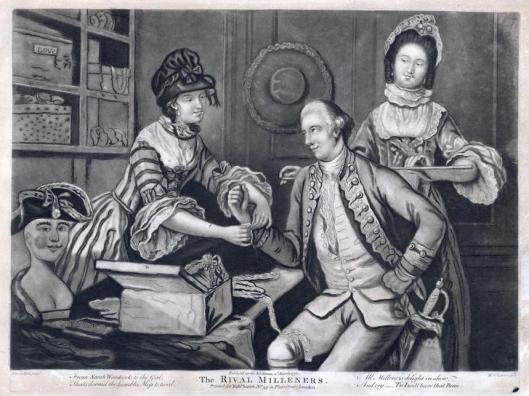
The Rival Milleners. Mezzotint after John Collet, 1772. Colonial Williamsburg Foundation, 1955-125

Brim shape and bonnet material— fabric and colour–  vary by period (and region). So let’s look at Boston in the first years of the 1770s. One tricky bit is that there are fewer indentured servants and enslaved people in Boston than elsewhere in the American Colonies in this period, so runaway ads are scarce, giving us fewer clues than we get in Pennsylvania and points south. Still, there are plenty of ads to help guide us.

As early as 1769, we see color variations, with the mention of “black, blue, green, white, and crimson bonnets” in Caleb Blanchard’s store. The year before, Joshua Gardner and Company advertised “black, pink, blue & crimson sattin hats and bonnets.” That means that on the streets of Boston and environs, by 1775, you’d see half-worn black, blue, green, white, crimson and pink satin bonnets.

The best statistics around for bonnets are currently tabulated for Pennsylvania, and definitely show the preponderance of bonnets are black (52 of 75 tabulated, or 69%). So don’t give up on black silk bonnets! They are the most common color. If we extrapolate these statistics, for a Pennsylvania event in the 1770s, of every 10 bonnets, seven should be black, one should be white, one should be green, and one should be blue. In larger groups, we’d also see red and brown bonnets, but again, just one in 20 or 30.

The Boston Gazette, April 4, 1774. Benjamin Franklin’s sister advertises “Sattins of the newest Fashion… for Bonnets.”

“A few sarsnet taffety bonnets,” in the Boston Evening Post, September 28, 1772.

For Massachusetts, statistics are more difficult to compile, given the dearth of runaway ads and the fact that I haven’t yet dived into inventory and probate records. Merchants’ ads give us some clues as to materials, and one thing I find is that “sattin” shows up, as well as “sarsnet taffety” or pelong. Sarsnet or sarcenet was a “think transparent silk of plain weave,” according to Textiles in America. Thicker than Persian, sarcenet was woven both plain and twill, and could be plain or changeable. Pelong is a kind of silk satin, again according to Textiles in America, and in The Dictionary of Fashion History, described as a kind of “thin silk satin,” but I have also seen it described as a ribbed silk. Joshua Blanchard advertised “Pelong sattins of all colours” in 1768. Where does that leave us with materials? Probably with the need for more bonnets to be made of silk satin than of silk taffeta, though the proportions are difficult to calculate yet.

Miss Theophila Palmer (1757-1848), oil on canvas, attributed to Sir Joshua Reynolds ca 1770.

What about shape? For those dressing a la mode, we are past the deep-brimmed, small-cauled “lampshade” of the 1760s, and into a smaller, tighter bonnet with a larger caul and more trimming. In the portrait of Miss Palmer, we see how the brim stands away from the face, and the caul or crown poufs up. “A Lady’s Maid Purchasing a Leek” and “The Rival Milleners” (aee above) both depict women in similarly tight-brimmed and round-crowned bonnets trimmed with bows. These are shapes that I am confident appeared almost universally (with variations) in the American colonies in the first years of the 1770s. Now, there are different shapes to be sure, but these seem to predominate. I do think we need to see more brims that wrap around the head, as seen in the 1774 mezzotint of George Whitefield (Anglo-America’s most popular preacher) and his followers.
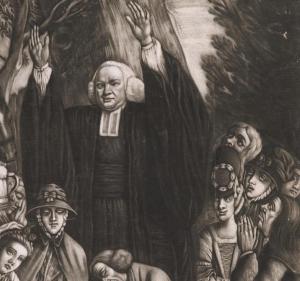
Detail, A Call to the Converted. Publish’d April 15, 1774, by W. Humphry . Lewis Walpole Library, 774.04.15.01+

So what’s the take away, if we are looking specifically at Boston and environs in the first half of the 1770s?

  1. Most bonnets (70%) were black, but a few white, green, crimson, and blue were seen.
  2. Most bonnets were made of silk satin, with others of taffeta or sarsnet (sometimes twilled silk).
  3. Most bonnets would have a shorter, higher brim that curves across the face just above eye level, with a high, rounded crown/caul and bow trims.
  4. Bonnet brims would vary between bonnet (paste) board and boned

Each place has a local style– which, if you think about it, is still true today. When I stand on the Metro platform in the red wool coat I bought in Providence, these folks know I’m not from here. The way we dress for the past should reflect the place and the time we are representing as best we can. And that means we need accessories to match those times and places, as well as clothes.

And yes, full disclosure, I sell researched bonnets on Etsy. If you want a bonnet for a particular time and place, that’s what I make.

* Known on this blog as “lampshade”
** Nope, don’t know what that means yet, haven’t looked into it

Share this:

  • Click to share on Facebook (Opens in new window) Facebook
  • Click to share on Pinterest (Opens in new window) Pinterest
  • Click to email a link to a friend (Opens in new window) Email
  • Click to share on X (Opens in new window) X
Like Loading...

Bed Gown, my Bed Gown

08 Friday Feb 2019

Posted by kittycalash in Clothing, Events, Living History, Research

≈ Comments Off on Bed Gown, my Bed Gown

Tags

bed gowns, bedgowns, chintz, Research, workshops

The female orators/ M. Rennoldson sculp. etching & engraving on laid paper, hand-colored. 1768. Lewis Walpole Library

I’m teaching a workshop in a few weeks, and that is giving me all kinds of reason to re-examine how I do things, what I know, and how I know it. After a few years, I worry that I take the knowledge I’ve gained for granted– which is a dangerous thing to do! Even when you have the good fortune to be building on the work of notable experts (like Sharon Burnston), you have to fact-check yourself. In part, I did this to verify that the pattern I use will work for the time period in question (last half/quarter of the 18th century). The other question I had was about material and prevalence. I’ve maintained that the bedgown is the most common, cozy, and cute garment of the 18th century, but is that true?

View near the Ring in Hyde Park, looking towards Grosvenor Gate, during the Encampment, Paul Sandby, 1780. Pen and watercolour |RCIN 451581

Many of the images of women in bed-gowns seem to depict older women made deliberately unattractive, poor women with their clothes in rags, or bawdy women. All of those are great in their own way, but most of us want to look our best (even when being our worst). For me, this affects the fabric choices I make. Fabric cheers me up– the varieties of color, texture, pattern make winter bearable, job rejections tolerable, and future plans graspable. I have a predilection for pattern, particularly Indian patterns, so I’m always looking for references to prints and chintz being worn.

Maryland Journal, July 17, 1776

Well, bless Jean Shepherd’s heart for running away (with a “down look”) from York, PA in 1776. She took off in a dark calico bed-gown, a brown worsted petticoat, and a half-worn white pelong bonnet. The images of printed bed gowns I’ve found thus far have light grounds (the yellow of the orators being more light than dark, though certainly saturated).

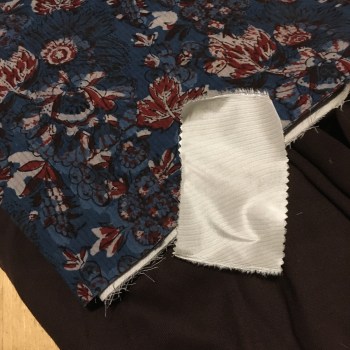
But I can find dark ground cottons, and while what I have is not documented reproduction, I am comfortable with it. The lining will be off-white plain weave wool because it’s winter. I don’t have documentation for this combination but among the fabrics on hand in my reduced-but-accessible Strategic Fabric Reserve, the wool has the best hand and the correct yardage, so wool it is. (It feels like brushed cotton, and was meant for a shift but needs must.)

Blue chintz lining in a man's banyan, 1731 - 1760. Museum of London, 53.101/10
Blue chintz lining in a man’s banyan, 1731 – 1760. Museum of London, 53.101/10
detail, banyan at left.

Newspaper ads for runaways show a fair range of fabrics: red baize; red calico; brown linsey; stamped linen; black and white calico. That last sounds so graphic– and, worn with a black calimanco petticoat, must have been striking. This same woman, Katey Norton, also took with her “an homespun Cotton tight bodied Wrapper” which is appealing indeed– and which I can picture. But that’s another patterning exercise.

Share this:

  • Click to share on Facebook (Opens in new window) Facebook
  • Click to share on Pinterest (Opens in new window) Pinterest
  • Click to email a link to a friend (Opens in new window) Email
  • Click to share on X (Opens in new window) X
Like Loading...

The Colour of Things to Come

28 Monday Jan 2019

Posted by kittycalash in Clothing, History, Living History, material culture, Reenacting, Research

≈ 5 Comments

Tags

18th century clothing, bonnets, Costume, fashion, French and Indian War, millinery, Research, Revolutionary War

I have a thing for hats– well, for bonnets, really. I know I made stays and a shift before I made anything else for the 18th century, but I might have made a bonnet before I made a proper gown. It’s a condition I inherited from my grandmother, and a great aunt who was a milliner, so there’s little to be done about it– except to dive in deeper.

Miss Theophila Palmer (1757-1848), oil on canvas, attributed to Sir Joshua Reynolds ca 1770. Pretty sure that’s a white “whalebone” or “skeleton” bonnet.

As people do more research and generously share it with me, I’ve come to realize that I need to synthesize what we are seeing. It’s a tricky thing, what with that single (known) extant bonnet at Colonial Williamsburg and only prints and images to go on. What I’ve done to compile a stack of references from newspaper ads (primarily Mid-Atlantic and New England colonies at the moment) and interfiled them with images. This has given me a much better sense of  the change in shapes and construction over time, as well as the range of colours– yes, colours, available and popular.

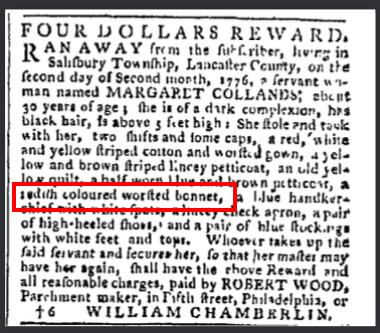
It’s not just that wool bonnets are a thing– there’s the ““a reddish coloured worsted bonnet” in the April 8, 1776 Pennsylvania Packet an ad for runaway Margaret Collands, and the “black durant” recommended in Instructions for Cutting Out Apparel for the Poor– but close reading shows that the colors are more varied than we’ve accept lately, but they vary by region and time period.

The Misses Waldegrave. Are blue bonnets *only* for children? Maybe.

There’s been a rule that “all bonnets are black silk,” which is too broad a statement. Most bonnets are black, that’s true. But in 1768, in Boston, a place where folks would have you think that black is the only colour bonnet you can ever have, you can have “Black, pink, blue and crimson sattin hatts and bonnets” (Joshua Gardner and Com. ad, Boston News-Letter, November 24, 1768).

Heck, if you shopped at Caleb Blanchard, you could have a green bonnet, too! Blanchard advertised “black, blue, green, white and crimson Sattin bonnets” in the Boston Gazette on December 18, 1769.

screen shot 2019-01-26 at 6.56.33 am
screen shot 2019-01-26 at 6.56.22 am
What does this mean? My SWAG is that roughly 60-70% of bonnets should be black. After that, blue, white, red and green would make up the balance. In Philadelphia, green bonnets– and green flowered bonnets– last longer in the ads. Philadelphia is also where I see more white bonnets, a brown silk bonnet, a diaper bonnet, a “queen’s grey” bonnet, and, in Trenton, a “lye coloured” bonnet. In Rhode Island, there’s a blue stuff bonnet. So yes, bonnets should mostly be black. But they can also be other colours.

Share this:

  • Click to share on Facebook (Opens in new window) Facebook
  • Click to share on Pinterest (Opens in new window) Pinterest
  • Click to email a link to a friend (Opens in new window) Email
  • Click to share on X (Opens in new window) X
Like Loading...

The Past Never Grows Old

18 Tuesday Dec 2018

Posted by kittycalash in Living History, Movie Review, Philosophy, Reenacting, Research

≈ 2 Comments

Tags

movie reviews, movies, public history, Research, They Shall Not Grow Old, world war I

It’s obvious that the people I know and associate with understand the genius of They Shall Not Grow Old, and the importance– necessity– of seeing it. This is a brilliant public history project in the most public sense of all– and not only because it’s a movie made by Peter Jackson, which one hopes will attract a wide audience– but because the mini-documentary after the feature lays bare the bones of the making. Jackson’s explication feels at times as if he is speaking to you through his laptop camera on the best Skype connection you’ve ever had. Despite the occasional weirdness of that, it’s worth staying for, because it makes clear what makes the film powerful: research and meticulous attention to detail (plus phenomenal computing power and the genius of WingNut productions).

Royal Irish Rifles, Battle of the Somme

This film rests on research: 100 hours of footage from the Imperial War Museum, 600 hours of oral history audio. Jackson and his team immersed themselves in the media, and it shows. Their intention was to create a generic experience of the common soldier (I may well have teared up at that), so the description of the assault is generic– is it the Somme? Vimy Ridge? Ypres? It is all of them and none of them.

Now the magic of that choice is not that we hear anything about how a Lee-Enfield works, but rather about the minutiae of getting ready to go over the top. We are in the soldiers’ world, and that world is made up of mud, bread and jam, and tea. Yes, there’s talk of the packs and what they carry, but the descriptions of what the waiting was like, how the officers behaved and gave their orders, are what make the moments so immersive. The words match the abject terror on one private’s face, caught in a grimace more rictus than smile. At the same time, we do get descriptions of the logic of the shelling, what the shells contain, and how the mines work. Matched to footage showing what the veterans describe, we come to understand how terrifying those moments were– and then we hear how, once you go over the top, fear disappears as you walk towards the German lines. (The walking always astonishes me: but that’s how they did it, lines of soldiers walked towards the machine gun nests.)

But it’s the details of the getting ready and the tension of the waiting that make the assault so much more intense, as contrast always will. The assault itself, for which there is no footage because it was too dangerous to send cameramen over the top, is depicted with halftones from The War Illustrated, selected for their realism and lack of heroics. (Published in Britain, it was as much a propaganda tool as a documentary publication, though accuracy improved over time.)

We don’t get the “glory” of a battle. We don’t get heroics. We get descriptions of the most terrifying and dehumanizing “job of work” people (mostly men) are ever asked to do. And we get the aftermath, rendered small. In detail. The descriptions of wounds and deaths are moving, and the tireless work of the doctors, but then there is the desire for a cup of tea. Tea threads through the film, seeping into every aspect of the war. It is, after all, men living daily lives in the most outrageous conditions, where every banal desire– dry feet, strawberry jam, a safe place to defecate–is thwarted by the conditions that make those desires so achingly large and yet dismissable. You have to enjoy what you have and can achieve and laugh at what you cannot, or you won’t survive. No one can ache endlessly.

What makes this film really work is the hyper-attentive focus on detail, on getting everything as right as possible, from the color of the uniforms to the accents giving the soldiers voice. The point of the research is not detail for details’ sake, but immersion. Only when there is nothing to notice– nothing that seems amiss, an entirely seamless world–can we fully enter the other, another time, place, culture. That is what we are seeing: another culture, with its own language, mores, habits and taboos.

This is what we are trying to recreate when we reenact the past: we are reviving a lost culture. To do that correctly and well, we need to apply the same level of care and understanding and empathy visible in Jackson’s film. We need to make sure that the details are correct not because the public will call us out on errors, but because the oversights are disrupting. The difference between a well-researched, highly detailed impression that does not focus on “Want to know how a musket works?” and one that’s musket-centric and approximates the past with “If they’d had it, they would’ve used it” is not actually of quality or necessarily or care. The difference is that one allows both the enactor and the audience to more fully enter the past. It’s like a bubble of time we can step into, one where we get as close as we can to how the people of the past saw, thought, felt, smelled. The other, often excused with “The public can’t tell the difference,” remains performative and distant, only half-reaching the past.

The public can tell the difference. They can tell when what they are seeing comes closer to the past, engages with the material in detail and in attitude, and creates attitude, worldview, empathy rather than a recitation of facts. To reenact the past, we must inhabit it, from the color of the wool to accent of the speech, to the taste of the food. The moments we recreate are specific in time, and, when they embody everything you can know about that moment, help us reach across time to understand both the past and the moment in which we stand.

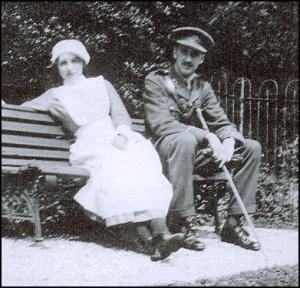
Vera Brittain and her brother, Edward, in 1915. Testament of Youth was my gateway drug to World War I.

I am the last person to tell you I get close to this ideal of detail. I strive for it, and do the best I can to be whatever character I’ve selected. I write this not from the position of someone who has mastered the past, but as someone who has seen technique and principles applied to one medium– film– that are applicable to living history, exhibit design, public programming, and writing. Jackson’s film illustrates the power of knowing details and the power of caring about those details not for trivia’s sake but for the Tommy’s sake. Those specific details serve to create the “everymen” of the War. The research to find which regiments are shown, to get the shoulder badges right, to find how what speech an officer is reading, prove the power of the archives. The past is there, waiting for us, in acid free boxes. We can restore the dignity and humanity of the people of the past by reading their words. Specificity creates archetype.

At the end, Jackson encourages the audience to ask their family members about their history, to find out what stories there are, to find out how the Great War touched them. He reminds us that those memories die with the people who carry them, unless we ask and write them down (or record them). That is perhaps the greatest public history lesson of all: that the past touches us all through the people we know and love, and that by knowing those stories, we can understand not only our family stories, but the history we all share.

Share this:

  • Click to share on Facebook (Opens in new window) Facebook
  • Click to share on Pinterest (Opens in new window) Pinterest
  • Click to email a link to a friend (Opens in new window) Email
  • Click to share on X (Opens in new window) X
Like Loading...

Turn Me Round

14 Friday Dec 2018

Posted by kittycalash in material culture, Research

≈ 1 Comment

Tags

1950s, Augusta Auctions, Clothing, party clothes, red dress, Research, style, vintage clothing

Gattinoni red brocade party dress, Rome, 1950s Augusta Auctions Lot: 155 October 24, 2018.

One of the best things about auction sites (when compared to museum sites) is that you get far more images of the objects, and often from unusual but helpful angles. This is true for furniture– good auction sites will post photographs of the undersides of sofas and desks, a level of detail museums simply lack the time for. For clothing, construction details aren’t always noted in the record, so we rely on images. This is where the auction sites can really be a boon: turn me round, baby.

Interior, showing black mesh boned corset w/ attached black petticoat. Gattinoni red brocade party dress, Rome, 1950s Augusta Auctions Lot: 155 October 24, 2018

I don’t know if I’d go as far as “boned corset” (well, I wouldn’t) but the boned bodice provides a lot of interior structure to this gown. The box pleats give the brocade skirt structure and fullness, but rely on the petticoat for the full silhouette. The interior structure probably didn’t provide enough support to allow the dress to be worn without additional undergarments– bra, panty girdle, even another petticoat– though it’s hard to say without knowing the original owner and feeling the dress. (Think of the boned bodices in late 19th century bodices: we know those weren’t enough to create the proper silhouette.)

It’s a wonderful look at the interior of a vintage dress, though, and one that makes replicating this garment (and look) so much easier.

Share this:

  • Click to share on Facebook (Opens in new window) Facebook
  • Click to share on Pinterest (Opens in new window) Pinterest
  • Click to email a link to a friend (Opens in new window) Email
  • Click to share on X (Opens in new window) X
Like Loading...
← Older posts
Newer posts →

Archives

wordpress statistics

Creative Commons License
Kitty Calash blog by Kirsten Hammerstrom is licensed under a Creative Commons Attribution-NonCommercial-ShareAlike 4.0 International License.

Website Built with WordPress.com.

  • Subscribe Subscribed
    • Kitty Calash
    • Join 621 other subscribers
    • Already have a WordPress.com account? Log in now.
    • Kitty Calash
    • Subscribe Subscribed
    • Sign up
    • Log in
    • Report this content
    • View site in Reader
    • Manage subscriptions
    • Collapse this bar
 

Loading Comments...
 

    %d