• Home
  • Completed Costumes/Impressions
  • Emma and Her Dresses
  • Free Patterns and Instructions

Kitty Calash

~ Confessions of a Known Bonnet-Wearer

Kitty Calash

Tag Archives: resources

Authenticity: Sources I

09 Friday Aug 2013

Posted by kittycalash in Clothing, Living History, Making Things, Research

≈ 1 Comment

Tags

18th century clothes, authenticity, Clothing, common dress, Costume, fashion, linen trousers, Research, resources, Rhode Island, sewing, style
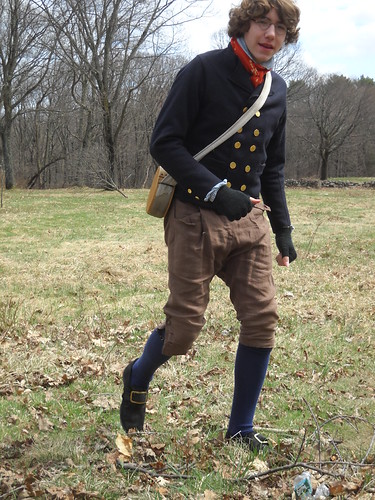
There he goes!

You know this guy: the reluctant drummer and avid ensign who wants to be in uniform but struggles with the fact that he might be seen by someone. (14 is complicated.) I’ve been mulling over several upcoming events and the comments that swirl around on the Interwebs after any large event, and, as I often do, find my clarity in writing. That means you’ll have to wait till the end of this post or a series to get “answers,” or what pass for them.

One of the things I struggle with is that the kid is not a mannequin. He has stated quite plainly that he feels like I fuss too much over his appearance, when he has nothing to do at events, which leads him to believe that I am fussing over nothing. There’s some truth in that, right: while God and authenticity may be in the details, all is for nought if there’s nothing to do or interpret.

This means I cannot simply dress him up as I see fit, I have to negotiate with him, and keep on eye on what he’ll be doing. And I don’t have the time to make all the lovely things I’d like to make (or not all at once, anyway) so it’s a matter of choosing.
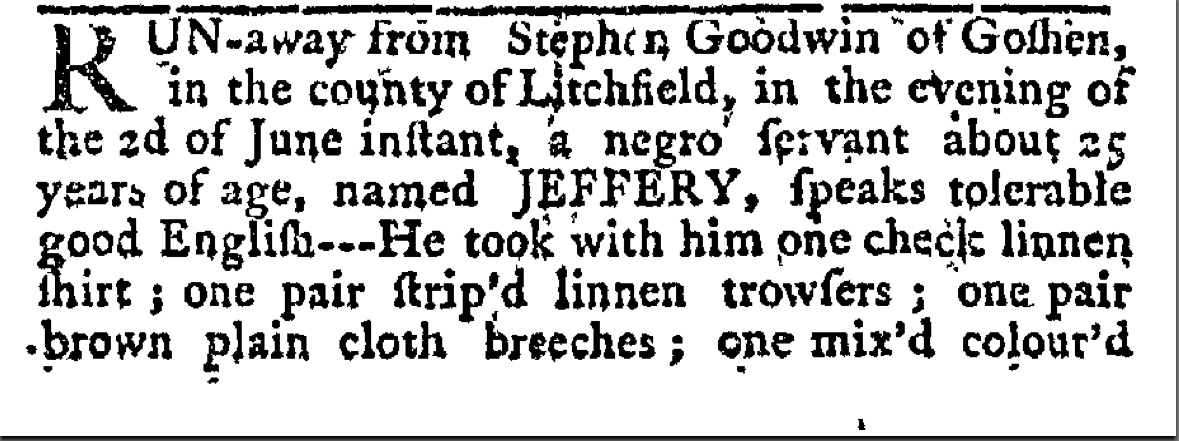
June 21, 1774 Connecticut Courant

Connecticut Courant, June 21, 1774

Let’s start with what the kid has already: the blue jacket, checked shirt, neck cloth, breeches, stockings and shoes. I went to the newspapers (the lower sorts’ Vogue) looking for examples of runaways, and found some good ones. On June 21, 1774, an ad was published in the Connecticut Courant for a boy who had run away in a “check linen shirt, pair of striped linen trousers, one pair brown plain cloth breeches…” but the Young Mr wants no part of striped linen trousers, and his breeches are linen, not wool.
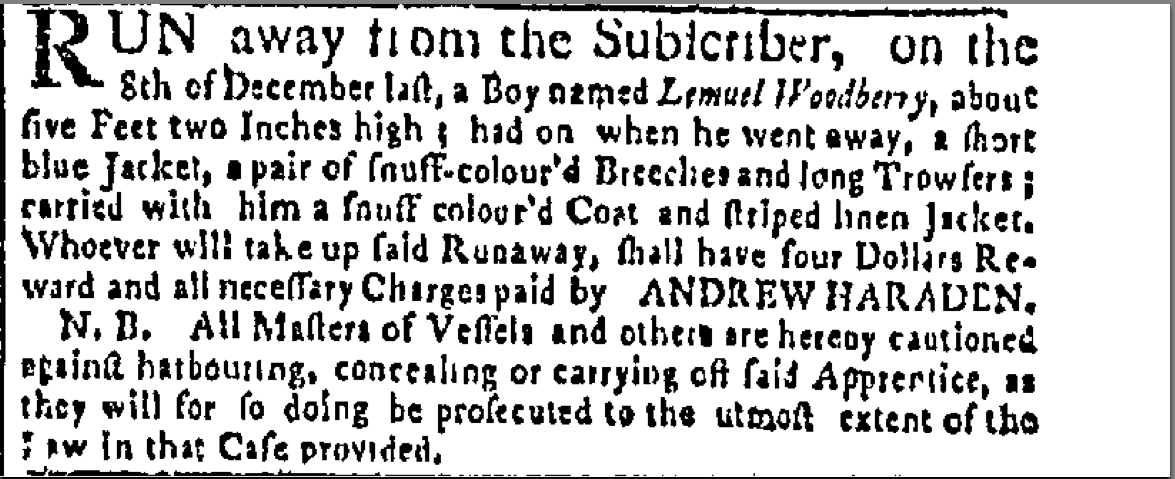
Essex Gazette, January 10, 1775

Essex Gazette, January 10, 1775

On January 3, 1775, the Essex Gazette ran an ad for a boy in a “short blue jacket, snuff colored breeches and long trousers.” Now that’s more like it!

Long trousers sound good to the kid, more “normal” than breeches,  but there’s a jacket in there that would satisfy my stripey love. For the short run, even if I don’t get the trousers made up in the next couple of weeks, he’s reasonably well documented, or at least within the realm of plausible appearances, even if he should be in wool and not linen, and even if one of the best reasons for making trousers is to replace the poorly-fitted breeches.

Kids shouldn’t just get a pass for inauthentic clothing, and children in what are really costumes do make me crazy–probably because I’m hand-sewing clothing for a wily teenager to grow out of, and looking for sources to make sure the choices I make have some form of documentation.
Share this:

  • Share on Facebook (Opens in new window) Facebook
  • Share on Pinterest (Opens in new window) Pinterest
  • Email a link to a friend (Opens in new window) Email
  • Share on X (Opens in new window) X
Like Loading...

Tentage

26 Friday Jul 2013

Posted by kittycalash in Events, Living History, Making Things, Museums, Research

≈ Comments Off on Tentage

Tags

18th century, authenticity, common soldier, Reenacting, resources, Revolutionary War, tents

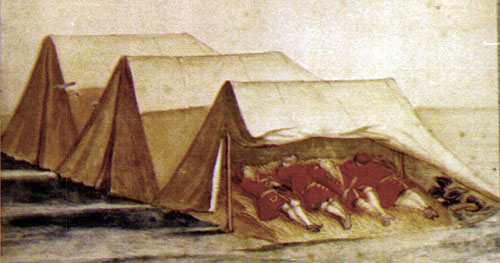
Scene of the Camp on Hampton Green, 1781

Scene of the Camp on Hampton Green, 1781

Like many other reenactors/living historians/suckers for wool in summer, I’ve been following the First Oval Office project with interest and envy. Imagine my delight upon finding this blog by Tyler Rudd Putman, who is working on that and many other projects of interest.
The common tent project l is one that I really do hope to take on someday, though I doubt I can ever achieve a tent of this level of quality. (Reader, I cannot weave.) But I can aspire, at the least, and I see that a hand-sewn tent is something even I can achieve. It won’t get done by me in just one day, but over the course of several weeks I could get one done as long as I cleared the downstairs of all our furniture, and put up with a cat sewn into a seam. (My assistant has been lying down on the job, melting in the heat.)

The Howling Assistant Lies Down on the Job

I’ve been thinking about tents since the after-dark hilarity at Monmouth setting up an unknown tent in the dark with a brittle pole that had to be repaired with string from a pasty wrapper, and the later perhaps over-zealous cleaning by Mr S of the tent abused by a cat and identified on the NJ turnpike’s extended play of “What the Hell’s that Smell?”

I’m not sure why we’re allowed to remain in our regiments, really, I am not. But I suspect that an ability to produce Chesire Pork pie is a factor in our favor.

We’ll be setting up tents at OSV in just about a week, broken pole and all, and looking ahead to that, I give you the following links for further reading on tents.

John U. Rees on tents in both armies of the Revolution.

How to fold a tent.

Period (British) images.

Even more documentaton: scrolling down, Rhode Islan had a return of 147 tents in May, 1781– that’s about 882 soldiers, at 6 men per tent, a max of 1029 at 7 men per tent. (At least one is always on duty, so there would not be more than 5 or 6 sleeping at any one time).

Amazing and image-rich essay, The Tent Article

Lochee, Essay on Castremetation, which I read and forget by the time it is dark and some man is trying to reason with me about how a camp should be arranged, when all I want to do is sleep. With that in mind, a brush arbor is starting to look good…

Share this:

  • Share on Facebook (Opens in new window) Facebook
  • Share on Pinterest (Opens in new window) Pinterest
  • Email a link to a friend (Opens in new window) Email
  • Share on X (Opens in new window) X
Like Loading...

In the Pink

14 Sunday Jul 2013

Posted by kittycalash in Clothing, Making Things, Reenacting, Research

≈ Comments Off on In the Pink

Tags

18th century clothes, Clothing, common dress, Costume, dress, fashion, resources, sewing

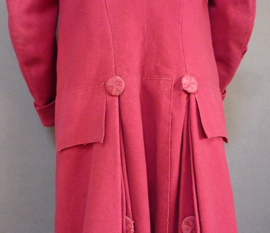
Detail, back pleats

Detail, back pleats

I swear I try to be positive about the mistakes I make. But not only did I discover this morning that I had lost my struggle with spacial processing, now I have found clear imagery to show how I should have handled the pleats on the Zombie Coat. Live, learn, unstitch and restitch: that’s all I can do. Now I have only to decide whether to do the unstitching this weekend, or next week. It will have to be done: now I know the way I’ve done it is wrong, and the master’s eye will be on that mistake and then he will know, and I will know that he knows, and it will just go on from there to tired shame.

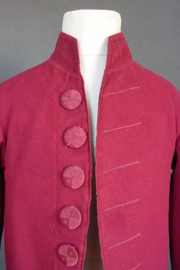
Man's wool  coat, 1770s. Meg Andrews.

Man’s wool coat, 1770s. Meg Andrews.

My favorite part of the description is this:

Either the coat was altered for another man or the wearer got fatter! … There is a half moon insertion under the arms… There’s no detail photo of that half-moon insertion, but I do so wish there was. The description notes additional changes: “If you look at one cuff you can see a lighter part of a button shape next to the seam. The cuffs have been removed and then added to the edge of the cuff to lengthen the sleeve.” At least we know garments in the past, even ones as lovely as this, were altered and changed.

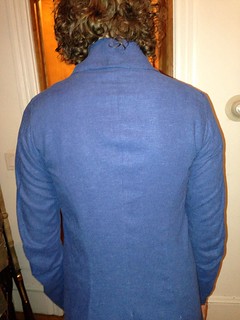
Puckering on the Zombie Coat. It’s still a nice blue, and you know what? It fits me, so maybe he’ll lose it to his refugee mother.

I will probably be inserting shapes of various kinds into the Zombie Coat, since I do now have a diagnosis for this puckering at the shoulder blades. “Viewed from the back and sides, it appears that the sleeve is binding on the front of his shoulder, causing pulling across the back shoulders – the puckers are caused by the stretching of the fabric across the rounding of the back and shoulders. If you make the top of the upper sleeve wider, or raise the shoulder cap it will create more fullness over the top of the sleeve and reduce the binding that is translating down the sleeve and across the back.”

By the time I make the changes I need to, the Zombie Coat will have acquired its own pre-history.

Share this:

  • Share on Facebook (Opens in new window) Facebook
  • Share on Pinterest (Opens in new window) Pinterest
  • Email a link to a friend (Opens in new window) Email
  • Share on X (Opens in new window) X
Like Loading...

One Hot Banyan

11 Thursday Jul 2013

Posted by kittycalash in Clothing, History, Museums

≈ 1 Comment

Tags

18th century clothes, Costume, exhibits, fashion, Museums, Research, resources

Prince of Wales' banyan, ca. 1780. Royal Pavilion & Museums, Brighton. ID CT002728

Prince of Wales’ banyan, ca. 1780. Royal Pavilion & Museums, Brighton. ID CT002728

Alert! This item is currently on display at the RISD Museum of Art in Providence, through August 18, 2013. I have been to see it twice now.

As much as I am itching to get this on a table and investigate it, I am limited to craning my neck and squatting in front of the case. Awesomeness in cotton, this banyan has a five-button mariner’s cuff with a double arc like a broken pediment on a chest-on-chest. It would be a crazy thing for a Continental private to come strolling out of a tent in, not to mention impossible to make before the next camping excursion, but holy cats! that’s one fine banyan.

The RISD Museum is free on Sundays. You, too, can entertain the guards by craning your neck–photography is not allowed. Next visit: sketchbook.

There are a lot of other wonderful things to see, too–silk jersey breeches I expect to see on a colleague at some point, an indigo silk frock coat, the greatest great coat ever, and Fred Astaire’s tails, as well as a small section that I think does everything PUNK wanted but failed to do.

Share this:

  • Share on Facebook (Opens in new window) Facebook
  • Share on Pinterest (Opens in new window) Pinterest
  • Email a link to a friend (Opens in new window) Email
  • Share on X (Opens in new window) X
Like Loading...

The Drowsy Dame

14 Tuesday May 2013

Posted by kittycalash in Clothing, History, Research

≈ 2 Comments

Tags

18th century, history, knitting, Research, resources

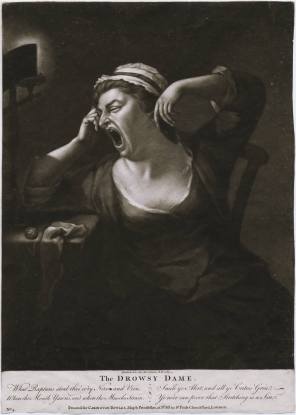
The Drowsy Dame, 1769. LWDL, 769.00.00.11+

The Drowsy Dame, 1769. LWDL, 769.00.00.11+

Like many people, I could sleep better. Lately, the middle-of-the-night waking has been caused by the Young Mr sneaking down the creaking stairs at 2:30, ostensibly to get a drink. Sounded more like a snack to me, but either way, I was awake at in the middle of the night and am yawning this morning.

The 18th century prints are full of domestic details not always found in formal portraits– and certainly this is  an image never to be found in a formal portrait. Prints gave artists a chance to play with light in a different way; lithographs, by their nature, allow this kind of chiaroscuro imagery and informality.

knittingNeedles 1768

On the table next to the “Drowsy Dame” is what really caught my eye: the stocking. This print, from 1769, goes very nicely withWm. and Joseph Russell’s ad in the Providence Gazette and Country Journal, 1768. That ad included knitting needles.

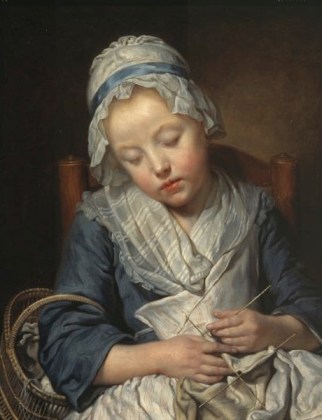
Young Knitter Asleep, Jean-Baptiste Greuze, ca. 1759. Huntington Museum, 78.20.8

Young Knitter Asleep, Jean-Baptiste Greuze, ca. 1759. Huntington Museum, 78.20.8

At this time, needles are slender steel rods, not bamboo or wood or anodized aluminum (or plastic) we use today. Hand knitting is done in the round, as you can see in the hands of this sleepy young knitter. (Is it the repetitive nature of stockings that lulls these knitters to sleep?) For more in historical knitting, there’s Colleen Humphrey’s blog, Mara Riley’s website, as well as English sources. It’s not my thing–I’m able, but like these women, I cannot finish a stocking, though there are plenty of published patterns.

Share this:

  • Share on Facebook (Opens in new window) Facebook
  • Share on Pinterest (Opens in new window) Pinterest
  • Email a link to a friend (Opens in new window) Email
  • Share on X (Opens in new window) X
Like Loading...
← Older posts
Newer posts →

Archives

wordpress statistics

Creative Commons License
Kitty Calash blog by Kirsten Hammerstrom is licensed under a Creative Commons Attribution-NonCommercial-ShareAlike 4.0 International License.

Website Built with WordPress.com.

  • Subscribe Subscribed
    • Kitty Calash
    • Join 621 other subscribers
    • Already have a WordPress.com account? Log in now.
    • Kitty Calash
    • Subscribe Subscribed
    • Sign up
    • Log in
    • Report this content
    • View site in Reader
    • Manage subscriptions
    • Collapse this bar
 

Loading Comments...
 

    %d