• Home
  • Completed Costumes/Impressions
  • Emma and Her Dresses
  • Free Patterns and Instructions

Kitty Calash

~ Confessions of a Known Bonnet-Wearer

Kitty Calash

Tag Archives: Revolutionary War

Now Left

13 Sunday Nov 2016

Posted by kittycalash in Events, History, Living History, Museums, Reenacting

≈ Comments Off on Now Left

Tags

authenticity, Fort Ticonderoga, living history, military events, progressive reenacting, Revolutionary War, women's history, women's work
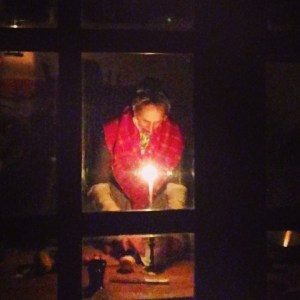
Through the barracks window on Friday night. Photo by Eliza West.

Through the barracks window on Friday night. Photo by Eliza West.

While for some events there are no second chances, Fitzgerald himself knew it wasn’t true that there are no acts in American lives.  And so it is with Fort Ticonderoga, changing hands several times throughout its existence, until British troops, retreating in 1777, did their best to raze the structure.

A day after participating in the “Now Left to their Own Defense” event at the Fort, I feel a bit destroyed myself, in the best possible way. (It isn’t history till it hurts, but sometimes cold nights on straw-filled ticks get into what’s left of my hip bones.)
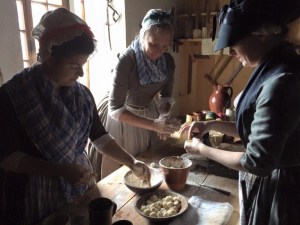
Women at work.

Women at work. Photo by M.S.

Every trip to Ti teaches me something new. This time, against all odds, it was cooking. Against all odds because I usually object to reinforcing gender norms at living history events, particularly in a military setting, when women did not typically cook for mens’ messes. Fort Ti is different: both times I have cooked there, it has been as part of the women’s mess.
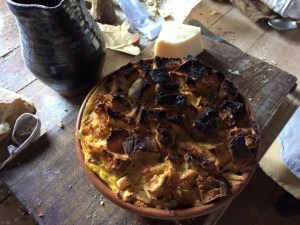
img_8435

Done! And no, it didn’t taste burnt. Photo by M.S.

This past Saturday, we may have gone a bit overboard, but we justified our efforts with the thought that Loyalist women would not only have used up all the supplies they could (waste not, want not) before retreating, but that they might also have striven for normal activity and to prove their worth to men whose protection they needed.

To that end, we made bread pudding. I’m a fan of Indian pudding and rice pudding, but I’ve never made a bread pudding, despite the similarity of these starch-and-custard concoctions. I like to think that rather than having reached a “throw reason and caution to the winds” point, I have, like any good 18th century cook, become comfortable enough not to rely on measuring cups but rather trust my eye and experience. Enablers help, of course, and I had the pleasure of spending my day with some of my favorites and meeting new ones, too.

Share this:

  • Click to share on Facebook (Opens in new window) Facebook
  • Click to share on Pinterest (Opens in new window) Pinterest
  • Click to email a link to a friend (Opens in new window) Email
  • Click to share on X (Opens in new window) X
Like Loading...

Indocent Exposure

28 Tuesday Jun 2016

Posted by kittycalash in Events, Fail, History, Living History, Reenacting, Thanks

≈ 2 Comments

Tags

18th century, authenticity, common people, common soldier, Events, interpretation, living history, New Jersey, Revolutionary War

IMG_7288 Or, Confusion into Confusion.

Docents and volunteers: the backbone of any non-profit organization, right?

Well…sort of. I’ve worked with docents for more than a decade, and along the way I’ve learned what does and doesn’t work. What does work is intensive engagement and participation, though the occasional shock to the system can be necessary and useful. For special events, though, and in cases of turf, diplomatic relations must be opened with the enemy early and often.

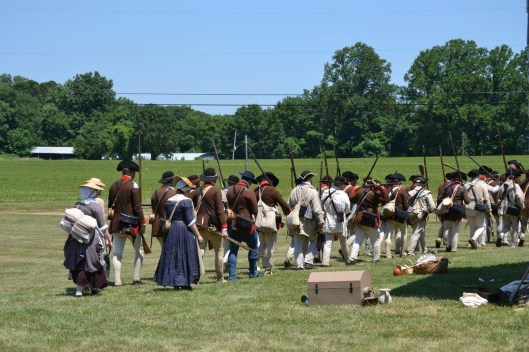
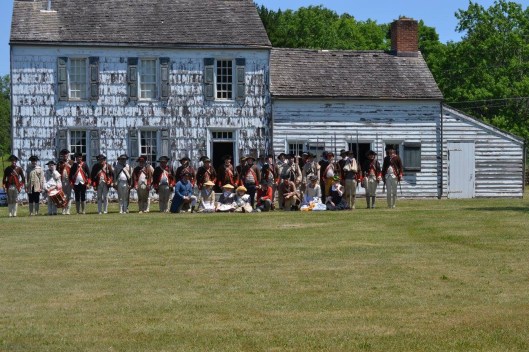
That is not to fault the organizers of the “Order Out of Confusion” event this past weekend, for I was one of the people organizing the civilian, non-marching end of things, and due to turbulence in my own life, I failed to plan adequately in the arena of Docent Relations.

IMG_7296

We had a Retaliator, a Pine Robber, a Quaker, and a Slave-Owning Patriot. We managed a debate or two over slavery. We begged people to take the Quaker home with them. But we did not occupy the house, for the house was occupied by red-shirted volunteers who gave at least some of us the five cent Condescension Tour punctuated with, “But I suppose you’re not interested in that.”

IMG_7298

Actually, that look was one of sheer disbelief, sir, at the farm implements in a bedroom, the tidy piles of perfectly formed ashen coals under the cookware in the fireplace, and the roomful of flax accented with a snake charmer’s basket. In my line of work, I enjoy house tours, but find they generally go better when tour guides don’t point out all the flaws to me. Complaining about the state (which owns the site) and onerous regulations that make repairs expensive will also increase my look of horror and disbelief. But really, if you want full-on horror, kindly inform the Quaker that Japanese POW camps “really weren’t that bad” because we are thriving on confusion today.

IMG_7297

The volunteers were thrilled by the marchers, and were clearly very positive about the event. They love Craig House, and the battlefield, but that sense of pride and ownership made it impossible for them to share the house with us, or to see us as anything but invaders– an Army of Occupation in our own right.

It’s my fault that I’m not an agile enough negotiator to convince recalcitrant octogenarians that my friends and I are safe to play with and will respect the house, and it’s my fault that I didn’t put in place all the lessons I’ve learned in the past decade. Then again, I don’t know that I would have had time to travel for meetings with the volunteers to generate buy in and support, given the maelstrom that was my life this past spring.

IMG_7289

But it’s a lesson well-learned: interpreters will read voraciously, acquire tons of material, and turn that research into appropriately-dressed characters making interpretive points, but unless you work with the site and its volunteers or staff to create agreement about presentation, you’ll get about half the value of the work you put into the planning.

Many heartfelt thanks to everyone who participated, and to the organizers for letting me try out my interpretive model. Next time, I know I have to work with the site staff and volunteers to make sure that execution matches vision.

Share this:

  • Click to share on Facebook (Opens in new window) Facebook
  • Click to share on Pinterest (Opens in new window) Pinterest
  • Click to email a link to a friend (Opens in new window) Email
  • Click to share on X (Opens in new window) X
Like Loading...

Free-for-All Friday

24 Friday Jun 2016

Posted by kittycalash in Events, History, Living History, Reenacting, Research

≈ Comments Off on Free-for-All Friday

Tags

18th century, authenticity, common people, interpretation, living history, Monmouth NJ, New Jersey, Quakers, Research, Revolutionary War

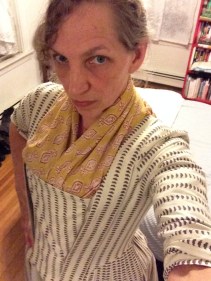
Well, at least I can dress myself.

Well, at least I can dress myself.

Most sadly, my obnoxious yellow gown will not be finished for this coming weekend, so I will not be flaunting my goods in such flashy clothing. Instead, I will be dressed like a giant version of the darling Miss B, whom I fear does wear the Space Invaders print better than I.

The real point, of course, is the action expected for Saturday, June 25, at the Craig House. The press release is fairly general about how we’ll be representin’ New Jersey’s 18th century civil war, and no one has leaped up to portray Little Anthony the [Quaker] Insurrectionist, but here’s the scene:

Craig House is empty the day of the battle. John Craig is with the Continental Army, leaving Ann Craig to flee with chattel, child, and two slaves in two wagons. This leaves the house and remaining property vulnerable to occupation and depredation.

An armed member of the Association for Retaliation is snooping around the Craig house and catches Loyalist and Quaker refugees who are squatting/hiding, as well as a “London” trader. He can’t let them go, and he is afraid to move them for fear of the British by day and the Tories by night. The Retaliator is joined by a local farmer who has stopped by to check on Mrs Craig’s safety in the surrounding commotion of the troops moving towards the coming battle. 

“Disaffected” smugglers use the chaos of the war in New Jersey to continue trading with the British and Loyalists. The “London trade” feeds the taste for tea, fabrics, rum, lemons, and sugar that even the Revolutionaries cannot shake.

Quakers are viewed with suspicion and animosity for their pacifist, anti-slavery views, which gives the impression that they are Loyalists. Harassed in Philadelphia by various committees requisitioning blankets and other goods; by 1778, the Quakers’ abolitionist views make them vastly unpopular in Monmouth County.

These characters in search of a plot will encounter each other at Craig House and, with some history improv, portray the tension and conflict between New Jersey residents in the Revolutionary period. Want to come out? Craig House is here, and a visitors’ guide is here.

Share this:

  • Click to share on Facebook (Opens in new window) Facebook
  • Click to share on Pinterest (Opens in new window) Pinterest
  • Click to email a link to a friend (Opens in new window) Email
  • Click to share on X (Opens in new window) X
Like Loading...

Civil War and Uncivilized War

07 Tuesday Jun 2016

Posted by kittycalash in Events, History, Living History, Reenacting, Research

≈ 1 Comment

Tags

18th century, common people, first person interpretation, historic houses, interpretation, Monmouth NJ, New Jersey, Revolutionary War

The Hunting Party- New Jersey. oil on canvas ca 1750. MMA 1979.299

The Hunting Party- New Jersey. oil on canvas ca 1750. MMA 1979.299

Slightly turbulent and busy days chez Calash have resulted in a lack of postings, but work proceeds: Genesee and then New Jersey lie ahead, with some extra-interesting interpretation at Monmouth in late June. For a time, I despaired of figuring out what to do to occupy the time and interpret what was essentially a civil war in Monmouth County. The Craig House, while interesting, is no longer a working farm, so we couldn’t farm a not-farm. Then there’s the tedious issue of the not-home not-farming Craigs: on the day of the battle, John Craig is with the Continental Army and Ann Craig has taken off with wagons of chattel, two slaves, and her child. This began to seem a lot like interpreting the John Brown House without John Brown: they are more present by their absence.

Full Sail off Sandy Hook- Entrance to New York Harbor. watercolor and gouache by Pavel Petrovich Svinin, MMA 42.95.2

Full Sail off Sandy Hook- Entrance to New York Harbor. watercolor and gouache by Pavel Petrovich Svinin, MMA 42.95.2

What to do? Read more, of course, and talk and talk and talk with Drunk Tailor, who discovered the Association for Retaliation (yes, exactly what it sounds like: vigilanteism) and the Pine Robbers. Much satisfaction there, and finally I listened when he said, “Why can’t we all be refugees?”

Sometimes, you just have to give in to reality. The “London trade” flourished between New York and New Jersey, Sandy Hook providing ready access to the city and Staten Island, where so many Loyalists fled the radical Whigs of New Jersey. Male slaves ran away to join the British army, and the most fearsome and feared in New Jersey was Colonel Tye. The Retaliators promised “a man for a man” for every depredation Whigs suffered, while a similarly-chartered Loyalist association promised the same in return. Chaos reigned and people of all kinds fled the civil war and the uncivilized war. It promises to be an interesting weekend.

Share this:

  • Click to share on Facebook (Opens in new window) Facebook
  • Click to share on Pinterest (Opens in new window) Pinterest
  • Click to email a link to a friend (Opens in new window) Email
  • Click to share on X (Opens in new window) X
Like Loading...

A Request from the Academie

18 Wednesday May 2016

Posted by kittycalash in Events, Living History, Reenacting, Research

≈ Comments Off on A Request from the Academie

Tags

18th century, authenticity, living history, Research, resources, Revolutionary War

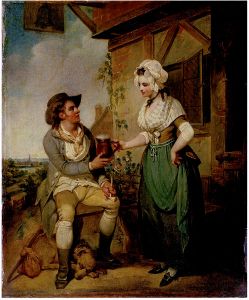
At the Inn Door, oil on canvas by Henry Singleton, ca. 1780, V&A Museum 1834-1900

At the Inn Door, oil on canvas by Henry Singleton, ca. 1780, V&A Museum 1834-1900

Gentle Readers, Living History Enthusiasts, and Rev War Junkies: Your assistance is requested. Mrs. Boice’s Historie Academie is looking for your input for future hands-on learning weekends.

There are some interesting topics in the list– brewing? I certainly enjoy the results of brewing. Dairying? I like cows and love the local dairy farm. Language and speech patterns? I could certainly do better. Professions? Hmmm….I’ve considered several. Much to love in this list, and I’m looking forward to learning more.

Go forth, and register your opinion.

Share this:

  • Click to share on Facebook (Opens in new window) Facebook
  • Click to share on Pinterest (Opens in new window) Pinterest
  • Click to email a link to a friend (Opens in new window) Email
  • Click to share on X (Opens in new window) X
Like Loading...
← Older posts
Newer posts →

Archives

wordpress statistics

Creative Commons License
Kitty Calash blog by Kirsten Hammerstrom is licensed under a Creative Commons Attribution-NonCommercial-ShareAlike 4.0 International License.

Website Built with WordPress.com.

  • Subscribe Subscribed
    • Kitty Calash
    • Join 621 other subscribers
    • Already have a WordPress.com account? Log in now.
    • Kitty Calash
    • Subscribe Subscribed
    • Sign up
    • Log in
    • Report this content
    • View site in Reader
    • Manage subscriptions
    • Collapse this bar
 

Loading Comments...
 

    %d