• Home
  • Completed Costumes/Impressions
  • Emma and Her Dresses
  • Free Patterns and Instructions

Kitty Calash

~ Confessions of a Known Bonnet-Wearer

Kitty Calash

Tag Archives: style

Pinner Aprons

23 Thursday Jan 2014

Posted by kittycalash in Clothing, History, Laundry, Making Things, Reenacting, Research

≈ 3 Comments

Tags

18th century clothes, apron, Clothing, common dress, Costume, fashion, laundry, Paul Sandby, pinner apron, style, watercolors

Mr & Mrs Thomas Sandby. Watercolor by Paul Sandby. RCIN 917875, Royal Collection Trust.

Mr & Mrs Thomas Sandby. Watercolor by Paul Sandby. RCIN 917875, Royal Collection Trust.

On Saturday, Sew 18th Century and I went out for lunch and fabric shopping. Along the way, I brought up pinner aprons, and that I’d seen them in British prints. She said, “You should blog about that!” and I went back to check my sources. Fail! There was an English print after a French original, and that doesn’t count!

So I shelved that idea, and went about looking for more Paul Sandby images of soldiers and maids and tents, and found instead Mr and Mrs Thomas Sandby. Ahem. Pinner apron alert.

Fluke, right? Well, no, not exactly.

Lady Chambers and child. Watercolor by Paul Sandby, RCIN 914409. Royal Collection Trust.

Lady Chambers and child. Watercolor by Paul Sandby, RCIN 914409. Royal Collection Trust.

Because here is Lady Chambers and child, with Lady Chambers in a pinner apron.

The thing to note, though, is that “apron” here is a decorative, almost ceremonial garment made of black silk, while the maid engaged in Domestick Employment is wearing a working garment of [probably white] linen.
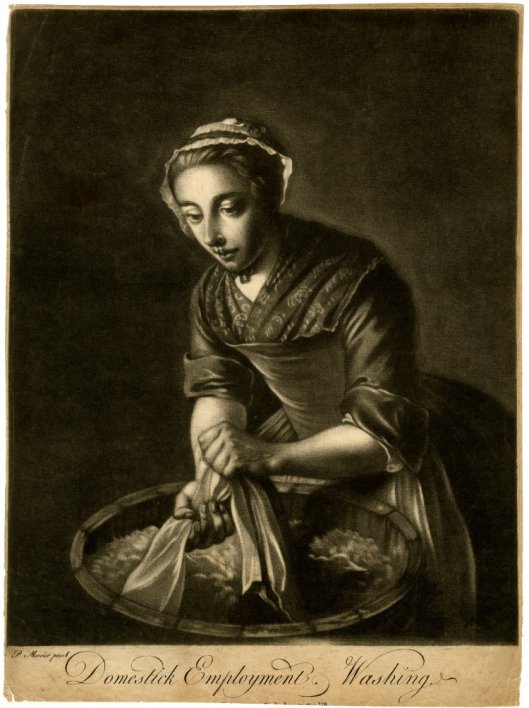
Domestick employment, washing. Mezzotint by Richard Houston after Phillipe Mercier, 1736-1775. British Museum 1876,0708.23

Domestick employment, washing. Mezzotint by Richard Houston after Phillipe Mercier, 1736-1775. British Museum 1876,0708.23

Well, can I wear a pinner apron as a Continental army laundress or not? Probably not, though I will be going back through all the images of laundering I can find. It would be so useful and protective a garment!

No, instead, it looks as if the black silk pinner apron was a fashion adopted by the British upper class probably in imitation of the aprons worn by young girls. These fleeting, black silk accessories were probably adapted to some other use when the fashion had fallen from favor. (You could make a lot of mitts out of one of those.) Sadly, I don’t care enough about the elite to go chasing inventories and more images, but someone else can. I think I have seen a few other examples of this style, but cannot immediately place them. My sense is that these are not common.

I’m much more interested in laundresses and maids. Doesn’t she look sassy? We could call her Bridget. 

A country girl, full-length, facing front, leaning against a fence & a tree. Watercolor by Paul Sandby. RCIN 914438. Royal Collection Trust

A country girl, full-length, facing front, leaning against a fence & a tree. Watercolor by Paul Sandby. RCIN 914438. Royal Collection Trust

Share this:

  • Share on Facebook (Opens in new window) Facebook
  • Share on Pinterest (Opens in new window) Pinterest
  • Email a link to a friend (Opens in new window) Email
  • Share on X (Opens in new window) X
Like Loading...

At the sales this month…

14 Tuesday Jan 2014

Posted by kittycalash in Art Rant, History, Research

≈ 4 Comments

Tags

18th century clothes, 18th century clothing, art history, auctions, fashion, jewelry, portraits, Sotheby's, style

It’s auction season in antiques land, and the catalogs arrived at work smelling of money and expensive ink. Sotheby’s Folk Art and Americana sales offer some lovely pieces  at the end of this month.

From the Folk Art sale, Mr and Mrs (maybe) Fitzhugh Greene of (maybe) Newport, RI.

Lot 606 from Sotheby's sale N09106 "Esmerian"

Lot 606 from Sotheby’s sale N09106 “Esmerian”

Pretty sweet stuff, right? With an estimate of $400,000-600,000, chances are good that these aren’t headed for public display, so enjoy them now.

Mrs (maybe) Fitzhugh Greene

Mrs (maybe) Fitzhugh Greene

Mrs (maybe) Greene is a pretty fantastic painting, even if John Durand lacked the grace and skill of Copley or Feke. There is an airless quality to these paintings, though the details are fine and the contrast between the husband and wife in presentation is delightful. My favorite line of the catalogue entry is the final one: “When juxtaposed to the drab coloring of her husband’s portrait, Mrs. Greene can clearly be perceived as his adornment, a fertile beauty in the flush of womanhood.”

Egads, right? I suppose she could be, but I also suppose she could be a fine way to flaunt his wealth and success while he projects fiscal and mercantile stability and restraint. Without a solid link to actual people (and there isn’t) it could be that more is happening in these paintings than the woman serving as the man’s adornment. If you read the footnotes, you’ll see that the attribution to Newport is slim (it’s a story without a real source). If a Mr and Mrs Fitzhugh Greene lived in Newport in the 1760s and 1770s, they’re not buried in RI. They could be Loyalists who fled– auction catalogs are a fiction writers dream of inspiration– but so far, no solid evidence links these portraits to Rhode Island.

In terms of documenting a man and a woman of substance in 18th century America, or the material aspirations of those men and women, these portraits are interesting whether the clothes and jewelry Mrs (maybe) Greene is wearing are real or not. Because they could be fabrications.

Mr (maybe) Greene

Mr (maybe) Greene

Mr (maybe) Greene is firmly real. The frock coat, waistcoat and breeches are all presumably made of the same fine brown wool broadcloth, worn with a fine white linen shirt and stock adorned with lace. The buttons are interesting, and neither the zoom nor my nose pressed to the catalog page clearly reveal the pattern. They look like pretty standard issue death’s head buttons, except when one looks like it might be more like a dorset pattern, or the one that looks floral. These will be on display in New York if one has the chance, which I will not.

There are pendant portraits like these in museum collections that show a man and his sister. It is possible that what Sotheby’s is offering for sale is a pair like that: a man and his highly eligible sister, not a man and his wife.

Share this:

  • Share on Facebook (Opens in new window) Facebook
  • Share on Pinterest (Opens in new window) Pinterest
  • Email a link to a friend (Opens in new window) Email
  • Share on X (Opens in new window) X
Like Loading...

A Cloak for the Cold

04 Saturday Jan 2014

Posted by kittycalash in Clothing, Living History, Making Things

≈ 4 Comments

Tags

18th century clothes, 18th century clothing, cloak, common dress, fashion, living history, Rhode Island, sewing, short cloak, style, winter, wool

January 11

January 11, 1777. Providence Gazette

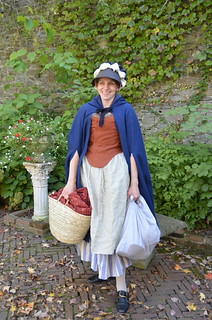
We’ve had a bit of snow and cold, which kept me at home (when there’s a parking ban, most businesses have to close, as most parking is on the street here). We have plans in another century this evening, so I thought a second cloak would be in order. The first cloak I made was based on one in the collection at work as well as on a Rhode Island runaway advertisement.

Long blue cloak, in 2012

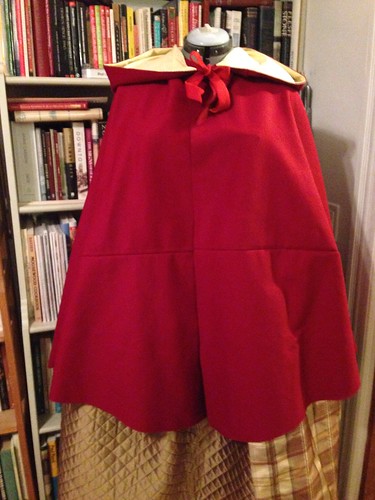
Although I’m not displeased with the cloak, the length can be annoying and I knew that the blue cloak for a runaway was not what I wanted to wear with the sacque. So I sacrificed some yardage from the Strategic Fabric Reserve, read up on cloaks, and got out my scissors. A cloak is a fairly simple thing to make, so I don’t know why it took all day, beyond getting distracted, making dinner, shoveling, re-learning high school geometry, and trying to do a very careful job.

Hood, with lining, pinned to the body of the cloak

Because I’m tall and have long arms, I made the new cloak a little longer than I would have for a true short cloak: it is easier to trim than to add, though this is pieced on the fronts and on the hood and on the hood lining.

Pieced across the front.

The front piecing is more noticeable than I really like, but that’s how this came out and how cloaks often work out. I won’t really care, as long as I am warm and able to move my arms. When it’s really cold, as it is today, I can wear both red and the blue cloaks with a wool gown and petticoats and wool kerchief. Or perhaps I should just wear a sheep.

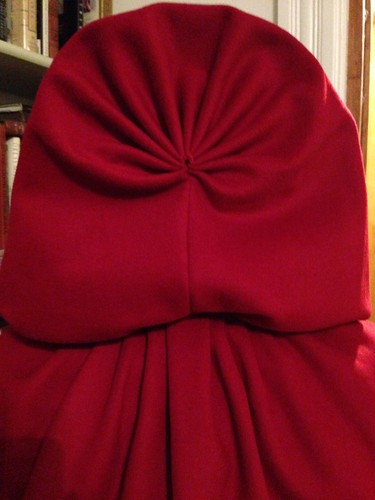
Back pleats. By a third cloak, I might get them really right.

I found the trick to getting the pleats/gathers on the hood to flip correctly was to work from the outside, or right side, once the back seam had been sewn up partway. It took three tries to figure that out, but somehow working the pleats/gathers from the right side worked. I did backstitch the pleats/gathers on the inside to hold them in place.

Inside the hood. with lining in place.

In all, this took less than a yard of yellow silk Persian, about half a yard of red wool twill tape, and two yards of crimson broadcloth, all from Wm Booth, and all but the Persian purchased as remnants. There’s a fair amount of broadcloth left, so a yard and a half with aggressive piecing might work, especially if you want a shorter cloak, and are not as tall as I am.

Share this:

  • Share on Facebook (Opens in new window) Facebook
  • Share on Pinterest (Opens in new window) Pinterest
  • Email a link to a friend (Opens in new window) Email
  • Share on X (Opens in new window) X
Like Loading...

So Hip

02 Thursday Jan 2014

Posted by kittycalash in A Silk Sacque, Clothing, Making Things, Reenacting

≈ 5 Comments

Tags

10th Massachusetts, 18th century clothes, 18th century clothing, Costume, fashion, patterns, questioning my sanity, sacque, sewing, silk taffeta, style

I don’t always feel the need to enhance my anatomy; in fact, I rarely do, but then I started on the sacque. Ah, the sacque. I nearly abandoned the whole business but then I thought I’d look pretty silly dressed as the maid, or for George Washington’s funeral instead of his birthday party.[1]

I also don’t want to have a house littered with UFOs, because that is what my knitting stash is for. In order for the sacque to look right, I need hips. HIPS.

And while I planned to make panniers AKA pocket hoops, a simpler and easier solution occurred to me. Hip pads: I’d seen them on Sharon’s site and thought I could at least try a pair. They’d help my poor fake quilted petticoat (FQP, long story[2]), which will come in handy for a party in February. So I spent my New Year’s Day making hips and playing a bit with the sacque silk.

Half hipped, or me, right after my hip replacement.
Whole hipped: symmetrical, and wide.

To make the hips, I started out by laying a piece of muslin against Cassandra, and tracing a waist arc. I worked between the muslin and paper to create a paper pattern, and then made up a muslin, which I filled with polyester stuffing and then tested under the FQP. Better, no?

Then I added the seam allowance to the paper pattern (which you can download here and print at 100% if you have a waist in the 30 inch range and want enormous hips yourself) and cut four more of linen.

After three episodes of Death Comes to Pemberly[3], I had hips. They weren’t quite the same size, but my right hip is larger or higher or something, so I put the smaller one on the right and the larger on the left to balance my own deficiencies.

The alteration to the silhouette is pretty amazing, though Mr S did laugh. Perhaps this figure is an acquired taste.


[1] All I have right now to wear with the Celebration Spencer is a black petticoat, so I’d be rocking the 1799 George-is-Dead look.

[2] The story is that I have a real one basted onto a frame but I cannot fit both the frame and a sofa in the apartment. We chose sofa. I am sad but comfy.

[3] I’m ambivalent. Though I do love Trevor Eve, I wondered why there was not more changing of dress for various times of day

Share this:

  • Share on Facebook (Opens in new window) Facebook
  • Share on Pinterest (Opens in new window) Pinterest
  • Email a link to a friend (Opens in new window) Email
  • Share on X (Opens in new window) X
Like Loading...

HSF # 26: Celebration Spencer

30 Monday Dec 2013

Posted by kittycalash in Clothing, Historical Sew Fortnightly, Making Things, Research

≈ 8 Comments

Tags

18th century clothing, dress, fashion, Historical Sew Fortnightly, patterns, Research, Spencer, style, wool

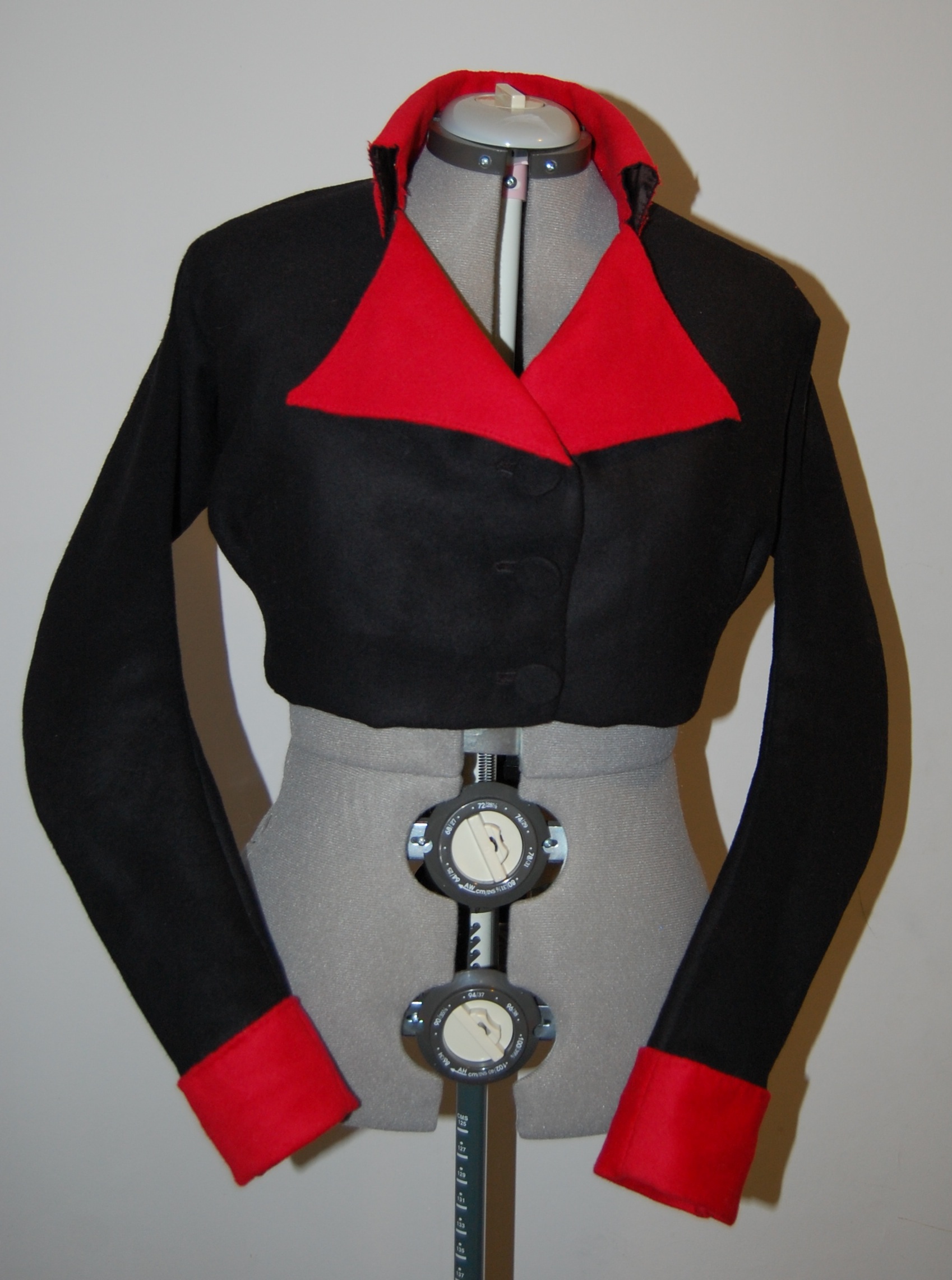
Cassandra in her new Spender.

Cassandra in her new Spencer.

This was supposed to be for #25: One Metre (yard) but things went awry. now it’s cause or #26, Celebration.

Make something that is celebration worthy, make something that celebrates the new skills you have learned this year, or just make something simple that celebrates the fact that you survived HSF ’13!

Heck, I survived the last two weeks of 2013, and that’s reason enough to celebrate. Water at work, relatives at home, high-stress holidays: if you can’t say anything nice, don’t say anything. So on to those pesky facts!

The Challenge: #26, Celebration! with a backward glance at #25, One Metre

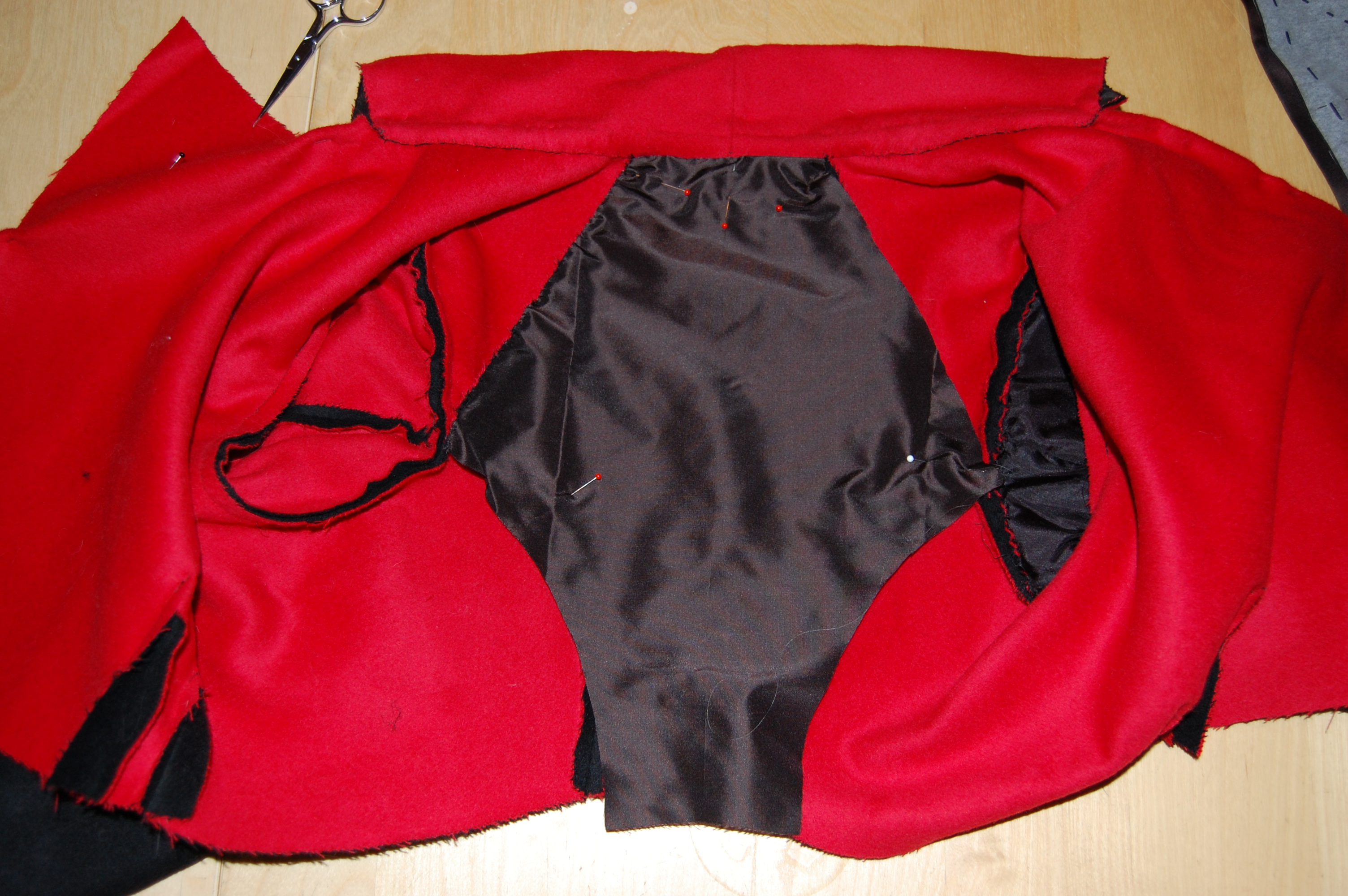
Fabric: 34 inches of double-faced Italian wool, bought at Apple Annie Fabrics as a 50% off remnant after she found it in a pile. The collar is lined with black silk taffeta and interfaced with buckram. The sleeves are lined with black silk Persian from Wm Booth Draper, but I used taffeta on the bodice to give it more body. Technically, that’s almost two yards because it’s two kinds of fabric. Initially I didn’t plan to line this, but the edge did not hold as well as expected so I ended up breaking the rules in order to make a better garment. Celebrate rule breaking! Also, better sewing skills!

The pattern pieces on 34 inches of fabric. One cuff is pieced.

Pattern: My own, mostly. I started with the Sense & Sensibility pattern, and then modified it to make the first Spencer, working my way towards the double-breasted broadcloth of the Swedish Spencer. I first modified the lapels, and then, in order to match the arm scye to the sleeve correctly, modified the bodice at the side, and at the shoulder point. I used the Janet Arnold Spencer/riding habit as a reference, and then measured up the Leloir pattern to check my work. The two-part sleeves are borrowed from Henry Cooke’s 1770s man’s frock coat pattern taken from that extant suit; the collar and cuffs came from the same place.

Once I reshaped the sleeves from the elbow to the wrist (as I do not have a gentleman’s forearms of steel), I concentrated on adapting the bodice to make the seam sit properly on the shoulder line. Watching Mr Cooke manipulate Mr S’s garments made this a lot easier to do.

Inside view in progress.

Inside view in progress.

My theory was that if you thought of a Spencer as a miniature frock coat, starting with a man’s pattern might be the way to go. I played with that in a theoretical way, but did not pursue it fully, as I was committed to the double-breasted look.

Year: 1797, if you take the Amazon as the inspiration and marker, which I do. This style, and even the revers, persists for a while, at least in fashion plates. 1797-1800 seems about right. (See the expanded Pinterest board for examples)

Notions: Thread counts, right? Also button molds. But that was it.

How historically accurate is it? This is always the toughest part! I have verified the revers, the style, the fit, and the pattern pieces. The garment is entirely hand-sewn of the most period-appropriate materials I could find. I found reference to a very similar example in a Danish museum; if I had possessed enough fabric for a cape, I would have made one. The inaccuracies will be in details of techniques and the lining materials, which were chosen to ameliorate the very snug fit. Is it 90%, with points off for not being able to time-travel back to buy my fabrics from Providence merchants in 1797? Aside from the Andes Candies coat, I think this is the most accurate and nicest thing I’ve made yet.

The shaped back piece.

The shaped back piece.

Hours to complete: 12 to 18 for the pattern and muslins. Each sleeve took 30 minutes to pin and stitch into the armscye, but the long seams were more time consuming. 12 hours of sewing, perhaps? It seems like more than 30 hours, but once the pattern was done, parts of this moved quickly. (Personally, I love setting sleeves and sewing curvy back pieces.)

First worn: Not yet. As soon as I can talk Mr S into taking photos, I’ll wear it, but right now I have no firm plans for wearing it, which makes me sad. Wouldn’t it be a fun thing to ice skate in? Except for the very authentic way it pulls your shoulders back, which could compromise your balance.

Total cost: $15 for the wool, $6.50 for thread, and $2.80 for button molds; $8 for the amount of silk Persian for the sleeves, the taffeta was in the stash, so $24.30.

Share this:

  • Share on Facebook (Opens in new window) Facebook
  • Share on Pinterest (Opens in new window) Pinterest
  • Email a link to a friend (Opens in new window) Email
  • Share on X (Opens in new window) X
Like Loading...
← Older posts
Newer posts →

Archives

wordpress statistics

Creative Commons License
Kitty Calash blog by Kirsten Hammerstrom is licensed under a Creative Commons Attribution-NonCommercial-ShareAlike 4.0 International License.

Website Built with WordPress.com.

  • Subscribe Subscribed
    • Kitty Calash
    • Join 621 other subscribers
    • Already have a WordPress.com account? Log in now.
    • Kitty Calash
    • Subscribe Subscribed
    • Sign up
    • Log in
    • Report this content
    • View site in Reader
    • Manage subscriptions
    • Collapse this bar
 

Loading Comments...
 

    %d