• Home
  • Completed Costumes/Impressions
  • Emma and Her Dresses
  • Free Patterns and Instructions

Kitty Calash

~ Confessions of a Known Bonnet-Wearer

Kitty Calash

Tag Archives: style

Cold Comfort Compromises

09 Monday Nov 2015

Posted by kittycalash in Clothing, Events, History, Living History, Making Things, Reenacting, Snark

≈ 6 Comments

Tags

18th century clothes, 18th century clothing, authenticity, fashion, living history, sewing, style
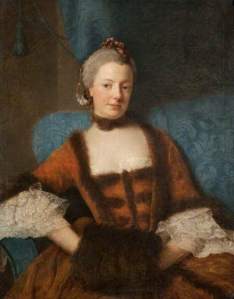
"Henrietta Diana, Dowager Countess of Stafford", Allan Ramsay, 1759; Glasgow Museums 3026 (c) Glasgow Museums; Supplied by The Public Catalogue Foundation

Henrietta Diana, Dowager Countess of Stafford, Allan Ramsay, 1759(c) Glasgow Museums. Fur: cozy, but not for me. Also too early.

Winter is bearing down upon us, and while I was not in Connecticut last weekend, nor will I be in New Jersey two weekends hence, I do have winter history plans, barring the proverbial 50 feet of snow, which even a Subaru cannot handle. The Noble Train: I could not resist, for, as regular readers know, I prefer my history to hurt.

Still, I try to avoid cold-related illness and extreme discomfort, so I’m making sensible preparations. Of course, I have not finished my quilted petticoat, and lack the time to make a proper hand-quilted silk under-waistcoat. Reader, I have done a terrible thing: I have compromised.

The saddest part of all of this is that the waistcoat I’m making is the most feminine and luxurious item, and the only item even close to lingerie (aside from shifts) that I have ever made myself, or even own, no matter its inaccuracies. There is a kind of irony built into this project, hence a post while the irony is hot.
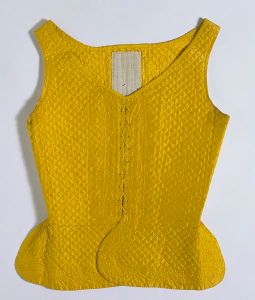
Waistcoat. Silk quilted and bound with silk grosgrain ribbon. ca. 1745. V&A Museum, T.87-1978

Waistcoat. Silk quilted and bound with silk grosgrain ribbon. ca. 1745. V&A Museum, T.87-1978

The waistcoat: an item of occasional debate, these are not the most common beast in museum collections. Fortunately, Sharon Burnston has a handy article and pattern posted on her website. To be clear, I am not recreating the Atwater-Kent waistcoat. I am cobbling together my own inappropriate but satisfying item. I am also using the absolutely inexcusable excuse that no one will see this garment, as well as previous bouts of pleurisy after long, cold events in stays when I had the merest hint of a cold. (My boss kindly offered to cup me for a cure when I had to take time off work, but I declined. The look on her face suggested a lack of appreciation for my historic ailment.)

But here we are, “confessions of a known bonnet-wearer” and all that, so onward to the project. I started with Sharon Burnston’s scaled diagram of the Atwater-Kent woman’s waistcoat. The shapes are very similar to a basic woman’s jacket of the period, bonus: loose fitting, no sleeves. It was easy enough to pattern up in an afternoon, with limited fitting (I did test it over stays, just in case.)

overview

The compromises I made are in the materials: pre-quilted silk (with a cotton backing), lined with wool-cashmere, and bound in silk grosgrain ribbon. The size of the diamonds and the machine quilting, plus the wool lining, make this an inauthentic, inaccurate garment. The shape, construction, and binding are at least correct, as far as they go. But the lusciousness of that remnant table cashmere and the soft colors please me immensely, and I do expect to be warm.

corner

This has been a quick project, with the majority of time spent on the binding. As in the Atwater-Kent waistcoat, I’m top stitching with a running stitch on the inside, folding the ribbon over, and hem stitching on the outside.

Will this feel like a hair shirt of shame under my gown, compromise as it is? Maybe, but at least it’s cashmere.
Share this:

  • Click to share on Facebook (Opens in new window) Facebook
  • Click to share on Pinterest (Opens in new window) Pinterest
  • Click to email a link to a friend (Opens in new window) Email
  • Click to share on X (Opens in new window) X
Like Loading...

Frivolous Friday: Festive but Frigid

31 Friday Jul 2015

Posted by kittycalash in 1830s, Clothing, Events, Frivolous Friday

≈ 1 Comment

Tags

1833, 19th century, 19th century clothing, Clothing, common dress, common people, Costume, fashion, Federal style, Reenacting, Sleigh Ride, style, William Sidney Mount

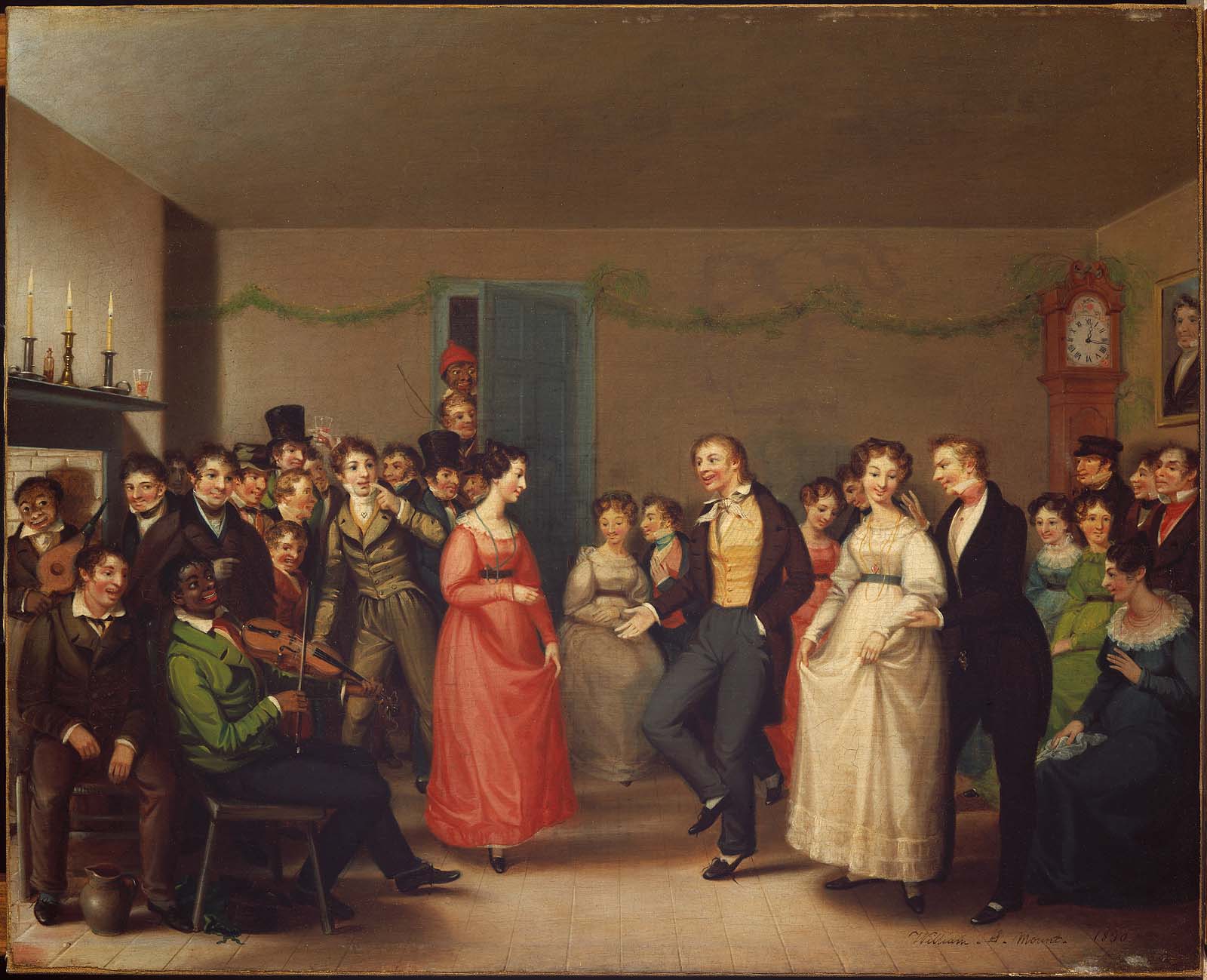
Rustic Dance After a Sleigh Ride, 1830. William Sidney Mount MFA Boston 48.458

Rustic Dance After a Sleigh Ride, 1830.
William Sidney Mount MFA Boston 48.458

I don’t know about your weather, but we’re in full summer in New England, sultry and humid, with the occasional thunderstorm and power outage to enliven the evening. A sleigh ride sounds like fun today– and I know we all just finished complaining about the snow of February– but a brisk ride followed by a dance would certainly round out this week.

1833 approaches faster than expected, so it’s time to pick that back up and get serious. Not just a gown but petticoats and, ideally, a new shift should be made. This may be the project that breaks my resolve and finds the Bernina back on my table for cording a petticoat.

Detail, Rustic Dance After a Sleigh Ride, 1830. William Sidney Mount. MFA Boston 48.458

Detail, Rustic Dance After a Sleigh Ride, 1830. William Sidney Mount. MFA Boston 48.458

This image helps define the look of the early 1830s: not nearly as exaggerated as the fashion plates, these dresses and coats seem to fall into a progression from the 1820s– as you’d expect this early in the decade.

The gentleman at the back, in the drab colored suit, sports an interesting pair of trousers. I don’t think I know anyone ready to bust out the cossacks, but Mr Drab may be sporting a slightly modified pair. The collars and lapels show a shawl-shape that seems new, and modified from the more serpentine form seen in fashion plates– or else not yet as developed. There’s a range of headwear, too: tall hats on the left, a soft cap on the right. The Ladies’ Workbook has a pattern for one of those caps. Wonder how hard they are to make?

Detail, Rustic Dance After a Sleigh Ride, 1830. William Sidney Mount. MFA Boston, 48.458

Detail, Rustic Dance After a Sleigh Ride, 1830. William Sidney Mount. MFA Boston, 48.458

In the detail, we can also see the women’s hairstyles, less exaggerated than the fashion plates with their high top knots, and within the realm of possibility for those of us not practiced in historical hairstyle recreation.

So much has carried into this decade: colored neck wear, ruffles or chemisettes under women’s gowns, men’s hair brushed forward. As always, it’s the details that count. Tall shirt collars, rounded lapels, ladies’ sashes, the shape of sleeves. This should be a fun decade to represent.

Share this:

  • Click to share on Facebook (Opens in new window) Facebook
  • Click to share on Pinterest (Opens in new window) Pinterest
  • Click to email a link to a friend (Opens in new window) Email
  • Click to share on X (Opens in new window) X
Like Loading...

Mind the Gap, or, The Basket Case

22 Wednesday Jul 2015

Posted by kittycalash in Clothing, Events, History, Living History, Philosophy, Reenacting, Research

≈ 5 Comments

Tags

18th century, authenticity, common people, fashion, historical reenactors, interpretation, living history, lower, philosophy, Reenacting, style

I was in the midst of planning yet another maid’s dress (some of us have all the luck) when a friend alerted me to an online discussion that drew from my recent post on baskets. The comments — which I skimmed but twice– made me think about philosophy and intent.

Engraved by John Raphael Smith, 1752–1812, British, A Lady and Her Children Relieving a Cottager, 1784, Mezzotint and line engraving on medium, slightly textured, cream laid paper, Yale Center for British Art, Paul Mellon Collection

Engraved by John Raphael Smith, 1752–1812, British, A Lady and Her Children Relieving a Cottager, 1784, Mezzotint and line engraving on medium, slightly textured, cream laid paper, Yale Center for British Art, Paul Mellon Collection

There are two approaches to developing a living history persona and appearance I’ll consider here: one prescriptive, and one not. The prescriptive, didactic approach tells you what to wear and carry. Some folks like that. It is completely correct in some cases: soldiers, for example. You want to fall in with a unit of Light Infantry in 1777, it’s generally more convincing if you don’t wear the 1781 coat. Not everyone cares: some people will keep on wearing the Brighty Whitey Hunting Frocks and 1780 coats at reenactments commemorating events of 1776. Those folks can no longer be reached by prescriptive standards, and my preferred approach probably won’t reach them either.

Joshua Cristall, 1768–1847, British, Young Woodcutter, 1818, Watercolor with scraping over graphite on moderately thick, slightly textured, beige wove paper, laid on thick, slightly textured, beige card, Yale Center for British Art, Paul Mellon Collection

Joshua Cristall, 1768–1847, British, Young Woodcutter, 1818, Watercolor with scraping over graphite on moderately thick, slightly textured, beige wove paper, laid on thick, slightly textured, beige card, Yale Center for British Art, Paul Mellon Collection

Mindful reenacting or living history sounds pretty nutty, but that’s what I would encourage. Thoughtfulness. Consideration. Not just the what, but the why. Why you wear or carry something can be as important and interesting as what you’re wearing and you’ll be all the more convincing for thinking it through. Thinking, not rationalizing. How appropriate is it to be in your best clothes carrying a basket also used to carry fire wood? You have to answer that for yourself, and if you’re doing it right, the answer will not always be the same– nor will the question!

Print made by James Bretherton, ca. 1730–1806, British, A Maid, 1774, Etching on moderately thick, rough, blued white laid paper, Yale Center for British Art, Paul Mellon Collection

Print made by James Bretherton, ca. 1730–1806, British, A Maid, 1774, Etching on moderately thick, rough, blued white laid paper, Yale Center for British Art, Paul Mellon Collection

This isn’t the easiest way to go about anything, asking all these questions, but for some of us, the experiences make it worthwhile. You won’t always be able to do, carry, or wear what you want.* But the picture you create of the past will be more accurate and more engaging if you think more and justify less.

Look, I threw down about that floppy bird basket, but I have to provide food to troops this Saturday in Cambridge. What the heck will I carry it in? What will I take my sewing in?**

Probably a wallet and a bag, unless I can pack that floppy basket convincingly– it is entirely suitable to my lower sorts-stained gown impression– but if I can’t, I won’t take it. And that’s just one less thing to carry.

*I’m pretty much always the maid to make scenarios work, and while it doesn’t come naturally, art imitates life.

**Prays no one gets the bright idea to bring (shhh) tents to work on.

Share this:

  • Click to share on Facebook (Opens in new window) Facebook
  • Click to share on Pinterest (Opens in new window) Pinterest
  • Click to email a link to a friend (Opens in new window) Email
  • Click to share on X (Opens in new window) X
Like Loading...

Itching for Style

09 Thursday Jul 2015

Posted by kittycalash in 1830s, Clothing, Living History, Reenacting, Research

≈ 3 Comments

Tags

10th Massachusetts, 19th century, 19th century clothing, authenticity, common dress, Costume, fashion, living history, style

Dress Date: 1830s Culture: American Medium: wool Dimensions: Length at CB: 53 1/2 in. (135.9 cm) Credit Line: Gift of John Eastman and Gerard L. Eastman, 1976 Accession Number: 1976.209.2

Dress, 1830s. American, wool.
Gift of John Eastman and Gerard L. Eastman, 1976.209.2 Metropolitan Museum of Art

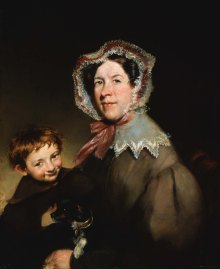
Wool. It’s a thing. This dress from the Met has many of the markers of everyday fashion– a vernacular form, if you will, of what Deliverance Mapes Waldo is wearing in this portrait

Deliverance Mapes Waldo and Her Son about 1830 Samuel Lovett Waldo (American, 1783–1861 American) DIMENSIONS 77.15 x 64.45 cm (30 3/8 x 25 3/8 in.) ACCESSION NUMBER 45.891 MFA Boston

Deliverance Mapes Waldo and Her Son, about 1830
Samuel Lovett Waldo. 45.891 MFA Boston

Of course, dating these things is never a science when they don’t come with a clearly labeled tag you can affirm with research. The extant garment first. The sleeves say 1820s, the waistline says 1830s. Could it be 1840s? Perhaps. Without provenance, it’s really hard to know.

Mrs Waldo’s sleeves are clearly 1830s sleeves: full on gigot, sloped shoulder. It’s the contrast between her sleeves and the Met’s dress that makes me question their date (along with the fashion plates we saw yesterday).

Here’s a wool gown from England, land of the fabulous wools.

Dress, England, Great Britain.  1836-1838. Printed wool, trimmed with printed wool, lined with cotton, hand-sewn Given by Mrs H. M. Shepherd, T.11-1935. Victoria & Albert Museum.

Dress, England, Great Britain. 1836-1838.
Printed wool, trimmed with printed wool, lined with cotton, hand-sewn
Given by Mrs H. M. Shepherd, T.11-1935. Victoria & Albert Museum.

Here the sleeves are starting to be narrowed at the shoulder, taming the gigot. That places this 1836 or later, which is helpful. The bodice style is still not the pleated or smocked front of the 1840s, so that’s another marker for mid-to-late 1830s.

What will I do? I don’t know. I’ve ordered two patterns (and one for a new chemise, sigh). The Past Patterns Lowell Mill Girl dress appears to make up quite nicely, but I also ordered the Wisconsin Historical Society pattern for comparison. (Hey, when you can’t examine originals, you have to use the patterns.) Fabric is always a question, but if I’m feeling plain wool, there’s always Burnley & Trowbridge’s “Virginia Cloth.” I’ve worked with it before, so I know how it handles, and while the color looks itchy, it’s actually pretty soft.

Share this:

  • Click to share on Facebook (Opens in new window) Facebook
  • Click to share on Pinterest (Opens in new window) Pinterest
  • Click to email a link to a friend (Opens in new window) Email
  • Click to share on X (Opens in new window) X
Like Loading...

Gigot or Gigantic?

08 Wednesday Jul 2015

Posted by kittycalash in Clothing, Events, Living History, Making Things, Research

≈ 6 Comments

Tags

10th Massachusetts, 1833, 19th century, 19th century clothing, authenticity, Clothing, common dress, fashion, fashion plates, living history, Making Things, style

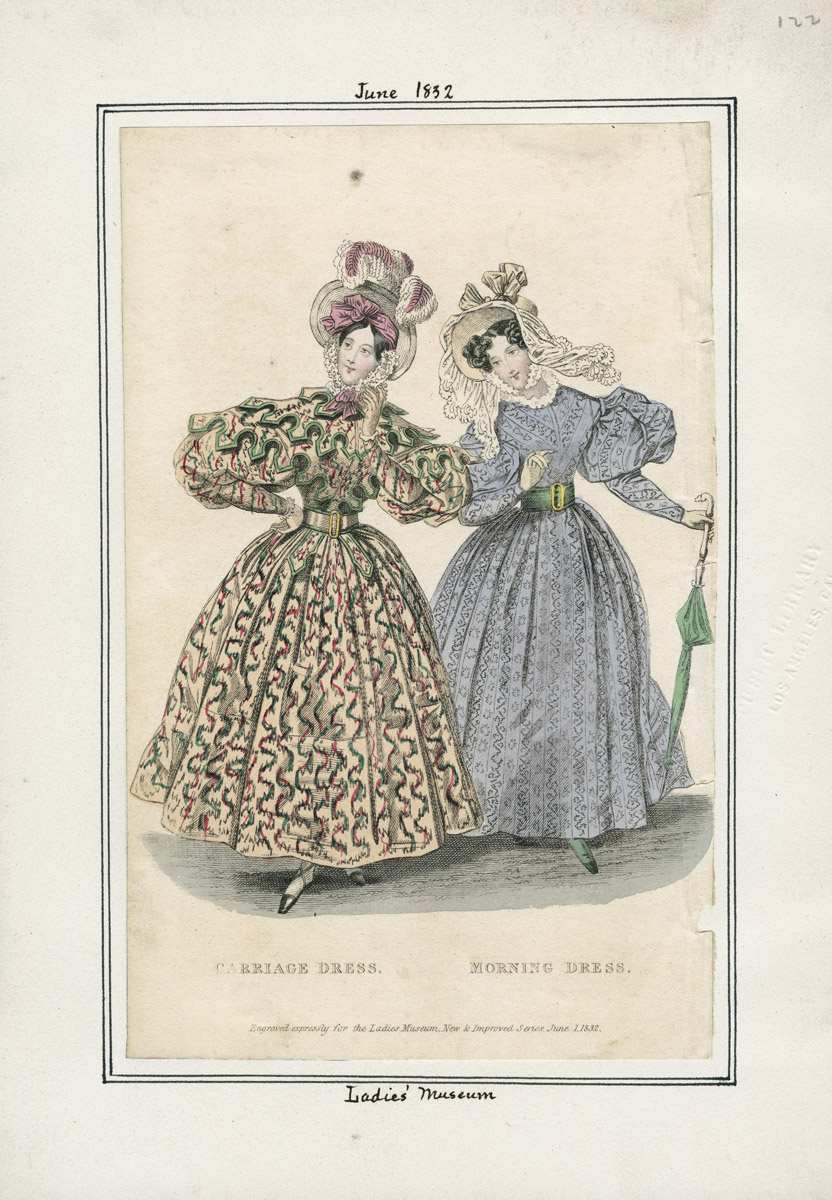
Carriage and Morning Dress, 1832. LAPL Fashion Plate Collection

Carriage and Morning Dress, 1832. LAPL Fashion Plate Collection

So, about that 1833 thing…

No, it’s not that I’m reconsidering. It is merely that as I consider the options, the fashion plates are a bit overwhelming. On the other hand, I am getting really good at recognizing the look of the 1830s in undated portraits. There’s an upside to everything.

Extant garments are fairly plentiful in the Usual Suspects’ Collections; there’s even a Tumblr. There’s a Tumblr for everything.

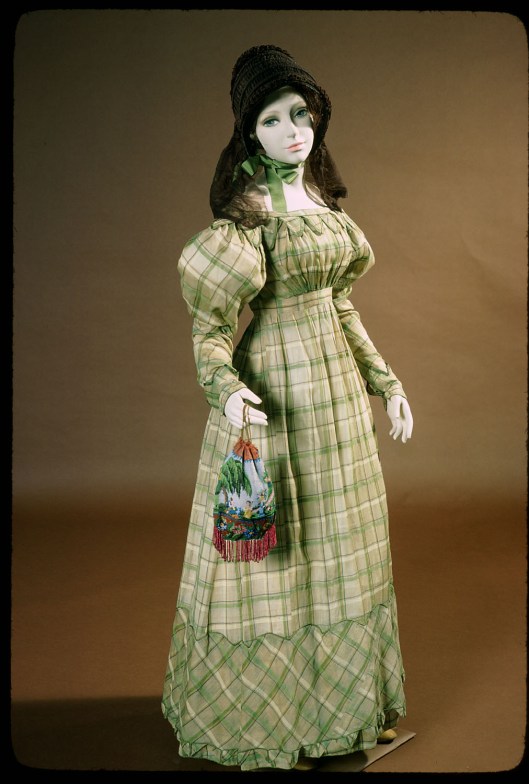
Woman's Green, Tan, Yellow and Blue Striped/Plaid Gown. OSV, 26.33.63

Woman’s Green, Tan, Yellow and Blue Striped/Plaid Gown. OSV, 26.33.63

Fortunately, there are some tamer garments out there, with sleeves less likely to result in flight in a high wind. Bonus: not floral, and not silk. Printed wool seems to have been fairly common, but the weight is just impossible to find. I did some looking in New York, but nothing convinced me with print or price.

This is a milita muster, so there will be time outside. I’m toying with a habit or Amazone (hard to resist a garment with that name) though the most I know about horses is that they have four legs. It’s tailoring that attracts me, not use. Also, wool. Mid-September might warrant wool, even if that’s hard to imagine today. (The downside, of course, is that there’s menswear to be made, too, so a simple dress is surely the best option.)

Share this:

  • Click to share on Facebook (Opens in new window) Facebook
  • Click to share on Pinterest (Opens in new window) Pinterest
  • Click to email a link to a friend (Opens in new window) Email
  • Click to share on X (Opens in new window) X
Like Loading...
← Older posts
Newer posts →

Archives

wordpress statistics

Creative Commons License
Kitty Calash blog by Kirsten Hammerstrom is licensed under a Creative Commons Attribution-NonCommercial-ShareAlike 4.0 International License.

Website Built with WordPress.com.

  • Subscribe Subscribed
    • Kitty Calash
    • Join 621 other subscribers
    • Already have a WordPress.com account? Log in now.
    • Kitty Calash
    • Subscribe Subscribed
    • Sign up
    • Log in
    • Report this content
    • View site in Reader
    • Manage subscriptions
    • Collapse this bar
 

Loading Comments...
 

    %d