
• Home
  • Completed Costumes/Impressions
  • Emma and Her Dresses
  • Free Patterns and Instructions

Kitty Calash

~ Confessions of a Known Bonnet-Wearer

Kitty Calash

Tag Archives: work

What (Cheer) to Wear?

07 Saturday Sep 2013

Posted by kittycalash in Clothing, History, Living History, Reenacting, Research

≈ Comments Off on What (Cheer) to Wear?

Tags

18th century, 18th century clothes, authenticity, John Brown House Museum, living history, resources, Revolutionary War, What Cheer Day, work
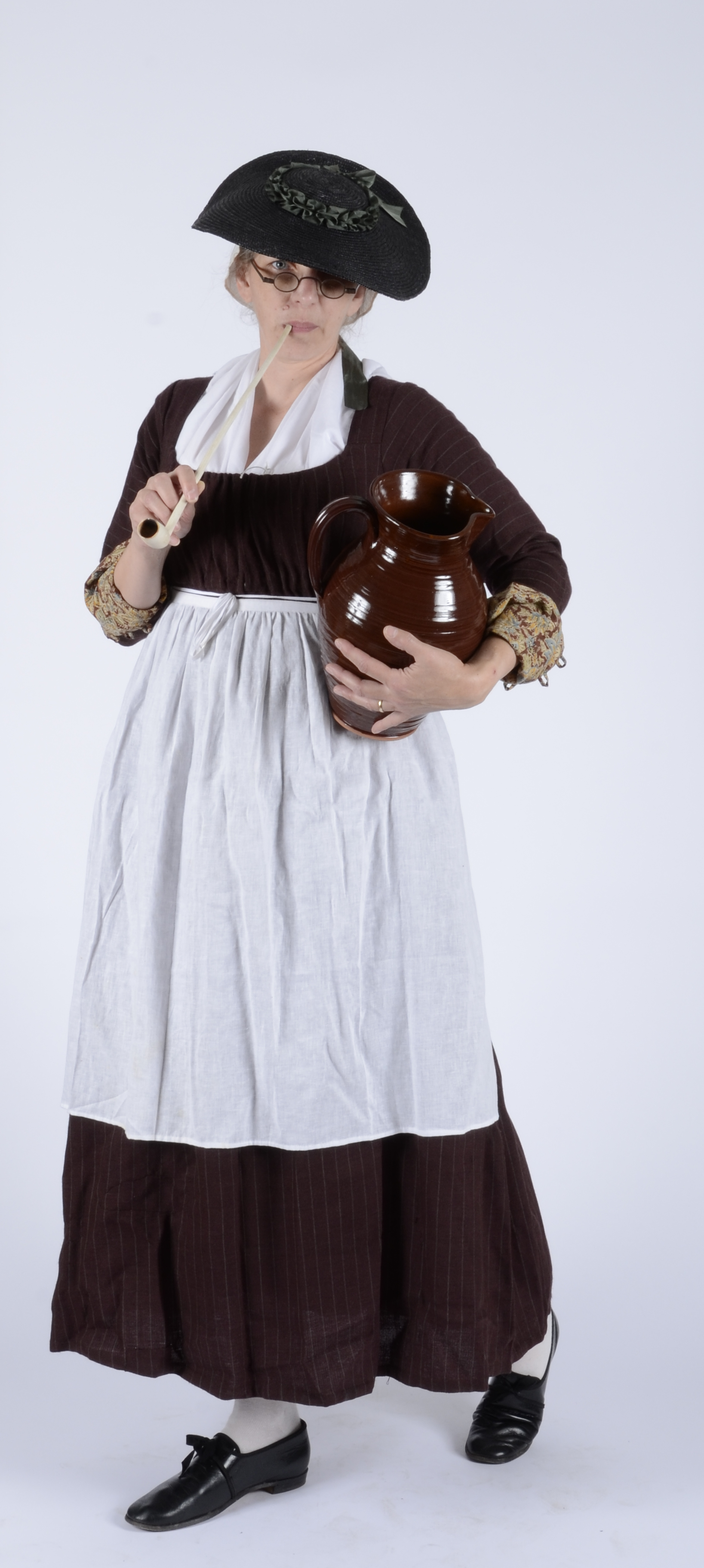
JBs HousekeeperIt’s 1800. Do you know what your housekeeper is doing? I don’t. Or, more accurately, I can’t decide.
I’m hung up on stays, and not wanting to make another pair. I’m indecisive about style, and though Mrs Garnett has her charms, it’s her bonnet I love more than anything.

Here’s what I’ve found, in servant-land:
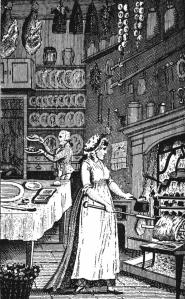
18th-century-kitchen-servants-prepare-a-meal-jane-austen-cookbook-cover-page

Note that this woman is, in the kitchen, wearing an open robe and quilted petticoat.The style of her bodice–which looks  like a cross-over bodice–and the train of the robe suggest the 1790s. Score one for style.

That open robe, where have I seen that before? Why, yes, Mr Sandby showed us that style for a nurserymaid. (It’s interesting, too, that both images show women with their hair quite visible under their caps, and not pulled up and out of sight.)
20130109-061710.jpg

Why does “robe stye” matter? Because I only found 3 and a quarter yards of a brown fabric I like, and even with the most careful cutting, that’s unlikely to make a full gown. However, I have some lightweight black wool that will make a decent petticoat. The bodice style is a bit of a stumper, though: the wool has good drape, so it might work for something other than the usual bodice I make. I did consider whether a very smooth, edge-to-edge, front-closing style of the 1780s would be more appropriate, but I think that I can move the bodice style forward, style-wise, and be correct.
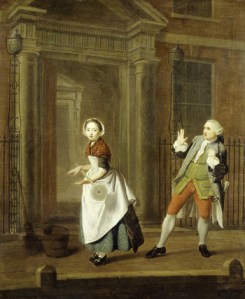
138263

Brown gowns are a fine tradition in the sartorial habits of questionable servants. This young housemaid twirls her mop dry while wearing a brown gown over what could be a dark blue or a black quilted petticoat. The red “bandannoe” is a nice touch, though I don’t think I’ll wear one myself for this event.

In all this there is a compromise: using fabric I like, in a style I know I can make and document, perhaps even without having to make new stays. That would be ideal, because although it’s four weeks to the event, I’ll lose a week of sewing time to other commitments. Three weeks to pattern and hand sew a petticoat, gown, apron and cap seems just manageable.

Share this:

  • Click to share on Facebook (Opens in new window) Facebook
  • Click to share on Pinterest (Opens in new window) Pinterest
  • Click to email a link to a friend (Opens in new window) Email
  • Click to share on X (Opens in new window) X
Like Loading...

Thinking Ralph Earl

29 Thursday Aug 2013

Posted by kittycalash in Clothing, Events, History, Living History, Making Things, Museums, Research

≈ 2 Comments

Tags

18th century clothes, common dress, Costume, fashion, John Brewster Jr, living history, maids, Museums, portraits, Ralph Earl, Rhode Island, sewing, work

Mabel Ruggles Canfield. Oil on canvas by Ralph Earl, 1796. Litchfield Historical Societym 1917-04-4

Mabel Ruggles Canfield. Oil on canvas by Ralph Earl, 1796. Litchfield Historical Society, 1917.4.4

In three weeks, I start a three week cycle of events in different decades: Saratoga in 1777 will be followed by Boston in 1763, followed by Providence in 1800. This causes a kind of temporal whiplash, though I know well enough what I should wear for 1777 and 1763, and Mr S’s brown coat will cut out this week so I can begin to sew on Saturday.

Providence in 1800 worries me more, but last Saturday’s conversation with Sharon helped immensely, especially when she said, Think Ralph Earl. So simple, I was embarrassed not to have remembered one of my favorite painters.

I need to think below Ralph Earl’s sitter’s station, but as Mrs Brown’s housekeeper or bossiest maid, these portraits represent the type of people I see, people who live in Providence but aren’t the Browns. Ralph Earl’s world of Connecticut merchants and ministers is much like the world I would see. How much more cosmopolitan was Providence than Stonington or New London? They’re all ports, and Providence is busier, but I think that Ralph Earl is a safe bet for understanding the visual context of the southern New England in the 1790s and the styles people wore.

It is especially helpful because he painted women of about the right age. Mrs Canfield at the top of te page was born in 1760, so she’s just a little younger than my character.

Oiver Ellsworth and Abigail Wolcott Ellsworth. Oil on canvas by Ralph Earl, 1792. Wadsworth Atheneum, 1903.7

Oiver Ellsworth and Abigail Wolcott Ellsworth. Oil on canvas by Ralph Earl, 1792. Wadsworth Atheneum, 1903.7

Mrs Ellsworth was born in 1756, so she’s a little bit older. Different ages, different styles (yes, styles have also changed between 1792 and 1796). But some constants: long, slim sleeves. White caps and handkerchiefs, layered at the neck. Silk–though that won’t be me–in solid, slightly muted colors.

There’s another Connecticut painter worth looking at: John Brewster, Jr. In this New Republic period, I think it’s really critical to look to American sources for clues to how people projected themselves, how they were seen and wanted to be seen. This is pretty high-falutin’ stuff for a maid, but I’m presuming that I know how to read (because John Brown and his brothers placed an emphasis on education in their own families, and on public education). And if I know how to read, and I work in a house with books and political discussions, chances are good that even in the late 18th century, I have eavesdropped on the discussions and I have read at least the newspapers. I’m living in a certain atmosphere, and how I dress and what I think about will reflect the world around me.

John Brewster and Ruth Avery Brewster. Oil on canvas by JOhn Brewster, Jr. ca. 1795-1800. Old Sturbridge Village.

John Brewster and Ruth Avery Brewster. Oil on canvas by John Brewster, Jr. ca. 1795-1800. Old Sturbridge Village.

Dr. John Brewster, seen here with his second wife, Ruth, descended from William Brewster. His wife, Ruth, is obviously literate. These people are signaling education and sensibility to us: sober, well to do, respectable. Brewster is not as good a painter as Ralph Earl, so fabric is harder to read. What is her gown made of? Could be fine wool, could be silk: hard to tell. But see that little edge of shift peeking below that three-quarter sleeve? That’s old school for 1795. But I like the neckline and the color. Burnley & Trowbridge have a light-weight wool that color…

Mother with Son (Lucy Knapp Mygatt and Son, George), 1799. Oil on canvas by John Brewster, Jr. Palmer Museum of Art, Pennsylvania State University

Mother with Son (Lucy Knapp Mygatt and Son, George), 1799. Oil on canvas by John Brewster, Jr. Palmer Museum of Art, Pennsylvania State University

Brewster’s portrait of Lucy Knapp Mygatt and her son, painted in 1799, does, I think, help push the date for the Brewster double portrait earlier: by 1799, the painter in more accomplished and bolder in the full-length portrait. He’s also learned to render fabric somewhat more convincingly.

Long sleeves, white cap and kerchief, high waistline: the styles are consistent, but as you move through the subtleties of class, the expression of the style shifts. Front-closing round gown with a waistline that’s high, but lower than what I’ve made in the past, with long sleeves: settled. Now all I need to decide upon is fabric: probably a lightweight, dark-colored wool, though I haven’t found exactly what I want yet.

Share this:

  • Click to share on Facebook (Opens in new window) Facebook
  • Click to share on Pinterest (Opens in new window) Pinterest
  • Click to email a link to a friend (Opens in new window) Email
  • Click to share on X (Opens in new window) X
Like Loading...

Installation Progress

30 Tuesday Apr 2013

Posted by kittycalash in Museums

≈ 3 Comments

Tags

Exhibitions, exhibits, John Brown House Museum, museum collections, Museums, Rhode Island Historical Society, work

Faith & Freedom Case 2: Establishment

Faith & Freedom Case 2: Establishment

It starts with words on a wall, and then we bring in the objects. They get hung up, placed, arranged, listed, reported. They’ve already been photographed and cleaned.

Faith & Freedom Case 4: Thomas Wilson Dorr

This might be my favorite case, though it is very brown. We’re adding a daguerreotype today. The Dorr Rebellion was a local phenomenon, but then, all politics is local.

The biggest goal this time? Washing the inside of the glass!

Share this:

  • Click to share on Facebook (Opens in new window) Facebook
  • Click to share on Pinterest (Opens in new window) Pinterest
  • Click to email a link to a friend (Opens in new window) Email
  • Click to share on X (Opens in new window) X
Like Loading...

Busy!

29 Monday Apr 2013

Posted by kittycalash in Museums

≈ Comments Off on Busy!

Tags

18th century, busy!, exhibits, Museums, Rhode Island, work

[French Barracks] T. Rowlandson, 1786, Drawings R79 no. 13, Lewis Walpole Library

This is a busy week chez Calash, so here’s an image by Rowlandson, as described by the Lewis Walpole Library:

A view of the interior of busy French barracks shows a more domestic atmosphere than military although weapons and other gear adorn the walls and lay scattered on the floor.

And now you know what can feel like trying to get an exhibit mounted, though at least the cats are only at home and the children are in school.

Share this:

  • Click to share on Facebook (Opens in new window) Facebook
  • Click to share on Pinterest (Opens in new window) Pinterest
  • Click to email a link to a friend (Opens in new window) Email
  • Click to share on X (Opens in new window) X
Like Loading...

Working the Curtains

14 Thursday Mar 2013

Posted by kittycalash in Clothing, Museums

≈ 3 Comments

Tags

18th century clothes, Clothing, curtain-a-long, Museums, sewing, work

Like most people, I have good days and bad days at work. Unlike most people, I sometimes get to use my hobby at work.

MuseumStaff

We have a new audio tour at the museum, and one of my colleagues is working on the rack card for the tour. He got an idea that needed people in costume, and lucky for him, my friend and I have wardrobes handy. He dressed, too–those deerskin breeches are really fantastic–and another colleague took the photos.

Taking tea, with a coffee pot.

Taking tea, with a coffee pot. It won’t matter on the card!

This was the first outing for the Curtain-A-Long dress, and its friend IKEA Curtain petticoat. I like it, though I have petticoat issues. Every time I wear any dress, I find some new thing to tweak. Fortunately, the problems are pretty simple to solve and involve channels for petticoat waist ties.

It was a fun morning, playing in the house, and only makes me want to do more living history tours and costumed interpretation. (Apologies to my Library compatriots for being late getting back!)

CityShower

I do love this one,and the original print, too.

When I wear the Curtain Gown, I think of the Sandby drawing of Sarah Hough, and I think of well-turned out housemaids. It would be a great deal of fun to develop more behind-the-scenes tours. After attending the first-person interpretation workshop, I had hoped to work on more tour ideas. Not yet, but I’ll get there someday this year!

We probably won’t actually spray filthy water on those lovely breeches, though. It would be a shame, and I know who made them!

Share this:

  • Click to share on Facebook (Opens in new window) Facebook
  • Click to share on Pinterest (Opens in new window) Pinterest
  • Click to email a link to a friend (Opens in new window) Email
  • Click to share on X (Opens in new window) X
Like Loading...
← Older posts
Newer posts →

Archives

wordpress statistics

Creative Commons License
Kitty Calash blog by Kirsten Hammerstrom is licensed under a Creative Commons Attribution-NonCommercial-ShareAlike 4.0 International License.

Website Built with WordPress.com.

  • Subscribe Subscribed
    • Kitty Calash
    • Join 621 other subscribers
    • Already have a WordPress.com account? Log in now.
    • Kitty Calash
    • Subscribe Subscribed
    • Sign up
    • Log in
    • Report this content
    • View site in Reader
    • Manage subscriptions
    • Collapse this bar
 

Loading Comments...
 

    %d