
• Home
  • Completed Costumes/Impressions
  • Emma and Her Dresses
  • Free Patterns and Instructions

Kitty Calash

~ Confessions of a Known Bonnet-Wearer

Kitty Calash

Monthly Archives: June 2014

Dating Mr Darcy…

18 Wednesday Jun 2014

Posted by kittycalash in Clothing, History, Museums, Research

≈ 7 Comments

Tags

1812, 19th century clothing, Clothing, Costume, fashion, frock coats, menswear, museum collections, Rhode Island, Rhode Island Historical Society, style

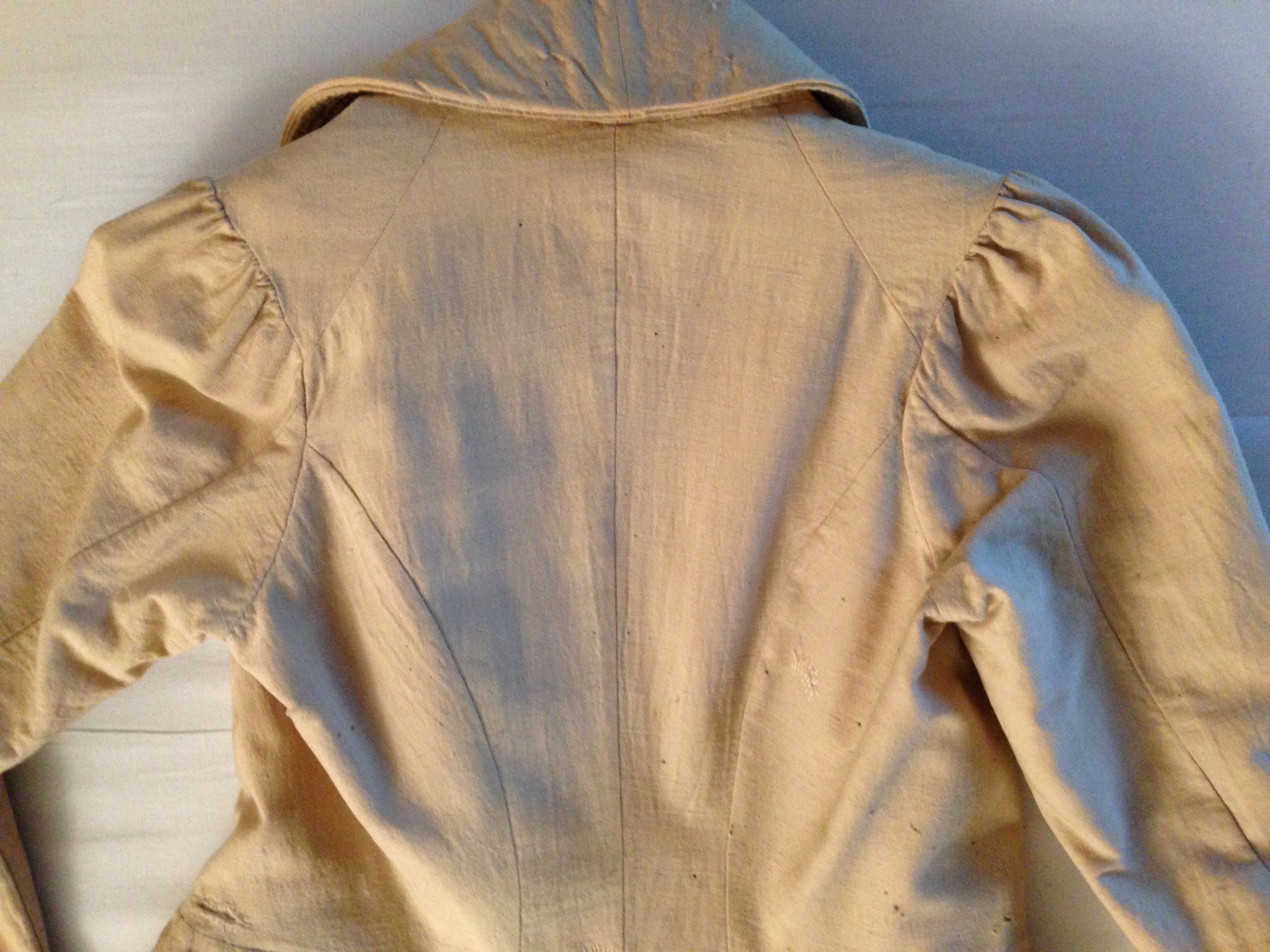
1996.66.4, RIHS Museum Collection

1996.66.4, RIHS Museum Collection

Or at least his coats.

I don’t know about you, but as the summer weather warms up, I like to think wool. I’ve got menswear to sew and desires beyond my knowledge, skills and abilities. Making a wool coat for an event in August seems like a patentable Bad Idea, so it’s a good thing that I have a nice piece of Italian linen-cotton denim-like fabric that I’ve set aside to make a summer-suitable coat for Mr S.

There is a Rhode Island coat, in a Rhode Island collection, of which I am particularly fond. I’ve had this coat in mind for some time now, and have inflicted it upon have shared it with experts several times.  It has a lot to recommend it: a soil mark on the collar, extensive damage and repairs to the left sleeve, fading and wear on the back, fragments of botanical material in the pocket lint, and the nicest linen fabric I’ve ever felt.

This is the coat I wanted to make for Mr S, but then I started thinking about that waist seam, which eliminates this from the style competition for 1812. Rats! But, OK, no reason that we can’t use this as inspiration and make a coat using the fabric but not the waist seam.

1956.9.3, RIHS Museum Collection

1956.9.3, RIHS Museum Collection

So I looked at another coat that just happened to be handy (I know, I am very lucky, and that’s part of why I’m sharing this with you). At first glance, I thought I was good. And by glance, I mean extended looking. But look again: there is a waist seam, it’s just harder to see. So much for the iPhone and lousy light, right? (I noticed the seam today, in even less light, so go figure.) This coat is made of a single twill off white wool can easily be mistaken for plain weave and that is rather light. Very summery, in a way.

Coat style found? Maybe. But I was wondering about the sleeves. I spend a great deal of time looking at sleeves and backs of much earlier coats, so I’m accustomed to a smooth sleeve head. That’s not what you’ll find on this garment, though. This one has gathers, and I thought that was pretty exciting. My closest expert probably had a weird twinge at that moment that he will soon learn to associate with an incoming email from me…
Sleeves, 1956.9.3 RIHS Museum Collection

Sleeves, 1956.9.3 RIHS Museum Collection

This is a nice detail, but one I’m not familiar with. The fashion plates on Serendipitous Stitchery’s post do show increasingly full sleeves in the early years of the 19th century, but that detail didn’t fully register with me until I looked at this coat and processed what Mr C had told me about sleeves and shoulders. Seeing an extant example always makes principles more real.

So what next? At work, I’ve started updating the catalog records for these coats, and they’ll go live early next month. Every time we learn something new, we try to update and correct records so that everyone can benefit. That’s the easy part.

The hard part is reconciling style details for Mr S’s coat. In comparing these examples with fashion plates, I think it’s clear that they are both later than 1812 (waist seam) and nodding to but perhaps not fully embracing high style (see the gathers on the white coat, but the blue coat has only one gathered sleeve, which I attribute to maker error). Plausible dates for both might be 1818-1826, bearing in mind that these will be interpretations of styles, the way Old Navy knocks off adapts its sibling Banana Republic’s styles.

I may be back at that fabulous checked linen coat at the Met, with inspiration drawn from Providence’s plainest blue coat. The process always seems a compromise, in part because I do not think Mr S wants a checked coat, and in part because I’d like to use fabric I already have. Still, there is yet another coat to think about…but tomorrow is another day.

Share this:

  • Share on Facebook (Opens in new window) Facebook
  • Share on Pinterest (Opens in new window) Pinterest
  • Email a link to a friend (Opens in new window) Email
  • Share on X (Opens in new window) X
Like Loading...

Musical Monday: Chester

16 Monday Jun 2014

Posted by kittycalash in Events, History, Living History, Reenacting

≈ Comments Off on Musical Monday: Chester

Tags

10th Massachusetts, common people, common soldier, history, living history, Reenacting, Revolutionary War, singing

Virtue Rewarded

Virtue Rewarded

Saturday was Flag Day, but you knew that, right? There are a lot of holidays we no longer pay much attention to, from Armed Forces Day (when Mr S and I once hosted a very amazing and lengthy party in an 1870s brick row house in St. Louis) to Arbor Day to Flag Day.

To celebrate the Bicentennial of the Star Spangled Banner, the Paul Revere House asked us (which means Mr HC) to lead the visitors in the national anthem. “Never miss an educational opportunity” could be one of the 10th Massachusetts’ mottoes, so with the regimental colors unfurled, the time was right to lead the assembled company in a rendition of Chester, written in 1770 and perfected in 1778 by William Billings, and the song to which the men are accustomed to march. (It is also the song mostly likely to play accidentally on my phone while it’s in my pocket.)

So here they are, the 10th Massachusetts and Members of the Publick, led in Chester by Mr Cooke.

IMG_1590

IMG_1590


As mentioned elsewhere, it is nearly impossible to read and sing simultaneously. It is also clear that we do not generally sing in our daily lives, or not nearly as often as people did in the past. Most of us think we have awful voices and refuse to sing, though we endure singing in school, or did. It’s an art that we should enjoy more and more often. You don’t have to be Idina Menzel to please the right audience (in my case, some cats).

Share this:

  • Share on Facebook (Opens in new window) Facebook
  • Share on Pinterest (Opens in new window) Pinterest
  • Email a link to a friend (Opens in new window) Email
  • Share on X (Opens in new window) X
Like Loading...

History is Not a Competition

15 Sunday Jun 2014

Posted by kittycalash in Events, History, Living History, Reenacting

≈ 1 Comment

Tags

10th Massachusetts, 18th century, 18th century clothes, Amasa Soper's Company, Boston, historic houses, history, living history, Massachusetts, Paul Revere House, Reenacting, Revolutionary War

IMG_1583

Drilling by the Sergeant

Saturday was my first post-operative foray into costumed interpretation, up to Paul Revere House on Flag Day. This went much better than my first attempt at Paul Revere House, which ended in ignominy as I missed the train. In April, I managed to convince Mr S to drive in Boston, which he usually refuses to do (in fact, he nearly abandoned me once at the Old State House one Saturday after a miserable drive that had us stuck in the Downtown Crossing vortex).

I’m so glad we managed this, Despite anticipatory near-tears and epic pouting by the Young Mr, we managed to have a rather nice time.

Poise, with extra elevation by the Young Mr

Poise, with extra elevation by the Young Mr

We were in the courtyard, and Mr HC and Mr FC told the story of Amasa Soper’s company and its members several times to the streams of tourists. They solicited recruits and ran them through the 1764 drill using the nicest wooden muskets I’ve ever seen, though with mixed results. Some new volunteers held their muskets backwards, and the Young Mr’s ramrod got stuck in the barrel, though that is a known issue with that particular musket.

I sat on my ladder-back chair near the house and made the tiniest hems I could on Mr S’s next shirt, which will be for best. People asked about the sewing and my clothes, and I had a chance to talk about what women wore, typical fabrics and fibres, supplying the army, and who made what.

The day was warm, but fortunately not overwhelming, and as a museum person, I found the crowd quite interesting. This is a facet of Boston I don’t usually see: the tourist experience.

In one memorable moment, a pair of young women stood just outside the door to the house.
Young Woman Number One: “Is this really his house?”
Young Woman Number Two: “Yes, this is where Paul Revere lived.”
YWNO: “Oh, my God! I’m so excited! This is so neat!”
Kitty Calash: <eats heart out with jealousy> “Why can’t my museum do that?”

The celebrity factor of Paul Revere is undeniable. There were tourists with guide sheets in Chinese, and tourists who made me wish I still remembered my college German. Some seemed to be hitting every Boston landmark they could in one day, carrying white cardboard pastry boxes; some seemed to be going more slowly, looking, and trying to figure out what they were seeing, and what it meant.

Virtue Rewarded

Virtue Rewarded

What living history means is something I’ve been thinking about lately, or trying to. It’s tangled up with questions of authenticity and appropriateness, but what I learned on Saturday, or re-learned, was how very happy this business makes me. I like history, and historic costume. It doesn’t matter to me if we are talking Revolutionary War or New Republic or Lewis and Clark.

My favorite visitors were a mother and daughter from Steamboat Springs, Colorado, visiting Boston for the first time with a young man from New Hampshire. The mother said, “There’s so much more history here than where we’re from. Our town’s only 100 years old.”

That’s a challenge I’m always ready for, so I asked where they were from. Colorado to me means Native American settlements reaching back a thousand years, Spanish explorers and conquistadors, French, and then American, fur traders. It means hundreds of years of history, and a chance to remind people this isn’t a competition for “oldest” or “mostest.”

Knowing where our country came from is important: so yes, please visit Boston, and Paul Revere House, and Providence and Newport, too! But knowing where you are is just as important. There’s history all around you, and your local historical site, society and museum would love to tell you about it.

Share this:

  • Share on Facebook (Opens in new window) Facebook
  • Share on Pinterest (Opens in new window) Pinterest
  • Email a link to a friend (Opens in new window) Email
  • Share on X (Opens in new window) X
Like Loading...

Frivolous Friday: Just a Pretty Bonnet

06 Friday Jun 2014

Posted by kittycalash in Clothing, Frivolous Friday, Living History, Making Things, Reenacting

≈ 2 Comments

Tags

1812, 19th century, 19th century clothing, bonnets, fashion, fashion plate, Frivolous Friday, millinery, millinery shop, Regency, Salem event, style

DSC_0134
DSC_0136

Like Sew 18th Century, I’ve been enjoying preparing for the August 2nd event in Salem.

I’ve not ventured too much into Regency bonnets, or into straw, but I did flirt with a 1794 bonnet. Now I’ve got hats on the brain, and the time to fully indulge my whimsy (though it runs out Sunday).

1812_CostumesParisiens_2
1812_CostumesParisiens_1

From the fashion plates, one would almost say, Anything Goes.  Of course it doesn’t, really, but you can get a sense of the exuberance of bonnet trimmings in the illustrations, and the lavish use of ribbons, bows, feathers and flowers.

DSC_0138
DSC_0140

Not all straw bonnets were lined– in fact, they often weren’t– but the lining protects the straw and the wearer’s face, and finishes this off in a way I like. Pleating in my condition was, ah, challenging, but I figure it was good for my brain to have the exercise. The lining in the brim is white taffeta, but I used white linen in the main crown or tip portion of the bonnet. Instead of bagging the lining, or trying to fit it, I mimicked what Mr B does in the hats he’s made for us. The gathered linen closes with a drawstring and required slightly less effort to fit into the hat.

The velvet ribbons came from Lunarain Designs on Etsy, the ties are taffeta ribbon from Taylor’s Etsy shop, and the straw bonnet form came from Regency Austentation. While the finish work takes time and concentration, I do enjoy both making up and trimming bonnets, and look forward to several more.

Share this:

  • Share on Facebook (Opens in new window) Facebook
  • Share on Pinterest (Opens in new window) Pinterest
  • Email a link to a friend (Opens in new window) Email
  • Share on X (Opens in new window) X
Like Loading...

More than Just a Pretty Hat

04 Wednesday Jun 2014

Posted by kittycalash in Clothing, History, Living History, Research

≈ 2 Comments

Tags

1812, 19th century, 19th century clothing, fashion, living history, milliner, millinery, millinery shop, Reenacting, Research, resources, Rhode Island, Salem event, style

While pretty hats were pretty important parts of the milliner’s trade, many more things were sold in a millinery shop.
Colonial Williamsburg’s Margaret Hunter shop is probably the best-known living history milliner’s shop, and they provide a nice definition and explanation of the trade. But that’s never enough: what’s the primary source information for New England milliners?

While there is documentation of a Rhode Island milliner in the 1830s, and even a thesis on her work, Sew 18th Century and I are working on an earlier shop. I started with Rhode Island newspaper advertisements, because I like the sound of “lately arrived from Providence,” and because I understand that context.

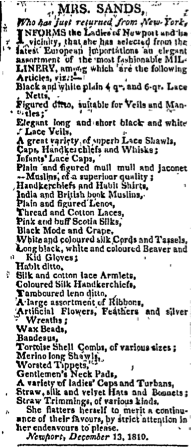
The Rhode-Island American, December 25, 1810. III:20, p. 1

The Rhode-Island American, December 25, 1810. III(20), p. 1

Here is Mrs. Sands, just returned from New York to Newport and vicinity, with a long list of things for sale, “selected from the latest European importations, an elegant assortment of the most fashionable MILLINERY.. viz,:–” (you have the love the punctuation, which is like the Chicago Manual of Style on New Republic crack)

What is she selling? In addition to what we think of as traditional millinery, the “variety of ladies’ Caps and Turbans, Straw, silk and velvet Hats and Bonnets; Straw Trimmings of various kinds,” listed at the bottom of the ad, Mrs. Sands carries:

  • Lace Shawls
  • Caps, Handkerchiefs and Whisks;
  • Infants’ Lace Caps
  • Plain and figured mull mull and jaconet
  • –Muslins, of a superior quality;
  • Handkerchiefs and Habit Shirts,
  • India and British book Muslins,
  • Plain and figured Lenos,
  • Long black, white and coloured Beaver and Kid Gloves;
  • Silk and cotton lace Armlets,
  • A large assortment of Ribbons,
  • Artificial Flowers, Featehrs and silver Wreaths
  • Tortoise Shell Combs of Various sizes;
  • Merino long Shawls
  • Worsted Tippets
  • Gentlemen’s Neck Pads

Whew! That’s a lot of stuff, and many different kinds of things, though all broadly in the ‘accessories’ or supplies range. I am delighted to see Habit Shirt on the list, as I buy my chemisettes, and I am intrigued by the range of handkerchiefs and by the Tortoise Shell combs, in part because I did not buy an assortment of them at a shop in western Rhode Island a month ago (kicks self).

Newport Mercury, December 11, 1811. L:2593, p.1

Newport Mercury, December 11, 1811. L(2593), p.1

In the December 21, 1811 Newport Mercury, Mrs Sands again advertised her goods lately arrived from New York. This is a less exhaustive, but no less interesting, list. “Ladies elegant green velvet mantles, with and without spencers” is particularly intriguing for a Spencer fan, and not particularly clear to me.

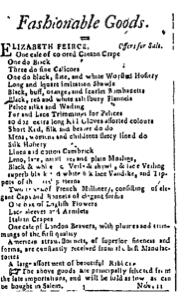
November 21, 1812. Essex Register

November 21, 1812. Essex Register

In Salem, which is where we will be in August, Elizabeth Pierce advertises her “Fashionable Goods” for sale. She, too, has a long list of things she will sell, from Canton crapes to imitation shawls, hosiery, lace sleeves and armlets, one box of English flowers, and American Straw bonnets.

I suspect that just as retailers do today, milliners of the late 18th and early 19h century probably had an assortment of things designed to bring buyers in to shop (new bonnet styles), and small items to tempt them into impulse purchases (English flowers). You can’t buy a new bonnet every week, but you can refresh an old one.

Share this:

  • Share on Facebook (Opens in new window) Facebook
  • Share on Pinterest (Opens in new window) Pinterest
  • Email a link to a friend (Opens in new window) Email
  • Share on X (Opens in new window) X
Like Loading...
← Older posts
Newer posts →

Archives

wordpress statistics

Creative Commons License
Kitty Calash blog by Kirsten Hammerstrom is licensed under a Creative Commons Attribution-NonCommercial-ShareAlike 4.0 International License.

Website Built with WordPress.com.

  • Subscribe Subscribed
    • Kitty Calash
    • Join 621 other subscribers
    • Already have a WordPress.com account? Log in now.
    • Kitty Calash
    • Subscribe Subscribed
    • Sign up
    • Log in
    • Report this content
    • View site in Reader
    • Manage subscriptions
    • Collapse this bar
 

Loading Comments...
 

    %d