• Home
  • Completed Costumes/Impressions
  • Emma and Her Dresses
  • Free Patterns and Instructions

Kitty Calash

~ Confessions of a Known Bonnet-Wearer

Kitty Calash

Monthly Archives: February 2016

Writing for the Weekend

25 Thursday Feb 2016

Posted by kittycalash in Events, History, Living History, personal, Reenacting, Research

≈ Comments Off on Writing for the Weekend

Tags

first person interpretation, interpretation, living history, Rhode Island history, servants, What Cheer Day, women's history

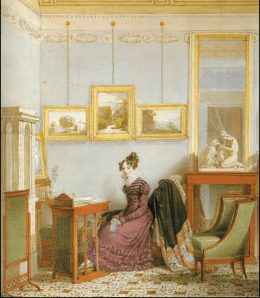
Johann Ender, Woman at her writing desk ca 1820

Johann Ender, Woman at her writing desk ca 1820

or, Women’s History at Washington’s Crossing

I haven’t dropped the peddling question, I promise! But I’m busy writing a paper for this coming weekend’s women’s history conference (yes, I know: but I’ve read that procrastination fuels creativity, so those digressions into the Canton voyage of the Ann and Hope were totally worth it).

Georg Friedrich Kersting: Briefschreibende Dame im Biedermeier Interieur, 1817

Georg Friedrich Kersting:
Briefschreibende Dame im Biedermeier Interieur, 1817

If you’re curious about the process I go through developing characters for living history programs, or best practices for women of the Revolutionary War-era armies, among other topics, there are some tickets left, and you can register online here.

But before I can compile what I’ve found about food markets in 18th century Boston, I have to go back to writing for this weekend.

Those Providence servants don’t research and describe themselves, and the housekeeper is particularly unreliable.

Share this:

  • Share on Facebook (Opens in new window) Facebook
  • Share on Pinterest (Opens in new window) Pinterest
  • Email a link to a friend (Opens in new window) Email
  • Share on X (Opens in new window) X
Like Loading...

Peddling a Myth

23 Tuesday Feb 2016

Posted by kittycalash in Events, Fail, History, Living History, Reenacting, Research

≈ 13 Comments

Tags

18th century, Boston, common people, Events, fail, interpretation, Research, Revolutionary War

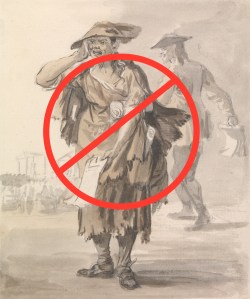
Paul Sandby RA, 1731–1809, British, London Cries: Last Dying Speech and Confession, ca. 1759, Watercolor over graphite on medium, cream, slightly textured wove paper, Yale Center for British Art, Paul Mellon Collection

Paul Sandby RA, 1731–1809, British, London Cries: Last Dying Speech and Confession, ca. 1759, Watercolor over graphite on medium, cream, slightly textured wove paper, Yale Center for British Art, Paul Mellon Collection

Every now and then, I reach the dammit! point of my research, where I am forced to realize that Everything I Assumed Was Wrong. I try to make those moments a cause for celebration, even though they’re often deeply frustrating. Do not pass GO, Do not collect $200, Go directly to the Library.

What now?

Well… Boston ain’t London. And the North American colonies ain’t Great Britain. The business structure, the size of the cities, is different. Distribution of goods is different, thanks to tariffs and non-import/export laws. Which means?

Peddling. It’s not a thing. Or it’s a very difficult thing to document.
Which means that all the things I’d thought about doing for the Massacre (day or night) are probably wrong. (Remember, this is when we celebrate!)

Hey, I’m not the only one rethinking my approach.

But there it is: I’ve looked in the Boston Selectmen’s Minutes for 1768-1771, and while there is plenty of small pox (yay!) and many lemons being imported (yay! punch!) and there are licenses being granted for selling strong drink in inns and houses, there are no peddlers licenses. There are no licenses for street vendors of any kind. Hmmmm….

I’ve also read the Dublin Seminar publications Itinerancy in New England and New York (1984) and Life on the Streets and Commons, 1600 to the Present (2005). Not looking good here for street vendors and hawkers pre-1800.

While I never particularly trust early 20th century monographs and articles without footnotes, the somewhat entertaining Hawkers & walkers in early America : strolling peddlers, preachers, lawyers, doctors, players, and others, from the beginning to the Civil War informed me that street vending was not common in North American British Colonies, and in fact, was not commonly seen until after 1800.

What the ever-loving heckers?

I found peddlers’ licenses in Philadelphia for 1770: all men. But so far, nothing in Providence, Boston, or Newport (or Connecticut). The theory is that itinerant sales people didn’t pay taxes the way merchants did, and that merchants therefore lobbied against them. In Providence, the earliest mention I’ve found thus far is a lobster and fish man at the Great Bridge in 1818.

Just as the watch of Boston differed from the watch in London, so too, it seems, did the petty retailers. I still can’t quite believe there were no street peddlers and hawkers in colonial cities, but I’ll need a new way to approach this question.

Share this:

  • Share on Facebook (Opens in new window) Facebook
  • Share on Pinterest (Opens in new window) Pinterest
  • Email a link to a friend (Opens in new window) Email
  • Share on X (Opens in new window) X
Like Loading...

The Devil is in the Details

21 Sunday Feb 2016

Posted by kittycalash in History, Living History, Movie Review, Philosophy

≈ 1 Comment

Tags

authenticity, interpretation, living history, progressive reenacting

durer_hare

The Hare. Watercolor on paper by Albrecht Durer, 1502. The Albertina, Vienna.

The Witch. I had to go see it after Mr JS sent me a link to this article, and of course I was captivated. (I also needed a break after what was very nearly the Worst Week Ever, starting Wednesday at 4:30AM.)

“The recreation of farm life in 1630s Massachusetts is so complete it pulls you into the pocket universe that exists inside the characters’ minds. As you experience their fear, you experience your own. The barrier between you and the people on film disappears, and their terror consumes you. And that is how you make a scary movie!”

That pocket universe: that’s what some of us are after when we go about this living history business, creating a world so seamless (or so meticulously hand-seamed) that you, the interpreter, appear to inhabit the past and the present simultaneously.¹

So how does it work? How did it work in The Witch?

Here’s Eggers on authenticity:

“…authenticity for the sake of authenticity doesn’t really matter. To understand why the witch archetype was important and interesting and powerful—and how was I going to make that scary and alive again—we had to go back in time to the early modern period when the witch was a reality. And the only way I was going to do that, I decided, was by having it be insanely accurate.”

Got that? Authenticity for the sake of authenticity doesn’t really matter.

But the only way to make the witch powerful was to be “insanely accurate.”

The only way to make living history powerful is to be <ahem> insanely accurate.² If we’re not, the points where we are not accurate will stand out, the spell will be broken, and the visitor will be lost. The real thing is the right thing for your time and place. Context: It really does matter. 

That means that just because you perfectly replicated a silk gown from a French fashion plate it may be wildly incorrect for the streets of Providence, Boston, or Philadelphia– much less a military camp– even if it’s the same year as the event you’re attending. It means that just because you got every buttonhole perfect on your 1765 frock coat, it won’t be right for an 1803 funeral if you’re only 30.

Don't take an anecdote to a data fight.

Don’t take an anecdote to a data fight.

When you’re wearing and carrying the right clothes and objects for your portrayal, you can focus less of the what and more on the why. As interpreters, re-enactors, enactors, whatever you want to call yourself, we lead the visitor to better questions and a better understanding of not just events but the meaning of the past if we are thoroughly convinced and convincing. And that only happens by questioning ourselves.

The Witch is a horror movie, and while it was tense, the world it portrayed felt pretty close and natural to me and to Mr JS. Maybe that’s because we spend so much time trying to understand that vanished world—it’s Roger Williams, baby—maybe because we engage in living history and material culture. I don’t know if it’s scarier for folks who don’t have that level of context, don’t assume a world where hierarchy, acceptance, succumbing to a higher power, is normal. Where everything is a matter of faith, and belief. It’s a tiny world, that past. We were so immersed in that world that walking out into the mall was a shock: colors, noises, smells. And the world was so immersive because the details were so correct.

Ultimately, what we do with living history is interpretation, and interpretation is provocation.³ But what should be provoked is not a question about what you have, but why you have it, and what you’ll do with it. And that only happens if you have the right thing.

………………….

1 Your mileage may vary. It’s my dream goal. “Man’s reach should extend his grasp” and all that.

2 That is, as accurate as possible, recognizing the limitations of modern materials and access to primary source documents. More on that later.

3 Freeman Tilden. Interpreting Our Heritage, Chapel Hill: 2007. p. 35

Share this:

  • Share on Facebook (Opens in new window) Facebook
  • Share on Pinterest (Opens in new window) Pinterest
  • Email a link to a friend (Opens in new window) Email
  • Share on X (Opens in new window) X
Like Loading...

[Re-en]Activism

18 Thursday Feb 2016

Posted by kittycalash in History, Living History, Philosophy, Reenacting

≈ 5 Comments

Tags

interpretation, living history, philosophy

Dread Scott performing “On the Impossibility of Freedom in a County Founded on Slavery and Genocide” under the Manhattan Bridge (photo by Hrag Vartanian for Hyperallergic)

Dread Scott performing “On the Impossibility of Freedom in a County Founded on Slavery and Genocide” under the Manhattan Bridge (photo by Hrag Vartanian for Hyperallergic)

So I know a guy. Where I live, everybody knows a guy, but this guy I went to high school with, and stayed in touch with off and on over the years– we’re both art school refugees, looking at “America” in very different ways.

The work he’s done over the years has been controversial. But it’s his latest stuff that I’m thinking about– yeah, I know, I missed it: he’s always scheduled for when I’m at Fort Moonrise Kingdom, or, you know, tearing my life apart and rebuilding it.

Dread Scott. Images of Oppression. After a whirling dervish of a weekend that culminated in some fancy early-morning driving in Boston, I’ve almost forgotten why I was thinking of Dread Scott and living history, but here’s the short version:

Why do we choose to reenact or enact the moments or events we do? We are, by default in our selections, limiting our characters because of the script we choose. In the main, we continue to choose to re-tell and enact the dominant stories that align with common myths about the founding and history of the United States. Until we choose to enact other stories about our collective past, we will continue to enact the same arguments that Our Girl History and I have made in the past. That’s too meta even for me.

As a friend asked a few weeks ago, “Why do we commemorate massacres and not Mondays?” Let’s commemorate some Mondays, shine a light on some moments, and reimagine what enacting history can mean.

Share this:

  • Share on Facebook (Opens in new window) Facebook
  • Share on Pinterest (Opens in new window) Pinterest
  • Email a link to a friend (Opens in new window) Email
  • Share on X (Opens in new window) X
Like Loading...

That Belongs in a Museum

11 Thursday Feb 2016

Posted by kittycalash in Art Rant, Collecting, Museums, personal

≈ 7 Comments

Tags

art history, collections, historic house museums, museum collections, museum practice, personal, philosophy

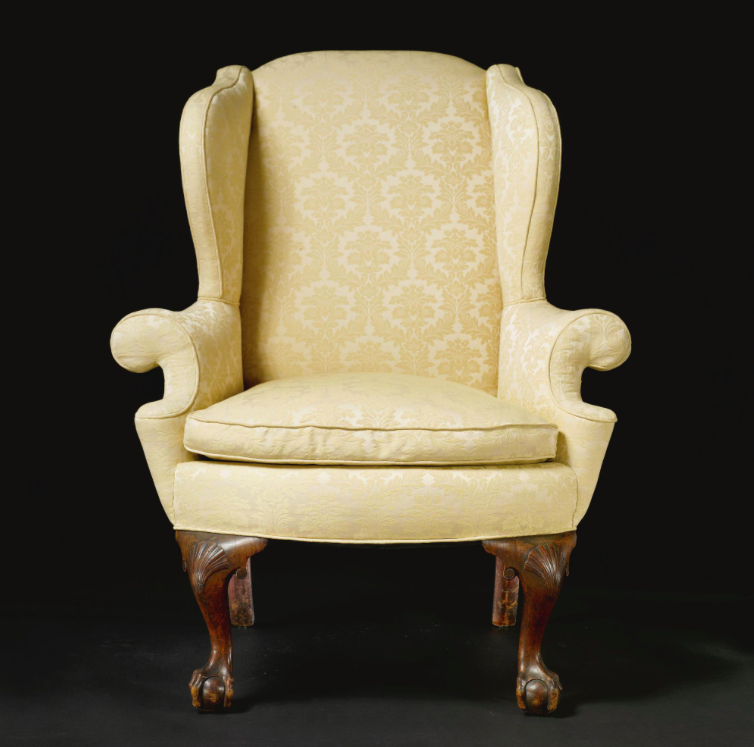
Sotheby's Sale 8278, Lot 586. Easy Chair, Philadelphia ca 1770

Sotheby’s Sale 8446, Lot 20. Easy Chair, Philadelphia ca 1770

We’re taking a brief break from this week’s nightlife programming to bring you this special report. Regular snark resumes with the next post.

It’s not a secret that I work in a museum. I operate in a world of objects that cannot be touched, sat upon, slept in, worn– you get the idea. Well, sometimes things that I believe belong in a museum don’t end up in one. Sometimes beautiful objects with great stories and deep resonance with the museum I think they belong in don’t make it there. Sometimes museum professionals take phone calls from irate family members who are incensed that you’re even talking to someone in the family about how to organize their materials. Sometimes objects do make it,  but then, before the paperwork is executed, the gift is rescinded. People get weird about stuff.

Sometimes they get weird about stuff because of what it’s worth. Eleven years ago, a family chose not to fight over objects, but instead sold their family furniture. They grossed nearly $13 million. Thirteen Million Dollars: Enough for a baker’s dozen of Dr. Evils. With chairs that sell for $204,000 (Sale 8278, lot 586), it’s no wonder people get weird about stuff because of money.

Lot 586. It’s a pity the catalog is no longer available online, but even Sotheby’s has to conserve server space. It was a beautiful chair: a 1763 upholstered easy chair– upholstered by Plunket Fleeson of Philadelphia.* I pored over that catalog page in the Important Americana sale catalog. It would have come in just before Christmas, or just after, slick clay-coated pages printed with fine ink. When the auction catalogs arrive at work, we stand in the kitchen-mail room and bury our noses deep in the gutter: smells like money.**

Staircase Group (Portrait of Raphaelle Peale and Titian Ramsay Peale I) Charles Willson Peale. Philadelphia Museum of Art, E1945-1-1

Staircase Group (Portrait of Raphaelle Peale and Titian Ramsay Peale I)
Charles Willson Peale. Philadelphia Museum of Art, E1945-1-1

I wanted that chair, Lot 586, that walnut easy chair made in Philadelphia. Wrong town, you say? Mais non, Philadelphia was the place to buy fancy goods– especially upholstered goods– in the 18th century. Providence merchants were trading with Philadelphia, the town that set the style for the colonies.*** It was sophisticated, urbane, refined. So, when Sarah Brown was pregnant with their first child, John Brown sent to Philadelphia for an easy chair. It would be the best.

He’d already ordered a tea table and roundabout chairs from Newport at the time of his marriage in 1760. These objects were about more than function: they were signifiers of taste and sensibility as much as wealth. So, as the time came closer for Sarah’s confinement, John Brown became increasingly agitated with Plunket Fleeson, who was delaying the delivery of the chair. John Brown was concerned for Sarah’s comfort postpartum, and said so in a letter. I can’t quote or link to it, because it’s in private hands, quoted in the catalog entry for lot 586.****

So what about that chair? Well… I got permission from the Authorities (a Board-level committee, with the support of the Executive Director) and we bid on the chair by phone. You know already we were not the winning bid. We were willing to bid a lot– really, a lot of money for us– for this chair.

Why?

Not because it’s worth so much. Not because of Plunket Fleeson, or the quality of the carvings, or the craftsmanship, really.

Because Sarah Brown sat in that chair cradling her son, James Brown, in 1763. She sat in that chair with the children who came after him, the babies who lived, and the babies who died.

Because that chair told a story about a family, about a relationship between a husband and wife, a man and a woman, at its most basic level.

That chair told a story about love.

Even I am a sucker for love.

Love is why people get weird about stuff, about the chairs, the family photos, the workbaskets, heck– the drill presses. We imbue objects with meaning, with memories, that substitute for the people we love when they’re gone. Sometimes it’s a t-shirt that smells of a lover. Sometimes it’s sewing basket used by three generations of women. And sometimes it’s a chair.

In the case of the easy chair, imagining the cradling comfort of the chair and the memories it recalls is simple. In the case of, say, shield back side chairs, the leap is a little harder. But perhaps– just perhaps– arranged around a festively set table, those chairs conjure memories of holiday meals, birthday dinners, graduation parties. Maybe those chairs take you back to the people and times when you felt loved.

Or maybe they’re worth $100,000, and you consign them to auction.

But if you value the story as much as the object, here’s the funny thing: you can keep that memory forever, and share the story with everyone, if you give that object to a museum.*****

When people really love an object and are fighting with their families over who gets to keep the things, I don’t play Solomon. I tell them a story about memory, and preservation, and about endurance. Sometimes I can convince them. Sometimes I can’t.

When I can’t, I tell them I understand, and that my priority– and my institution’s priority– is not things, but people. They can keep their object: we’ll be here when they’re ready. It’s all true, and I do mean it.

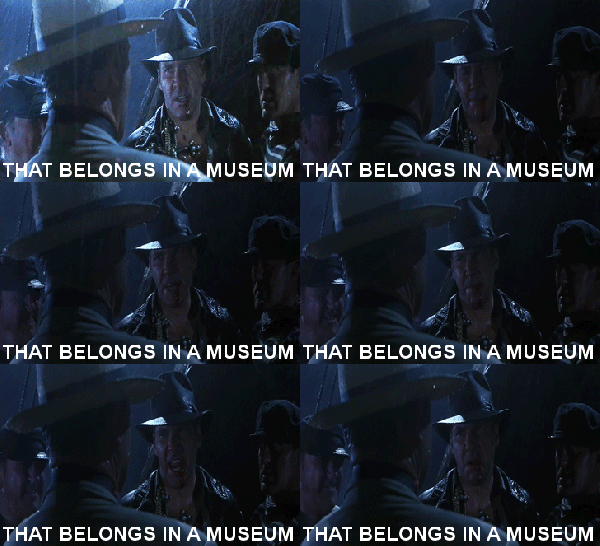
But inside, I feel like Indiana Jones, soaking wet on the deck of a pitching ship.

That belongs in a museum.
When-you-visit-home-and-see-your-parents-outdated-computer

*If money were no object, I’d buy it for that name alone.

**The quality decreased in 2008, when the financial crisis hit everybody hard, but the paper weight and ink have been creeping back up in quality of late.

***I know, it sounds crazy now, but it was true. At the time of the American Revolution, it was the second largest English speaking city in the world, after London.

****You are correct, sir: I’d like the letter book it’s in, too.

*****Subject to acceptance. Some rules and regulations apply. Leaning is touching. Don’t lick it.

Share this:

  • Share on Facebook (Opens in new window) Facebook
  • Share on Pinterest (Opens in new window) Pinterest
  • Email a link to a friend (Opens in new window) Email
  • Share on X (Opens in new window) X
Like Loading...
← Older posts

Archives

wordpress statistics

Creative Commons License
Kitty Calash blog by Kirsten Hammerstrom is licensed under a Creative Commons Attribution-NonCommercial-ShareAlike 4.0 International License.

Website Built with WordPress.com.

  • Subscribe Subscribed
    • Kitty Calash
    • Join 621 other subscribers
    • Already have a WordPress.com account? Log in now.
    • Kitty Calash
    • Subscribe Subscribed
    • Sign up
    • Log in
    • Report this content
    • View site in Reader
    • Manage subscriptions
    • Collapse this bar
 

Loading Comments...
 

    %d