• Home
  • Completed Costumes/Impressions
  • Emma and Her Dresses
  • Free Patterns and Instructions

Kitty Calash

~ Confessions of a Known Bonnet-Wearer

Kitty Calash

Category Archives: Clothing

Gigot or Gigantic?

08 Wednesday Jul 2015

Posted by kittycalash in Clothing, Events, Living History, Making Things, Research

≈ 6 Comments

Tags

10th Massachusetts, 1833, 19th century, 19th century clothing, authenticity, Clothing, common dress, fashion, fashion plates, living history, Making Things, style
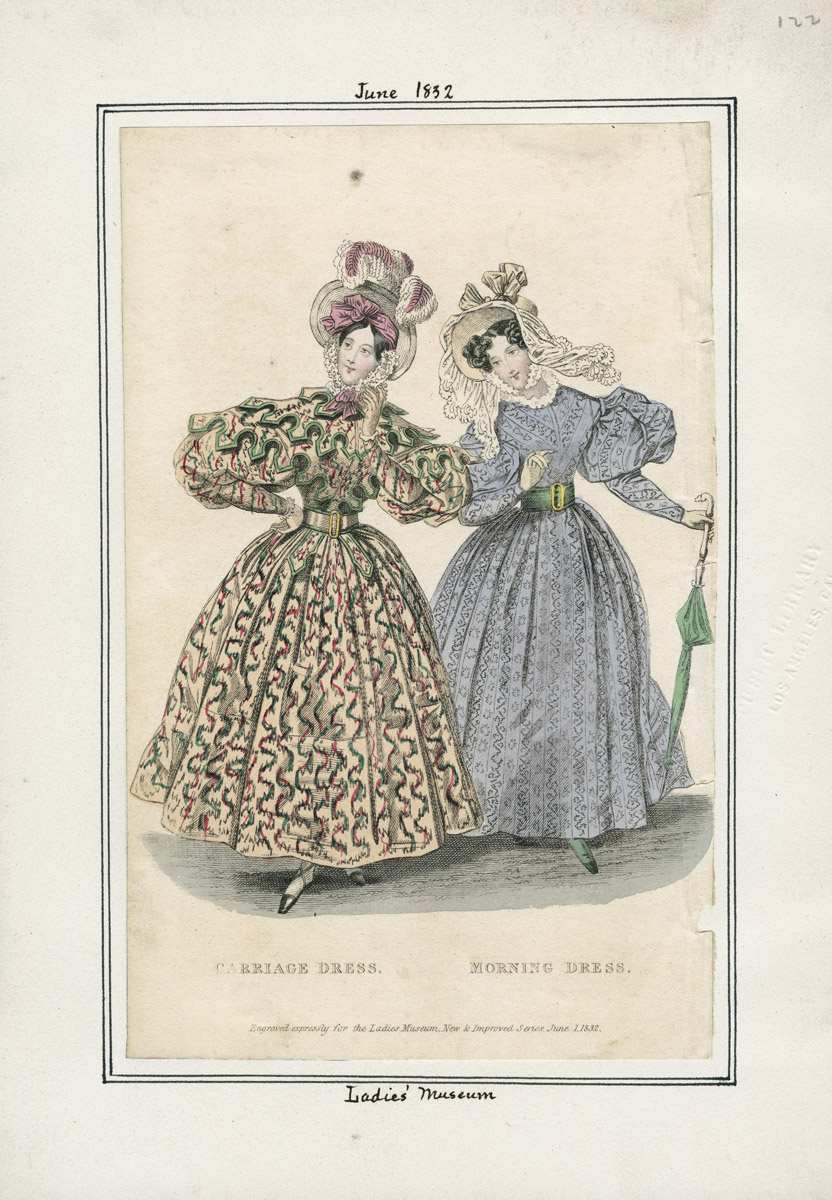
Carriage and Morning Dress, 1832. LAPL Fashion Plate Collection

Carriage and Morning Dress, 1832. LAPL Fashion Plate Collection

So, about that 1833 thing…

No, it’s not that I’m reconsidering. It is merely that as I consider the options, the fashion plates are a bit overwhelming. On the other hand, I am getting really good at recognizing the look of the 1830s in undated portraits. There’s an upside to everything.

Extant garments are fairly plentiful in the Usual Suspects’ Collections; there’s even a Tumblr. There’s a Tumblr for everything.
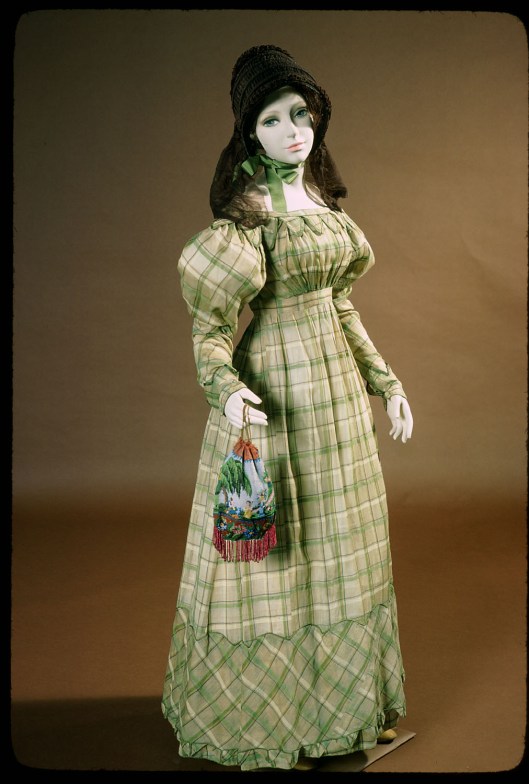
Woman's Green, Tan, Yellow and Blue Striped/Plaid Gown. OSV, 26.33.63

Woman’s Green, Tan, Yellow and Blue Striped/Plaid Gown. OSV, 26.33.63

Fortunately, there are some tamer garments out there, with sleeves less likely to result in flight in a high wind. Bonus: not floral, and not silk. Printed wool seems to have been fairly common, but the weight is just impossible to find. I did some looking in New York, but nothing convinced me with print or price.

This is a milita muster, so there will be time outside. I’m toying with a habit or Amazone (hard to resist a garment with that name) though the most I know about horses is that they have four legs. It’s tailoring that attracts me, not use. Also, wool. Mid-September might warrant wool, even if that’s hard to imagine today. (The downside, of course, is that there’s menswear to be made, too, so a simple dress is surely the best option.)
Share this:

  • Share on Facebook (Opens in new window) Facebook
  • Share on Pinterest (Opens in new window) Pinterest
  • Email a link to a friend (Opens in new window) Email
  • Share on X (Opens in new window) X
Like Loading...

Proper Sewing for Proper Garments

20 Saturday Jun 2015

Posted by kittycalash in Clothing, Making Things, Research

≈ 4 Comments

Tags

advice, Clothing, menswear, sewing, tailoring, technique, thimble

Synchronized sewing

Synchronized sewing

Tailoring: It’s the thing, right? A well-cut, well-fitted, and well-crafted garment fits like no other. Why do you think I prefer my historical clothes? They’re fitted to me, so they feel right.

There are lots of resources, if you’re willing to dig a bit. Last year, thanks to Mr Cooke, I brought you The Taylors’ Instructor. Good stuff, right?

But wait: there’s more. So much more. Not just the V&A Tailoring Reading List. Actual media. You can watch tailors using thimbles properly, and pad stitching with grace and ease. Prepare yourself for the bona fide English accent as Rory (winner of the 2009 Golden Shears Award) Duffy teaches you a thing or two in these videos.

Just want to know about thimbles? Here’s Savile Road Training to teach you technique.

Share this:

  • Share on Facebook (Opens in new window) Facebook
  • Share on Pinterest (Opens in new window) Pinterest
  • Email a link to a friend (Opens in new window) Email
  • Share on X (Opens in new window) X
Like Loading...

Smell Ya Later

16 Tuesday Jun 2015

Posted by kittycalash in Clothing, Fail, History, Laundry, Living History, Reenacting, Research

≈ 9 Comments

Tags

19th century, 19th century clothing, authenticity, clothes, Clothing, common people, historical clothing, historical myths, historical reenactors, history, interpretation, laundry, smell

Wool on hooks, cat on prowl

Wool on hooks, cat on prowl

One of the most common questions you get when you’re wearing historical clothing is the undying, “Aren’t you hot in those clothes?”

A heavily perspiring visitor wearing practically nothing usually asks this question, and the standard reply is a variation of “Aren’t you hot? In really warm weather, everyone is hot. But natural fibre clothing wicks the moisture from the skin and helps to keep you cool.” My internal response (vocalized only once) is, “Why yes, I am—and thank you for noticing. I work hard for this look.”

The “aren’t you hot” question is often followed by, “Wow, and they didn’t bathe, so everyone really smelled.” You try not to think of that Monty Python sketch about Britain’s deadliest joke program in WWII and move the conversation on to weekly laundering of body linen, multiple shifts, shirts, and under-drawers, and the general hygienic practices of the past.

What struck me after a sticky weekend is how much I noticed the smell of modern people.

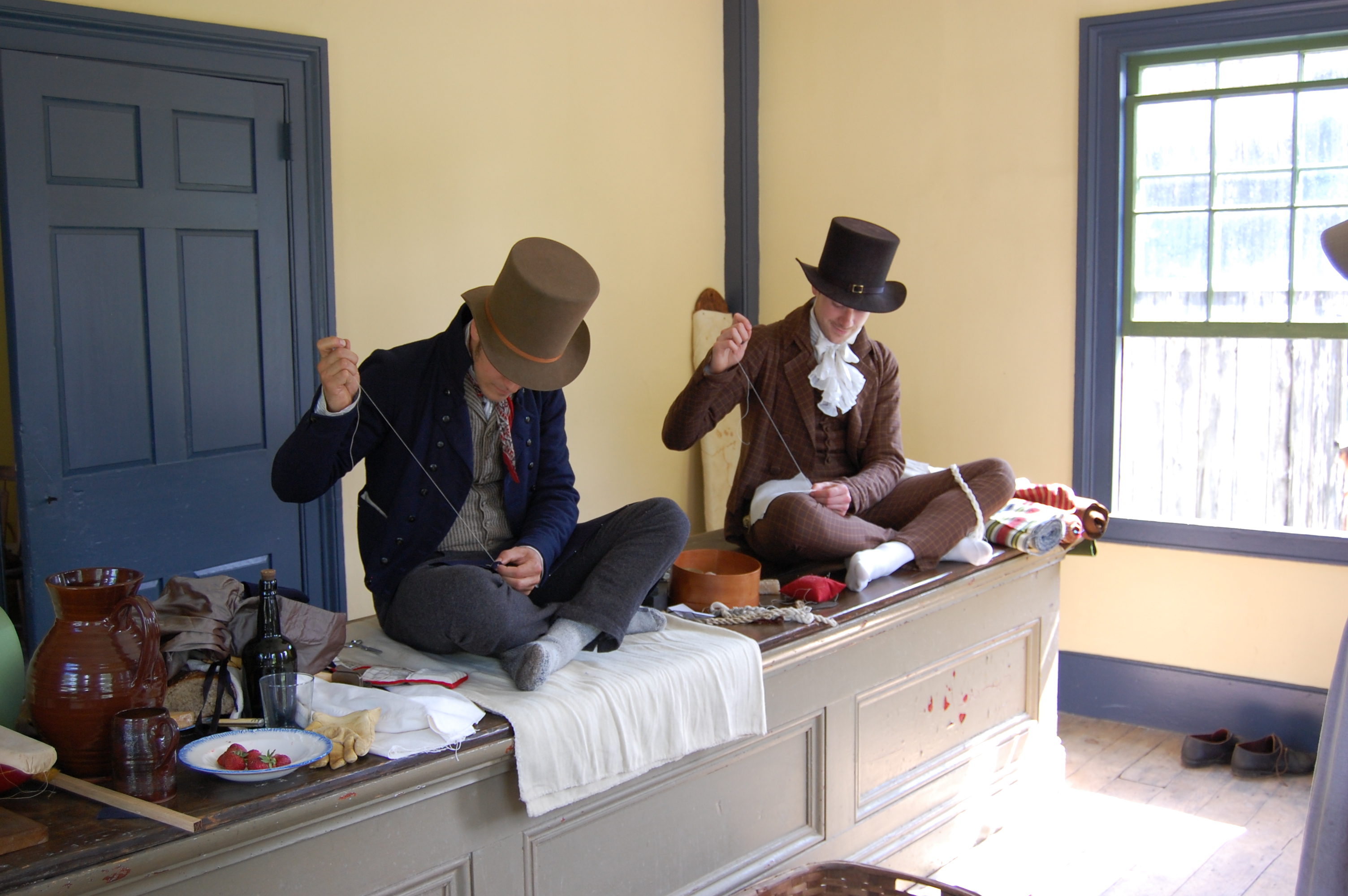
two tailors and a tailoress

two tailors and a tailoress

My traveling companions and I bathed on Friday morning, drove for 7+ hours in muggy weather, slept in our clothes, wore wool, cotton and linen in rain and thick humidity, sweated in the tailor’s shop, slept in our clothes again, and spent another warm, close, day in muggy weather, including grave digging and pall bearing. But as feral as my shift may have been on Sunday night, I never smelled us.

Mr H reported that his wool trousers were really stinky in the rain, and I think his white Spencer was well-seasoned even before this weekend, but I didn’t notice anything. Mr S’s soaking greatcoat was whiffy only at extremely close range.

What I did smell were modern perfumes, deodorants, and hair products. Those linger around their wearers and trail behind them, sometimes eye-watering in their intensity. I encountered lingering perfume in a bathroom at the museum, and we were overwhelmed by cologne at diner Monday morning: wow, people must really smell now, of petrochemicals.

more wool

more wool

This is not to say that homeless people and sulky teenagers don’t smell of unwashed bodies and clothes, but people in the past may not have smelled quite as badly as we think. They washed, if not bathed (bathing being full immersion washing) and by changing body linen and airing their clothes, they kept reasonably clean.

There was plenty to whiff in the past: wastes of all kinds, stagnant bodies of water used as dumps, rotting foods and corpses. But I’m not convinced that we haven’t simply exchanged one set of smells for another of different origin and intensity.

Share this:

  • Share on Facebook (Opens in new window) Facebook
  • Share on Pinterest (Opens in new window) Pinterest
  • Email a link to a friend (Opens in new window) Email
  • Share on X (Opens in new window) X
Like Loading...

Sheer Madness

10 Wednesday Jun 2015

Posted by kittycalash in Clothing, Events, Living History, Making Things, Reenacting

≈ 3 Comments

Tags

19th century clothing, Clothing, Costume, dress, Events, fashion, fashion plates, Federal style, Genesee Country Village, living history, Reenacting, sewing, style

Mercury is retrograde and the schedule is tight, even for me, as I made the plans I’ll put into action at the end of this week: a special event Thursday night at work, followed by mad packing and a drive pretty far into New York.

I did say sheer.

Yes: I am going to Genesee. It’s a long drive from here, so I’m happy to be picking up some friends in Albany (neither of whom live there) for company and some relief behind the wheel. Of course we’re taking our car: it’s the Quartermaster cart.

Since this is one of two occasions when I can portray someone in trade rather than in service (and a better trade than selling fruit on the street), I made a new gown. And a new Spencer. And a new reticule. And cut out a new coat for Mr S, with a newly (fingers crossed!) patterned collar, based on plates in Lapsley and Queen and images texted from a friend.

Yes, I am a little crazy, but it does make life interesting.*

Finished –even hemmed– days before the event!

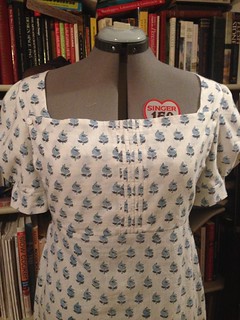
The gown is made from fairly sheer block-printed Indian cotton found on eBay. The pattern is based on one in Nancy Bradfield’s Costume in Detail with a bib front and tucks in the center back. To help with measurements, I also referred to the bib-front dress in the back of Bradfield’s book, as patterned on the fabulous 19th US site, as well as Janet Arnold.

The first bib-front gown I made ended up a little slanted: your mileage may vary, but I find patterning on opioids is not recommended (I sewed while recovering from hip replacement surgery). This one seems a little better, though the fabric came in for some commentary when I was working on this in a room full of light infantry “men.” We devolved from “chicken on flower” to “Seagull on a bush” in describing this buta-like shape. I only bled a small amount on the tucks, despite texting while sewing.

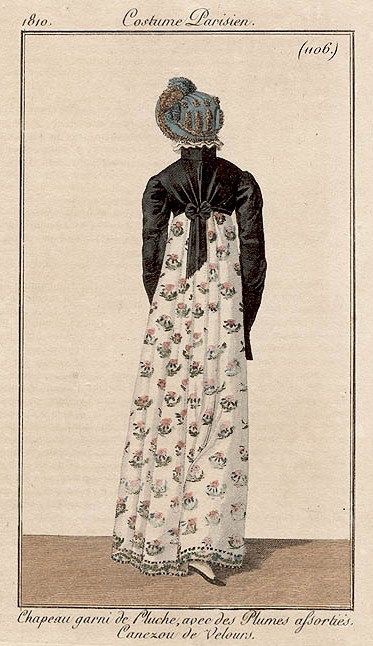
Canezou de Velours, 1810

Inspired by this 1810 fashion plate, I made a black velvet Spencer as well. That’s finished, save for the buttonholes, though there will be no texting while button holing.

Men’s waistcoats often have cotton or linen at the CB neck.

It got pretty matchy-matchy when I did the lining.

You will note that the plate describes a “Canezou de Velours.” Canezou was new to me, and while I don’t trustthe internet too much, here we are with Larousse: Vieux. Corsage de femme en lingerie.

Huh. It seems to be a lightweight-bust length garment for women.

Here’s the OED:

Oxford English Dictionary

canezou canezouHist.

(ˈkanzu)
[Fr., of unknown origin.]
A woman’s blouse-like garment of muslin or cambric. Also attrib.
1827 Lady’s Mag. Sept. 510/2 A canezou spencer of embroidered muslin. Ibid. 511/1 Muslin canezous over high dresses. 1893 G. Hill Hist. Engl. Dress II. 241 A cambric canezou..with sleeves full to the elbow. 1898 Daily News 26 Sept. 6/4 When the Restoration came in 1815,..Fleur-de-lys appeared on everything… The canezou replaced the hideous spencer.


Ah, the hideous Spencer. I rather like them, myself.


*A very long time ago, I had a drawing teacher who said there is never an excuse for being bored. There is always something to do, to see, to observe. That was my first lesson in being present. Perhaps I take this statement a bit too literally.

Share this:

  • Share on Facebook (Opens in new window) Facebook
  • Share on Pinterest (Opens in new window) Pinterest
  • Email a link to a friend (Opens in new window) Email
  • Share on X (Opens in new window) X
Like Loading...

Under the Green Umbrella

06 Saturday Jun 2015

Posted by kittycalash in Clothing, Research

≈ 5 Comments

Tags

19th century, 19th century clothing, British Museum, Costume, fashion, fashion plates, menswear, Metropolitan Museum of Art, museum collections, Museums, style, umbrellas

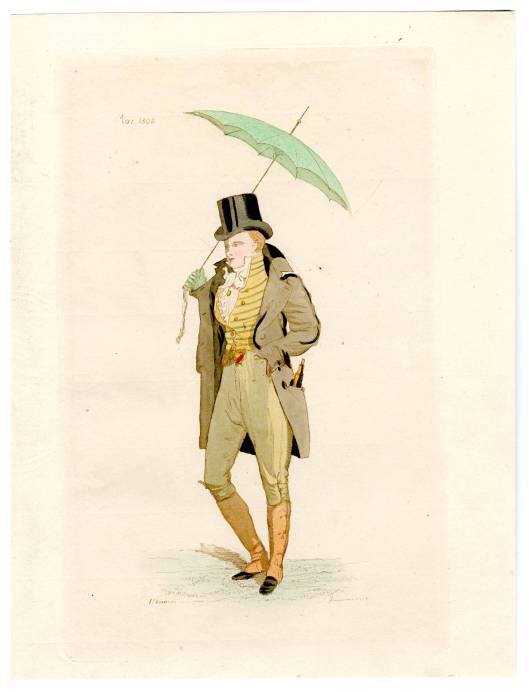
May, 1802. Gift of Woodman Thompson, Costume Institute Fashion Plates, Metropolitan Museum of Art

May, 1802. Gift of Woodman Thompson, Costume Institute Fashion Plates, Metropolitan Museum of Art

How do you like this gentleman? He’s from the Met’s online collection of fashion plates, in Men’s Wear 1790-1829, Plate 032.

I know a gentleman with a similar waistcoat and a similar smirk who needs only the umbrella and spy glass to complete this picture.

In case you’re wondering, the Hull Museum (UK) has a page devoted to a brief history of the umbrella. While classically and stereotypically British, it certainly rains enough here to justify carrying one. The British Museum has 46 trade cards that include umbrellas, with a few pre-1800 examples.

Share this:

  • Share on Facebook (Opens in new window) Facebook
  • Share on Pinterest (Opens in new window) Pinterest
  • Email a link to a friend (Opens in new window) Email
  • Share on X (Opens in new window) X
Like Loading...
← Older posts
Newer posts →

Archives

wordpress statistics

Creative Commons License
Kitty Calash blog by Kirsten Hammerstrom is licensed under a Creative Commons Attribution-NonCommercial-ShareAlike 4.0 International License.

Website Built with WordPress.com.

  • Subscribe Subscribed
    • Kitty Calash
    • Join 621 other subscribers
    • Already have a WordPress.com account? Log in now.
    • Kitty Calash
    • Subscribe Subscribed
    • Sign up
    • Log in
    • Report this content
    • View site in Reader
    • Manage subscriptions
    • Collapse this bar
 

Loading Comments...
 

    %d