• Home
  • Completed Costumes/Impressions
  • Emma and Her Dresses
  • Free Patterns and Instructions

Kitty Calash

~ Confessions of a Known Bonnet-Wearer

Kitty Calash

Category Archives: Clothing

Starting Over, Again

31 Thursday Oct 2019

Posted by kittycalash in Clothing, Living History, Making Things, personal, Research

≈ 4 Comments

Tags

16th century, Events, personal, Research, sewing

Autumn is my favorite time of year, a time for fresh starts and new beginnings. Surely for many, that season would be spring, but for me, after summer’s dreary end, when the world seems stale, flat, and unprofitable, autumn is something else again.

This year, it was the time when my Kickstarter campaign succeeded, I quit a job I hated and stumbled into another that paid twice as much for fewer hours and was situated completely within my competencies. All of that was unexpected and probably hinged almost completely on taking the leap to quit a thing I hated doing.* The most successful moments– the most satisfying ones– come when I start something entirely new that scares me completely and for which I have no script. Those are dramatic and risky: big gestures, where failing will be public and painful.

There are other ways to change, smaller, incremental, but still meaningful, and sometimes still painful. Failure is always an option.** So this fall, in addition to the big changes, I took on some small ones.

I signed up for a Burnley & Trowbridge workshop, An Introduction to Mantua-making. When I signed up, I knew I would need to quit the job I had in order to take the workshop– and I had zero regrets. (There was no way to take three days off that included non-negotiable Sundays). I also knew I would be making a dress in miniature rather than a full-size gown, and I was thrilled: I do not need another gown.

IMG_0377
IMG_0384

What I wanted from the workshop was a skills reboot. I’ve been sewing and fitting clothing off-and-on since I was in middle school, and after a few years making my own clothes, toys and quilts for my son, and exhibition props for work, I took up historical costuming. Along the way, I took some workshops, did a lot of research, and developed habits both good and bad. What I wanted from the workshop was to unlearn my bad habits and acquire new skills, and Brooke Welborn delivered. I understand construction in ways I didn’t before, and now that I’m back home, my sewing is fast again (thank goodness!).

The joy of taking a basic workshop when you’re experienced is that you have a higher likelihood of completing the project, and you get to see a technique laid bare, broken down, and simplified. Sometimes we forget how important a regular, fast, backstitch can be– and how lovely it can be.

Ballet dancers take classes at all levels: they are always working on technique. Apollo or Coppelia: both are built on basic steps repeated endlessly unless perfect and apparently effortless. There’s always something to refine, perfect, polish, re-examine, or an old habit to break. Dancers also take classes in different genres: jazz, modern, ballroom, hip-hop: these require movement and gestures very different from classical ballet, but help expand a dancer’s abilities and understanding. And to that end, I took up something new as well.

I signed up for a new-to-me event at Fort Dobbs, the military timeline. Muskets and guns really aren’t my thing anymore, but the possibility of embarking on a new time period, and a character full of laments, appealed: the Lost Colony of Roanoke. This requires a new realm of research and new garments to make.***

Attributed to Abel Grimmer, The Marketplace in Bergen op Zoom, Flemish, c. 1570 – 1618/1619, probably 1590 and 1597, oil on panel, Gift of Mr. and Mrs. Earl H. Look

Working in the 16th-century aesthetic is pretty different from my usual comfort zone of the last half of the 18th century. Bodied petticoats or kirtles instead of stays; smocks with square neck openings or even collars instead of the more open shift neck; transitioning silhouettes; waistcoats and doublets as well as gowns; coifs and forehead cloths instead of caps: all pretty different. But all helpful in thinking about how fashion evolves, how we get from loose gowns to bodies to mantuas to open robed gowns to chemise gowns. Looking back can help us see the present more clearly, and so it is with fashion.

Detail, Attributed to Abel Grimmer, The Marketplace in Bergen op Zoom, Flemish, c. 1570 – 1618/1619, probably 1590 and 1597, oil on panel, Gift of Mr. and Mrs. Earl H. Look

It has also been an interesting look at the effect of climate on economy, society, and dress. In addition to reading about Roanoke and the archaeology of early English settlements in North Carolina and Virginia, I picked up Nature’s Mutiny from the Library. All the wool and layers make more sense in a period when temperatures were 2℃ colder than they are now. Blom’s arguments began to tire for me (the Times review is fair), but overall, thinking about the push of lower harvests on European exploration of the “new” world was a helpful angle to consider.
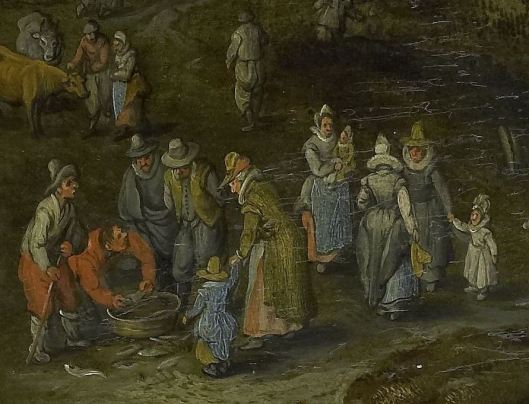
Riverside, Jan Brueghel (I) (copy after), 1600-1650.oil on copper. SK-A-68, Rijksmuseum, Amsterdam

Finishing all the pieces I need to be a sad shopkeepers wife who wishes she’d never set foot on the Lion is a challenge, but the effort has definitely been worth it for all the things I’ve learned along the way.

*Retail was hard the first time I did it of necessity, and several decades in public service made it only slightly easier.

**I am a big Adam Savage fan, and if you’re a maker or just enjoy my blog, I recommend Every Tool’s a Hammer. It was a birthday present this year, but you can likely find it at your local library. Short version? Keep learning, be adaptable, and put your tools away.

***Yes, an entire 1585 wardrobe at the same time I am working on patterns, researching the Lost Colony, finishing commissions, starting commissions, and starting a new short-term contract untangling collections. This kind of load is not new and is a habit that needs unlearning.

Share this:

  • Click to share on Facebook (Opens in new window) Facebook
  • Click to share on Pinterest (Opens in new window) Pinterest
  • Click to email a link to a friend (Opens in new window) Email
  • Click to share on X (Opens in new window) X
Like Loading...

Saturday Afternoon in the Park with Kitty

27 Friday Sep 2019

Posted by kittycalash in Clothing, Events, Living History, Reenacting

≈ Comments Off on Saturday Afternoon in the Park with Kitty

Tags

18th century, 18th century clothes, 18th century clothing, Clothing, living history, Making Things, millinery, Museums, Van Cortlandt House Museum

The strawberries and cream hat, with pinballs and pincushions

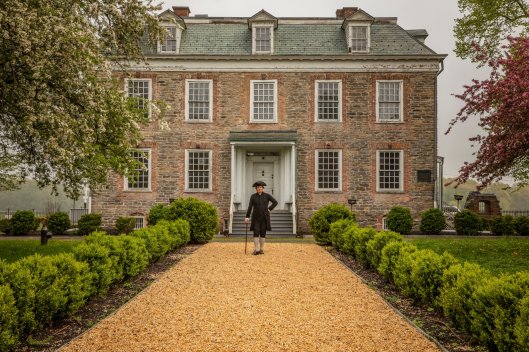
Last Saturday, I enjoyed a beautiful late summer afternoon on the lawn at Van Cortlandt House Museum in the Bronx. Built in 1748 for Frederick Van Cortlandt and his family, the house served as Washington’s headquarters in 1776, and again in 1783.

was  The Van Cortlandt House, dating from 1748, is the oldest building in the Bronx.CreditTony Cenicola/The New York Times

It’s an idyllic site, and waking up to the sound of cricket bats and Canada geese, a visitor could be fooled into thinking you were not in the Bronx at all. Mist rose above the cricket pitch when I woke up, a large flock of geese picking at the grass. It was Netherland come to life, men beating bats on their cleats and laughing. I’m really grateful to Mrs M. for the place to sleep and chance for adventure.

This trip was a remarkable cultural experience for me, and one I really needed. Growing up on the north side of Chicago, I was used to urban density and scale, so after two years in Northern Virginia suburbs, a dose of urban life was welcome. It was all the more welcome because instead of spending my time judged by cats, I got to play with dogs (and earned a sore bicep for all the stick and giraffe throwing I did for one). The trip to Stew Leonard’s was remarkable, after the tame mercantile experiences of tiny Rhode Island, and even Wegman’s paled in comparison. It was a good set up for thinking about mercantile enterprises, impulse purchases, and the ways merchants (including milliners) and shop owners needed to keep customers coming back, tempting them with new goods. (Or, in the case of Stew Leonard’s, singing cows and/or milk cartons.)

More bonnets, most of which are available on Etsy

I managed, somehow, to finish a red silk satin quilted petticoat in time (lined with red “stuff” from Burley and Trowbridge, it was not too bed-covering like until the late afternoon) to dress up the Nancy Dawson dress. I didn’t manage to locate my sleeve ruffles in time ( stitched on a garment ) but in other regards, I was pleased with how this turned out.

Bathroom selfie, but you can see that sweet silk petticoat

Dressing my clothes up– that is, moving them up the social ladder– can be a challenge, but good accessories make a big difference. Eventually I will get a finer apron made, one with a ruffle, but for now, that has to wait.

With Lark, perhaps the sweetest little rescue pup I’ve ever met.

I have a trip to Philadelphia to make, bottles to label, and receipts to write. Elizabeth Weed returns to Carpenters Hall this weekend as part of the Occupied Philadelphia programming.

Share this:

  • Click to share on Facebook (Opens in new window) Facebook
  • Click to share on Pinterest (Opens in new window) Pinterest
  • Click to email a link to a friend (Opens in new window) Email
  • Click to share on X (Opens in new window) X
Like Loading...

“Now Selling at Prime Cost”

28 Wednesday Aug 2019

Posted by kittycalash in Clothing, Living History, material culture, Reenacting, Research

≈ 2 Comments

Tags

18th century, kickstarter, living history, merchants, milliner, millinery, millinery shop, women's history, women's work

Although I’ve portrayed a milliner before, the earliest iteration has been as a shopkeeper in August, 1804, so I thought it best to refresh my knowledge of what 18th century milliners advertised. (Deep dives into bonnets help me focus on bonnets, but necessarily what else was being sold.)

Pennsylvania [Philadelphia] Packet, January 15, 1772.


One of my favorite ads is from the January 15, 1772 Pennsylvania Packet. Mary Symonds of Philadelphia published an extensive list of goods, many of which will lead you down a rabbit hole. Three of the listings had particular appeal.

“Womens’ and childrens’ black and coloured silk, Dunstable and chip hats, and bonnets”

“Black and coloured silk” almost surely encompasses the range of colored silk bonnets seen in Boston advertisements, but what’s the difference between Dunstable and chip hats? Price, of course. What most of us think of, or call, “chip” hats should be called Dunstable or simply straw.

Silk covered chip hat, Snowshill Wade Costume Collection, NT 1349840
Detail, silk covered chip hat, Snowshill Wade Costume Collection, NT 1349840

Chip hats like the one above in the Snowshill Wade Costume Collection, were made of plaited (woven) thin strips of wood, more like flat baskets or chair seats.

Straw hat, Snowshill Wade Costume Collection, NT 1349843
Detail of straw hat, Snowshill Wade Costume Collection, NT 1349843

Straw hats, like the one above (also in the Snowshill Wade Costume Collection) are clearly finer than chip and do not need to be covered. The earliest description of the distinctions between hat types that I’ve found thus far is from 1815, in “An Encyclopæaedia of Domestic Economy, Comprising Such Subjects as are Most Immediately Connected with Housekeeping etc etc” which goes into some detail.


The most entertaining discussion I found was in  The Sessional Papers Printed By Order Of The House Of Lords, Or Presented By Royal Command, In The Session 4 And 5 Victoriae And The Session 5 Victoriae 1841. The recorded exchange resonates with current discussions of tariffs on imports, but the really revelatory bit is this:

Class distinctions expressed in materials and apparel are eternal.

“Tobines” were new to me (or at least forgotten) and have nothing at all to do with the bishop of Providence. Thankfully, Textiles in America has the answer: “A wide variety of dress materials from fine silks to silk and worsted, and linen and cotton combinations that have warp-float patterns of small flowers or intermittent stripes and dots.” (p 367). Once you’ve seen it, you realize you’ve seen it before.

Berch papers, Nordiska Museet.

“Childbed baskets” were also a new concept to me, but The Female Reader, Or, Miscellaneous Pieces in Prose and Verse; Selected from the Best Writers, … for the Improvement of Young Women illuminated the term; the current equivalent is a layette set that includes bedding, and goes beyond the crocheted sweater, cap and booties some of us came to fear receiving. (Mint green acrylic? really?)

It’s a wide range of goods for women to buy (including small accessories for the men and boys in their families), and somewhat beyond the bonnets-hats-jewelry-trimmings we typically associate with milliners. While I don’t have any plans to start manufacturing chip bonnets or making up childbed baskets, I am definitely intrigued by the possibility of expanding my “offerings.”

Share this:

  • Click to share on Facebook (Opens in new window) Facebook
  • Click to share on Pinterest (Opens in new window) Pinterest
  • Click to email a link to a friend (Opens in new window) Email
  • Click to share on X (Opens in new window) X
Like Loading...

A Little Black Bonnet

02 Tuesday Jul 2019

Posted by kittycalash in Clothing, Living History, Making Things

≈ 1 Comment

Tags

18th century, 18th century clothing, authenticity, bonnet, common dress, helmets, milliner, millinery


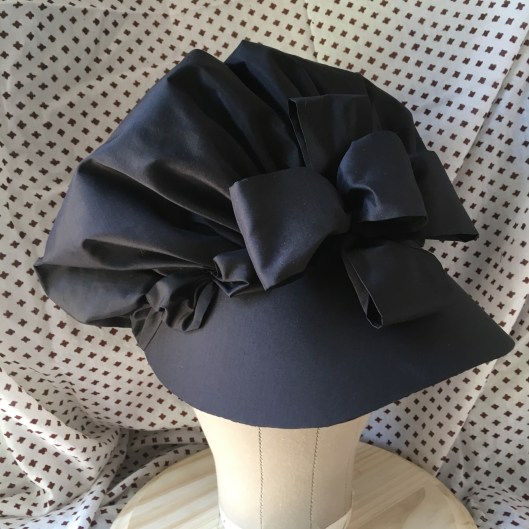
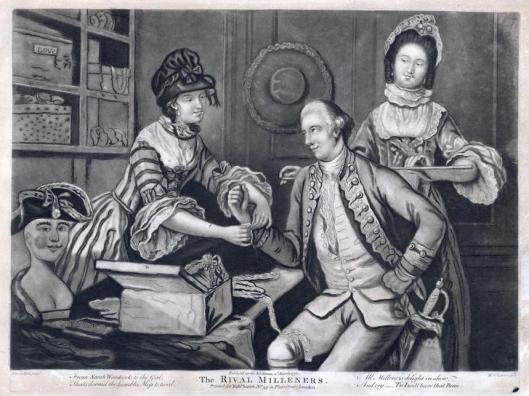
Practically everyone needs one, and like the Little Black Dress, the little black bonnet flatters practically everyone, too. In finishing up some inventory projects, I went back to basics and made up a black silk taffeta bonnet with trimming inspired by “The Rival Milleners.”

The Rival Milleners.

Really, it’s a look that’s hard to resist, the black bonnet with poufs and bows. I’ve always loved my black bonnets, but now I might need to trim another one up for myself– if I can only make the time. Up on Etsy if you want one for yourself (along with some other colors, too).

Share this:

  • Click to share on Facebook (Opens in new window) Facebook
  • Click to share on Pinterest (Opens in new window) Pinterest
  • Click to email a link to a friend (Opens in new window) Email
  • Click to share on X (Opens in new window) X
Like Loading...

A Bonnet, Universally Acknowledged

11 Monday Feb 2019

Posted by kittycalash in Clothing, History, Living History, material culture, Reenacting, Research

≈ 2 Comments

Tags

1770s, 18th century clothes, American Revolution, authenticity, bonnets, Boston, living history, millinery, Research

Print made by James Caldwall, 1739–1819, British, A Ladies Maid Purchasing a Leek, 1772, Yale Center for British Art, Paul Mellon Collection

“It is a truth universally acknowledged that if a bonnet existed in the 1770s, it was black taffeta” has long been the rule reenactors have followed, particularly those wanting to adhere to the strictest standards of well-researched impressions based on primary source documents and period material culture. Truth examined is more subtle, showing that bonnet colours, materials, and shapes varied from decade to decade—and year to year—and that these factors seem to have varied by region. What worked in Boston would not be comfortable in the Carolinas, and people adjusted accordingly.

I was asked recently about Boston-area bonnets in the first half of the 1770s. My impression of this decade is that it is one in which there is a stylistic change in women’s headwear, as the “sunshade”* and “Bath” bonnet terms fade from use, giving way to plain “bonnet” or “chip” bonnets. These appear to have been made from “bonnet paper,” seen in both blue and white** in newspaper ads, though prints and paintings show brims in both boned and paper forms.

The Rival Milleners. Mezzotint after John Collet, 1772. Colonial Williamsburg Foundation, 1955-125

Brim shape and bonnet material— fabric and colour–  vary by period (and region). So let’s look at Boston in the first years of the 1770s. One tricky bit is that there are fewer indentured servants and enslaved people in Boston than elsewhere in the American Colonies in this period, so runaway ads are scarce, giving us fewer clues than we get in Pennsylvania and points south. Still, there are plenty of ads to help guide us.

As early as 1769, we see color variations, with the mention of “black, blue, green, white, and crimson bonnets” in Caleb Blanchard’s store. The year before, Joshua Gardner and Company advertised “black, pink, blue & crimson sattin hats and bonnets.” That means that on the streets of Boston and environs, by 1775, you’d see half-worn black, blue, green, white, crimson and pink satin bonnets.

The best statistics around for bonnets are currently tabulated for Pennsylvania, and definitely show the preponderance of bonnets are black (52 of 75 tabulated, or 69%). So don’t give up on black silk bonnets! They are the most common color. If we extrapolate these statistics, for a Pennsylvania event in the 1770s, of every 10 bonnets, seven should be black, one should be white, one should be green, and one should be blue. In larger groups, we’d also see red and brown bonnets, but again, just one in 20 or 30.

The Boston Gazette, April 4, 1774. Benjamin Franklin’s sister advertises “Sattins of the newest Fashion… for Bonnets.”

“A few sarsnet taffety bonnets,” in the Boston Evening Post, September 28, 1772.

For Massachusetts, statistics are more difficult to compile, given the dearth of runaway ads and the fact that I haven’t yet dived into inventory and probate records. Merchants’ ads give us some clues as to materials, and one thing I find is that “sattin” shows up, as well as “sarsnet taffety” or pelong. Sarsnet or sarcenet was a “think transparent silk of plain weave,” according to Textiles in America. Thicker than Persian, sarcenet was woven both plain and twill, and could be plain or changeable. Pelong is a kind of silk satin, again according to Textiles in America, and in The Dictionary of Fashion History, described as a kind of “thin silk satin,” but I have also seen it described as a ribbed silk. Joshua Blanchard advertised “Pelong sattins of all colours” in 1768. Where does that leave us with materials? Probably with the need for more bonnets to be made of silk satin than of silk taffeta, though the proportions are difficult to calculate yet.

Miss Theophila Palmer (1757-1848), oil on canvas, attributed to Sir Joshua Reynolds ca 1770.

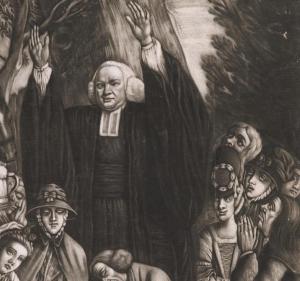
What about shape? For those dressing a la mode, we are past the deep-brimmed, small-cauled “lampshade” of the 1760s, and into a smaller, tighter bonnet with a larger caul and more trimming. In the portrait of Miss Palmer, we see how the brim stands away from the face, and the caul or crown poufs up. “A Lady’s Maid Purchasing a Leek” and “The Rival Milleners” (aee above) both depict women in similarly tight-brimmed and round-crowned bonnets trimmed with bows. These are shapes that I am confident appeared almost universally (with variations) in the American colonies in the first years of the 1770s. Now, there are different shapes to be sure, but these seem to predominate. I do think we need to see more brims that wrap around the head, as seen in the 1774 mezzotint of George Whitefield (Anglo-America’s most popular preacher) and his followers.

Detail, A Call to the Converted. Publish’d April 15, 1774, by W. Humphry . Lewis Walpole Library, 774.04.15.01+

So what’s the take away, if we are looking specifically at Boston and environs in the first half of the 1770s?

  1. Most bonnets (70%) were black, but a few white, green, crimson, and blue were seen.
  2. Most bonnets were made of silk satin, with others of taffeta or sarsnet (sometimes twilled silk).
  3. Most bonnets would have a shorter, higher brim that curves across the face just above eye level, with a high, rounded crown/caul and bow trims.
  4. Bonnet brims would vary between bonnet (paste) board and boned

Each place has a local style– which, if you think about it, is still true today. When I stand on the Metro platform in the red wool coat I bought in Providence, these folks know I’m not from here. The way we dress for the past should reflect the place and the time we are representing as best we can. And that means we need accessories to match those times and places, as well as clothes.

And yes, full disclosure, I sell researched bonnets on Etsy. If you want a bonnet for a particular time and place, that’s what I make.

* Known on this blog as “lampshade”
** Nope, don’t know what that means yet, haven’t looked into it

Share this:

  • Click to share on Facebook (Opens in new window) Facebook
  • Click to share on Pinterest (Opens in new window) Pinterest
  • Click to email a link to a friend (Opens in new window) Email
  • Click to share on X (Opens in new window) X
Like Loading...
← Older posts
Newer posts →

Archives

wordpress statistics

Creative Commons License
Kitty Calash blog by Kirsten Hammerstrom is licensed under a Creative Commons Attribution-NonCommercial-ShareAlike 4.0 International License.

Website Built with WordPress.com.

  • Subscribe Subscribed
    • Kitty Calash
    • Join 621 other subscribers
    • Already have a WordPress.com account? Log in now.
    • Kitty Calash
    • Subscribe Subscribed
    • Sign up
    • Log in
    • Report this content
    • View site in Reader
    • Manage subscriptions
    • Collapse this bar
 

Loading Comments...
 

    %d