• Home
  • Completed Costumes/Impressions
  • Emma and Her Dresses
  • Free Patterns and Instructions

Kitty Calash

~ Confessions of a Known Bonnet-Wearer

Kitty Calash

Category Archives: Fail

Authenticity Measur’d in Moments

30 Thursday Oct 2014

Posted by kittycalash in Events, Fail, History, Living History, Philosophy, Reenacting

≈ 10 Comments

Tags

authenticity, historic houses, history, living history, military events

Chopping wood: it takes  a lot to cook and to keep warm in 1799

Chopping wood: it takes a lot to cook and to keep warm in 1799

In the post-What Cheer Day aftermath, when I was very tired and two houses were very messed up, I started thinking about why I bothered with living history. What exactly is this thing, and why I do it? Those questions made me think about the very best moments I have had in this business of re-creating the past in cloth and smoke and time.

In no particular order:

1. Going up to the field at Coggeshall Farm to call the boys down to dinner after spending all day in the kitchen. I was desperate to get out, and finally knew first hand how limited women’s lives could be in the 18th century, especially non-elite women.

2. Running upstairs at the John Brown House with Eliza, giggling over a joke to be played on Mr Mason. I don’t know what Mr C thought of it but I felt twelve years old, silly, carefree and light. John Brown’s housekeeper surely never felt that way, but a naughty maid might have, and for an instant I knew what it was to have no responsibilities.
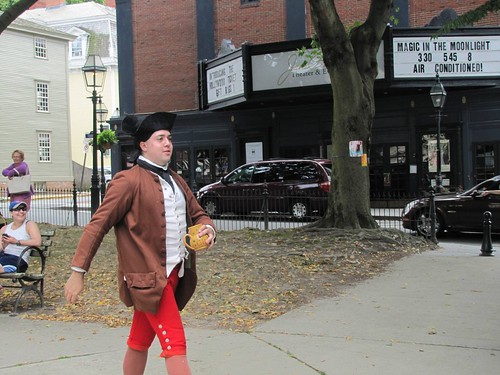
We didn’t even notice the background at the time

3. Chasing the Young Mr, a wayward apprentice, across the street; mobbing Mr Howard’s house; and arguing with the Stamp Inspector, all during the Stamp Act Protest in Newport It was not until I looked at the photos that I realized we really had been in front of a theatre, and that there were actual cars! A friend confirms that he, too, forgot about the cars, to the point of nearly being hit whilst running to Mr Howard’s house.

4. Assembling with a group of friends to take tea with Mrs Silsbee in Salem, sorting ourselves into a group on the sidewalk and venturing out, only to meet Mrs Silsbee on the street. That is the most Jane Austen/Mrs Gaskell I have ever felt. The wretched cobblestones do not count, as they were from the 20th century, but walking out on the wharf, and meeting a friend who brought an umbrella as the rain began was also very Austen-esque.

Perhaps more Gaskell than Austen, here

Perhaps more Gaskell than Austen, here

None of these are military events, and the majority of them happened this year, in past three months. I think this may be because we have been to fewer military events, and I expect the concentration is due, in part, to finally getting better at this practice. They are also site-specific, and trending toward first-person interpretation.

Coats

Those coats.

For reasons explained better by the NPS and in the excellent study of NPS-Reenactor relationships, no battle reenactment can ever capture the truth of the war it attempts to recreate, and that is true even when the battle takes place on the same site, at the same time of year, and even when soldiers are dressed in as-close-as-possible replicas of the uniforms worn at that battle, on that field, on that date, 236 years earlier, and no one has brought a spinning wheel or tent chandelier to camp.

I respect the notions of moveable monuments and performances as commemoration. I like military history, I like war memorials: there is not a competition between civilian and military reenactments. But military events have not yet had the power to transcend experience for me.

My best guess as to why military events are not transformative for me is that, to this point, the business remains too much like camping in funny clothes. As I experiment more with 18th century methods of cooking appropriate rations, and as I strip away the gear we carry into the field, the military events are better (as at Bennington). But I already know how limited women’s perspectives could be (see item 1), and while Bennington was instructive in how ridiculously different the experiences of men and women could be, the military events remain more instructive experiences for the men.

18th century camp

Domesticity in the Field

Why? Because the specificity of site plays out at those events in the battle, and not in the camp. The point at Bennington and at Saratoga and at Stony Point was to use the site as it had been used. The men experienced the landscape in ways as close as possible to what soldiers and militia had actually seen. And women stayed in camp and got smoke in their eyes, cut up vegetables, or washed clothes, which is pretty much what happens at any outdoor event where we can have a fire and, with differences in technology, is pretty much what I do when I get home from work every day.

All that leaves me wondering what to make of military events, and what I want to do in the coming year. No matter how much of this is “for the public,” it still has to be rewarding for the practitioner.
Share this:

  • Share on Facebook (Opens in new window) Facebook
  • Share on Pinterest (Opens in new window) Pinterest
  • Email a link to a friend (Opens in new window) Email
  • Share on X (Opens in new window) X
Like Loading...

Woolen Woes

08 Wednesday Oct 2014

Posted by kittycalash in Clothing, Fail, Living History, Making Things, Research

≈ 7 Comments

Tags

19th century clothing, Costume, dress, failure, fashion, fashion plate, Federal style, Joseph Taber, living history, Making Things, Providence Journal, Regency, Research, sewing, Spencer, Spencers, style

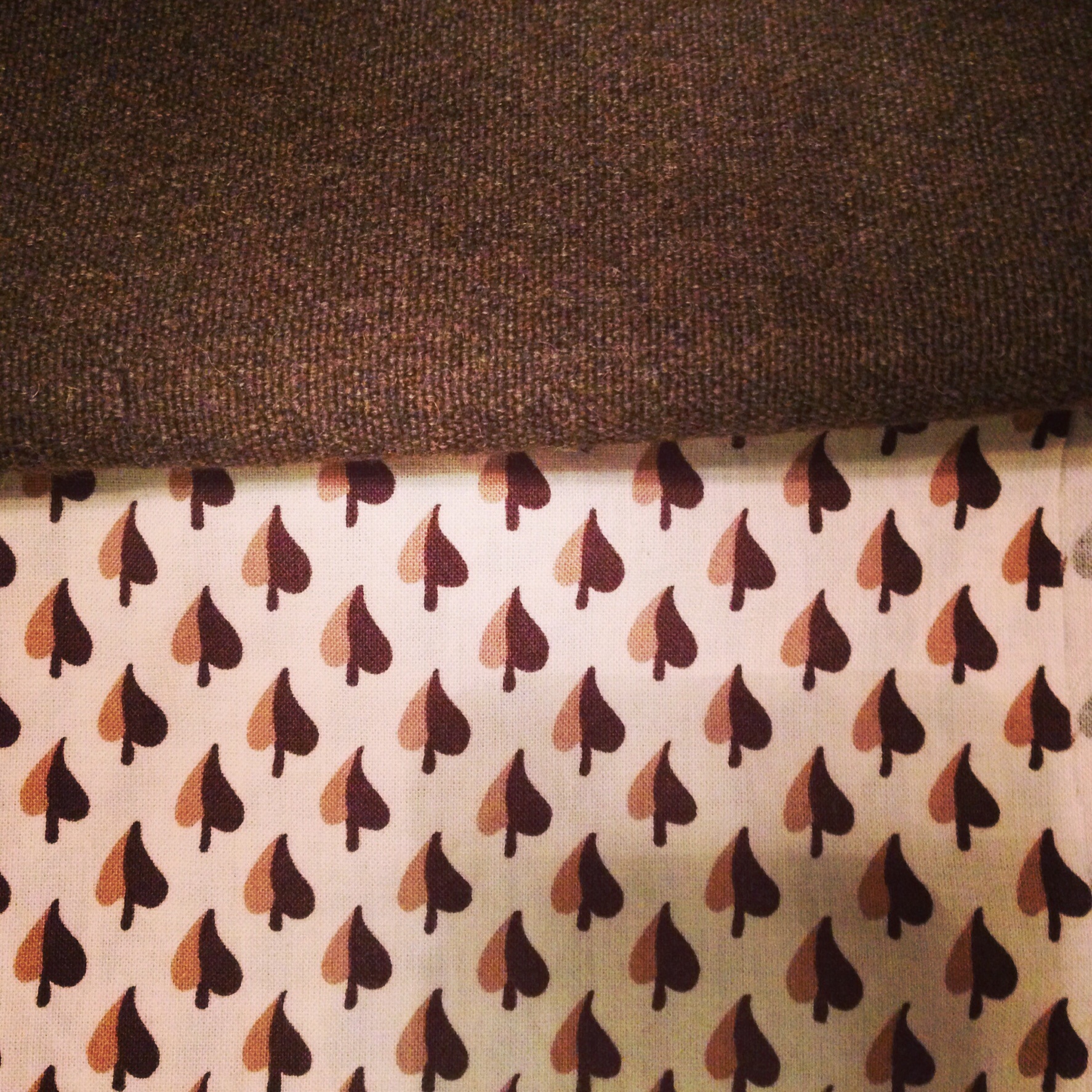
imageOn Saturday, I got a very nice piece of wool from Mr C’s Strategic Fabric Reserve, just the color and weight I’d been looking for to make a Very Specific Spencer. The VSS is not a replica, but rather specific to a gown: I want it to go with a 1797 V&A print.

Did women wear Spencers in 1797-1800 Providence? At least one tailor, Joseph Taber, advertised that he made Habits and Spencers, but as far as I know, there are no extant Rhode Island Spencers. Given how few collections are fully online here, and how few Spencers survive anywhere, I’m not too surprised. Julia Bowen’s diary covers Spring and Summer, when she’s quilting (mighty lazy work, she says), but she doesn’t say much about outerwear.

Providence Journal, 11-13-1799

Providence Journal, 11-13-1799

I’ve been on the fence about how common Spencers were– after all, the drawings in Mrs Hurst Dancing show women clearly wearing red cloaks– but might a Spencer and cloak combination have been just the thing to keep warm on a raw October day? With a wool petticoat and long wool stockings, you could be fashionable and warm.

There’s no firm documentation of any of that– which does not mean, as I once muttered in the general direction of some recalcitrant docents, that rich people in Providence hunkered naked in cold corners of curtain-less rooms gnawing on raw meat.** What it does mean is that much of what we make and wear is conjecture, based on examples from the same time period in other geographic areas.

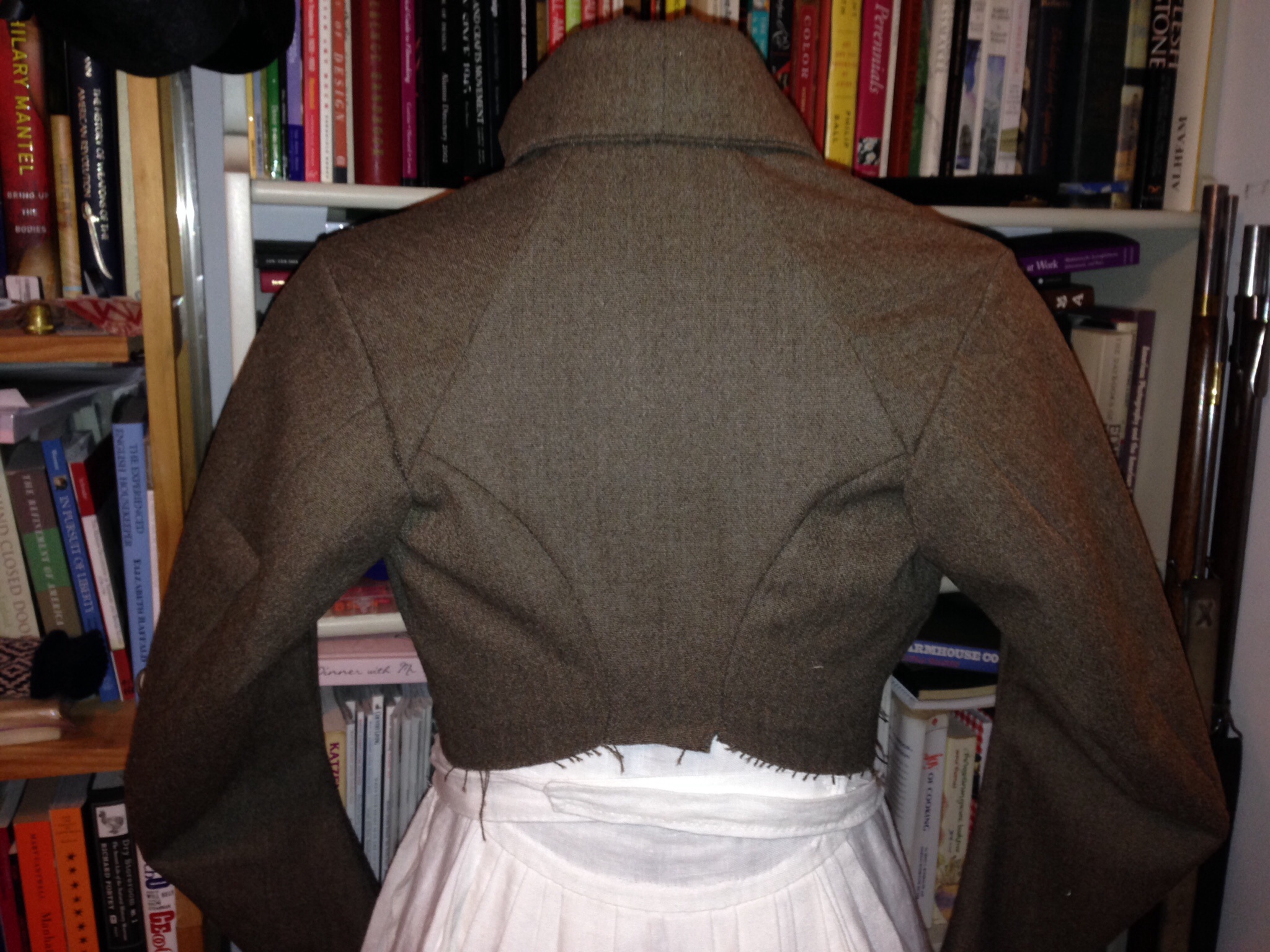
Can I have a Spencer in New England? I’m not sure, but I’ve made another one anyway, and here it is, still underway. (The thing about Cassandra is that while she is a very patient model, she has terrible posture. I can verify the back fits me a great deal better than it fits her.)

Cassandra's posture is very different from mine. She will not pull her shoulders back!

Cassandra’s posture is very different from mine. She will not pull her shoulders back!

This wool is buttery and soft, and takes the needle well. Waxed thread glides through it and grips. It does have a tendency to fray a bit at the cut edges, but has a good pinked edge, and there are examples of pinked-edge facings in extant men’s wear. Sweet, right?

I’m not showing you this to boast about my skills, but to show off an dandy mistake. In working the folded edge of the collar, I trimmed a bit too much at the neck edge, and found the collar a bit small when I basted it in. Of course I removed it, and started again, easing a bit more as I went: Huzzay! It fit!

Really, I'm not sure how this happened. But there it is: upside down.

Really, I’m not sure how this happened. But there it is: upside down.

Oh, reader: rejoice not. I backstitched that bad boy on upside down. Expletive deleted! Mad Skillz: I even managed that bit of genius before my pre-work panic attack.

I took the garment in to work to seek council from my tailoring-class-educated friend who possesses native common sense and Yankee practicality. It came down to this: is it worse to have the collar upside down, or to have it not fit as well right side up? Decide with the knowledge that working the fabric more will affect the cut edge badly. My friend suggested stitching in the ditch with contrasting thread to make this flaw an Intentional Design Element.

Black trim on a Spencer?

That is a good idea, but I thought the flaw will still be too noticeable. Then it came to me: trim. Just as the construction guys are spreading drywall mud in the chinks around the window frames, I can spread some wool braid love around this collar. There’s certainly evidence for trim use on Spencers in fashion plates, and trim would push the men’s wear aspect of this garment even farther. As soon as I got home, I double-checked extant garments and fashion plates, Roy Najecki’s lace page, and measured my edges.

Four yards of quarter-inch black mohair braid should do the job, stitched around the edge of the collar and lapels, the cuffs and possibly the hem edge.

Do I run the chance of looking like a black-outlined cartoon drawing? Yes.

Did I just buy endless hours of tiny stitching? Yes.

This is a crazy, work-making solution that may leave me with a garment not suited to my class in early Federal Providence. But I think it’s going to look amazing when it’s finished.

**(The docents argued that textiles were SO RARE and SO PRICY in late 18th century RI that NO ONE in Providence had curtains. NO ONE. The lack of fire was my own bitterness coming out at this Great Curtain Kerfluffle which took place at a public lecture I gave explaining what we knew about the use of textiles to furnish Providence homes of people who would be as rich as Bill Gates today.)

Share this:

  • Share on Facebook (Opens in new window) Facebook
  • Share on Pinterest (Opens in new window) Pinterest
  • Email a link to a friend (Opens in new window) Email
  • Share on X (Opens in new window) X
Like Loading...

Malaise or Ennui?

09 Tuesday Sep 2014

Posted by kittycalash in Clothing, Events, Fail, Living History, Making Things, Philosophy, Reenacting

≈ 17 Comments

Tags

19th century, 19th century clothing, authenticity, Clothing, common dress, Costume, Events, fashion, history, interpretation, Newport, Newport Historical Society, Quaker, Quakers, Rhode Island, Rhode Island history, style

image Hard to say which, but I am ill at ease and dissatisfied with my costuming. You might even call it bratty. But I don’t wanna be like Bridget Connor!

It started the week of the Stamp Act protest, when I felt quite tired of being the shabby, unrefined woman of the regiment and street vendor, and wanted a nice cozy shop like the milliner had. I was also looking forward to being a housekeeper again, and several weeks of moving boxes and volumes with red rot at work had me feeling generally filthy and unappreciated. Bratty.

When in doubt, sew. A new dress can’t help but cheer you up, right?

Well… sort of…

Last Thursday, we did a reprise of the Williams family letters program at the Newport Historical Society. The Williams family were Quakers, and the letters were from the early part of the 19th century, so for the program in March, I made a green silk cross-front gown based on the Quaker gown in the back of Costume in Detail. (Check out the schematic on the 19thus.come page; I didn’t see this until I was mostly done with the dress, but thank goodness I got it right!)

But it’s September, and Thursday was expected to be quite warm, so I salved my bureaucratic wounds in the $1.99 loft at the local mill store, and made a new Quaker gown, also suitable for a maid.

I ask you! Even though it’s my very own pattern based on sketches of original drawings, even though it fits, even though it cost $10, even though every seam is overcast and the whole thing is made with period correct stitches, it still fails to make me happy and cheerful and delighted.

image

This brattiness has resulted in a reappraisal of my approach– and a trip to Sewfisticated in Framingham. What did I buy there? Yards and yards of pink taffeta? Gold taffeta? Blue taffeta?

No.

Because they didn’t have the right colors in the right weave– too slubby– or in enough yardage. Brace yourselves: I bought brown.

Many thanks to Sew 18th Century for taking the photos!

Many thanks to Sew 18th Century for taking the photos!

It appears I do not learn from my mistakes. When I think, “Gee, I’d like a pretty dress,” I end up buying fabric based on the texture as much as the color, and I have to tell you, that brown taffeta has the most wonderful l hand and sheen, and I will look much more like a Copley portrait than I ever have before, so that’s something.

It seems I have created a set of mental rules for myself, a mission, if you will, for the historic clothing I sew and the roles I take on, and I only play within those rules.

Share this:

  • Share on Facebook (Opens in new window) Facebook
  • Share on Pinterest (Opens in new window) Pinterest
  • Email a link to a friend (Opens in new window) Email
  • Share on X (Opens in new window) X
Like Loading...

On Wanting to Quit the Hobby

29 Friday Aug 2014

Posted by kittycalash in Fail, Living History, personal, Philosophy, Reenacting

≈ 8 Comments

Sometimes I want to quit this hobby.

It’s usually for selfish, petty reasons: for all I swear that I didn’t see the trash compactors and cars in Newport, spinning wheels, cast iron, and candelabra in dining flies made me nuts at Bennington. Why the difference? In Newport, the modern things were all backdrop and unchangeable. At Bennington, reenactors had choices.

Why would someone else’s cast-iron kitchen make me want to pack up my sticks and go home? Maybe because I’ve been very tired this summer. But more honestly, I have a streak of self-righteous grade-grubber: “I work hard at this, why can’t you?” was surely my internal whine as I surveyed the mess area at Bennington.

My emotional immaturity aside, I think that same “I get this, why can’t you?” is felt by a lot of reenactors/interpreters when they stand in their well-researched, hand-sewn, and agonized-over clothes in a Spartan camp watching the public interact with sofa-print-gown- or baggy-breeches-wearing cooks bent over cast iron in camps littered with slat-back chairs, folding tables, and candlesticks.

We feel unappreciated. We feel like no one recognizes our hard work. We are not getting the grade we deserve.

We need to get over it.

Don’t abandon the authenticity: abandon the attitude. Abandon the eye-rolling, the snubbing, the sneers, and the turning away.

Comparison is the enemy of contentment. Even when you think you’re better.

Stop playing the “I’m more authentic than you” game. It sucks. It makes people want to quit this hobby. It makes people want to skip events.

You want to have events where only people who meet your personal authenticity standards can play? Knock yourself out. Keep it private. In privacy, be as catty as you like with people who enjoy it, but keep it in the real world and not online. Online, it comes off as passive-aggressive cowardice.

Right?

Right?

Not everyone wants to play the same game. But no matter what the game is, it’s never fun to be the butt of meanness, and it’s not really fun to be mean—plus, it’s bad for your health, bad for the hobby, bad for the people around you.

We’re visual creatures: we can over-focus on what we see. We focus on the clothing being worn instead of the person inside those clothes. But really, it is the person who is important.

So maybe we should lighten up a little.

So maybe we should lighten up a little.

Individual choices don’t always affect a group. When choices do affect a group—cars in camp past stated removal times, weapons and fire safety violations—then I think anyone can and should speak up. But violations of published and easily accessible standards should be pointed out to event organizers, and not handled at the individual level. When there are no published and readily accessible shared standards, there’s nothing to enforce. So consider stepping down from the fashion police and enjoying yourself instead. I’ve been to very few events without redeeming factors.

Lighten up!

All that iron at Bennington? Forgotten when I focused on what I was doing: cooking something new in camp, and forgotten even more when I shared the pudding and compote with my friends.

That’s why I don’t quit this hobby: it allows me to share amazing experiences with my friends, I learn new things all the time, and I get far outside my petty worries.

Share this:

  • Share on Facebook (Opens in new window) Facebook
  • Share on Pinterest (Opens in new window) Pinterest
  • Email a link to a friend (Opens in new window) Email
  • Share on X (Opens in new window) X
Like Loading...

Measure for Measure

12 Tuesday Aug 2014

Posted by kittycalash in Fail, Food, History, Living History, Reenacting, Research

≈ 5 Comments

Tags

10th Massachusetts, 18th century, authenticity, common people, cooking, experimental archaeology, food, living history, Research, resources, Revolutionary War

or, a boiled Flour Pudding in two tries.

14699830917_63d67ffee0_b
Tablespoons and Cups

Alone in my Ossining ca. 1962 kitchen, I decided to tackle Amelia Simmons. The first task seemed to be to establish measurements, and then proportions, so I took stock of the tools and containers I would have in a typical camp. Spoon, mug, half-pint: these are plausible items, though we have tin cups that hold exactly 8 ounces, so the measure is unnecessary. The spoon was cast from a 1780 mold, so it seemed like a reasonable place to start for “how much is a spoon?” It will hold exactly one tablespoon if you scrape it flat across or are measuring liquid. Handy to know.

Next, I checked the recipe again.

A boiled Flour Pudding.
One quart milk, 9 eggs, 7 spoons flour, a little salt, put into a strong cloth and boiled three quarters of an hour.

This is not a popular receipt, so you won’t find it on History is Served, nor will you find this version on other popular sites; you can find a boiled pudding with suet, but that’s not what I’m after: I’m after a receipt that starts with a portion of the ration of flour soldiers received, and adds only eggs, milk, and available seasonings.

You have to remember that Simmons corrected the 7 spoons to 9 spoons of flour and increased the boiling time; you also have to remember that eggs were smaller then.

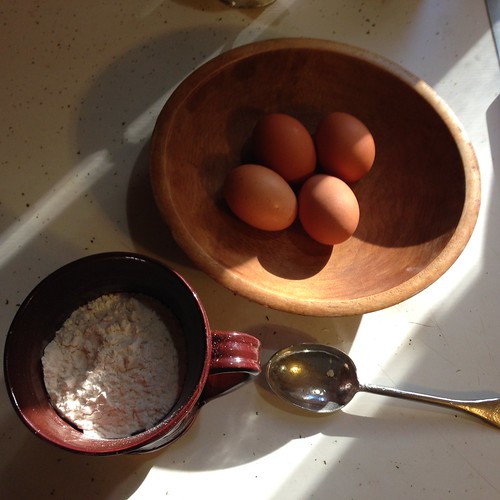
redware mug and wooden bowl with egggs

Halfsies.

I thought I’d try a half receipt first. There are no directions as we think of them– American Cookery sometimes has that “put your lips together and blow” feeling–but this is not too complex. The eggs and milk must be beaten together, and then combined with the flour. For this first attempt, I got it a bit backwards, adding the spices to the eggs, which I beat in the large wooden bowl.

That left me scooping the egg-and-milk with the measure into the flour, which I had in a smaller wooden bowl, remembering too late the method for scones.

egg and flour mixing in wooden bowls

Fuzzy photo, fuzzy logic.

And then it was really too late: I added just too much egg-and-milk, and it became more like batter than dough. This was not correct, and I knew it, but I didn’t dump it and I didn’t add more flour. Now it’s clear that 7:00 AM is not my best time for baking experiments (it was also quite early the day I made gingerbread without any eggs).

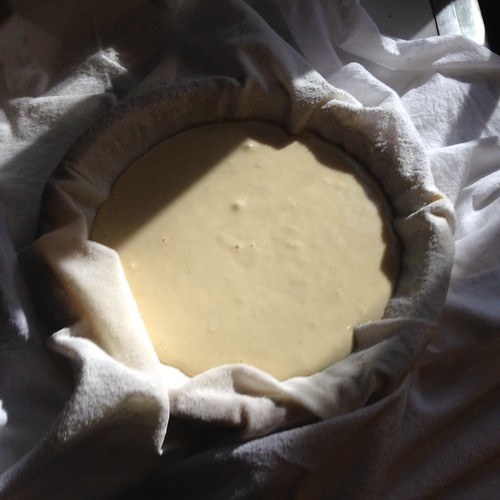
pudding mixture in cloth

Well, it took a decent photo.

I buttered and floured a cloth anyway, and poured the mixture into it. After tying the gathered neck of the cloth with string, I boiled the whole business for 45 minutes.

I did not take a photo of the mess I found when I unwrapped the bag. It wasn’t pretty, and it was clear that while some portions of the pudding were ‘done,’ they constituted about 5% of the whole, which otherwise resembled steaming cottage cheese. Really, truly, awful.

But from time to time I am undeterred by my failures, and instead of consigning the mess to the trash and sticking with store-bought bread*, I rinsed the cloth and regrouped.

This time, I went smaller: 1 cup of flour (about five spoons), two eggs, and a scant two spoons of milk. I also managed to put the flour, salt, and allspice in the regular sized wooden bowl, crack the eggs into the mug and beat them there with the milk. When I mixed the egg-and-milk into the flour, the mixture was far too stiff, so I added more milk, but kept the mixture stiff.

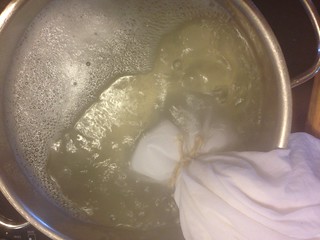
pudding bag in boiling water

Patience is required for pudding

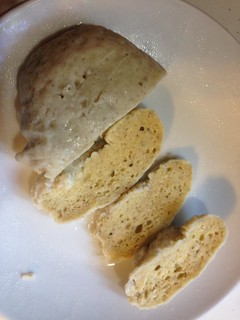
Once more into the buttered cloth, once more into the water, once more boiling for three-quarters of an hour. This time was better, though. The results actually looked and tasted much more like what I’ve had before.

sliced boiled flour pudding

A boiled Flour Pudding

So, where does this leave me? Knowing that I’m the only documented fan of this in the regiment, I’ll stick with the smaller receipt: five spoons flour; two eggs, beaten; and three or four spoons of milk.

My plan is to boil this in whatever stew or stew-like device we have for supper on Saturday, and then eat it sliced with the stew. The plain flour-egg-milk mixture will pick up some of the flavors of the stew (think dumplings), but these could also have been served with a sauce, if made at home.

I’m also going to go back to the Experienced English Housekeeper, and see what she has to say.

* Years in ceramics classes taught me to knead all the air out of plastic material, so my bread tends to be better for building than eating. Even the dog wouldn’t eat the biscuits I made while in grad school…

Share this:

  • Share on Facebook (Opens in new window) Facebook
  • Share on Pinterest (Opens in new window) Pinterest
  • Email a link to a friend (Opens in new window) Email
  • Share on X (Opens in new window) X
Like Loading...
← Older posts
Newer posts →

Archives

wordpress statistics

Creative Commons License
Kitty Calash blog by Kirsten Hammerstrom is licensed under a Creative Commons Attribution-NonCommercial-ShareAlike 4.0 International License.

Website Built with WordPress.com.

  • Subscribe Subscribed
    • Kitty Calash
    • Join 621 other subscribers
    • Already have a WordPress.com account? Log in now.
    • Kitty Calash
    • Subscribe Subscribed
    • Sign up
    • Log in
    • Report this content
    • View site in Reader
    • Manage subscriptions
    • Collapse this bar
 

Loading Comments...
 

    %d