• Home
  • Completed Costumes/Impressions
  • Emma and Her Dresses
  • Free Patterns and Instructions

Kitty Calash

~ Confessions of a Known Bonnet-Wearer

Kitty Calash

Category Archives: Historical Sew Fortnightly

A Swedish Spencer

11 Friday Oct 2013

Posted by kittycalash in Clothing, Historical Sew Fortnightly, Making Things

≈ 3 Comments

Tags

19th century, Costume, Historical Sew Fortnightly, plans, sewing project, Spencer, wool

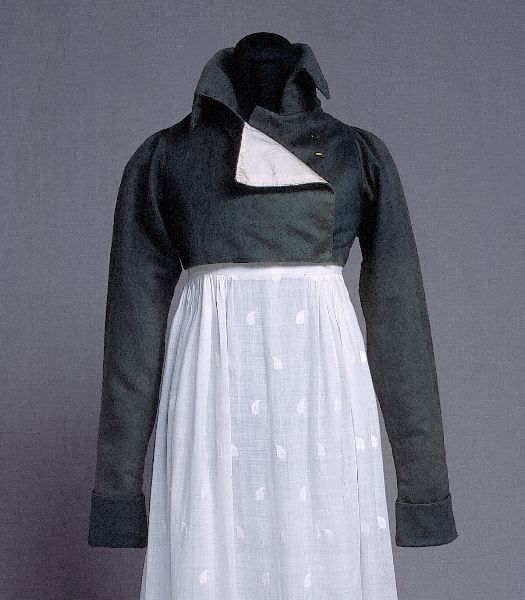
The Swedish Spencer

The Swedish Spencer

Because I lack good sense, I have fixated upon this Spencer from a museum in Lund. I have inflicted it upon people who have no particular interest in women’s wear, and extracted opinions on the fabric. Shameless, really. But I love the simplicity of this garment, and have therefore closed my eyes, written a check for some Kochan & Phillips bottle green broadcloth so that I can pet the wool to cheer myself up while patterning this beast.

To be fair, I have a Spencer half-patterned, and need “only” to work on the sleeves and collar. I have a sense, from examining a friend’s frock coat, of how to construct this stand-and-fall collar. Pad stitching, here I come. I enjoy the challenge of sleeves and hope this will not break me of that. So far, I have not been able to find a photo of the back of this lovely garment, so I’ll have to extrapolate from other examples.

I’d thought about making this for the Historical Sew Fortnightly # 21: Colour Challenge Green, but it took me too long to commit to the K&P wool, and at that price, you can bet I’ll make a careful muslin. While I’m not certain when or where I will wear this, I already know that I will wear it with my black petticoat and green boots, and will have to make a shirt to go under the petticoat, which will be its own challenge.  

Puffy sleeves aren’t my thing, and they won’t fit under these trim Spencer sleeves, but there is at least one extant example of a long-sleeved shirt-like garment. I expect I will feel about chemisettes much the way I feel about caps…but in the end, it will be worth all the tiny hems and the muslins. After all, the Spencer has a huge bonus: it closes with clasps so there are no buttonholes!

Share this:

  • Click to share on Facebook (Opens in new window) Facebook
  • Click to share on Pinterest (Opens in new window) Pinterest
  • Click to email a link to a friend (Opens in new window) Email
  • Click to share on X (Opens in new window) X
Like Loading...

HSF# 17 Robes & Robings

28 Wednesday Aug 2013

Posted by kittycalash in Clothing, Historical Sew Fortnightly, Living History, Making Things, Research

≈ 3 Comments

Tags

blue, check, common dress, fashion, Historical Sew Fortnightly, open robe, prints, robings, style

I started on the HSF#15 Color Challlenge: White, but haven’t finished the white petticoat yet. It’s a bit short, and pieced in the back, but having seen Sew18thCentury’s  curtain along petticoat online, I wanted a bordered petticoat. (There are extant examples in museum collections, and one in Fitting and Proper, if you’re keeping score.) Now that I’ve seen the petticoat in person, I will definitely stick it out for a border….all in good time.

Native Meltons: she's out there in plain and colored lithographs

Native Meltons: she’s out there in plain and colored lithographs

I did originally think that I might get this gown completed for HSF # 15, but I did not. I came close, became disheartened, and stopped work on it for a time. Not only did I think I could not adequately document the fabric, I worried about style, fit, and fabrication. At some point, though, I rallied, and finished the gown. Yes, it looks a lot like Emily’s, because it is based on the same print.

I know, you’re here for The Facts.

The Challenge:  HSF #17: Robes & Robings

Finished! Another garment in the “Am I Blue” Ocean State Line

Fabric:
Indigo Cross Bar Light-Weight Check Irish Linen from Burnley & Trowbridge.
I collected images of checks and “plaids” on a Pinterest board. Remember that plaid doesn’t mean the same thing in the 18th century, but I used the term to help people know what the board included.

Pattern:
My own, based on a fitted lining and draped to the dummy, tried on and tweaked. You can see some construction progress here. Yes, that’s a center-finding ruler. Yes, it has extra pleats. Call it bling for the linen-wearing.

Matching crossbars is crazy, but fun.

Year:
Let’s call it 1760. It’s an open robe with robings and cuffs suitable for 1765, but I’m old enough to keep wearing that style. Actually, the double-lapped robings (which I really like the look of) are earlier– see this Pinterest board–but I like the way the fold creates a decorative element in linen and wool. The probable 1750s date for the double lapped robing caused another round of heartache in the documentation land. Oh, well. Carrying on wearing the older style…

Notions:
Does thread count? That’s all this takes.

Bowers_check

Newport Mercury, 7/11/1774

Geyer_checks

Boston Post Boy, 3/11/1771

How historically accurate is it?
Well…In the right circles, one could argue that for some time. Is that not the circle one wishes to be in? Consider this, then: The gown is hand-sewn using period techniques as much as I can muster. It is based on pictorial examples from the 1750s through the 1760s. I have found newspaper advertisements for “CHECKS” in Newport (Newport Mercury, July 11, 1774) and “checks of all wedths” in Boston (Boston post Boy, March 11, 1771). Wedths means of fabric in all likelihood, not widths of the checks, so while one can find evidence of people wearing what we’d call plaid, mostly silk but the oyster seller is likely linen or cotton…we don’t know exactly what  every “checks of all wedths” fabric looked like.  I’ll go with 75% accurate and 25% conjecture and choose my wearing venue with care. Yes, I can over-think and rationalize anything.

Hours to complete:

I did this many, many times. It’s like being a carpenter with fabric and pins.

Actual sewing? 16 to 18 hours, I think; it’s a lot of hemming. The body of the gown, the draping and the lining were constructed in about a day while the guys were out doing musket-related things. The agonizing and over-thinking consumed more time. Documentation took, on the whole, perhaps 2 or 3 hours of museum collections and newspaper searching.

First worn: 
Not yet! I’m not sure when I will, now that the weather has turned. I meant to have this done for Sturbridge but despaired of the design and fabric. It’ll be wool for Saratoga, so who knows? I’d like a photo, though.

Total cost: 
Mental agony? Priceless.
Fabric? $60.

Share this:

  • Click to share on Facebook (Opens in new window) Facebook
  • Click to share on Pinterest (Opens in new window) Pinterest
  • Click to email a link to a friend (Opens in new window) Email
  • Click to share on X (Opens in new window) X
Like Loading...

HSF # 11: Squares, Rectangles and Triangles

05 Wednesday Jun 2013

Posted by kittycalash in Clothing, Historical Sew Fortnightly, Reenacting

≈ 1 Comment

Tags

10th Massachusetts, authenticity, Brigade of the American Revolution, fringe, Historical Sew Fortnightly, hunting frock, hunting shirt, Research, Revolutionary War

Hunting frock from the side. Just two sizes of one curve

I drifted away from the HSF. While, at some point, I had plans for HSF #11: Squares, Rectangles and Triangles, and they were even written down somewhere, something like table clearing and recycling happened…but, hey wait a minute, if you will allow me one curve done twice, I give you the Hunting Frock! (also, the checked bag).

Since there was a search for “best rifle frock for rev war reenacting,” I think this probably bears going into.

Presented, for your consideration, The Facts.

The Challenge:  HSF #11: Squares, Rectangles and Triangles

Without fringes or hem

Fabric: 100% “Osnaburg” linen, acquired from Henry M. Cooke IV of Historical Costume Services. I think he orders from the Ulster Linen Co. We are talking bolts here, people.

Pattern: Cut by Mr. Cooke, who used a yardstick, chalk, and an extant shirt (for the cape curve). I have watched him cut two now, and it’s pretty cool.

Year: 1778-1781 <choke> I forgot to ask.

Notions: Does thread count? That’s all this takes.

resolver

How historically accurate is it? Based on Mr. Cooke’s research into the hunting shirts worn by Massachusetts troops, and revised to reflect recent research by Neal Hurst, this frock pattern reflects the most current, accurate representation of the hunting frocks (sometimes called shirts) worn by Continental troops during the American Revolutionary War. The garment is entirely hand-sewn using, as much as possible, the correct (thankfully basic) stitches. Flat-felled seams, all that good stuff. Any place it is incorrect is purely my own genius.

Triangles and trapezoids!

Hours to complete: Remember those soul-crushing hours? Yes, these were among them. Actually, no, it’s not too bad. Perhaps twenty-four? You can power down on one of these, but even once you have the initial fringing done and the fringes attached, you will have more thread-pulling ahead of you.

First worn: Monday, May 27, 2013, for the Memorial Day Parade in Warren, Rhode Island.

Total cost: $45, for the linen and the cutting. Your mileage may vary, as the Young Mr and Mr S are in the regiment for which Mr. Cooke is the adjutant.

Hunting Shirt/Frock Schematic

Hunting Shirt/Frock Schematic, no scale whatsoever

To the person looking for the “best rifle frock for rev war reenacting,” I have to say, it depends. If you are with a Rhode Island regiment, for example, the linen you choose could be brighter, to reflect the fact that the state called for “whitened towcloth” for hunting frocks for Rhode Island troops. I have found some I think might be likely at Burnley and Trowbridge, but I have not checked it with the RI captain. You need to know if your regiment or group favors hunting shirts (pull over) or hunting frocks (open down the front), and then you need to figure out what kind of linen they were wearing in the period.

But, like a shirt of the period, these garments are very simple: triangles for the gussets (or squares), rectangles, and just the curved cape. The pattern (schematic) at right is adapted from what I have seen Mr. Cooke cut, which is quite similar to the Brigade of the American Revolution pattern I had for the Rhode Island frock I made (also entirely by hand). Since these were so close to shirts, they would have been very easy to construct, and since they’re large, measurements could be generalized. The BAR pattern does not use the under-arm gussets, and the sleeves are not tapered; there is more fringe on the standard Rhode Island frock than on the Massachusetts frock, but there seem to have been variations at the time.

You may also wish to consider whether or not there is a difference between hunting frocks and rifle frocks (I do not know, please don’t ask, I wasn’t told this would be on the test).

For more, here is Neal Hurst, on Fringe on the American Hunting Frock. You can read it before or after you pull threads out of those two inch strips until only 6 to 8 remain in the center. Happy fringing! 

Share this:

  • Click to share on Facebook (Opens in new window) Facebook
  • Click to share on Pinterest (Opens in new window) Pinterest
  • Click to email a link to a friend (Opens in new window) Email
  • Click to share on X (Opens in new window) X
Like Loading...

HSF #5: A Peasant’s Jacket

11 Monday Mar 2013

Posted by kittycalash in Clothing, Historical Sew Fortnightly, Living History, Making Things

≈ 13 Comments

Tags

18th century clothes, common dress, Costume, dress, Historical Sew Fortnightly, living history, sewing, weekend

WIth the buttons to be installed

WIth the buttons to be installed

A Workman’s Jacket…not quite done. I had to work Saturday, so there went 7 hours; I got sick, I got tired, so it’s an almost, oh-so-close jacket. Buttons and buttonholes are all we lack. Of course, for a man’s jacket, that’s, you know, a significant lacking. However, I don’t want to have the crack-addled monkey buttonholes again, so I’m not doing them until I’m not rushed or distracted.

You’ve seen it already here, and know that it has chamois pockets. The Facts:

Buttons, with button holes to come

Buttons, with button holes to come

The Challenge: Peasants & Pioneers

Fabric: Blue wool broadcloth, with a blue and white striped linen lining

Pattern: Kannik’s Korner Double-Breasted Short Jacket

Year: It will be worn for 1775, but can be worn from 1760-1800.

Paul Sandby, A Sandpit. YCBA B1975.3.930

Paul Sandby, A Sandpit. YCBA B1975.3.930

Notions: Linen thread, brass buttons, interfacing, cotton twill stay tape

How historically accurate is it? Well…the fit is a trifle off. It’s better than the base pattern, as I altered the shoulders, but it could use another round of alterations and fitting if the intended wearer would tolerate it.  Still, like the man to the left, the kid is supposed to be working in this, so he’ll need some room.

The edges of the wool are unfinished, as I’ve seen in originals, with the lining turned back. It is all hand sewn. But, I don’t have any documentation for the striped linen lining, (it’s fine for quilted petticoats) so I would not go above 8/10 for this.

Stripes!

Stripes!

Hours to complete: I can remember about 18 to this point, and the buttonholes will add another 5 to 7. They’re about 20 minutes each, with 16 – 18 to do, plus sewing on buttons. Total time likely to be 22-24 hours.

First worn: To be worn April 13, 2013.

Total cost: $79.36 can be accounted for in materials. The broadcloth was purchased from Wm Booth’s remnants and the buttons are Burnley & Trowbridge: those I have numbers for. The striped linen, purchased at Jo-Ann Fabrics,  was in the stash.

Share this:

  • Click to share on Facebook (Opens in new window) Facebook
  • Click to share on Pinterest (Opens in new window) Pinterest
  • Click to email a link to a friend (Opens in new window) Email
  • Click to share on X (Opens in new window) X
Like Loading...

Work, work, workman’s jacket

04 Monday Mar 2013

Posted by kittycalash in Clothing, Historical Sew Fortnightly, Making Things, Reenacting

≈ 4 Comments

Tags

18th century clothes, Battle Road 2013, common dress, Historical Sew Fortnightly, living history, Making Things, Revolutionary War

It fits! It might be painful, though.

Ah, yes. Work. It continues on the workman’s jacket for the Young Mr to wear at Battle Road, and for next week’s HSF deadline. There are some additional views of him in the same pose here. I tacked the lapels down because I have seen that detail on an original garment, and because if I don’t, they’re likely to bother the kid.

The nice thing about a workman’s jacket is that a waistcoat is optional underneath it. This short, only post-RevWar waistcoats look alright. So for Battle Road, long underwear may be in order. It wasn’t last year, but who knows?

Paul Sandby, A Sandpit. YCBA B1975.3.930

Paul Sandby, A Sandpit. YCBA B1975.3.930

Sandby, Roslin Castle detail, YCBA, B1975.4.1877

Paul Sandby, Roslin Castle detail, YCBA, B1975.4.1877

The form is authentic, thank goodness, for working men’s clothes; on the left, in a detail from Sandby’s A Sandpit, is a jacket in blue. On the right, in a detail from Roslin Castle, Midlothian, is another jacket that looks short, worn without a waistcoat. It may not be as short, but I am encouraged by the lack of waistcoat, though I will insist on shoes…

The form persists for a long time, and is seen in military wear as well, in light infantry and dragoon troops, as well as in sailor’s clothing.


Share this:

  • Click to share on Facebook (Opens in new window) Facebook
  • Click to share on Pinterest (Opens in new window) Pinterest
  • Click to email a link to a friend (Opens in new window) Email
  • Click to share on X (Opens in new window) X
Like Loading...
← Older posts
Newer posts →

Archives

wordpress statistics

Creative Commons License
Kitty Calash blog by Kirsten Hammerstrom is licensed under a Creative Commons Attribution-NonCommercial-ShareAlike 4.0 International License.

Website Built with WordPress.com.

  • Subscribe Subscribed
    • Kitty Calash
    • Join 621 other subscribers
    • Already have a WordPress.com account? Log in now.
    • Kitty Calash
    • Subscribe Subscribed
    • Sign up
    • Log in
    • Report this content
    • View site in Reader
    • Manage subscriptions
    • Collapse this bar
 

Loading Comments...
 

    %d