• Home
  • Completed Costumes/Impressions
  • Emma and Her Dresses
  • Free Patterns and Instructions

Kitty Calash

~ Confessions of a Known Bonnet-Wearer

Kitty Calash

Category Archives: Making Things

Material Girl

05 Sunday Oct 2014

Posted by kittycalash in Making Things, Museums, Philosophy

≈ 3 Comments

Tags

advice, fabric, scissors, sewing, sewing project, strategic fabric reserve, tools

Yes, I am a material girl. The Strategic Fabric Reserve has grown beyond the allotted cupboards into plastic containers hidden under living room furniture and my desk. Reader, it’s true: I have a fabric problem.

But here’s the thing: you want to work with the best materials you can afford, and that means fabric, scissors, needles, thread, even measuring tapes. As a carpenter I know once said, “Life’s short; buy a good hammer.”

Just enough!

Just enough!

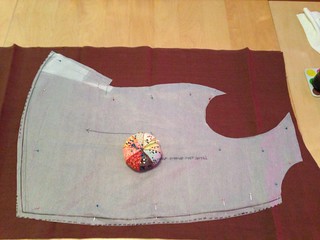
I’m currently working with a remnant of wool camblet from a friend’s stash, left over from making someone else’s coat. There’s just enough to make me a Spencer (with a little perfectly-accurate cuff piecing), and I’m finding that running the needle through the wool is like a knife through butter. Baby, it’s smooth.

And that’s the thing: working with better materials is actually easier than working with lesser goods. Maybe you’re buying from the remnant table (I know I do): just buy the best stuff you can afford, and as much of it as you afford.*

It’s taken me a while to learn this, and I’ll confess: I still have IKEA furniture, because I still have a teenager living at home, and three insufferable cats. But we swap out as we find affordable better things, because they are more beautiful and more pleasing.

Shears: former fabric and current fabric.

Shears: former fabric and current fabric.

You can do the same with your sewing (or cooking or carpentry or cat husbandry) tools. My former fabric shears finally gave up after 15 years; I replaced them with better Ginghers (thank goodness for coupons) and downgraded the formerly “best” scissors to pattern-cutting duty. I have small thread scissors for home, and scissors for events that I’ll shed fewer tears over if I lose, because event sewing is often mending and not garment construction.

Second best for events; best for home.

Second best for events; best for home.

Buy it once: that’s an ideal that can be hard to achieve in reenacting. Research moves on, everybody makes mistakes**, but you can never go wrong buying the best you can afford. Ease of use and finished beauty will make it worthwhile.

*They laughed when I bought that striped velvet from Wm Booth at Bennington– until they saw the originals I had in mind.Quirky can be right and even amazing, but cheap requires caution.

**I hear this in my head as the refrain from a New Order song at least once a day. And then I sigh. But it’s true, and worth taking to heart without beating yourself up over it. You will survive whatever unfortunate yardage or pink-handled, blistered-inducing scissors you now regret. There’s always the office Yankee Swap or Goodwill.

Share this:

  • Share on Facebook (Opens in new window) Facebook
  • Share on Pinterest (Opens in new window) Pinterest
  • Email a link to a friend (Opens in new window) Email
  • Share on X (Opens in new window) X
Like Loading...

Replication and Responsibility

18 Thursday Sep 2014

Posted by kittycalash in Clothing, History, Living History, Making Things, Museums, Reenacting, Research

≈ 8 Comments

Tags

1812, fashion, John Miner coat, menswear, Stonington, Stonington Historical Society, style, tailcoat

Detail, the John Miner Coat, Stonington Historical Society, 2009.120.001

Detail, the John Miner Coat, Stonington Historical Society, 2009.120.001

If I examine and exactly replicate a coat for personal use, what do I owe the museum that owns that coat– anything? I think I owe the museum any information I can share that will improve their records and help build a research file for the future.* I also think I owe them copies of the images I may take, and with digital images, that’s now incredibly easy.

But if I replicate this coat (shoulder intact) for Mr S or the Young Mr, should I give the coat to the Stonington Historical Society when we are done with it? SHS thinks I probably should, but as someone who manages collections, how many replicas do I want, and what standards do I use to judge them?

I think the best course of action is for museums to make patterns of popular or often-requested garments available for purchase, so that anyone who wants to make a replica has all the data they need. Short of that– and funds are often short for that– catalog records with as many measurements and as complete a description as possible will allow dedicated tailors and stitchers to get as close as possible to original garments.

True replicas involve recreating fabrics and using period techniques, and matching a garment measurement to measurement– and in the case of the Miner coat, there is no way to replicate its history. And the amount of work and expertise that would go into a true replica of any historic garment seems enormous– it would constitute a large donation to the museum, even if the garment had been worn.

*For those of you reading the caption on the Miner coat, yes, it needs work, and yes, SHS knows there are problems with that description. I promised to help them with their catalog record.

Share this:

  • Share on Facebook (Opens in new window) Facebook
  • Share on Pinterest (Opens in new window) Pinterest
  • Email a link to a friend (Opens in new window) Email
  • Share on X (Opens in new window) X
Like Loading...

Half Robe or Jacket: How Do You Wear One?

10 Wednesday Sep 2014

Posted by kittycalash in Clothing, Events, History, Making Things, Reenacting, Research

≈ 3 Comments

Tags

18th century clothing, 19th century clothing, bonnets, Costume in Detail, Costumes, costuming, Federal style, frock coats, half robes, Isaac Cruikshank, living history, National Trust Collections UK, Regency, Research, resources, tailcoat, What Cheer Day, Yale Center for British Art

Half robe, 1790-1800. National Trust Inventory Number 1348749,

Half robe, 1790-1800.
National Trust Inventory Number 1348749,

What Cheer Day is coming, and I hate to miss an opportunity to make a new gown (despite having just made one, and despite needing to make some waistcoats and trousers for the event). While I lay awake last night, I pondered my options, and whether a half gown would be suitable.

Although I have concluded it probably is not, I was curious about how these should be worn. Where can you wear such a garment? Is it only suitable for at-home use?

This is the robe from Nancy Bradfield’s Costume in Detail, replicated by Koshka the Cat here, and approximately by me, here.

CostumeinDetail_p84
CostumeinDetail_page83

Since I will be a housekeeper again, I think a gown is more correct for me, but that doesn’t stop me thinking about half robes, and whilst scrolling images by year at the Yale Center for British Art, I found this by Cruikshank:

ladies in a lending library

Isaac Cruikshank, 1756–1810, British, The Lending Library, between 1800 and 1811, Watercolor, black ink and brown ink on medium, lightly textured, beige wove paper, Yale Center for British Art, Paul Mellon Collection

There’s a lot to love in this image, even with its fuzzy “between 1800 and 1811” date. Not only do we get an array of reading material (Novels, Romance, Sermons, Tales, Voyages & Travels, Plays), we get costume tips and– special bonus– a dog gnawing its leg.

(If you are curious about some of the books in the Library at the John Brown House, check out this tumblr bibliography. I’ve been using it of late, and the representative genres are quite similar to what we see in the Cruikshank.)

We also get a chemisette on the lady at the counter, along with a very dashing hat, a fancy tiered necklace on the lady in pink, who also carries a green…umbrella? Parasol? With just a veil, that seems likelier than the longest reticule ever.

I like our Lady in a Half-Robe and her deep-brimmed bonnet showing curls at her brow. She and her companions show the range of white and not-white clothing seen in early 19th century fashion plates, and the range of head wear, too.

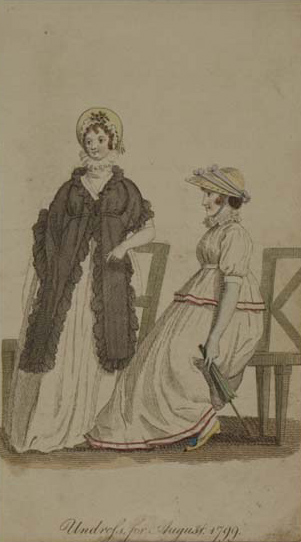
Undress for August, 1799. Museum of London

Undress for August, 1799. Museum of London

The last question I’m asking myself, though, is whether the yellow garment is a half-robe or a short pelisse or a jacket. And can you wear a half robe out of doors? And what did the ladies of the period call that garment?

In this fashion plate (featured by Bradfield on page 84, found by me at the Museum of London), the lady on the right is certainly wearing a short upper body garment, and I’d wager that she’s out of doors or headed that way, since she’s carrying a (green) parasol. Bradfield calls her garment a “jacket,” and until I can find the text of the Ladies’ Monthly Museum for August 1799, perhaps that is the term we should use instead.

While two images aren’t a lot of evidence, it does appear possible to wear a half-robe or jacket out of doors for informal visits in clement weather, and finding two is as good a reason as any to look for more.

Share this:

  • Share on Facebook (Opens in new window) Facebook
  • Share on Pinterest (Opens in new window) Pinterest
  • Email a link to a friend (Opens in new window) Email
  • Share on X (Opens in new window) X
Like Loading...

Malaise or Ennui?

09 Tuesday Sep 2014

Posted by kittycalash in Clothing, Events, Fail, Living History, Making Things, Philosophy, Reenacting

≈ 17 Comments

Tags

19th century, 19th century clothing, authenticity, Clothing, common dress, Costume, Events, fashion, history, interpretation, Newport, Newport Historical Society, Quaker, Quakers, Rhode Island, Rhode Island history, style

image Hard to say which, but I am ill at ease and dissatisfied with my costuming. You might even call it bratty. But I don’t wanna be like Bridget Connor!

It started the week of the Stamp Act protest, when I felt quite tired of being the shabby, unrefined woman of the regiment and street vendor, and wanted a nice cozy shop like the milliner had. I was also looking forward to being a housekeeper again, and several weeks of moving boxes and volumes with red rot at work had me feeling generally filthy and unappreciated. Bratty.

When in doubt, sew. A new dress can’t help but cheer you up, right?

Well… sort of…

Last Thursday, we did a reprise of the Williams family letters program at the Newport Historical Society. The Williams family were Quakers, and the letters were from the early part of the 19th century, so for the program in March, I made a green silk cross-front gown based on the Quaker gown in the back of Costume in Detail. (Check out the schematic on the 19thus.come page; I didn’t see this until I was mostly done with the dress, but thank goodness I got it right!)

But it’s September, and Thursday was expected to be quite warm, so I salved my bureaucratic wounds in the $1.99 loft at the local mill store, and made a new Quaker gown, also suitable for a maid.

I ask you! Even though it’s my very own pattern based on sketches of original drawings, even though it fits, even though it cost $10, even though every seam is overcast and the whole thing is made with period correct stitches, it still fails to make me happy and cheerful and delighted.

image

This brattiness has resulted in a reappraisal of my approach– and a trip to Sewfisticated in Framingham. What did I buy there? Yards and yards of pink taffeta? Gold taffeta? Blue taffeta?

No.

Because they didn’t have the right colors in the right weave– too slubby– or in enough yardage. Brace yourselves: I bought brown.

Many thanks to Sew 18th Century for taking the photos!

Many thanks to Sew 18th Century for taking the photos!

It appears I do not learn from my mistakes. When I think, “Gee, I’d like a pretty dress,” I end up buying fabric based on the texture as much as the color, and I have to tell you, that brown taffeta has the most wonderful l hand and sheen, and I will look much more like a Copley portrait than I ever have before, so that’s something.

It seems I have created a set of mental rules for myself, a mission, if you will, for the historic clothing I sew and the roles I take on, and I only play within those rules.

Share this:

  • Share on Facebook (Opens in new window) Facebook
  • Share on Pinterest (Opens in new window) Pinterest
  • Email a link to a friend (Opens in new window) Email
  • Share on X (Opens in new window) X
Like Loading...

Coats and Cooking

11 Monday Aug 2014

Posted by kittycalash in Clothing, Events, Food, History, Living History, Making Things

≈ Comments Off on Coats and Cooking

Tags

10th Massachusetts, 18th century clothes, 18th century clothing, authenticity, Bennington, Brigade of the American Revolution, Clothing, common dress, common soldier, cooking, Costume, dress, Events, food, living history, menswear, Reenacting, Revolutionary War, style

And happy not to be walking to Walloomsac, since we can’t leave till Friday.

Before we leave, there’s plenty to done, of course, and most of it in men’s wear.*

The first piece on brown linen

The Young Mr needed a new jacket, a proper one, with pockets and everything, correct for a scalawag. So that meant patterns and muslins and fittings and questions, until neither of us could really stand the other and his father called me an ambush predator of fittings. The only way to fit these wily creatures is, as they amble through the room, to leap out and toile someone.

With the pattern more-or-less fitted to the wiggly Young Mr, I cast about for fabric: there was not enough of a striped piece for both waistcoat and jacket; waistcoat won, because matching stripes on a jacket seemed too risky in this great a hurry. Instead, I sacrificed the last yardage once meant for a gown.

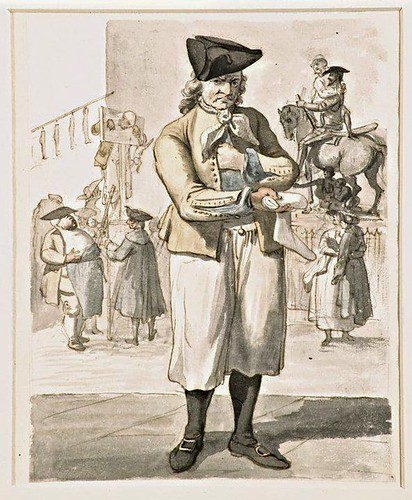
The Stocking Seller, by Paul Sandby, 1759

The Stocking Seller, by Paul Sandby, 1759

This is the inspiration for the kid’s new garment, along with Sandby’s fish monger. It seems a plausible garment to work from, and the brown linen is in keeping with the brown linen jacket at Connecticut Historical Society and the unlined linen frock coat recently sold at auction. It will also match his trousers, but this is what happens when you sew from the stash.

One pair of breeches altered, one waistcoat wanting the last seven newly-made buttons, one waistcoat in production, one jacket in production: you’d think that would be enough to get done. But I’m also working to expand my cooking repertoire, as bread and cheese gets tiresome and scrounging broken ginger cakes from the Sugar Loafe Baking Co.— while potentially good theatre–is not a solid plan for sustenance.

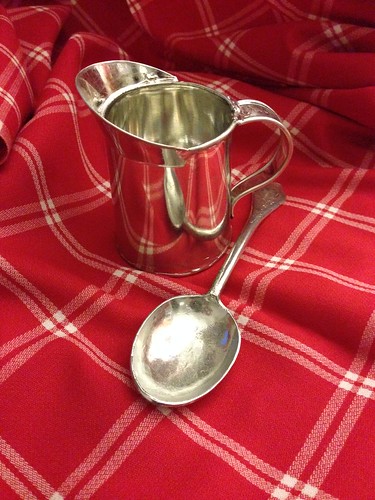
half pint and spoon measures

Half-pint and spoon

Boiling food in summer- sounds awful, right? But it’s an easy and correct way to cook,once you translate recipe measures and control the amount you’re making. I like to use Amelia Simmons’ cookbook, because it is specifically American, and my more skillful friends cooked from it at the farm.

From Enos Hitchcock’s diary, I know that he ate a boiled flour pudding with some venison stew (near the Saratoga campaign, I think) so I consider this a plausible recipe for the field, pending eggs, of course.

A boiled Flour Pudding.

One quart milk, 9 eggs, 7 spoons flour, a little salt, put into a strong cloth and boiled three quarters of an hour.

Simple enough, though Simmons later corrected the receipt to 9 spoons of flour, and boil for an hour and a half. I got out the spoon, and looked online at modern boiled pudding recipes, and will give a modified version a whirl sometime this week (always better to fail at home than in the field). Boiling the pudding in a linen cloth in a stew would make a savory bread substitute…and I really liked the one we had at the farm. Will the gentlemen at Bennington like it? Perhaps we’ll find out. If we’re not cooking with hosewater, almost anything should be edible.

*Yes, it’s a terrible and terribly dated show, but I always hear  this in Mr Humphries‘ voice from Are You Being Served?

Share this:

  • Share on Facebook (Opens in new window) Facebook
  • Share on Pinterest (Opens in new window) Pinterest
  • Email a link to a friend (Opens in new window) Email
  • Share on X (Opens in new window) X
Like Loading...
← Older posts
Newer posts →

Archives

wordpress statistics

Creative Commons License
Kitty Calash blog by Kirsten Hammerstrom is licensed under a Creative Commons Attribution-NonCommercial-ShareAlike 4.0 International License.

Website Built with WordPress.com.

  • Subscribe Subscribed
    • Kitty Calash
    • Join 621 other subscribers
    • Already have a WordPress.com account? Log in now.
    • Kitty Calash
    • Subscribe Subscribed
    • Sign up
    • Log in
    • Report this content
    • View site in Reader
    • Manage subscriptions
    • Collapse this bar
 

Loading Comments...
 

    %d