• Home
  • Completed Costumes/Impressions
  • Emma and Her Dresses
  • Free Patterns and Instructions

Kitty Calash

~ Confessions of a Known Bonnet-Wearer

Kitty Calash

Category Archives: Making Things

Flummery, and other flimsy excuses

22 Monday Jul 2013

Posted by kittycalash in Food, Living History, Making Things

≈ 2 Comments

Tags

18th century, cooking, food, recipe, weekend

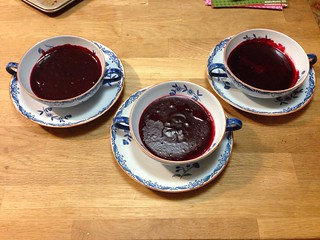
Flummery, in Oest India bowls.

We did not go to Salem. If you were there, you already know this. Mr S was only willing to go up on Saturday, but I wanted to go on Sunday. After looking at the schedule, we couldn’t figure out why the Young Mr would ever want to go. A bored teenager is a terrible thing to be around. So what did we do instead?

We cleaned, for one thing. We laid in provisions, which disappear at an alarming rate each week. We went to the weird antique place and found a brass kettle and a copper skillet. We went to the lumberyard, twice, and bought lumber, once. We did several loads of laundry. (By now, I know you are incredibly jealous of this glamorous lifestyle; I assure you, it gets better.) I cleaned the bathrooms and replaced the shower curtain.
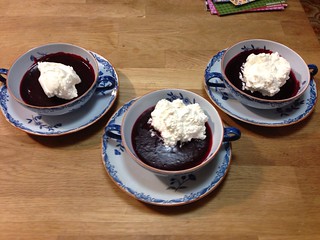
Served!

What incredible banality! But this is what the kid wants: weekends where we are home, cooking and cleaning and being normal. At a certain point, if I cannot figure out what he’ll do at an event and assure him that he will be busy, he does not want to go. (Not that I blame him, for I like to be busy as well.) So a weekend of normal, when we have drilling next week and OSV the next, is probably worth having, for family peace.

Of course, I’d rather be busy in another century, so I cleaned the tub early and moved on to more engaging tasks, flummery, for one.

The guys weren’t sure about this at first, but it is fabulous. It would make an excellent “blood” pudding for a vicious pirate banquet. The recipe is ridiculously easy.

Blackberry Flummery
4 Cups Blackberries
2/3 cup sugar (up to ¾ cup if you prefer sweeter)
½ cup hot water
Juice from ½ lemon, strained of seeds
½ cup cold water or milk
2 T corn starch (AKA corn flour if you’re not in the US; the fine white stuff)
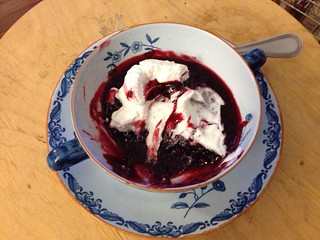
Excellent with cream.

Wash the blackberries and put into a large saucepan with sugar and hot water over medium high heat. Bring to a soft boil and cook until the fruit is soft and falling apart.
Remove from heat, and push through a fine sieve with a spoon. Discard seeds and cores.

In a small bowl, whisk cornstarch into milk or water.

Return fruit to pan and place over heat, bringing to a soft boil again. Stir in cornstarch mixture until completely blended and fruit begins to thicken.

Slowly stir in lemon juice, taking care to keep fruit from thinning or thickening too much.
When blended, remove from heat.

Pour into 3 to 8 individual ceramic or glass serving dishes; portions will depend on audience.
Chill for at least two hours. Serve with whipped cream or yogurt.
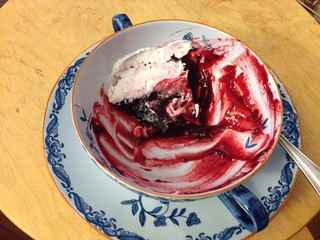
Almost gone!

I made three servings, because I thought that was right, but I think six would have been better, based on intensity rather than richness. Not to worry: we ate it all.

Cooking this up is easy, but the blackberry mixture does have a tendency to get everywhere and make you and your kitchen look like your hobby is home butchery. Don’t wear white, and keep your sponge handy.

Share this:

  • Share on Facebook (Opens in new window) Facebook
  • Share on Pinterest (Opens in new window) Pinterest
  • Email a link to a friend (Opens in new window) Email
  • Share on X (Opens in new window) X
Like Loading...

Alterations in Force

15 Monday Jul 2013

Posted by kittycalash in Clothing, Living History, Making Things

≈ Comments Off on Alterations in Force

Tags

10th Massachusetts, 18th century clothes, authenticity, common dress, Costume, fashion, Reenacting, sewing

Horrid Green Frock Coat at Birth

Remember this coat? I’ve been attempting to solve this coat for a while. While the Zombie Coat had to be put aside after the tail pleat debacle (what was I thinking? Sewing while tired means hems only, or simple straight seams), I finished up the Horrid Green Frock Coat. It is somewhat less horrid now. Mr S wore it yesterday to be a member of the Jackson’s militia impression of the 10th MA at Longfellow House in Cambridge.

The sleeves were removed and the seam taken in to remove excess material. Perhaps I could have slimmed it a bit more, but it needed to sit the armscye.

The shoulder seam (where back and front join) was also taken in and snugged up twice. The side seams were taken in a great deal from the armscye down, but not enough. To fix the remaining bagginess at the small of the back above Mr S’s hips, I will have to take more out of the front panel, “and work it into the side pleats.” (Easy enough for the Master to say, harder for my brain to figure out.)

Somewhat better, but two more seams to snug.

This is the closest photo to the one above. You can see that the line of the front has been changed and slimmed, and a collar added for stability and style in addition to those cuffs. I also changed the shape of the pocket flaps, and moved them to change the look of the front panels. They don’t have to match the pocket slits, as long as they don’t reveal the slits (one bag is madder linen, I ran out of large pieces of green), so I moved them to change the look of the front.

The mariner’s cuffs were fun. If the Zombie behaves decently this week, I’ll give him mariner’s cuffs on his too-short-blue-wool-sleeves. Well, I’ll probably give him mariner’s cuffs anyway, just so he can get the coat on and off.

On Brattle Street, Cambridge, while it was still “cool.”

And, finally, a full-length view of the coat. It takes more than webbing and belts to reshape a silhouette. It’s taken 13 months from first making that coat to get it to this point. Thanks to an expert’s chalk marks in February, transforming it into something at least wearable was possible, though at first sight, those chalk marks were devastating and overwhelming. It took overalls to get me to face this coat, so thank goodness for the horribleness of overalls.

Share this:

  • Share on Facebook (Opens in new window) Facebook
  • Share on Pinterest (Opens in new window) Pinterest
  • Email a link to a friend (Opens in new window) Email
  • Share on X (Opens in new window) X
Like Loading...

In the Pink

14 Sunday Jul 2013

Posted by kittycalash in Clothing, Making Things, Reenacting, Research

≈ Comments Off on In the Pink

Tags

18th century clothes, Clothing, common dress, Costume, dress, fashion, resources, sewing

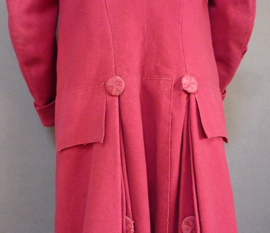
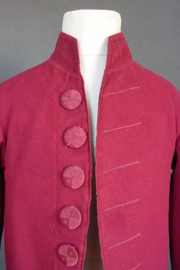
Detail, back pleats

Detail, back pleats

I swear I try to be positive about the mistakes I make. But not only did I discover this morning that I had lost my struggle with spacial processing, now I have found clear imagery to show how I should have handled the pleats on the Zombie Coat. Live, learn, unstitch and restitch: that’s all I can do. Now I have only to decide whether to do the unstitching this weekend, or next week. It will have to be done: now I know the way I’ve done it is wrong, and the master’s eye will be on that mistake and then he will know, and I will know that he knows, and it will just go on from there to tired shame.

Man's wool  coat, 1770s. Meg Andrews.

Man’s wool coat, 1770s. Meg Andrews.

My favorite part of the description is this:

Either the coat was altered for another man or the wearer got fatter! … There is a half moon insertion under the arms… There’s no detail photo of that half-moon insertion, but I do so wish there was. The description notes additional changes: “If you look at one cuff you can see a lighter part of a button shape next to the seam. The cuffs have been removed and then added to the edge of the cuff to lengthen the sleeve.” At least we know garments in the past, even ones as lovely as this, were altered and changed.

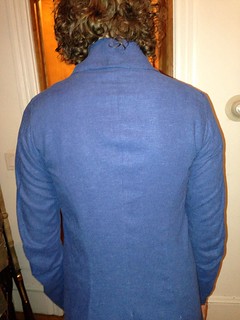
Puckering on the Zombie Coat. It’s still a nice blue, and you know what? It fits me, so maybe he’ll lose it to his refugee mother.

I will probably be inserting shapes of various kinds into the Zombie Coat, since I do now have a diagnosis for this puckering at the shoulder blades. “Viewed from the back and sides, it appears that the sleeve is binding on the front of his shoulder, causing pulling across the back shoulders – the puckers are caused by the stretching of the fabric across the rounding of the back and shoulders. If you make the top of the upper sleeve wider, or raise the shoulder cap it will create more fullness over the top of the sleeve and reduce the binding that is translating down the sleeve and across the back.”

By the time I make the changes I need to, the Zombie Coat will have acquired its own pre-history.

Share this:

  • Share on Facebook (Opens in new window) Facebook
  • Share on Pinterest (Opens in new window) Pinterest
  • Email a link to a friend (Opens in new window) Email
  • Share on X (Opens in new window) X
Like Loading...

Sewing for Zombies

13 Saturday Jul 2013

Posted by kittycalash in Clothing, Events, Making Things, Museums

≈ 4 Comments

Tags

18th century clothes, common dress, fashion, menswear, museum collections, Reenacting, Revolutionary War

Death by Fitting

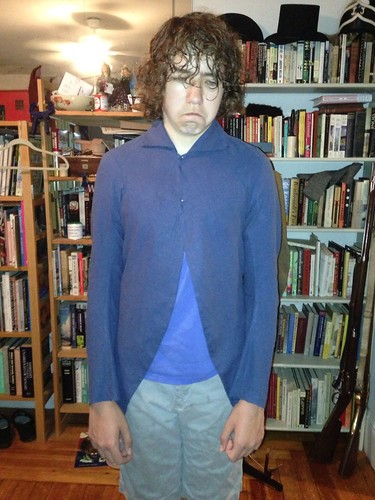
He doesn’t always look this horrible, but when the Young Mr sets out to look like death, he does it very well. Dressing 18th Century style comes at the price of fittings, and while we like to cut a fine enough figure at an event, we want no part whatsoever of the process. Even the promise of playing with a dog won’t get us to a fitting. And he dearly wants a dog…so you know fittings are a trial.

Cutting Out on Sunday

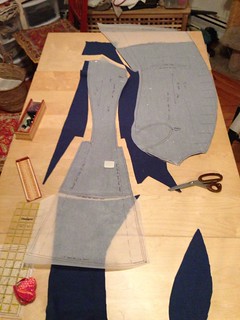
The pattern is by Henry Cooke, based on both a Rhode Island original in a private collection and a jacket in the collection of the Connecticut Historical Society. It is solidly 1770s-1780s, unlined, and both originals made up in brown linen. (From the pattern notes and what I know of the CHS jacket, accession number 1981.110.0; their catalog links are unstable, search for 1981.110.0.)

It goes together well; I started without directions, but as I am more idiot than savant, I got myself confused. I did have to alter the sleeve for the Young Mr, as he has long, thin arms. The rest of the pattern seemed to fit him pretty well, all in all, but a few untoward things happened between measuring, mock-up, basting and fitting. Still, it can be worn, with improvements made next week after he wears it in Cambridge this Sunday. 

Share this:

  • Share on Facebook (Opens in new window) Facebook
  • Share on Pinterest (Opens in new window) Pinterest
  • Email a link to a friend (Opens in new window) Email
  • Share on X (Opens in new window) X
Like Loading...

Getting Better, and Giving Back

10 Wednesday Jul 2013

Posted by kittycalash in Clothing, Living History, Making Things, Thanks

≈ 2 Comments

Tags

10th Massachusetts, common soldier, fitting, living history, Making Things, menswear, Revolutionary War, uniforms

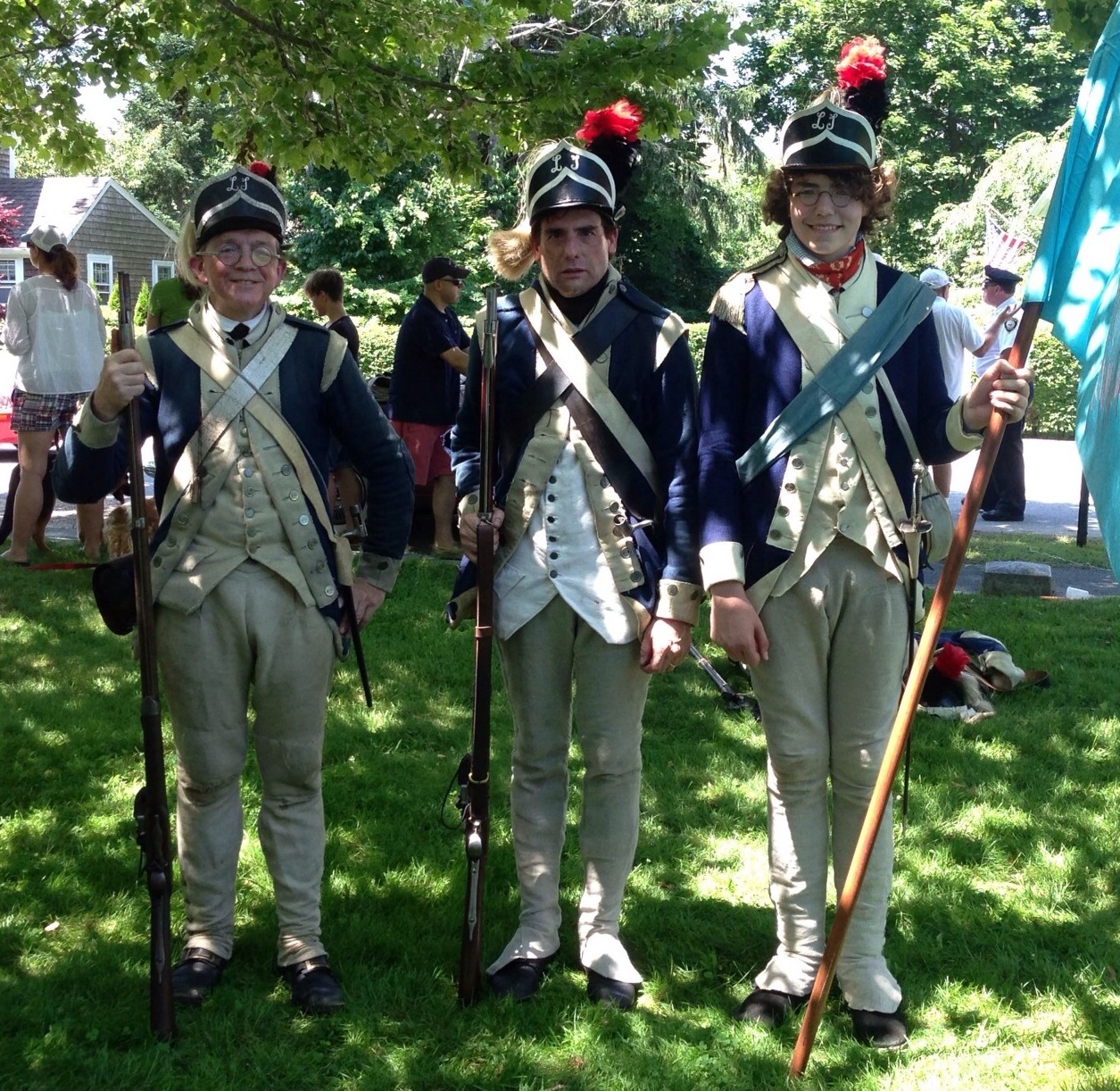
Mr Cooke, Mr S and the Young Mr.

10th Mass fittings: Mr Cooke, Mr S and the Young Mr.

There is good, if slightly terrifying, news about how to get better at sewing. It took me two years to get to a decent place, but this sped up considerably in the past year because of the weeks when I sewed for 30 or 40 hours a week. This business is about practice, looking, and patience … and also asking for help. Some of the help you can get online, some of the help you can get from whatever human is handy, and some you need a master for.

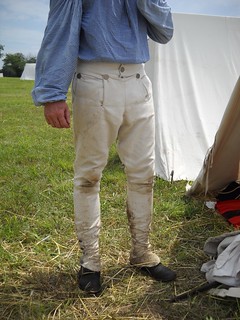
The Rhode Island pair, pattern by me based on Mill Farm breeches.

Online tutorials have saved my bacon: I make gowns with Koshka’s tutorial handy because after intensive menswear, I forget how this gown business works. The random human help I get comes from Mr S, who patiently takes photos as I try to fit backs or see what’s wrong. Trust me: you cannot see your own back in a mirror, so take a photo, or get someone else to. The masters who have helped me are Sharon Burnston and Henry Cooke. From both of them I’ve learned how to look and how to think about historic costumes. Sharon’s workshop really helped my sewing, and watching Henry has taught me a lot about fit. Also from both: patience.

When it came to Mr S’s overalls, I needed a professional bail out. Mr Cooke offered to help after watching me basting the things at MMNHP, and here’s what I wrote in reply:

[the] overalls have reached a rather bad place, and are now only half-basted on the legs after a third fitting attempt. He appears to have lost more weight. The fit in the seat confounds me, and when I get one leg right, the other twists. Your help would be deeply appreciated…

In the end, my basting was ripped out and Mr Cooke sat on the floor and basted the overalls on to Mr S. The process took a bit more than an hour, during which time Mr S became very familiar with the curtain material in Mr Cooke’s workroom, and realized that it was identical to the curtains he’s had as a child. This memory transported him back to a childhood trip to Williamsburg, when he yearned to be one of the costumed interpreters at CW. It was a transformative afternoon for Mr S and his overalls.

Now that they’ve been worn, I know that I need to:

  1. Adjust the waistband and seat
  2. Add a leather strap under the foot
  3. Finish the in-and out-seams (with fit proven, felling can begin)
  4. Switch ankle buttons from plain and RI mix to all plain or 10MA
  5. Take a pattern from the legs!

There is hardly any seam allowance over Mr S’s single-speed bike-riding-up-hills calves, so a pattern from the legs would make the next pair that much easier. He has two pairs, so why should I bother? Because he will undoubtedly wear these out doing as many belly crawls, stream fordings, nettle bush tangoes and other light infantry activities as he possibly can. At some point, mending will cease to be an option.

So how would I pass on the lessons I’ve learned? In some ways, by writing honestly about the struggles and successes in getting these things right, and to let you know that practice really does make a difference. It’s also become clear that maintaining an open, curious mind willing to accept criticism and new ideas will make you a better sewer, and maybe even a better living historian/reenactor…dare I say person?

Share this:

  • Share on Facebook (Opens in new window) Facebook
  • Share on Pinterest (Opens in new window) Pinterest
  • Email a link to a friend (Opens in new window) Email
  • Share on X (Opens in new window) X
Like Loading...
← Older posts
Newer posts →

Archives

wordpress statistics

Creative Commons License
Kitty Calash blog by Kirsten Hammerstrom is licensed under a Creative Commons Attribution-NonCommercial-ShareAlike 4.0 International License.

Website Built with WordPress.com.

  • Subscribe Subscribed
    • Kitty Calash
    • Join 621 other subscribers
    • Already have a WordPress.com account? Log in now.
    • Kitty Calash
    • Subscribe Subscribed
    • Sign up
    • Log in
    • Report this content
    • View site in Reader
    • Manage subscriptions
    • Collapse this bar
 

Loading Comments...
 

    %d