• Home
  • Completed Costumes/Impressions
  • Emma and Her Dresses
  • Free Patterns and Instructions

Kitty Calash

~ Confessions of a Known Bonnet-Wearer

Kitty Calash

Category Archives: Making Things

Making Plans….

26 Monday Aug 2019

Posted by kittycalash in Living History, Making Things, material culture, Museums, personal, Reenacting

≈ 1 Comment

Tags

historic house museums, kickstarter, living history, milliner, millinery, millinery shop, Van Cortlandt House Museum

I have set my sights on being at Van Cortlandt House Museum’s Second Annual History and Culture Fair on Saturday, September 21. This is a bit of a stretch: It’s farther than Philadelphia, where I’m scheduled to be the following weekend at the Museum of the American Revolution– and I want tweak that impression and its material culture a bit, too. Still: setting up a ca. 1777-1780 milliner and mantua maker or merchant display has been on my to-do wish list for years, and I’m pretty sure I can pull this off as long as I modify/upgrade items already in my closet.

There are enough images to provide good inspiration and ways to start accessorizing.

Several prints  from the British Museum provide guidance.

It’s clear– as I knew already– that my accessory game requires major upping. But this is solvable! It’s not ideal, being in a situation where I can’t buy new fabric, and I don’t have the time to make up the fabric I do already have in the garment styles I need. This is no time to start a new patterning project!

So this means making accessories to upgrade a gown and petticoat already on hand and known to fit (though they should be fit-tested once again before committing!).

Which dress? Why, Nancy Dawson, of course. She’s the brightest and most stylish gown I have. Thankfully, I have upgraded my cap collection, and could even– probably– manage a new cap in the time allotted.

So what do I need? A well-decorated, possibly floofier cap, a LBB (™) of the kind worn in “The Rival Milleners”, a breast knot or bow, a new fine silk or cotton apron, and some kind of sleeve treatment.

The maid in the back of “A Morning Visit,” carrying in the tea tray, demonstrates the more understated upgrades I think I will be able to manage in the time I have. In a year, a trimmed silk gown can happen. In a month, it cannot.

The main upgrade I’d like to make is to add a red silk quilted petticoat, since they appear in so many prints with cotton print gowns, including a print of Nancy Dawson herself.

Miss Nancy Dawson, aquatint print. Victoria and Albert Museum. E.4968-1968

I almost assuredly have red silk in my stash: the question is, can I find it, back it, and quilt it in time? Probably not. So there are choices to be made, like the sensible one of simply upgrading sleeve finish and apron and adding bow knots.

Those are just the upgrades I hope to make to my personal kit! I need a dome top trunk (underway; I need the one I have for Elizabeth Weed), and there are inventory items to make that have been on the list for a while.

All of this has to get done while I’m splitting my 55-60 hour weeks between commissions and a retail gig (which I am trying to streamline!).

Once again, I start down the path of madness. Won’t you join me? I think it’ll be a blast!

Share this:

  • Share on Facebook (Opens in new window) Facebook
  • Share on Pinterest (Opens in new window) Pinterest
  • Email a link to a friend (Opens in new window) Email
  • Share on X (Opens in new window) X
Like Loading...

Failure is Always an Option

09 Friday Aug 2019

Posted by kittycalash in Making Things, personal

≈ 1 Comment

Tags

I sew for money, mistakes, sewing, work

Or, if not failure, at least screwing up.

The big cold box….

In my more exhausted moments, I make interesting mistakes and choices. Once, I engaged in an argument at work in which I repeatedly used “orange” when I meant “blue.” Another time, I lost the word “refrigerator” and had to coin the phrase “big cold box where we keep the food.” My brain is an interesting place.

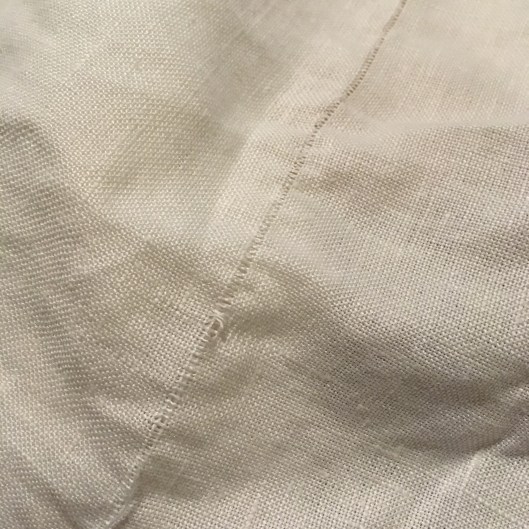
When I sat down to start on a commission for some officers’ white linen sheets to be 60” x 85” I was tired. I chose not to do the math on paper as I measured, but in my head. And using a 60” tape measure, I measured and marked 60” and then added 16” to make up 85” plus seam allowance. Yes, I measured 60 + 16 = 85 finished inches.

Obviously not.

Round two of thread pulling to cut the second sheet correctly.

But it was not obvious to me until I held the fabric up, ready to iron, and realized it was just a little bit longer than I am tall. Since I am not 7’ tall, something was clearly wrong. I dropped the fabric to the ironing board, messaged Drunk Tailor, and took to bed in mortification and hope of a nap.

I tell you this story not just to make you laugh, bring you a modicum of schadenfreude, or to make plain that we all screw up sometimes, but to remind you that mockups are good, and so is math on paper.

Really, I’m not sure how this happened. But there it is: upside down.

Starting a project without laying down some ideas on paper or making a muslin is a quick trip to madness, or at least dismay. Creative problem solving will undoubtedly result, but that’s energy you could put into planning your next project instead of salvaging your current one (as I have salvaged my sheet).

Here are some measures I’ve learned to take to prevent repeating hilarious mistakes:

  • After hemming skirt fronts that put pocket slits upside down, I now pin notes to the panels so I know which make up the left, and which the right sides of the gown skirts.
  • I have been known to mark linings extensively in pencil or chalk; I sometimes pin notes to sleeves to denote left and right, front and back, especially if I cut pieces long before I will get around to sewing them.
  • I make lists of which pattern pieces I need and must cut, and then tick them off as I go, to make sure I have all the pieces I need.
  • To make sure I’ll have enough fabric and can minimize piecing, I will do a rough layout of all the pieces before I do actually cut anything.

It is by no means an extensive list, but once you know the types of mistakes you are most likely to make, you can take measures to prevent them. You know, like measuring twice and cutting once, or doing math on paper to double check your work.

Share this:

  • Share on Facebook (Opens in new window) Facebook
  • Share on Pinterest (Opens in new window) Pinterest
  • Email a link to a friend (Opens in new window) Email
  • Share on X (Opens in new window) X
Like Loading...

Kitty Calash Clothing Company Launch

06 Tuesday Aug 2019

Posted by kittycalash in Events, Making Things, personal

≈ Comments Off on Kitty Calash Clothing Company Launch

This isn’t easy, and not because I learned Premiere Rush in a half day, or because failure is painful, but because I never like to ask for help. But I need your help to to take Kitty Calash where I want to go. To that end, I’ve launched a Kickstarter project to help me finish and publish a quilted waistcoat pattern, design more patterns, and prototype more bonnets, reticules, and accessories.

Maybe Kickstarter isn’t your thing: maybe you prefer swag. Well, there’s a Teespring store in case you feel like letting people you’re a Known Bonnet Wearer, or that All Your Fantasies are Documented, or that you, too, Will Humiliate Self for History.

I know not everyone can contribute financially, but word of mouth counts in this business– it’s how I get a lot of my work– so even if you can’t make a pledge, please share.

Share this:

  • Share on Facebook (Opens in new window) Facebook
  • Share on Pinterest (Opens in new window) Pinterest
  • Email a link to a friend (Opens in new window) Email
  • Share on X (Opens in new window) X
Like Loading...

A Little Black Bonnet

02 Tuesday Jul 2019

Posted by kittycalash in Clothing, Living History, Making Things

≈ 1 Comment

Tags

18th century, 18th century clothing, authenticity, bonnet, common dress, helmets, milliner, millinery


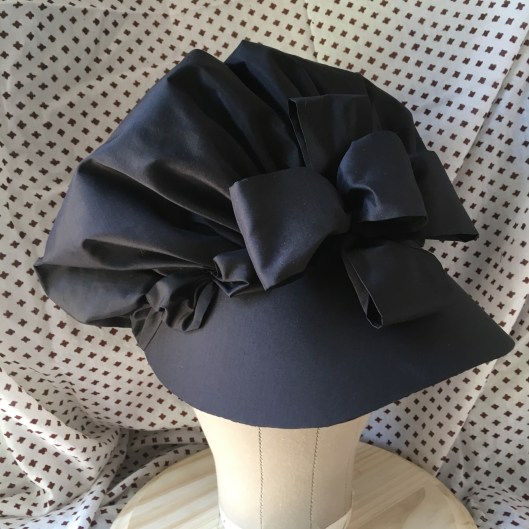
Practically everyone needs one, and like the Little Black Dress, the little black bonnet flatters practically everyone, too. In finishing up some inventory projects, I went back to basics and made up a black silk taffeta bonnet with trimming inspired by “The Rival Milleners.”

The Rival Milleners.

Really, it’s a look that’s hard to resist, the black bonnet with poufs and bows. I’ve always loved my black bonnets, but now I might need to trim another one up for myself– if I can only make the time. Up on Etsy if you want one for yourself (along with some other colors, too).

Share this:

  • Share on Facebook (Opens in new window) Facebook
  • Share on Pinterest (Opens in new window) Pinterest
  • Email a link to a friend (Opens in new window) Email
  • Share on X (Opens in new window) X
Like Loading...

Hints for a New Hobby

29 Monday Apr 2019

Posted by kittycalash in Living History, Making Things, material culture, Reenacting, Research

≈ 7 Comments

Tags

costuming, living history, Making Things, progressive reenacting, Research, sewing

The historical costuming/living history/reenacting hobby can be a daunting one to pick up. When I started, I was fortunate to have a background making things, including sewing my own clothes, as well as a career that taught me research skills, and gave me easy access to primary sources. Those factors made skill building relatively easy, though I definitely had a learning curve specific to what I was doing. As the season opens and people start to ease into new units, I thought about things I found that made this hobby a little easier to manage, and skills easier to acquire.

Same years....
Same years….
different class levels

Know who (and when) you are. When you step into the past, who are you? Where are you from? What year are you representing? With answers to these questions, you can begin to sort out what you need to know, and where you need to look for answers. What you’ll wear in North Carolina is not what you will wear in coastal New England. The styles of 1750 are not the same as those of 1780– and fashion information traveled quickly from England to America. American colonists were as stylish (or more so) than their English counterparts. Wearing a gown 20 years out of date without alterations is only going to work well if that gown really shows its age (and you do, too).

Learn to do research. If you are going to strike out totally on your own, you need to be able to do research and sift through the sources you find to understand and interpret them appropriately for your situation. What is right for Costume College may well not be right for a camp follower, no matter how accurate the fabrics or construction. It seems so obvious (and in the case of a silk sacque back gown, it really is) but in other ways it’s not. Jackets aren’t going to be right in New England, and calicos are more common in Philadelphia and Rhode Island than they are in Boston.

Lance needles: the best I've used.
Lance needles: the best I’ve used.
Rowenta steam iron
Rowenta steam iron

Buy good tools. Really: tools matter. Sharp shears, sharp thread snips, good, sharp needles, sturdy pins, a pin cushion, a cutting grid, a steam iron, a sleeve board, a sturdy ironing board: all of these things make my sewing life so much better. (I actually own three ironing boards: a full size board, a table top board, and a sleeve board and use them all.) Tailor’s hams are also useful– that’s what I steam my caps on.

Ruffle attachment in progress. Possible thanks to the material and the needle.

Use good materials. Good fabric is expensive, but what’s your time worth? If you calculate the per-wearing cost of a garment, you’ll find that the “cost” decreases over time. One of my favorite gowns is made of $2.99/yard fabric from a mill store in Rhode Island. (I was very lucky to find a woven check that matched one in a RI sample book.) I bought five yards, so $15. I’ve worn that gown more times than I can count, and it is perfectly filthy. If we calculate $450 for hand sewing, the total cost is $465. Since April 2014, I have worn that gown 12 times (that I recall), making the per-wearing cost $38.75. I’d call that a good value. If we count just the yardage, it’s $1.25 a wearing and honestly, you cannot do better that that.

IMG_7948
IMG_7947

When it comes to shifts, the ultimate per-wearing cost is even less. My most recent shift of hand-woven linen with vintage linen sleeves would have been $450 in materials, and $425 in hand-sewing. $875 seems crazy, right? Consider the shift I made in 2011, worn to almost every 18th century event I’ve attended (I had two); I’ve worn that shift….45 times that I can recall. That’s $20.83 per wearing, a better value over time than the $2.99/yard gown. If a soldier’s coat can cost $800, and you are going to every event your soldier goes to, an $800 shift is as good a value as the coat, and possibly more essential.

Cost aside, the value of good materials is in the time they save in making. Well-woven linen is easier to sew and will need less mending over time. Sharp shears cut cleaner. Sharp needles sew better, and smaller needles give you finer stitches.

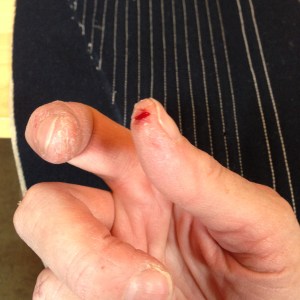
d’oh! surgical tape made this *much* better later.

Learn to sew with a thimble. Your fingers will thank you. I use a leather thimble with a metal tip (from the quilting notions section) and it helps. Thimbles are essential when sewing heavier fabrics like broadcloth and indispensable if you make your own stays (and you can expect bleeding even with a thimble).

Practice patience. Learning a new skill, or refining one you already have, takes time. It isn’t always fun. I get sick of sewing, and have to switch to something else (like cutting out, or research, or patterning) or take a break. Recognize that frustration is often the moment before you master something new, but also know when frustration means it’s time to stop. Just as we build muscle on rest days, our brains process skills when we stop. Then, the next time we pick something up, we’ll be stronger, or more skillful, than if we hadn’t stopped. (This New York Times article was helpful, and inspired this post.)

A purchased bonnet because it’s one I can’t make.

Buy what you cannot make. I thought I needed to make everything myself (with the exception of men’s hats and buttons) but that’s just not true. If you can’t manage fine sewing, buy a cap! If you hate assembling tricky things, buy mitts or a bonnet. I bought caps when I couldn’t make them as well as I wanted, and it saved me hours of frustration. I love flamestitch pinballs, but I can’t manage that needlework yet; lucky for me, I know someone who excels at it, so I can buy from her. Other people have skills, and buying things from them will save you time and frustration, so you can focus on what you really want to do.

Share this:

  • Share on Facebook (Opens in new window) Facebook
  • Share on Pinterest (Opens in new window) Pinterest
  • Email a link to a friend (Opens in new window) Email
  • Share on X (Opens in new window) X
Like Loading...
← Older posts
Newer posts →

Archives

wordpress statistics

Creative Commons License
Kitty Calash blog by Kirsten Hammerstrom is licensed under a Creative Commons Attribution-NonCommercial-ShareAlike 4.0 International License.

Website Built with WordPress.com.

  • Subscribe Subscribed
    • Kitty Calash
    • Join 621 other subscribers
    • Already have a WordPress.com account? Log in now.
    • Kitty Calash
    • Subscribe Subscribed
    • Sign up
    • Log in
    • Report this content
    • View site in Reader
    • Manage subscriptions
    • Collapse this bar
 

Loading Comments...
 

    %d