• Home
  • Completed Costumes/Impressions
  • Emma and Her Dresses
  • Free Patterns and Instructions

Kitty Calash

~ Confessions of a Known Bonnet-Wearer

Kitty Calash

Category Archives: material culture

Hoods and Caps and Bonnets, oh my!

07 Monday Jan 2019

Posted by kittycalash in Living History, Making Things, material culture, Research

≈ 1 Comment

Tags

18th century clothing, common dress, Etsy, hoods, millinery, winter

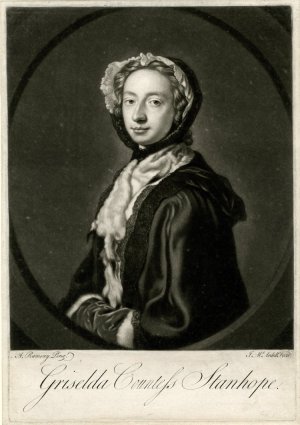
Griselda Countess Stanhope. Mezzotint engraving by James McArdell after Allen Ramsay. British Museum, ca 1760

Let’s take a closer look at Griselda, Countess Stanhope. She wears a hood over a fine white cap, as well as a hooded cloak. Around her neck, she wears a fur tippet, and her hands are snuggled into a muff. While most of the “common” women in the colonies wouldn’t rise to the Countess’s ermine tippet, they did have hoods.

Thomas Howe Ridgate’s inventory taken 19 June 1790 in Charles County Maryland includes “3 velvet and silk hoods,” while Mrs. Elizabeth Lawson’s inventory, taken 3 May 1766 in Prince Georges County Maryland includes one velvet hood and one “Allamod” hood. (She also has “1 old Striped Bonnet,” as well as 2 Womens New Capes, and 1 Womans Life everlasting Petticoat, which bears further investigation.)

Hoods appear fairly regularly in prints, worn over caps (as in Countess Stanhope), under hats, and even under bonnets, as in this print from the Victoria & Albert Museum.

January, engraving, ca. 1780. E.3520-1953. Victoria & Albert Museum

img_6676
img_6678

The mantelet hood worn over the bonnet, hood, and cap layers.

In the images above, I’m wearing a white cap, black silk hood, and black “stuff” bonnet, with a black silk mantlet over a silk neck-handkerchief. The hood needs some tweaking, size-wise, but the layers definitely recreate what we see in the print of “January.” The bonnet has an adjustable caul, so will easily fit over hair, cap, and hood; the hood has a drawstring closure at the neck that helps keep out the wind. Taken altogether, these layers are definitely insulating! Looking like an 18th century engraving is almost a bonus– but when you wear what they wore, you look like they did.

Share this:

  • Click to share on Facebook (Opens in new window) Facebook
  • Click to share on Pinterest (Opens in new window) Pinterest
  • Click to email a link to a friend (Opens in new window) Email
  • Click to share on X (Opens in new window) X
Like Loading...

“Comfortably Covered”

02 Wednesday Jan 2019

Posted by kittycalash in Living History, material culture, Research

≈ Comments Off on “Comfortably Covered”

Tags

18th century clothing, common dress, winter


The last event of 2018 (for me) was the “March In” evening event at Valley Forge. My reasons for choosing events may be quirky: anything I can get to at Fort Ti, because I love that fort and landscape; MoAR events because they’re imaginative, not too far, and, bonus, I get to see my mom; anything immersive at which I’ll have tasks and a role; anything that gets me behind the scenes or gives me a new perspective on a site, museum, or event; anything that allows me to flex my interpretive muscles. March In gave me a new perspective, a new site, and a chance to expand my interpretive range. I loved it. My son, not so much. While I’d thought he’d enjoy it– he got us into this living history business, after all–since we’d visited Valley Forge every summer when we went to see my mom, and our parts would be small, progressive-focused scenarios.

Reader, he quit. Ten minutes before the park reopened to the public, as we stood in the dark on the Joseph Plumb Martin Trail, he told me he wanted to quit reenacting.*

No wonder I found the evening chilly.

I wasn’t too concerned about keeping warm after surviving and thriving in Princeton. The weather on December 19th seemed, if not balmy, seasonably pleasant, so I left off a layer or two from the Princeton list, skipping the third neck handkerchief. My bonnet this time was an old woolen “stuff” bonnet made back when my bonnet obsession first began. In the April 8 1776 Pennsylvania Packet, an ad for runaway Margaret Collands records that she was wearing “a redish coloured worsted bonnet.” My choice seemed pretty apt for winter in Pennsylvania, and, lined with linen, I can confirm my head stayed warm. My neck was not!

Griselda Countess Stanhope. Mezzotint engraving by James McArdell after Allen Ramsay. British Museum, ca 1760

At Princeton, I solved the neck draft problem by tying my third neck handkerchief around the neck of my cloak hood (see above). When I came home from Valley Forge, I went shopping in the historical record to see what I could find: hoods. Close-fitting hoods, worn over caps. Some velvet, some, possibly, quilted. I also found bonnets with “quilted crowns,” which I think may describe quilted hoods.

_____________________
The title is taken from Tench Tilghman to John Cadwalder in Boyle, Writings from the Valley Forge Encampment, 1:26 “Our Men have all got comfortably covered in their Huts and Better quarters are not in the World…” Tench Tilghman to John Cadwalader, Valley Forge, 18 January 1778.

*More on this another time, but yes: he’s still alive and well and seems happy enough for an enormous 20-year-old home with a classic college break cold.

Share this:

  • Click to share on Facebook (Opens in new window) Facebook
  • Click to share on Pinterest (Opens in new window) Pinterest
  • Click to email a link to a friend (Opens in new window) Email
  • Click to share on X (Opens in new window) X
Like Loading...

Turn Me Round

14 Friday Dec 2018

Posted by kittycalash in material culture, Research

≈ 1 Comment

Tags

1950s, Augusta Auctions, Clothing, party clothes, red dress, Research, style, vintage clothing

Gattinoni red brocade party dress, Rome, 1950s Augusta Auctions Lot: 155 October 24, 2018.

One of the best things about auction sites (when compared to museum sites) is that you get far more images of the objects, and often from unusual but helpful angles. This is true for furniture– good auction sites will post photographs of the undersides of sofas and desks, a level of detail museums simply lack the time for. For clothing, construction details aren’t always noted in the record, so we rely on images. This is where the auction sites can really be a boon: turn me round, baby.

Interior, showing black mesh boned corset w/ attached black petticoat. Gattinoni red brocade party dress, Rome, 1950s Augusta Auctions Lot: 155 October 24, 2018

I don’t know if I’d go as far as “boned corset” (well, I wouldn’t) but the boned bodice provides a lot of interior structure to this gown. The box pleats give the brocade skirt structure and fullness, but rely on the petticoat for the full silhouette. The interior structure probably didn’t provide enough support to allow the dress to be worn without additional undergarments– bra, panty girdle, even another petticoat– though it’s hard to say without knowing the original owner and feeling the dress. (Think of the boned bodices in late 19th century bodices: we know those weren’t enough to create the proper silhouette.)

It’s a wonderful look at the interior of a vintage dress, though, and one that makes replicating this garment (and look) so much easier.

Share this:

  • Click to share on Facebook (Opens in new window) Facebook
  • Click to share on Pinterest (Opens in new window) Pinterest
  • Click to email a link to a friend (Opens in new window) Email
  • Click to share on X (Opens in new window) X
Like Loading...

You Are My Sunshine

10 Monday Dec 2018

Posted by kittycalash in Clothing, Making Things, material culture, Research

≈ 2 Comments

Tags

Federal style, miniatures, portraits, Regency, yellow print fabric

Miniature painting, probably 1815-1820. Private collection.

The best things turn up when I’m looking for something else entirely. First came the miniature, now in a private collection, with the lovely carnelian or coral jewelry and the bright yellow dress. I’ve got some yellow cotton with a red and black print pattern in the cupboard, so this dress seemed within reach.

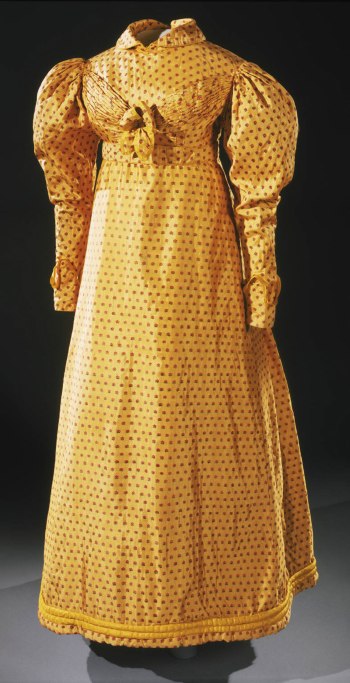
And then, while looking for something else, I found the right fabric! Not that I can buy it, mind you. It’s already owned and in use, in a gown at the Philadelphia Museum of Art. And not that I haven’t spent some quality time searching the interwebs for similar fabric, which can be found if you look hard enough. Fortunately, better sense prevailed and no cupboard will burst with an additional five yards of block printed silk.

Woman’s Day Dress, English, ca. 1820. Yellow silk brocade exported from India. Philadelphia Museum of Art. 1996-164-1a,b

Still, the fun bit is finding two such similar thoughts, one in paint and one in cloth, without even looking. that means there are more bright yellow Federal or Regency gowns out there. All it will take is the looking.

Share this:

  • Click to share on Facebook (Opens in new window) Facebook
  • Click to share on Pinterest (Opens in new window) Pinterest
  • Click to email a link to a friend (Opens in new window) Email
  • Click to share on X (Opens in new window) X
Like Loading...

Auction Season: The Holiday Sales

07 Friday Dec 2018

Posted by kittycalash in material culture, Research

≈ Comments Off on Auction Season: The Holiday Sales

Tags

auctions, material culture, Research, sales, toys

Screen Shot 2018-12-05 at 6.34.13 AM

Lot 1159 Antique Gold, Carbuncle Garnet, and Diamond Bracelet. Yes, those are rose-cut diamond flies.

First come the jewelry sales, the big guns like Sotheby’s leading the way with sales as crazy as Marie Antoinette’s jewelry (Royal Jewels from the Bourbon Family of Parma, technically, though it sounds more like a delicious lunch than a sale), but the smaller houses play, too. Skinner’s sale closed December 5, Freeman’s earlier, but later than Sotheby’s. These are not sales I bid in, but they are places to see things you’d might not otherwise see. Garnet bracelets with rose-cut diamond flies? Not something I see gracing the wrists of my fellow Metro riders or grocery shoppers.

Screen Shot 2018-12-05 at 6.41.39 AM

Lot 7, Contemporary painted tin hat trade sign, 20th Century. 7″ x 13.25″

Once the serious stuff has sold, the fun begins: the toys! Pook and Pook’s two-day toy sale begins December 7th, and you might call it whimsies and toys, since it begins with shop signs. Who doesn’t want an enormous tin hat? What’s the point, you ask? Why look, if you don’t collect? Because you can collect– information, screen caps of reference images, ideas for things to make, and a visual reference library to fill in the blanks of what you read. The steam engine that breaks in The Railway Children seemed crazy to me as a child, and I assumed it was just a model of a steam locomotive. But no: there were steam toys and accessories, from lighthouses in moats with Indians in sailboats to working looms to….steam locomotives.

Screen Shot 2018-12-05 at 6.52.23 AM

Day Two, Lot 521, Large Bassett Lowke live steam train locomotive and tender, 3 1/2″ gauge, engine – 13 1/2″ l.

The darling thing even looks like Percy, filling in the gaps of the origins of Thomas the Tank Engine, Edwardian children’s stories, and the wonders of the steam age (which you can replicate, if you choose). Hard to believe, in our age of safety, that steam engines might be de rigueur in the parlors of well-to-do Victorian and Edwardian families. (Perhaps your childhood was not as full of E. Nesbitt, Kenneth Grahame, and Arthur Ransome as mine, but if your mother’s primary caregiver was born in late 19th-century Great Britain, you might grow up with an attachment disorder and a taste for fabulist literature of the early 20th century.)

Day One, Lot 230,
German dressmaker and milliners shop room box.

And then there are the dioramas or room boxes, many, if not most, German. These early 20th-century displays give us a sense of the kinds of craft or hobby activities people enjoyed, front-facing dioramas. I think you either “get” them, or you don’t; not everyone wants a miniature world to control or fantasize about, but from the perspective of someone trying to understand what the past looked like, these can provide a three-dimensional view of what are usually only black and white images. Are they perfectly correct? No. But they do give us a sense of the kind of visual stimulation people encountered and enjoyed shopping and playing.

Day One, Lot 220, Papier-mâché milliner’s model doll.

There are dolls, always divisive (they’re creepy or cute, few folks fall in between) and they have they own usefulness. None in this Pook sale tell us much about early toys, but there are a couple of early 19th century examples to remind us of what children played with in the past, and how new fashions were disseminated. In the case of the milliner’s model doll at left, we get a good sense of the Apollo’s knot hairstyle, and a pair of red slippers I would love to have. The back view is equally useful, for it is only with three-dimensional objects (dolls or sculpture) that we can get a complete sense of a hairstyle or costume. With enough looking, you can extrapolate, but there’s nothing like being able to see the past in the round. That’s even better than the telephone-book-thick catalogs from Sears and J.C. Penney that arrived before the holidays in decades past.

Share this:

  • Click to share on Facebook (Opens in new window) Facebook
  • Click to share on Pinterest (Opens in new window) Pinterest
  • Click to email a link to a friend (Opens in new window) Email
  • Click to share on X (Opens in new window) X
Like Loading...
← Older posts
Newer posts →

Archives

wordpress statistics

Creative Commons License
Kitty Calash blog by Kirsten Hammerstrom is licensed under a Creative Commons Attribution-NonCommercial-ShareAlike 4.0 International License.

Website Built with WordPress.com.

  • Subscribe Subscribed
    • Kitty Calash
    • Join 621 other subscribers
    • Already have a WordPress.com account? Log in now.
    • Kitty Calash
    • Subscribe Subscribed
    • Sign up
    • Log in
    • Report this content
    • View site in Reader
    • Manage subscriptions
    • Collapse this bar
 

Loading Comments...
 

    %d