• Home
  • Completed Costumes/Impressions
  • Emma and Her Dresses
  • Free Patterns and Instructions

Kitty Calash

~ Confessions of a Known Bonnet-Wearer

Kitty Calash

Category Archives: Museums

D-Day: Robert Capa

06 Thursday Jun 2013

Posted by kittycalash in History, Museums

≈ 2 Comments

Tags

art history, D Day, history, Magnum Photos, photo editing, photography, photojournalism, Robert Capa, World War II

Robert Capa, American, b. Budapest 1913 - d. Indochina 1954

Robert Capa, American, b. Budapest 1913 – d. Indochina 1954 © International Center of Photography

Once upon a time in the Midwest, I worked in a Department of Photographs and Prints. (That’s where I met Mr S, when he was hired as the first museum Photographer, though he was initially known as the Badger in the Basement for the tenacity with which he defended his studio.)

I am fortunate to have a visual memory, and that’s part of how I got my job, and part of how I got to be an Assistant, and then a full, Photo Editor of the museum’s magazine. I love images, and I love photography, and I suppose I must love photographers, too, since there’s one around here somewhere in this place that I call home.

FRANCE. Normandy. June 6th, 1944. Landing of the American troops on Omaha Beach. Robert Capa, International Center of Photography

FRANCE. Normandy. June 6th, 1944. Landing of the American troops on Omaha Beach. © Robert Capa © International Center of Photography

One of the best assignments was photo editing an article based on the World War II diary and service of a local doctor who served in the Army infantry. He wasn’t the most enlightened or unbiased man, but in the 1940s, I suppose that was sadly normal. I read the piece for placement and image ideas, not for tone or subtlety. North Africa, Monty, Casserine, Messina, Easy Red and Omaha: that’s what I underlined.

My go-to for WWII photography was Robert Capa first and last. There’s Blood and Champagne, but the book I read first was Slightly Out of Focus. It was written by Capa, just as he wrote Images of War. (I discovered these killing time on summer weekends in the air-conditioned fine art reading room of the downtown public library.) Capa did not love war, even as he thrived in the combat photography environment, and said, “If your photographs aren’t good enough, you’re not close enough.” But he also noted, like Cartier-Bresson, that you had to like people to take good photographs of them.

His images are dark: not just the imagery, but the prints themselves. A well-printed Capa has deep, rich, dark tones (D-Day images excepted, thanks to a horrendous processing error), and even decades later, a vintage Capa print has magic.

I called Magnum, back in the days when one called, described what I had seen, cited the books I’d read, listed what I wanted prints of to use in the magazine. I think I knew enough to get a little more: vintage prints of images I hadn’t seen. They arrived, sandwiched in cardboard, in a FedEx envelope.

TALY. Near Troina. August 4-5, 1943. Sicilian peasant telling an American officer which way the Germans had gone. Robert Capa, International Center of Photography

TALY. Near Troina. August 4-5, 1943. Sicilian peasant telling an American officer which way the Germans had gone. R © Robert Capa © International Center of Photography

There were photos like this one, and one of a soldier shaving, using his helmet as a basin. There were images I’d seen, and some I had not. They were dark, and sympathetic, and captured the war and humanity as no other images I’ve seen have ever done.

His portfolio was huge, and includes not just war photography, but fashion and film and humorous photos, too. Holding one of his prints–or at least a print made close to the time when he had shot the negative, and might have been alive–was as close as I was ever going to get to meeting Robert Capa. For all he lived through–escaping Fascism, documenting the Spanish Civil War, the Rape of Nanking, the Blitz, all of World War II– Robert Capa died after stepping on a land mine on the road to Thai Binh in what was then French Indochina.

INDOCHINA. May 25, 1954. Vietnamese troops advancing between Namdinh and Thaibinh. This is one of the last pictures taken by Robert Capa with his Nikon camera before he stepped on a landmine and died at 14.55. © Robert Capa © International Center of Photography

INDOCHINA. May 25, 1954. Vietnamese troops advancing between Namdinh and Thaibinh. This is one of the last pictures taken by Robert Capa with his Nikon camera before he stepped on a landmine and died at 14.55. © Robert Capa © International Center of Photography

It seems so sad, and yet one has to remember that he died working, doing not just what he loved–taking photographs–but what he had to do. He didn’t love war, but he loved people. The beauty of the images he made almost undoes their purpose, in recording war’s horrors, but the real affection for people that comes through in those contrasty prints redeems the violence, I think, giving us sympathy for the people uprooted, displaced, used and abused by war, whether soldier or civilian. Through that love,Capa found courage and we can find truth. Keep looking: there is more to see.

Share this:

  • Share on Facebook (Opens in new window) Facebook
  • Share on Pinterest (Opens in new window) Pinterest
  • Email a link to a friend (Opens in new window) Email
  • Share on X (Opens in new window) X
Like Loading...

Street

30 Thursday May 2013

Posted by kittycalash in Art Rant, Museums

≈ Comments Off on Street

Tags

art, Exhibitions, Metropolitan Museum of Art, New York, Street

Street_featuredVideo art has often left me bored. It can be too schlocky, too stupid. Not that I don’t appreciate simple, silly work. The first piece of video art that made an impression on me was at the Museum of Contemporary Art in Chicago. It was  William Wegman’s  Heads With Tails, featuring the ultra-patient Man Ray. This simple video was an excellent introduction to conceptual for a 10-year-old. (I could not have been more than 10 or 12 to tolerate going to a museum with my mother…by 13 and 14 I was going on the bus by myself.)

Flipping a coin and turning a dog around, while hilarious, is not necessarily what everyone thinks of as art; for others, Nam June Paik is a more valid artist.

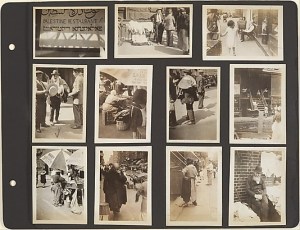
Album page, New York City. Bernice Abbott, 1929-30. MMA 1982.1180.106–.116

Album page, New York City. Bernice Abbott, 1929-30. MMA 1982.1180.106–.116

I give you James Nares, and his Street project at the Met (which closed 5/27/2013, sorry). There’s a short clip (2:17 out of 60 minutes) if you scroll down the page. This isn’t the section I stumbled upon, but it captures much of the essence of the piece. I think it was the best thing I saw all day, and even better, the video is bracketed by galleries of photos and objects selected by Nares from the Met’s permanent collection.

These are can be found online, though they are not divided or arranged the way they appear in the galleries. Still, you can see connections between the pieces.

For other interesting and rather less famous street still photographers, check out Vivian Maier, orJoe Sterling (who lived around the corner from us when I was growing up).

Please enable flash to view this media. Download the flash player.

Share this:

  • Share on Facebook (Opens in new window) Facebook
  • Share on Pinterest (Opens in new window) Pinterest
  • Email a link to a friend (Opens in new window) Email
  • Share on X (Opens in new window) X
Like Loading...

Museum Madness and Things to Make

23 Thursday May 2013

Posted by kittycalash in 1763 Project, History, Making Things, Museums

≈ 4 Comments

Tags

Museum of Fine Art Boston, Museums, muslin, over dress, Regency, tunic

After a day at the Met on Friday, I went to work at my own museum on Monday. We moved paintings, rounded up miniatures for photography, and packed an ax for transport.

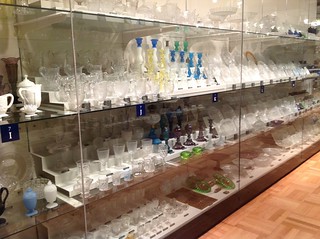
Glass at the Met. I hate this stuff.

On Tuesday, I took the MBTA up to Boston to deliver the ax (tomahawk, throwing ax, ax comma belt in Chenhall) to another museum, at the Old State House. I think this show will be very nice, and I had the pleasure of meeting someone whose wife I know through the interwebs: behold the power of the interwebs, and the small size of the reenacting community. Also, my state.)

Then, because I cannot get enough of this stuff, I took the Green line over to the MFA. By now you’re thinking, Kitty, really? How many museums do you need to visit in five days? Should we get you help? But the thing is, objects get me really stoked. Paintings, sculpture, heck, even glass– and I hate glass– make me pretty happy.

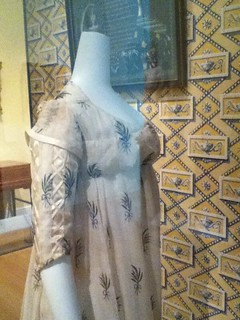
1998.96, overdress or tunic. MFA Boston

I’d just been to the MFA in July, so this trip was to visit some friends among the Copleys and Greenwoods and Blackburns. But I also know that the textiles have to rotate often, and there are dedicated mannequins in the Art of the Americas Wing.  My reward for a return trip? This lovely over dress or tunic.

I love the fabric, and thought immediately of Quinn’s Tree Gown. Hmm. As you can imagine, I will be hot on the trail of something like this fabric as soon as I am done with the menswear on my list. (There is a lot of menswear, but that doesn’t mean I can’t do some real thinking and research in preparation for this tunic…which is all I can do for now.)

It does cross over in the front, and the floral motifs line up across the layers.

There are more photos of the overdress in the MFA set on flickr, and I have a lot more thinking to do about this tunic. It does have a cross-over front, which I like, but the lacing is really striking. This may take another trip to the MFA with a better camera.

Oversleeves, cross front, lacing, diamond-shape piece in the back like a keystone…there’s a lot of detail, and lot to love (and eventually curse while making) in this tunic.

Share this:

  • Share on Facebook (Opens in new window) Facebook
  • Share on Pinterest (Opens in new window) Pinterest
  • Email a link to a friend (Opens in new window) Email
  • Share on X (Opens in new window) X
Like Loading...

Adventures in Public Transit

22 Wednesday May 2013

Posted by kittycalash in Museums

≈ 5 Comments

Tags

Amtrak, first world problems, MetroNorth, Metropolitan Museum of Art, Museums, Peter Pan Bus, trains, Travel

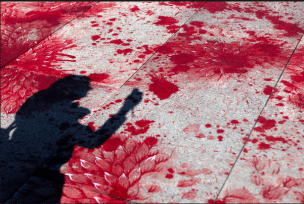
The backdrop for Imran Qureshi’s piece

Occasionally, I get a slightly wild idea and actually act upon it. My son probably has the best sense of when this is about to happen, so I no longer tell him my wild ideas plans. Of course, if the MetroNorth train collision hadn’t happened just in front of my Amtrak train, I wouldn’t have had the extra eight-block walk and the two-and-a-half hour line wait for the bus…and then I wouldn’t have ended up leaving the MFA two hours earlier than I wanted to on Tuesday.

Qureshi

Credit: Chang W. Lee/The New York Times

It began with the trip to New York: a slightly whimsical, spur-of-the-moment trip to see Impressionism, Fashion and Modernity before it closed, and everything else I could manage, including lunch on the roof. (It is weird to see children, babies, sitting, sobbing, on Imran Qureshi’s bloody chrysanthemum painting. The work itself is beautiful, though a reviewer asked if it is out of place. If you have ever walked past the site of a murder or bar fight and seen the stained pavement, this piece might creep you out. And once upon a time in Providence, I saw the blood-stained pavement near the bus stop whilst taking my dog to a vet…)

So, trip: all good, hop on the 6:42 Acela and get into Penn at 9:42, up to the Met by 10. That leaves all day for exploring, until about 4:15, when I had to beat it for the M1 back to Penn. One unfortunate act of vandalism of a Beaux-Arts railroad station later, we’re chugging along on the 5:43 Regional back up to Providence. We’re not even to New Rochelle when the train stops…and remains stopped. By 7:11 I’d figured out that there would be no trains up, and had purchased a bus ticket online thanks to my iPad with a rapidly depleting charge. By 8:00, we were back at Penn and I was fast-walking up to 40th Street where I got in line, got the ticket printed, and then trotted downstairs to get into another line: the line of no movement.

Eventually, a bus appeared. And then another bus appeared. The first bus left for a town in Pennsylvania that sounded like “West Coastville” but was probably Coatesville. A third bus appeared: rumor spread that this was the bus from Providence.

“Where have you been?” we interrogated the disembarked. “What took so long?”
“Bumper to bumper traffic,” someone said. And the line of no movement groaned.

No one dared move out of line if they did not have a blood relative to hold their place. Scouts from family groups were sent out to discover which gate had a bus, and intrepid men with girlfriends to hold their place went forth to count the line. I was in the low 40s, thank you, with about 60 people stretching behind my spot. Agitation behind me rose as line-cutting appeared to happen. Scenes from Lord of the Flies came to mind as I heard a mild wheeze from a fellow-stander. Cell phones began to die.

A typical Green Chariot, in Kennedy Plaza.

But, at last, 75 minutes after the alleged 9:30 PM departure, we were able to board the bus. I found a seat in nearly the last row, but it was a seat. At 10:56, I called home to report that we did in fact have forward movement, and were now leaving the PABT…for a short tour of Harlem. Eventually, we were on the highway (I love the quaintness of the sign for New England) and by 3:15 AM I was home, 22 and a half hours after I’d gotten up to start my day.

Now, just because I wrote the story in this tone doesn’t mean I don’t think that the people injured in MetroNorth accident, and inconvenienced in their commute since Friday, have had a far worse time than I did—I do. I’m both stunned and pleased with how quickly train service has been restored, and I have real sympathy for the anxiety of people who take the train to work every day, thanks to my husband’s daily 100-mile-roundtrip on the MBTA. Which, in a fitting moment of transit ironyy, found him delayed last night behind a broken-down Amtrak train, finally headed south…

Share this:

  • Share on Facebook (Opens in new window) Facebook
  • Share on Pinterest (Opens in new window) Pinterest
  • Email a link to a friend (Opens in new window) Email
  • Share on X (Opens in new window) X
Like Loading...

Impressionism, Fashion, and Modernity

21 Tuesday May 2013

Posted by kittycalash in Art Rant, Museums

≈ 1 Comment

Tags

Exhibitions, exhibits, fashion, Impressionism Fashion and Modernity, Metropolitan Museum of Art, Museums, painting

The authentic matters, the real matters. It is different. Great art leaps from the surface of the paper and lives. Photographs may burn into the paper, but in that depth, they, too, live and glow.

Gallery 2: En Plein Air

Gallery 2: En Plein Air

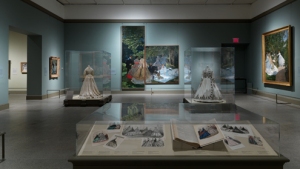
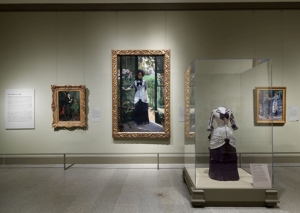
The Met’s installation of Impressionism, Fashion, and Modernity is worth seeing for the coalescence of so many real things in such a [relatively] small space. The monumental paintings, especially Monet’s Luncheon on the Grass in Gallery 2, En Plein Air, need to be seen for real, in the actual matter, to really be appreciated. The brushstrokes, the color, the enormity, all need to be in front of you to be appreciated—to be experienced. It doesn’t work any other way. (Click here for better views of the paintings and costumes; photography was not permitted.)

Gallery 5: The Dictates of Style

Gallery 5: The Dictates of Style

By way of an intimate contrast, consider the portrait of the gown and the gown itself in Gallery 5, The Dictates of Style. Here’s a lesson in the power of art, of paint, and an artist’s vision—and it’s Bartholomé, not Monet or some other genius, though a solid painter all the same.

Behold the cotton dress in conservator-approved lighting and yawn. Well designed, beautifully made, and real, right down to the stain on the upper bodice or collar, a pleat slightly misaligned at the hem. But yawn all the same. Now, the Bartholomé: bam! It’s not about the dress: it’s about light. This contrast is beyond a doubt one of the best lessons I have ever seen on the real nature of painting, and of impressionism: Light.

And if the authentic, the real is important, going to see the real thing is also important.

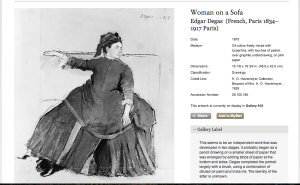
Here’s the Met’s catalog shot and record for a Degas drawing:

Degas

MMA, 29.100.185

And my iPad photo of the same drawing:

MMA, 29.100.185.

I’m not a wild fan of Degas; I’m more a Joseph Beuys/Caravaggio kind of art lover, but seen in person, this sketch was amazing.

This is an unfair comparison, and I had expected the catalog shot to be in color, because color is so important to this piece. In black and white, you miss the pop of the color contrast between the medium and the paper; you miss the bleed of the oil spot, more subtle in the black and white. You miss the way that image is fast and messy, the simmering tension between the artist and the sitter. Incredible as it seems, there is nothing like the real thing.

Share this:

  • Share on Facebook (Opens in new window) Facebook
  • Share on Pinterest (Opens in new window) Pinterest
  • Email a link to a friend (Opens in new window) Email
  • Share on X (Opens in new window) X
Like Loading...
← Older posts
Newer posts →

Archives

wordpress statistics

Creative Commons License
Kitty Calash blog by Kirsten Hammerstrom is licensed under a Creative Commons Attribution-NonCommercial-ShareAlike 4.0 International License.

Website Built with WordPress.com.

  • Subscribe Subscribed
    • Kitty Calash
    • Join 621 other subscribers
    • Already have a WordPress.com account? Log in now.
    • Kitty Calash
    • Subscribe Subscribed
    • Sign up
    • Log in
    • Report this content
    • View site in Reader
    • Manage subscriptions
    • Collapse this bar
 

Loading Comments...
 

    %d