• Home
  • Completed Costumes/Impressions
  • Emma and Her Dresses
  • Free Patterns and Instructions

Kitty Calash

~ Confessions of a Known Bonnet-Wearer

Kitty Calash

Category Archives: Philosophy

Wicked Inspiration

28 Thursday Apr 2016

Posted by kittycalash in Art Rant, History, Living History, personal, Philosophy, Reenacting

≈ 2 Comments

Tags

anarchist guide to historic house museums, Hamilton, historical reenactors, history, interpretation, literature, living history, passion, progressive reenacting, Reenacting

You know that musical? The one you can’t get tickets to unless they were willed to you by your grandmother because she was lucky enough to stumble out of the Tardis right at the box office on opening day, but had to buy them for, like, six years from now, and they’re actually for the Kansas City production? The one in which the founding fathers are, you know, brown? My friends and family assumed I’d hate the whole idea, but I don’t. Like so many people, I love it, and not just for the music, though my preferred method of psyching myself up for GeeDubs1790 or What Cheer Day is listening to the Stones or the Beastie Boys all the way up.

So, what then, interests me in “Hamilton,” and why do I think it relates to interpretation? This: the way that the show filters the concerns of the late eighteenth century through the lens of the twenty-first could make for enlightening listening.

My Shot gives me goosebumps: why? Is it because history and civics are finally sexy?

Maybe. But “Hamilton” as a whole, per Rebecca Mead in the New Yorker, “is a hymn to the allure that America promises the immigrant who aspires to reach its shores; it is also an argument for the invigorating power that this nation’s porous borders, and porous identity, have always offered.”

Porous identity. That’s part of why I’m fascinated. But just as “Sleep No More” and Occupy Providence (really really) were partial inspirations for What Cheer Day, “Hamilton” strikes me as the kind of production worth paying attention to. No, I am not suggesting that the paunchy reenactors start channeling their inner Biggie, though I might well pay to see that.

No, what I’m suggesting is that we reconsider what it is we’re doing out there on the field and in the historic houses, and not just what but how and why. Hamilton takes an unexpected approach to history and it’s going gangbusters, while Amazing Grace tanked. So it’s not about the costuming authenticity, though I implore you not to give that up. It’s about the passion. It’s about coming at things sideways.

What makes you love doing laundry, drilling with precision, telling local gossip, making soap, or whatever it is that you love best about your place in the past? Why does all this matter to you so much? What is it that we can learn about today as you teach us about the past? Let loose that love and passion, share those insights, and ten to one you’ll have more fun and excite more visitors.
Share this:

  • Click to share on Facebook (Opens in new window) Facebook
  • Click to share on Pinterest (Opens in new window) Pinterest
  • Click to email a link to a friend (Opens in new window) Email
  • Click to share on X (Opens in new window) X
Like Loading...

Zen and the Art of Living History

08 Tuesday Mar 2016

Posted by kittycalash in Events, History, Living History, Philosophy, Reenacting

≈ 2 Comments

Tags

authenticity, common people, history, interpretation, living history

sandpitGate

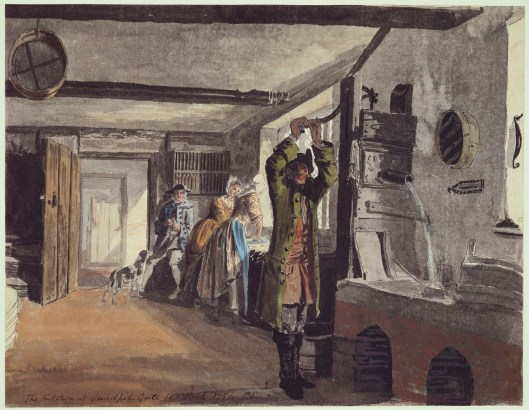
Paul Sandy. The Kitchen at Sandpit Gate, ca 1752 RCIN 914333

or, Embrace the Everyday

Chop Wood, Carry Water is taken from a Zen saying: Before enlightenment, chop wood, carry water. After enlightenment, chop wood, carry water.

Yes, I read the classic book decades ago when my life had fallen apart pretty completely, and when I dismantled it again recently, similar principles applied. After processing archival collections, sorting sewer bills and love letters– toiling in the salt mines of the mundane–I came to appreciate Chop Wood, Carry Water even more. The world isn’t really binary, but it can feel that way.

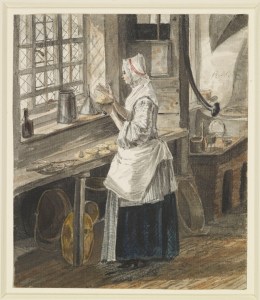
Paul Sandby. At Sandpit Gate circa 1752 Pencil, pen and ink and watercolor. RCIN 914329

Paul Sandby. At Sandpit Gate, ca 1752 RCIN 914329

We look up out of the trench of daily life and think we see giant, heroic figures doing great things, and we feel jealous. We want to feel special. Some of us want to feel pretty, or handsome, or important.

Some of us want to chop wood, carry water.

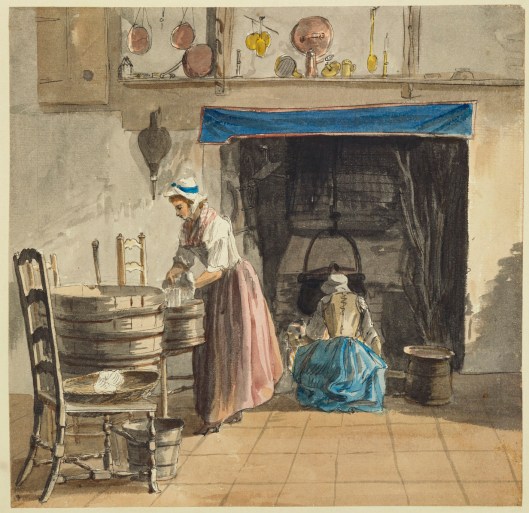
Paul Sandy. The Kitchen at Sandpit Gate, 1754. RCIN 914331

Paul Sandy. The Kitchen at Sandpit Gate, 1754. RCIN 914331

The way to make living history more interesting and more relevant is to go deep into the everyday. I don’t mean spinning– unless you tell me why you’re spinning, and I hope it’s part of Boston’s failed “We’ll make it all ourselves!” Little-Red-Hen experiment of the late 1760s–I mean living. Everyday things.

Dishes, laundry, three meals, sweeping, making up beds, mending, chucking the cat out the window, checking on dinner, chucking the cat out the window again. That’s the background against which all of the Great Men and Remembered Ladies stride and saunter. Us. You and me. Waking up with frowzy hair, blinking in the pale light of dawn. That’s the world the Great Men woke up in. That’s the world they occupied most of the time.

When we recreate Great Moments, we’re only replaying the highlight reel. Without context, those moments have less meaning. You’ve heard this sentiment before.

Chop wood, carry water. Embrace the everyday, bring everyone back into history.

Share this:

  • Click to share on Facebook (Opens in new window) Facebook
  • Click to share on Pinterest (Opens in new window) Pinterest
  • Click to email a link to a friend (Opens in new window) Email
  • Click to share on X (Opens in new window) X
Like Loading...

The Devil is in the Details

21 Sunday Feb 2016

Posted by kittycalash in History, Living History, Movie Review, Philosophy

≈ 1 Comment

Tags

authenticity, interpretation, living history, progressive reenacting

durer_hare

The Hare. Watercolor on paper by Albrecht Durer, 1502. The Albertina, Vienna.

The Witch. I had to go see it after Mr JS sent me a link to this article, and of course I was captivated. (I also needed a break after what was very nearly the Worst Week Ever, starting Wednesday at 4:30AM.)

“The recreation of farm life in 1630s Massachusetts is so complete it pulls you into the pocket universe that exists inside the characters’ minds. As you experience their fear, you experience your own. The barrier between you and the people on film disappears, and their terror consumes you. And that is how you make a scary movie!”

That pocket universe: that’s what some of us are after when we go about this living history business, creating a world so seamless (or so meticulously hand-seamed) that you, the interpreter, appear to inhabit the past and the present simultaneously.¹

So how does it work? How did it work in The Witch?

Here’s Eggers on authenticity:

“…authenticity for the sake of authenticity doesn’t really matter. To understand why the witch archetype was important and interesting and powerful—and how was I going to make that scary and alive again—we had to go back in time to the early modern period when the witch was a reality. And the only way I was going to do that, I decided, was by having it be insanely accurate.”

Got that? Authenticity for the sake of authenticity doesn’t really matter.

But the only way to make the witch powerful was to be “insanely accurate.”

The only way to make living history powerful is to be <ahem> insanely accurate.² If we’re not, the points where we are not accurate will stand out, the spell will be broken, and the visitor will be lost. The real thing is the right thing for your time and place. Context: It really does matter. 

That means that just because you perfectly replicated a silk gown from a French fashion plate it may be wildly incorrect for the streets of Providence, Boston, or Philadelphia– much less a military camp– even if it’s the same year as the event you’re attending. It means that just because you got every buttonhole perfect on your 1765 frock coat, it won’t be right for an 1803 funeral if you’re only 30.

Don't take an anecdote to a data fight.

Don’t take an anecdote to a data fight.

When you’re wearing and carrying the right clothes and objects for your portrayal, you can focus less of the what and more on the why. As interpreters, re-enactors, enactors, whatever you want to call yourself, we lead the visitor to better questions and a better understanding of not just events but the meaning of the past if we are thoroughly convinced and convincing. And that only happens by questioning ourselves.

The Witch is a horror movie, and while it was tense, the world it portrayed felt pretty close and natural to me and to Mr JS. Maybe that’s because we spend so much time trying to understand that vanished world—it’s Roger Williams, baby—maybe because we engage in living history and material culture. I don’t know if it’s scarier for folks who don’t have that level of context, don’t assume a world where hierarchy, acceptance, succumbing to a higher power, is normal. Where everything is a matter of faith, and belief. It’s a tiny world, that past. We were so immersed in that world that walking out into the mall was a shock: colors, noises, smells. And the world was so immersive because the details were so correct.

Ultimately, what we do with living history is interpretation, and interpretation is provocation.³ But what should be provoked is not a question about what you have, but why you have it, and what you’ll do with it. And that only happens if you have the right thing.

………………….

1 Your mileage may vary. It’s my dream goal. “Man’s reach should extend his grasp” and all that.

2 That is, as accurate as possible, recognizing the limitations of modern materials and access to primary source documents. More on that later.

3 Freeman Tilden. Interpreting Our Heritage, Chapel Hill: 2007. p. 35

Share this:

  • Click to share on Facebook (Opens in new window) Facebook
  • Click to share on Pinterest (Opens in new window) Pinterest
  • Click to email a link to a friend (Opens in new window) Email
  • Click to share on X (Opens in new window) X
Like Loading...

[Re-en]Activism

18 Thursday Feb 2016

Posted by kittycalash in History, Living History, Philosophy, Reenacting

≈ 5 Comments

Tags

interpretation, living history, philosophy

Dread Scott performing “On the Impossibility of Freedom in a County Founded on Slavery and Genocide” under the Manhattan Bridge (photo by Hrag Vartanian for Hyperallergic)

Dread Scott performing “On the Impossibility of Freedom in a County Founded on Slavery and Genocide” under the Manhattan Bridge (photo by Hrag Vartanian for Hyperallergic)

So I know a guy. Where I live, everybody knows a guy, but this guy I went to high school with, and stayed in touch with off and on over the years– we’re both art school refugees, looking at “America” in very different ways.

The work he’s done over the years has been controversial. But it’s his latest stuff that I’m thinking about– yeah, I know, I missed it: he’s always scheduled for when I’m at Fort Moonrise Kingdom, or, you know, tearing my life apart and rebuilding it.

Dread Scott. Images of Oppression. After a whirling dervish of a weekend that culminated in some fancy early-morning driving in Boston, I’ve almost forgotten why I was thinking of Dread Scott and living history, but here’s the short version:

Why do we choose to reenact or enact the moments or events we do? We are, by default in our selections, limiting our characters because of the script we choose. In the main, we continue to choose to re-tell and enact the dominant stories that align with common myths about the founding and history of the United States. Until we choose to enact other stories about our collective past, we will continue to enact the same arguments that Our Girl History and I have made in the past. That’s too meta even for me.

As a friend asked a few weeks ago, “Why do we commemorate massacres and not Mondays?” Let’s commemorate some Mondays, shine a light on some moments, and reimagine what enacting history can mean.

Share this:

  • Click to share on Facebook (Opens in new window) Facebook
  • Click to share on Pinterest (Opens in new window) Pinterest
  • Click to email a link to a friend (Opens in new window) Email
  • Click to share on X (Opens in new window) X
Like Loading...

Undocumented but Not Alien

07 Sunday Feb 2016

Posted by kittycalash in Events, Living History, personal, Philosophy, Reenacting, Research

≈ 1 Comment

Tags

18th century, authenticity, common people, Events, interpretation, living history, Reenacting, Research

Cherries. The Itinerant Traders of London in their Ordinary Costume, from Modern London; being the history and present state of the British Metropolis. Illustrated with numerous copper plates - British Library

Cherries. The Itinerant Traders of London in their Ordinary Costume, from Modern London; being the history and present state of the British Metropolis. Illustrated with numerous copper plates – British Library

Sometimes it’s hard to know how a riot gets started; other times, the cause is pretty clear. I’ve started one or two myself. The latest stems from Our Girl History’s musings on the Massacre.

There’s a lot to unpack, and it’s been happening online and in private conversations. Yes, children, Aunt Kitty pays attention, even if she’s silent. This is a tough topic: how can modern feminists represent historical women in a patriarchal culture without losing their minds? How can events better reflect the actual past? The population has, historically, always been about 50-50 male-female. We understand why there aren’t women on battlefields. We get that traditional events (by which I mean the ritualized commemorations of battles) have ridiculously gender-segregated and inauthentic roles. We get that it’s hard to adapt to new ideas, even free, documented ones.

The irritation and anxiety I feel as I expand the kinds of events I attend is actually reassuring: that’s how I know I’m learning. The frustration we feel means we’re banging up against a wall that we can break down with research.

Paul Sandby, London Cries: Black Heart cherries... ca. 1759. YCBA, B1975.3.206

Paul Sandby, London Cries: Black Heart cherries… ca. 1759. YCBA, B1975.3.206

It’s not easy research: women not married to or otherwise affiliated with prominent men are poorly documented. We may never know their names– or we may have a name from a census, newspaper ad, or city directory, and nothing more. But we can fill in the gaps with interpretation. (As it happens, I’ll be talking about this very idea in just a few weeks. Come taunt me in person.)

There’s a lot to think about in recreating the past, in particular at this event. The organizers have done a phenomenal amount of research, gathered the details, sorted them out, assigned roles, scripted and timed an event, and recruited a chorus of characters that reflects the texture of a tense city in 1770.

Building an event, even one that recreates an actual moment in the past, is as much as work of theatre or fiction as it is of fact: character development, motivations, costuming, setting, all of those combine with the documented words to create a scene that conveys an interpretive point for the public. It’s similar to a museum exhibition– it’s interpreted.

Traditionally, living history has interpreted the past with a bias to men’s roles (that’s the nature of our society, folks) and with a tendency to assign roles and activities by gender (again, the nature of our society for centuries). Our task in breaking that pattern is not to right the injustices of the past, for we cannot, but to interpret them.

Playing the game at quadrille : from an original painting in Vauxhall Gardens. London : Robert Sayer, ca. 1750. Lewis Walpole Library, 750.00.00.14

What about the people in the background? Playing the game at quadrille : from an original painting in Vauxhall Gardens. London : Robert Sayer, ca. 1750. Lewis Walpole Library, 750.00.00.14

One way to do that is to bring the undocumented, or poorly documented, people of the past to light. I tried to do that in exploring Bridget Connor. I’ve tried to do that by interpreting a late 18th/early 19th century servant. It’s a long and frustrating process, reading letters and diaries for scraps of information, usually casual references to servants and cooks.  But in the frustration lies the promise: we will find the people on the margins, and bring them in to clearer focus.

Share this:

  • Click to share on Facebook (Opens in new window) Facebook
  • Click to share on Pinterest (Opens in new window) Pinterest
  • Click to email a link to a friend (Opens in new window) Email
  • Click to share on X (Opens in new window) X
Like Loading...
← Older posts
Newer posts →

Archives

wordpress statistics

Creative Commons License
Kitty Calash blog by Kirsten Hammerstrom is licensed under a Creative Commons Attribution-NonCommercial-ShareAlike 4.0 International License.

Website Built with WordPress.com.

  • Subscribe Subscribed
    • Kitty Calash
    • Join 621 other subscribers
    • Already have a WordPress.com account? Log in now.
    • Kitty Calash
    • Subscribe Subscribed
    • Sign up
    • Log in
    • Report this content
    • View site in Reader
    • Manage subscriptions
    • Collapse this bar
 

Loading Comments...
 

    %d