• Home
  • Completed Costumes/Impressions
  • Emma and Her Dresses
  • Free Patterns and Instructions

Kitty Calash

~ Confessions of a Known Bonnet-Wearer

Kitty Calash

Category Archives: Reenacting

Wrestling with Myself

08 Sunday Mar 2015

Posted by kittycalash in Fail, History, Living History, Making Things, personal, Philosophy, Reenacting

≈ 5 Comments

Tags

authenticity, common dress, common people, everyday, first person interpretation, first world problems, interpretation, living history, Meriwether Lewis, ordinary people, Reenacting, William Clark, William Clark Papers

Hard choices!

Hard choices!

I wrestle a lot with myself, which sounds much sexier and more athletic than it is, when it’s your patience and conscience. It’s a constant fight with my own brain and animal nature, like Snowy pondering a bone.

  • It’s hard to keep sewing for an ever-taller young man who refuses almost all attempts at fitting. (Especially when your calloused fingertips and split thumb keep catching on the silk buttonhole twist.)
  • It’s hard to have program ideas and then realize you will end up as the maid, serving a meal to a group including some people you might not like. (Don’t you think that must be a fairly authentic emotion, historically?)
  • It’s hard to put aside plans for your first pretty silk dress because someone doesn’t want to go where you want to go.
  • It’s hard to embrace the importance and meaning of interpreting the ordinary in a culture that celebrates the unique.

I come to that and stop: mission.

I'm a bad maid. Watercolor by Thomas Rowlandson, 1785? Lewis Walpole LibraryDrawings R79 no. 7

Watercolor by Thomas Rowlandson, 1785? Lewis Walpole LibraryDrawings R79 no. 7

You can take anything too far, of course, and an occasional silk gown and turn around a dance floor might make being the maid a little easier, but in the end I know that what’s important to me is representing the people who have been forgotten.

That same impulse may be part of what drives the splintering into ever-smaller groups with every-different coats, but walking the cat back also leads me to think that lace, tape, and shiny buttons may be part of the equation, too. Are those uniforms the gents’ equivalent to cross-barr’d silk sacques? As in any culture, it is easier to have your cake and eat it, too if you’re a guy.

For most of us women inhabiting the past, if we’re not baking cake, we’re serving it.

Playing the game at quadrille : from an original painting in Vauxhall Gardens. London : Robert Sayer, ca. 1750. Lewis Walpole Library, 750.00.00.14

Playing the game at quadrille : from an original painting in Vauxhall Gardens. London : Robert Sayer, ca. 1750. Lewis Walpole Library, 750.00.00.14

It’s a funny thing to want a break from work you find important, but as with anything, variety and perspective are important.

She looks wistful, doesn't she? The others are whist-full.

She looks wistful, doesn’t she? The others are whist-full.

In a world of individualists, each trying to stand out, quotidian celebrities– cast a skeptical glance at your social media feed and tell me I’m wrong–our impulse may not be to inhabit the background. But most of us are the background. We’re large only in our own minds, stars of the movies of our lives that flicker past our eyelids. And that’s ok: that’s noble, even, to live a small, thoughtful life.

 Silver Pocket Watch of Meriwether Lewis, 1936.30.5

Silver Pocket Watch of Meriwether Lewis, 1936.30.5

Once upon a time, when I worked in Missouri, I was fortunate enough to spend a lot of quality time with some amazing artifacts.

Meriwether Lewis’s refracting telescope.

William Clark’s compass.

Meriwether Lewis’s pocket watch.

William Clark’s Account with John Griffin for thread, cloth and other articles including a hat for George and shoes for Mary. (July 1820, William Clark Papers, B13/F5, MHS)

Account of expenses in “horse keeping,” 1829- 1831. Request to Clark to pay to Mrs. Ingram, with request to serve as receipt. On same document: ADS Dashney to Major Graham, 26 June 1826. Order to pay William C. Wiggins. (1831 Dec 13, William Clark Papers, B14/F2, MHS).

There are letters to one of Clark’s sons, trying to get him to stay at West Point. There are bills for bolts and iron work for Clark’s house. Yes: there are amazing things in the collection as well, and historians of all kinds can do amazing work in the papers.

But they are ordinary. They are daily life played out in the first third of the nineteenth century in St. Louis, bills and accounts punctuated by letters from famous people and news of wars and explorers. But after processing the family’s collection, what struck me more than anything was how ordinary they were, how quotidian.

Meriwether Lewis in Indian dress. engraving after St. Memin, 1807.

Meriwether Lewis in Indian dress. engraving after St. Memin, 1807.

Lewis was fabulous, interesting and mysterious. I don’t know what really happened on the Natchez Trace, but I know what happened in St. Louis. William Clark kept living, paying his bills and stumbling sometimes, refusing a role as territorial governor before accepting it. He got boring. And for that, I love him more than Lewis.

There’s real value in interpreting the everyday, ordinary people, in bringing work and working people to life in the past. I don’t always love repressing my ego, but I know that a nostalgic view of the past can be dangerous. I meant backwardly aspirational when I first wrote it, and I mean it now: most of us would not have been merchants wearing silks and velvets and superfine wools.

After wrestling with my ego and silk dress disappointment most of this afternoon*, I’ve found satisfaction in the thought of expanding my understanding of working class women. If really digging into interpreting the world of the marginal makes me uncomfortable, it must be worth doing, and doing well.

*Thankfully whilst performing useful tasks like running errands and thus wasting little real time on this nonsense.
Share this:

  • Click to share on Facebook (Opens in new window) Facebook
  • Click to share on Pinterest (Opens in new window) Pinterest
  • Click to email a link to a friend (Opens in new window) Email
  • Click to share on X (Opens in new window) X
Like Loading...

Analogize This: Subcultures and Subgroups

05 Thursday Mar 2015

Posted by kittycalash in Living History, Philosophy, Reenacting

≈ 5 Comments

Tags

authenticity, living history, Reenacting

Remember the post about the Clash, the rawness of the Vanilla Tapes, and authenticity? In response, someone commented elsewhere that there is a cross-over between punk and reenactor subcultures.

“For one thing, it’s “anti-fashion”, if fashion is defined by what’s newest. Likewise, where do we see more punks within the reenactor subpopulation? Authentics/Progs – which is an even more stringent ideology where the clothing worn is atypical of the general masses (and hand-made, to boot! *uniqueness intensifies*). The list of similarities goes on and on…”

If that’s TL;DR for you, Agnostic Front summed it up thusly:

Talk about unity
Then talk about conformity
You don’t want to support the scene
Why don’t you get the fuck away from me?

It’s that last line I’m interested in: what’s with all the sub-groups and sub-sub groups and not playing together? Someone brought a similar phenomenon up to me this morning, and in my half-awake haze, I sent him this: Kelefa Sanneh on the NYHC scene from the March 9th New Yorker.

Here’s why: my friend said,

“The progressive “need to do your own thing and go your own way” leads to a constant parade of new units. Established Progressive units are always looking for new blood, but there are more splitters than lumpers…. There are huge farb units where quantity has a quality all its own.”

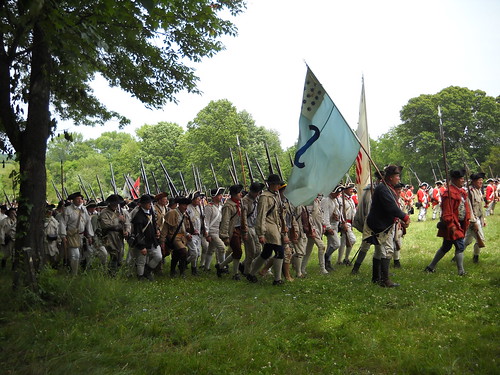
To have Men in Ranks, you need Men in Ranks.

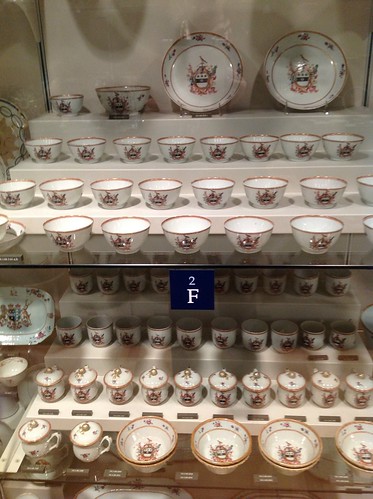
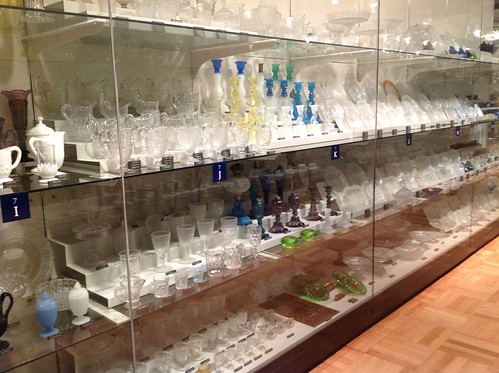
He’s not wrong, folks: there are times when size matters and Martha Stewart taught us about the impact of large groups of the same thing. You can see it working in a Met Museum open storage display of transferware or glass.

Mass Matters. Open storage at the Met, May 2013

Guys in uniforms, plates on shelves: comes to the same thing. When you get ‘em all together, they create a mass that gives an authentic presentation of force, while a handful of guys in super-accurate to the last rabbtre stitch might not—at least, not unless they’re a detachment from a light company or a scouting party, right? And what, then, of context?

So what’s happening? Are we cutting fine distinctions between groups that are actually very similar? Yes. “This new unit and uniform is totally different from your established unit: our buttons have a different number on the center.”

That raises my hackles. The more we divide, the less we conquer. It’s harder to win when you purposefully make it harder and more elite, and that’s happening as the units represented become more obscure, smaller, and more insular. It’s starting to look like show boating.

It may well be that the politics of the existing units are so awful that you have to splinter, and splinter again, but I also know units that have multiple impressions … of the same unit that show change over time. Is the sole reason this is not possible to replicate in other units the politics of these groups, or is there a badge of rank, a sense of accomplishment and uniqueness (dare I say a sense of elitism?) that comes from splintering to form ever smaller cadres of like-minded men?

“Most of all, being hardcore means turning inward, ignoring broader society in order to create a narrower one. In that narrower society, one’s ideological convictions can matter less than conviction itself—a sense, however vague, of shared purpose. In the New York hardcore scene, a wide range of characters—from Rastafarians to Republicans, street rats to suburbanites—came to see themselves as part of the same movement. That flexible spirit lives on in the genre’s famous suffix, which is now used to tag an array of movements, not all of them musical: rapcore, metalcore, grindcore, nerdcore, mumblecore, normcore.”

Ranks upon ranks of porcelain. Open storage, Met Museum May 2013

This is what we may have now: reenactor-core, instead of corps, if we fail to see ourselves as part of the same movement.

Groups, like egos and porcelain tea bowls, can be fragile. If we could handle each other with greater care, we might get more fun out of this business.

Ultimately, though, what this all makes me think of, as I lose patience watching the TWD mosh pit, is Woody Guthrie. The women may be ahead of the men, if only because there are so few of us, we must work together.

Share this:

  • Click to share on Facebook (Opens in new window) Facebook
  • Click to share on Pinterest (Opens in new window) Pinterest
  • Click to email a link to a friend (Opens in new window) Email
  • Click to share on X (Opens in new window) X
Like Loading...

Smock it to Me

18 Wednesday Feb 2015

Posted by kittycalash in Clothing, History, Making Things, Museums, Reenacting, Research

≈ 2 Comments

Tags

19th century clothing, anna maria von Phul, authenticity, Clothing, Colonial Williamsburg, common dress, common people, Costume, fashion, Federal New England Fashion, Federal style, Missouri History Museum, New England, style, watercolors

Smock, Checked cotton, Pocumtuck Valley Memorial Association. #2000.01.869.

Smock, Checked cotton, PVMA. #2000.01.869.

Edited to correct numerous typos and to add a bad sketch of the OSV apron. Don’t try to do research while conducting a small but energetic boy through a musket exhibit.

Two aprons, many questions, all of them excellent.

It’s really tough when an extant garment lacks provenance or even faux-venance, as in the “Revolutionary War” garments that turn out to be later. So, where do we look to figure things out when we a) like a garment a lot and don’t know if it’s right or b) are embarking on something a little new? And yes, in this case, we are talking bibbed aprons in the first quarter of the nineteenth century, in Rhode Island and in the Missouri Territory.

We start with questions:

1. What documentary sources can I find?
2. Is the form plausible for time period/area?
3. What is the typical fabric for the time period/area?
4. Is the item appropriate for my character/persona/impression?

Apron, checked with high waist, 1800-1820. Plain weave linen, probably Southeastern US. Colonial Williamsburg 1995-53

Apron, checked with high waist, 1800-1820. Plain weave linen, probably Southeastern US. Colonial Williamsburg 1995-53

What documentary sources do we have?

OSV's apron: I do my best work on the fly.

OSV’s apron: I do my best work on the fly.

We have some extant garments, two with images.

1. Extant apron 26.39.4, Old Sturbridge Village
2. Extant smock ca. 1800, Pocumtuck Valley Memorial Association 2000.01.869
3. Extant apron 18100-1820, 1995-33, Colonial Williamsburg (unstable links, search for accession number)
4. Apron 2005.24.4 at Historic New England has an intriguing description: A reddish brown linen apron with blue and white plaid. The apron is smock-like, with two holes for the arms and ties that extend from under the arms to the back. The bottom has a double hem. The neckline can be tightened or loosened with a blue and white string. What does that look like? Could it look like the Stonington plaid? It’s certainly a plausible New England weave 1810-1820.
5. Apron 1989.3, also at Historic New England, with a description similar to the CW high waisted apron:Cream & blue plaid linen; tucked at waist; no waistband; long cotton tape ties. (The tucked waist is similar to CW’s)

We have some imagery from the United States.

1. “Creole woman and child,” watercolor by Anna Maria von Phul, 1953.158.37, Missouri Historical Society

What else is out there? MHS’s database has an Apache error today, so not sure what aprons  they have, though they’re exactly where we need to look for one instance. I’ve looked and failed to find aprons of this description in the following catalogs: Historic New Orleans, Chicago Historical Society, State Historical Society of Wisconsin, Connecticut Historical Society, the Met, MFA Boston, Maine Historical Society, New Hampshire Historical Society, Ohio Historical Society, Newport Historical Society and Little Compton (RI) Historical Society. I’m now really tired of interacting with Past Perfect software.

Is this form plausible?

We have 5 objects and one image, all found in a cursory afternoon. Me, I’m still liking this form for the first quarter of the nineteenth century in the United States. I think the form varies somewhat, as can be seen in the descriptions; the OSV apron is the outlier, with the other 4 extant garments seeming more smock-like.

From RIHS MSS 72, Preserved Pearce papers,  Tailor's and Tavern account books, 1778-1781.

From RIHS MSS 72, Preserved Pearce papers, Tailor’s and Tavern account books, 1778-1781.

Fabric type?

Neither the OSV apron nor the PVMA smock have much (any) provenance, but the fabric is very typical of New England from the Connecticut River to the coast; it appears in inventories from 1777, on home- bound volumes, extant aprons in Deerfield and and in sample books from 1815.

Blue and white check: I am comfortable saying that those two aprons are 1800-1820 New England based on form and fabric. I am delighted to have found it in the apron at Colonial Williamsburg, which is thought to be from the Southeastern United States. I think that expand the range down the eastern seaboard. With the evidence of the extant garments and fabrics typical in New England, I am still OK with this form of apron, even if my rendition of the OSV apron is rather poor, thank you for noticing.

But what about Missouri? What should you wear out there, on the banks of the Mississippi?

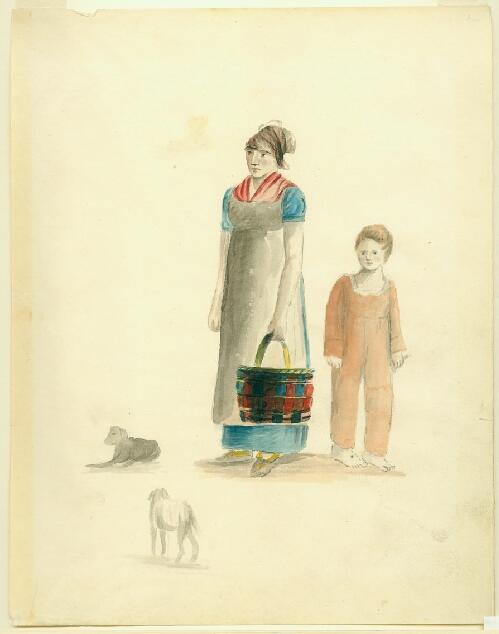
Creole woman and boy. Acc. # 1953.158.37. Watercolor and pencil on paper by Anna Maria von Phul, 1818. Missouri History Museum Collections. Von Phul 37

Creole woman and boy. Acc. # 1953.158.37. Watercolor and pencil on paper by Anna Maria von Phul, 1818. Missouri History Museum Collections. Von Phul 37

Enter Anna Maria Von Phul. She is a little sketchy on some details– these are watercolors, after all–but I think she would have made the apron blue if it was made of blue and white check. She has rendered some stripes (?) in the head scarf, so she does hint at some detail.

Because I know AMVP, I believe that she is documenting fashions pretty typical of the time and place. The ladies she portrays in St. Louis in 1818 are fashionably dressed and not behind the times for the year, even if we cannot see every detail of dress.

If I were to make the cognitive leap that women across what is now the eastern half-or-so of the United States wore bibbed-style smocks or aprons between 1810-1820, and made them up in the most common fabric of their area (cue blue and white checks for New England), I might step back from that link in Wm Booth’s catalog. If I were to copy this image’s apron, I think I would make it in plain, unbleached linen, based on how I read this color and shading.

Ideally, you would find bracketing aprons– that is, some a little earlier and some a little later– in a “typical” fabric. I didn’t find those animals in the Western Reserve or Louisiana Purchase Territory collections available online, but that only means I didn’t dig in hard enough.

I don’t think these utilitarian garments will turn up in shop records, and I don’t think we are likely to find detailed probate inventory descriptions– mostly it says “apron,” which is too general for our purposes. We won’t find runaway ads: it’s too late for those, and a little early for newspapers in the Territories, though it wouldn’t hurt to search online.

I think our best alternate documentary sources in this case will be in diaries (again, we may not get the specificity we want; Sylvia Lewis only makes Spencers differentiated by color, so we are ignorant of collar shape, trims, number of buttons, closures, etc.) and in watercolors and drawings, often amateur, of everyday life.  After all, you can never have too many sources.

Is it appropriate?

Well…the evidence on the PVMA smock is of some use, though stains can be acquired in storage, too. The CW smock-apron is less used. I think this form in a checked or plain linen fabric would be best suited for everyday and working wear, cleaning, cooking, gardening, but not for serving at table (in a house that supported that), and not for dress or best, when white would have been what was wanted.

Share this:

  • Click to share on Facebook (Opens in new window) Facebook
  • Click to share on Pinterest (Opens in new window) Pinterest
  • Click to email a link to a friend (Opens in new window) Email
  • Click to share on X (Opens in new window) X
Like Loading...

Checked Linen Aprons post-1800

16 Monday Feb 2015

Posted by kittycalash in Clothing, History, Living History, Museums, Reenacting, Research

≈ 6 Comments

Tags

19th century clothing, apron, authenticity, checks, Clothing, common dress, common people, Costume, dress, fashion, Federal New England Fashion, New England, Newport, Rhode Island, Rhode Island history, sewing, style

Not that this is an exhaustive or final chronicle, but Jackie asked about the apron.

Spring Cleaning, 2012

Spring Cleaning, 2012

I first encountered this form of apron at Old Sturbridge Village, on display in the Firearms and Textiles exhibit space, which I think of as “Muskets and Muslins.” The accession number given on the exhibit label was 26.39.4, but the object does not appear in the OSV online collections database (they do warn that it contains just a selection of their total 60K-plus object holdings). The original at OSV, as sketched and described by me in April 2012 has a drawstring at the neck, straps that button, string at the back opening, and is slim, without gathers. That means the bodice is very similar to the gown bodices of the early part of the 19th century.

Smock, Checked cotton, Pocumtuck Valley Memorial Association. #2000.01.869.

Smock, 2000.01.869 PVMA

There is another original checked bodiced apron in the Pocumtuck Valley Memorial Association collection in Deerfield, MA. This original appears in color in The Needle’s Eye by Marla Miller. As you can see in the images of my apron, I mashed the two styles together to suit the amount of material I had on hand, the skills I had three years ago, and the amount of time I had between seeing the apron and the day of the program, which was probably two days during which time I had pleurisy.*

This is also wrong, but funny.

This is also wrong, but funny.

To refocus: I chose to wear this apron at Whitehorse House in 1820 for a really wrong reason: it was what I had.

Prints in the British Museum show a maid in a yellow gown with a black apron, no bib; there is another, with a maid in a green gown, in a wikigallery, that I could not fully track down; a London Market scene; and a French print from 1818 that does show a bibbed black apron on a shop assistant. The visual research I’d done for the 1820 program suggested that black aprons were the height of fashion, and that they did not always have bibs.

Papering the Saloon at Tickford Hall, watercolor by Diana Sperling, 1816.

Papering the Saloon at Tickford Hall, watercolor by Diana Sperling, 1816.

Since we deal in confessions here, I will tell you that I did buy material for a black apron, and I planned to make a strapped or bibbed one, much like the one Sabine made. The appearance of the dark apron in Diana Sperliing’s watercolor of the ladies papering the saloon at Tickford Park put the dark strapped and sometimes bibbed apron the in English-speaking world. And still I did not manage to make one. If I were to do an 1820 program again, or even an 1813 or later millinery shop again, I like to think I would find the time to make a black strapped and possibly bibbed apron. I do think they were the height of fashion, and are likely to have been worn by women in shops, and by maids.

Do I think the checked apron is wrong? Given that I can rationalize anything, of course not! I think a checked apron is probably reasonably appropriate within the context of a kitchen, even in 1820, especially in New England. Since we did not cook on Saturday, the black apron would have been ideal, but I think the checked apron passes. To make it pass with a higher grade, I will freely admit it requires button and tape upgrades. Since the next dates on the horizon are 1775 and 1780, chances are good those upgrades won’t happen anytime soon. * Do not attend an all-day outdoor event in the cold when you are not well. Do not attend said event without your cloak, or in stays you have laced up a little too firmly. Do not deny that the cold you have might actually be the start of something bigger, when it includes a productive cough. Lo, the lessons of living history are many.

Share this:

  • Click to share on Facebook (Opens in new window) Facebook
  • Click to share on Pinterest (Opens in new window) Pinterest
  • Click to email a link to a friend (Opens in new window) Email
  • Click to share on X (Opens in new window) X
Like Loading...

An Afternoon in N’port

15 Sunday Feb 2015

Posted by kittycalash in Events, History, Living History, Museums, Reenacting

≈ 4 Comments

Tags

#WalkNPT, 1820s, 19th century, 19th century clothing, common people, Costume, dress, Events, Kitty Smith, living history, millinery shop, Nathaniel Sweet, Newport, Newport Historical Society, Rhode Island history, Whitehorne House

IMG_3041

New coat!

I set off for Newport yesterday to spend the day at Whitehorne House with Sew 18th Century. I was pleased to have my coat, and pleased as well to see the ads for “lead colored pelisse cloths” at Nathaniel Sweet’s shop at 112 Cheapside in N’port. Everything fits better when you have some documentation.

We occupied the kitchen at Whitehorne House, interpreting the lives of mythical maids and cousins Eliza and Kitty Smith.

DSC_0607

The Whitehorne Kitchen

We hope to save enough to reopen our millinery shop, which flourished once in Salem just a few years ago. Times are hard in Newport, but there are some promising lotteries–a $10,000 prize in the Kennebec Bridge lottery and an incredible $25,000 prize in the New York Literature Lottery! We will have to save our wages to buy even one ticket– difficult to do with so many tempting’ wares in the shop–but the rewards would well worth our efforts.

A shop on Thames Street is to let not far from the Great Friends Meeting House. We think ’tis a fine location, for while Friends may be plain, they are well dress’d. One of our visitors offered to spread the rumor that the shop is haunted, so no one else will rent it, but I worry that such a tale might drive off custom.

DSC_0611

Gingerbread, bread-and-cheese and apples form’d our repast

Visitors called from as far away as New Jersey, New York and Connecticut, but found Mr Whitehorne at the Coffee House and Mrs Whitehorne out makin’ calls. As prominent citizens, they are busy about the town. Mrs Whitehorne is well-known for her receipts, and we were pleased to offer callers a sample of her fruited gingerbread. Indeed, ’tis delicious, though not as sticky as the late Mr S preferred.

Some visitors thought our plan to invest in woolen mills was a fine idea, and in addition to the mills on the island (there is one in Portsmouth), we hear there are several in Hartford. Providence has not the monopoly on industry she imagines.

DSC_0615

There is much washin’ and mendin’

The laundry does pile up in a household of seven children, and since we have run out of wood, I suspect the laundress has as well. The island is short of lumber now, and wood must come from Swansea. Still, there is always mending’ to be done.

Perhaps if we had known how many visitors would call, I might have taken more care in tidyin’ up the kitchen. ‘Twas a surprise to see so many, from so far away, but we do think N’port is due for a revival. ‘Tis a busier day of visitin’ than I was accustomed to in winter at the farm on Poppasquash Neck, but with Mr Smith now dead, and our lad on a brig in the coastal trade, we could not keep the lease. I am grateful to my cousin for helpin’ me find work in such a lovely house.

IMG_3043

Share this:

  • Click to share on Facebook (Opens in new window) Facebook
  • Click to share on Pinterest (Opens in new window) Pinterest
  • Click to email a link to a friend (Opens in new window) Email
  • Click to share on X (Opens in new window) X
Like Loading...
← Older posts
Newer posts →

Archives

wordpress statistics

Creative Commons License
Kitty Calash blog by Kirsten Hammerstrom is licensed under a Creative Commons Attribution-NonCommercial-ShareAlike 4.0 International License.

Website Built with WordPress.com.

  • Subscribe Subscribed
    • Kitty Calash
    • Join 621 other subscribers
    • Already have a WordPress.com account? Log in now.
    • Kitty Calash
    • Subscribe Subscribed
    • Sign up
    • Log in
    • Report this content
    • View site in Reader
    • Manage subscriptions
    • Collapse this bar
 

Loading Comments...
 

    %d