• Home
  • Completed Costumes/Impressions
  • Emma and Her Dresses
  • Free Patterns and Instructions

Kitty Calash

~ Confessions of a Known Bonnet-Wearer

Kitty Calash

Category Archives: Reenacting

Monmouth Menus

12 Wednesday Jun 2013

Posted by kittycalash in Events, Food, Living History, Reenacting

≈ 6 Comments

Tags

10th Massachusetts, Brigade of the American Revolution, common soldier, food, Monmouth NJ, Revolutionary War, seasonal menus

Food: It is always on my mind, even cataloging. When the tan and brown and black colors of a sampler make me think of Tiramisu,  I know it’s time to wrap up work for the day. But food is particularly on my mind this week, as I plan and calculate for Monmouth, hoping to use the lessons I’ve learned in the past instead of just being anxious. I know it’s not a test, but it feels like one, somehow.

The Young Mr has aged suddenly, in Don Draper’s kitchen.

Continental rations were supposed to be a pound of beef and a pound of flour a day for man, half that for a woman employed by the army and a quarter of that for a child. The Young Mr (who isn’t really a child and is sort of a soldier) would get more if he was really a drummer… but in any case, we’re looking at 2 + ½ + ¼ or 2 ¾ pounds of beef and the equivalent of flour at a minimum to feed two soldiers, a woman, and a child per day (at a minimum, I expect to feed the adjutant as well as ourselves).

I float out ideas like fire cake or pudding to take account of the flour, but Mr S reels me in and suggests that we should stick to what we know until we can test other ideas on the landlord’s fire pit. We shall substitute bread, therefore, and I probably will not make a nuisance of myself at the bakery or the grocery and ask them to weigh the loaves, as I have my own kitchen scale and can obsess about this in the comfort of our home.
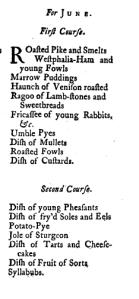
Too fancy! From the Complete Housewife.

Too fancy! From the Complete Housewife.

My plan is about the same as every camp dining plan: that’s suitable, given the repetitive nature of Army rations (and the repetitive complaints of the soldiers, echoed in every war).

Friday
Pasties. They keep and travel well.

Saturday Morning
Bread, cheese, strawberries, eggs
Ideally, I’ll find a farm stand where I can buy local strawberries, but we will only get into a discussion of what exactly would have been in season on New Jersey in June 1778, which leads to a discussion of global heating.

Saturday Lunch
Bread, cheese, ham, cookies from home

Saturday Dinner
Beef stew and bread, strawberries, cookies from home

Sunday Morning
Bread, cheese, fruit, eggs

Sunday Lunch
Bread cheese, ham, and anything that’s left

This is essentially the same plan that I had for OSV last year, with the biggest sticking points being: will I remember the eggs? Will I manage coffee? I’m not very good at anything until I have coffee, or some kind of caffeine, which could be a challenge this time around. There’s an ice truck scheduled to go through the camps, but what I want to know is, when’s the coffee truck coming?

Share this:

  • Share on Facebook (Opens in new window) Facebook
  • Share on Pinterest (Opens in new window) Pinterest
  • Email a link to a friend (Opens in new window) Email
  • Share on X (Opens in new window) X
Like Loading...

New Model Army Stove

11 Tuesday Jun 2013

Posted by kittycalash in Events, Food, Living History, Reenacting

≈ 7 Comments

Tags

18th century, Brigade of the American Revolution, camp kitchens, cooking, food, Revolutionary War

From the BAR FB page.

From the BAR FB page.

Cooking and eating will be different at Monmouth, because there will be camp kitchens.

This means two things that give me stomachaches: trying something new in public and sharing with strangers. How to alleviate this discomfort? Research, of course, because we don’t think our landlord wants to have an 18th century camp kitchen in our yard, even as an attraction or energy saving option. (Nor have we figured out how to ask him about the hanging-chicken-cooking experiment we want to try using the metal fire pit he lights for snuggling with his many girlfriends.) For more on camp kitchens, you can read John U. Rees’s article here, or check out the work done on the common British soldier in America by the 18th century Material Culture Center.

"D" are the kitchens.

The circles are the kitchens.

With a camp kitchen, we can leave our three sticks at home. Kitchens are also far more authentic for a large camp (see the plan from von Steuben at right). I’ve also read that it’s quicker than cooking over an open fire, which is a plus.

A large heap of earth cannot be good in a downpour.

A large heap of earth cannot be good in a downpour.

The main downside that I can see to a camp kitchen is rain: from the photo and this drawing, you can imagine for yourself the results of a downpour. At least it’s going to be drier there by the end of the week…

Share this:

  • Share on Facebook (Opens in new window) Facebook
  • Share on Pinterest (Opens in new window) Pinterest
  • Email a link to a friend (Opens in new window) Email
  • Share on X (Opens in new window) X
Like Loading...

HSF # 11: Squares, Rectangles and Triangles

05 Wednesday Jun 2013

Posted by kittycalash in Clothing, Historical Sew Fortnightly, Reenacting

≈ 1 Comment

Tags

10th Massachusetts, authenticity, Brigade of the American Revolution, fringe, Historical Sew Fortnightly, hunting frock, hunting shirt, Research, Revolutionary War

Hunting frock from the side. Just two sizes of one curve

I drifted away from the HSF. While, at some point, I had plans for HSF #11: Squares, Rectangles and Triangles, and they were even written down somewhere, something like table clearing and recycling happened…but, hey wait a minute, if you will allow me one curve done twice, I give you the Hunting Frock! (also, the checked bag).

Since there was a search for “best rifle frock for rev war reenacting,” I think this probably bears going into.

Presented, for your consideration, The Facts.

The Challenge:  HSF #11: Squares, Rectangles and Triangles

Without fringes or hem

Fabric: 100% “Osnaburg” linen, acquired from Henry M. Cooke IV of Historical Costume Services. I think he orders from the Ulster Linen Co. We are talking bolts here, people.

Pattern: Cut by Mr. Cooke, who used a yardstick, chalk, and an extant shirt (for the cape curve). I have watched him cut two now, and it’s pretty cool.

Year: 1778-1781 <choke> I forgot to ask.

Notions: Does thread count? That’s all this takes.

resolver

How historically accurate is it? Based on Mr. Cooke’s research into the hunting shirts worn by Massachusetts troops, and revised to reflect recent research by Neal Hurst, this frock pattern reflects the most current, accurate representation of the hunting frocks (sometimes called shirts) worn by Continental troops during the American Revolutionary War. The garment is entirely hand-sewn using, as much as possible, the correct (thankfully basic) stitches. Flat-felled seams, all that good stuff. Any place it is incorrect is purely my own genius.

Triangles and trapezoids!

Hours to complete: Remember those soul-crushing hours? Yes, these were among them. Actually, no, it’s not too bad. Perhaps twenty-four? You can power down on one of these, but even once you have the initial fringing done and the fringes attached, you will have more thread-pulling ahead of you.

First worn: Monday, May 27, 2013, for the Memorial Day Parade in Warren, Rhode Island.

Total cost: $45, for the linen and the cutting. Your mileage may vary, as the Young Mr and Mr S are in the regiment for which Mr. Cooke is the adjutant.

Hunting Shirt/Frock Schematic

Hunting Shirt/Frock Schematic, no scale whatsoever

To the person looking for the “best rifle frock for rev war reenacting,” I have to say, it depends. If you are with a Rhode Island regiment, for example, the linen you choose could be brighter, to reflect the fact that the state called for “whitened towcloth” for hunting frocks for Rhode Island troops. I have found some I think might be likely at Burnley and Trowbridge, but I have not checked it with the RI captain. You need to know if your regiment or group favors hunting shirts (pull over) or hunting frocks (open down the front), and then you need to figure out what kind of linen they were wearing in the period.

But, like a shirt of the period, these garments are very simple: triangles for the gussets (or squares), rectangles, and just the curved cape. The pattern (schematic) at right is adapted from what I have seen Mr. Cooke cut, which is quite similar to the Brigade of the American Revolution pattern I had for the Rhode Island frock I made (also entirely by hand). Since these were so close to shirts, they would have been very easy to construct, and since they’re large, measurements could be generalized. The BAR pattern does not use the under-arm gussets, and the sleeves are not tapered; there is more fringe on the standard Rhode Island frock than on the Massachusetts frock, but there seem to have been variations at the time.

You may also wish to consider whether or not there is a difference between hunting frocks and rifle frocks (I do not know, please don’t ask, I wasn’t told this would be on the test).

For more, here is Neal Hurst, on Fringe on the American Hunting Frock. You can read it before or after you pull threads out of those two inch strips until only 6 to 8 remain in the center. Happy fringing! 

Share this:

  • Share on Facebook (Opens in new window) Facebook
  • Share on Pinterest (Opens in new window) Pinterest
  • Email a link to a friend (Opens in new window) Email
  • Share on X (Opens in new window) X
Like Loading...

What’s behind that green suit?

04 Tuesday Jun 2013

Posted by kittycalash in 1763 Project, Clothing, Events, Reenacting, Research

≈ 5 Comments

Tags

1763, 18th century clothes, alterations, authenticity, Battle, Clothing, Events, fashion, frock coat, frock coats, menswear, planning, Reenacting, style

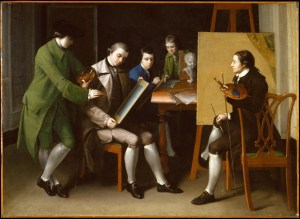
The American School, by Matthew Pratt, 1765. MMA 97.29.3

The American School, by Matthew Pratt, 1765. MMA 97.29.3

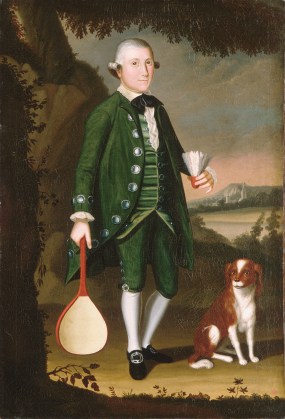
Mr S. has a green linen suit in the making; that is, he has breeches which mostly fit, and a frock coat in need of serious alteration. Since I will need to alter this coat eventually (that is, take it apart, re-cut and re-assemble it) I have started looking for images of green suits.

Portrait of a Boy, probably of the Crossfield family. William Williams, MMA 65.34

Portrait of a Boy, probably of the Crossfield family. William Williams, 1770-75, MMA 65.34

The green linen the suit was made from is no longer available, so there will be no matching waistcoat. If I can get the thing tweaked to an approximation of ca. 1763, we should be set for the August event (if that happens) and for Battle Road next year, though I know he might want wool. The taunts of “bet you wish you had the rest of that coat” from this year linger in my mind, at least.

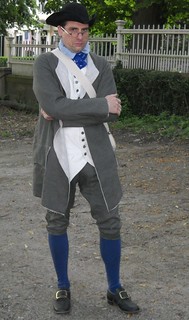
The jacket is, admittedly, too short. I begin to wonder if I need to cut it down even more, like a workman’s short coat; the Massachusetts line “Bounty Coats” are cut shorter, and similar to a coat at the Connecticut Historical Society (1981.110.0, search by number here, the links are not stable).

Mr S last June, in the unfinished 36-hour-frock coat

The problem with that plan, at least for 1763, is that the cuffs are clearly larger and coats longer, in 1763, than they are in 1775, at least for gentleman. I realize that this means I am better off starting over completely for the 1763 coat from a muslin up (which against all instinct and principles, I did not do for the 36-hour-frock coat). So I’m waffling here, as Mr S doesn’t always want to portray the day laborer/tenant farmer, but would like some pretensions to artisan and property owner. That means more fabric, and that means starting over completely is in order–breeches, waistcoat, frock coat and all. But wait, there’s more!

The events in the queue before the August 10th event for 1763 include Monmouth on June 15-16 (for which overalls and hunting frock are in production), Washington’s Arrival in Cambridge on July 14, which requires militia clothing, and Old Sturbridge Village the first weekend in August, for which a regimental coat is requested. Somewhere along the line, I’d like to make myself something…but it looks more and more like a summer of menswear. Perhaps cutting down that green coat and altering the breeches for July 14 is the most sensible plan…though where that will leave 1763, or the regimental coat, I do not know.

Share this:

  • Share on Facebook (Opens in new window) Facebook
  • Share on Pinterest (Opens in new window) Pinterest
  • Email a link to a friend (Opens in new window) Email
  • Share on X (Opens in new window) X
Like Loading...

Lunatic Fringe

28 Tuesday May 2013

Posted by kittycalash in Clothing, History, Living History, Reenacting

≈ 2 Comments

Tags

10th Massachusetts, 18th century clothes, Brigade of the American Revolution, common soldier, hunting frock, hunting shirt, overalls, Revolutionary War, uniforms

Hunting frock and overalls complete!

Hunting frock and overalls complete!

Oh, my goodness, it’s done! It’s done, and the photos have passed the master. Phew! Just one more to go, oh, my goodness, no.

The Young Mr was allowed to carry a musket in the Warren Memorial Day Parade. I do not love a parade, so I didn’t go. But he had no overalls of suitable fit and they were so nearly done, that I resolved to finish them, and finish them I did, in time for bed on Saturday, no less. It’s all thanks to BBC’s brutal but entrancing programming. My sewing better to blood curdling screams (also courtesy ITV), which seems awful but there it is…though the darkness of Mad Men has proven good for back stitching, decent button holes require murder.

Buttonholes. I hate those guys less now.

Buttonholes. I hate those guys less now.

Fifteen button holes, multiple fittings, and some curse words have resulted in a pair of decent-fitting overalls that did not split at the knee or stretch too extremely when worn. And atop it all, in the yard if not in the parade, the new model hunting front adopted by the 10th Massachusetts. The Young Mr is uniform-forward as Neal Hurst’s research has led the adjutant to conclude that the men were wearing frocks, and not shirts. (In the Rhode Island records, I found that rifle frocks were listed until 1780/1781, when the Records of the State of Rhode Island began to indicate rifle or hunting “frocks or shirts.” That’s a wrinkle for Mr Hurst, but I saw only frock in 1777-1780.)

Lunatic fringe. Cut, fold, clip, strip, stitch.

Lunatic fringe. Cut, fold, clip, strip, stitch.

The fringing is a task completed by Mr S, who has fringed the strips for his own Rhode Island hunting frock, and now knows what fun awaits him as another frock will made for him. My goal? Another complete 10th Massachusetts kit by June 15. I’ve sewn buttonholes in a moving car before, and I expect to be felling seams or sewing buttonholes as we travel down to New Jersey. They’ll be fine; after all, the traffic is murder.

Share this:

  • Share on Facebook (Opens in new window) Facebook
  • Share on Pinterest (Opens in new window) Pinterest
  • Email a link to a friend (Opens in new window) Email
  • Share on X (Opens in new window) X
Like Loading...
← Older posts
Newer posts →

Archives

wordpress statistics

Creative Commons License
Kitty Calash blog by Kirsten Hammerstrom is licensed under a Creative Commons Attribution-NonCommercial-ShareAlike 4.0 International License.

Website Built with WordPress.com.

  • Subscribe Subscribed
    • Kitty Calash
    • Join 621 other subscribers
    • Already have a WordPress.com account? Log in now.
    • Kitty Calash
    • Subscribe Subscribed
    • Sign up
    • Log in
    • Report this content
    • View site in Reader
    • Manage subscriptions
    • Collapse this bar
 

Loading Comments...
 

    %d