
• Home
  • Completed Costumes/Impressions
  • Emma and Her Dresses
  • Free Patterns and Instructions

Kitty Calash

~ Confessions of a Known Bonnet-Wearer

Kitty Calash

Category Archives: Research

Pockets of Evidence

02 Wednesday Apr 2014

Posted by kittycalash in Clothing, Reenacting, Research

≈ Comments Off on Pockets of Evidence

Tags

18th century clothes, 18th century clothing, Clothing, common dress, common people, Costume, living history, Metropolitan Museum of Art, Museums, Reenacting, Research, Rhode Island Historical Society, Wintherthur Museum

Or is it evidence of pockets?
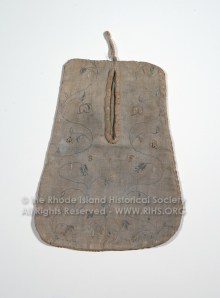
Pocket, 1770-1780 Rhode Island Linen, cotton and silk RIHS 1985.1.9

Pocket, 1770-1780
Rhode Island
Linen, cotton and silk
RIHS 1985.1.9

In any case, I thought it time to upgrade my pockets, since I have given so much attention to the rest of Bridget’s clothing. I have also been talking with a colleague about a pocket game activity, similar to the process I’ve used in thinking about Bridget: what is in your pocket? If I’m going to try that out in public, then I’d like not to be embarrassed about my pockets.

The first pocket I made was based completely on one in the RIHS Collection, and it annoyed the daylights out of me as it had exactly the same loop on top and twisted around under my petticoats, making the opening hard to find. I also realized that it was too small to be really correct for a woman’s pocket: those tend to be larger. Sew 18th Century has a really nice article on pockets here.
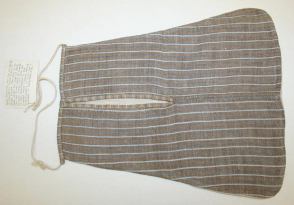
Pocket, 1789 American  linen  Gift of Miss Blanche Vedder-Wood, 1940  MMA Costume Institute C.I.40.159.4

Pocket, 1789
American
linen
Gift of Miss Blanche Vedder-Wood, 1940
MMA Costume Institute C.I.40.159.4

So I made a larger pocket based on this one at the Met, and made of a grey and cream striped linen with the slit bound in red calico. It’s dated to 1789, and technically that’s too late for my uses.

Pocket 1720-1730 block printed cotton and linen

Pocket
England, 1720-1730
Cotton; Linen
Winterthur Museum Collection 1960.0248

But the next one is too early.

Well, it has survived this long, and Wm Booth has that lovely shell print cotton, so what’s a sister to do? Pockets don’t take much fabric, so making a matched pair of printed pockets seems the thing to do.

Now the question is, what should be in those pockets?
Share this:

  • Share on Facebook (Opens in new window) Facebook
  • Share on Pinterest (Opens in new window) Pinterest
  • Email a link to a friend (Opens in new window) Email
  • Share on X (Opens in new window) X
Like Loading...

Frivolous Friday

28 Friday Mar 2014

Posted by kittycalash in Museums, Research

≈ Comments Off on Frivolous Friday

Tags

Metropolitan Museum of Art, Museums, resources

Robe à la Française 1778–85  French linen, silk  Purchase, Irene Lewisohn Bequest, 1965 MMA C.I.65.13.2a–c

Robe à la Française
1778–85
French linen, silk
Purchase, Irene Lewisohn Bequest, 1965 MMA C.I.65.13.2a–c

Yes, I give up. It has been a long week, I am tired of winter and tired of snow and packing books and carpets torn up and tired of bad communication. Fresh content? I am fresh out.

I spent Thursday beating my head against research into the Brown family textile collection, and Providence textiles in general, for a program I seem to part of next Saturday. I hope I’m prepared, but along the way to getting ready, I spent some time in many museum databases beyond our own.

The Met, as always, rocks the party and brings their largesse to us all with their online publications.

Get thee to their website, content-hungry pilgrim, and enjoy the downloadable fun. (Some of you already know this, but I keep losing the right link, so here it is again.)

Share this:

  • Share on Facebook (Opens in new window) Facebook
  • Share on Pinterest (Opens in new window) Pinterest
  • Email a link to a friend (Opens in new window) Email
  • Share on X (Opens in new window) X
Like Loading...

Order in the Court

26 Wednesday Mar 2014

Posted by kittycalash in Living History, Reenacting, Research

≈ 1 Comment

Tags

10th Massachusetts, authenticity, Brigade of the American Revolution, common people, common soldier, living history, Reenacting, Research

Female court martial : held upon the conduct of an admirable lady. [London? : s.n., 1757] Lewis Walpole Digital Library 757.03.00.04+

Female court martial : held upon the conduct of an admirable lady.
[London? : s.n., 1757] Lewis Walpole Digital Library 757.03.00.04+

Everything I think I know about courts-martial I learned from the movies (The Caine Mutiny and Breaker Morant, or Paths of Glory) but thankfully I can realize that knowledge is probably not so applicable to Bridget and her context.

Thanks to Yale, it’s easy enough to find the  Rules and Orders for the Continental Army, as set down by the Continental Congress in 1775. I don’t have to know this, the guys know it, but it’s helpful for me to understand what’s happening. I also figure Bridget would have known how the system worked (or should have) since she was part of it, and would have observed life around her. In the same way that I understand the  organizational politics and policies of my workplace, she and the soldiers would have understood the rules and regulations under which they lived and worked.

In the first case, remember the shirt-selling soldiers? Here’s the regulation they were breaking:

“Art. XV. Whatsoever non-commissioned officer or soldier, shall be convicted, at a regimental court-martial, of having sold, or designedly, or through neglect, wasted the ammunition, arms, or provisions, or other military stores, delivered out to him, to be employed in the service of this Continent, shall, if an officer, be reduced to a private centinel; and if a private soldier, shall suffer such punishment as shall be ordered by a regimental court-martial.”

There you have it: they sold provisions or “other military stores” delivered to them to be employed in the service of the Continent, and suffered such punishments as were ordered.

And Bridget? Well, for one thing, she should have known she was subject to the articles, rules, and regulations. She was one of those “all persons whatsoever.”

“Art. XXXII. All suttlers and retailers to a camp, and all persons whatsoever, serving with the continental army in the field, though not inlisted soldiers, are to be subject to the articles, rules, and regulations of the continental army.”

Technically, I cannot find anything stating outright that one could not buy issued goods from the soldiers to whom it had been issued, but since selling it was wrong, receiving was wrong, too.

We know from the final punishment that Bridget probably breaks yet another article:

“Art. XL. No person whatsoever shall use menacing words, signs, or gestures in the presence of a court-martial then sitting, or shall cause any disorder or riot, so as to disturb their proceeding, on the penalty of being punished at the discretion of the said court-martial.”

I think the “the Insolence to the officers of [the 10th Massachusetts] Regiment” may have taken place at the court-martial, given the swiftness of her punishment.

Share this:

  • Share on Facebook (Opens in new window) Facebook
  • Share on Pinterest (Opens in new window) Pinterest
  • Email a link to a friend (Opens in new window) Email
  • Share on X (Opens in new window) X
Like Loading...

Open to Interpretation

19 Wednesday Mar 2014

Posted by kittycalash in History, Living History, Reenacting, Research

≈ 1 Comment

Tags

10th Massachusetts, Bridget Connor, history, interpretation, living history, Reenacting

Interpretation: I’ve been thinking about it a lot lately, reducing it to basics. Beverly Serrel challenges exhibit designers to articulate the one Big Idea about their work; one sentence that describes what your exhibition is about. I’ve been thinking about the Big Ideas for some upcoming exhibitions and programs at work, and in my personal work.

Some seem easy: Slavery in Rhode Island: Everyone was involved, everyone is connected. Slavery is part of our shared past. We are all part of the web of complicity. (Pick one, they’re all related.)

For the house museum, and the living history day at the house museum, it’s a little more complicated. We tried an involved story line last year and it didn’t seem to matter to visitors who were mostly intrigued by watching pretty costumes in a pretty house.

Thomas Gainsborough, The Housemaid. 1782-86. Tate Museum, Presented by Rosalind, Countess of Carlisle 1913, N02928

Thomas Gainsborough, The Housemaid. 1782-86. Tate Museum, Presented by Rosalind, Countess of Carlisle 1913, N02928

What I’ve settled on for now is a crude variation of “it takes a village,” in that a complex web of food and support networks was necessary to sustain an elegant 18th century mansion. (Our theme this year is Rhode Island Seascape and Landscapes, AKA Surf & Turf.) I begin to imagine diagrams that support that theory: small holding farmers and dairymen and fishermen who sold supplies to the wealthy, the merchants importing goods, the sailors and captains and shipbuilders needed to bring the barrels of china, boxes of sweets and tea and nankeens back to Rhode Island to support the scenes of elegant perched at the very top of the social pyramid.

Then I come to my personal interpretation and Bridget Connor. What is that story about? A Bridget with a troubled past and nothing left to lose? Poor women struggled to survive in an unstable war economy? Or simply that not everyone in the Revolution was a hero?

Share this:

  • Share on Facebook (Opens in new window) Facebook
  • Share on Pinterest (Opens in new window) Pinterest
  • Email a link to a friend (Opens in new window) Email
  • Share on X (Opens in new window) X
Like Loading...

The Shurts off there Backs

17 Monday Mar 2014

Posted by kittycalash in History, Living History, Research

≈ 6 Comments

Tags

10th Massachusetts, 18th century clothes, authenticity, common soldier, dress, interpretation, living history, Research, shirts, uniforms

Francis Wheatley, 1747-1801, British, Soldiers and Country Women, undated, Pen and black ink with watercolor on medium, smooth, cream wove paper, Yale Center for British Art, Paul Mellon Collection

Francis Wheatley, 1747-1801, British, Soldiers and Country Women, undated, Pen and black ink with watercolor on medium, smooth, cream wove paper, Yale Center for British Art, Paul Mellon Collection

Among the things I wondered about Bridget Connor and her court martial was from whom she’d bought that “publick shurt.” Why would a soldier have an extra shirt, or be willing to sell an extra shirt?

There are some circumstances in which it is plausible.

ClothingRegs1776_77

While shirts could have been sent from home,  regulations established in 1777 called for soldiers be issued two shirts, or an equivalent bounty. A soldier who wanted cash for alcohol or other non-regulation and non-issued goods or services might sell his second shirt, or steal a shirt to sell.

With the context of what soldiers should have been issued, we can  begin to tease the story out of the orderly books.

Regimental Orders July 15th 1782

At a Court Martial whereof Capt Dean was pre
sident, was tried Paul Pendexter & Titus Tuttel
soldiers in the 6th Company 10th Massachusetts Regt
For Stealing a Shurt and Disposing of the Same
ware Both found Guilty and Sentancd to Sixty Lashes
on there Naked Backs—the Colo approves
the opinion of the Court and orders it to
take this Evening and the prisoners to Return
to Duty——-The Court Martial of
which Capt Dean is president is Desolvd

The quote above is a full seven days before Bridget appears at her own Regimental Court Martial “for purchasing a publick Shurt from a Soldier.”

Paul Pendexter and Titus Tuttel were just the guys to get caught, until Bridget was discovered. It does make me wonder if there was an extensive ring for black market shirts (and where did they go once Bridget had them? Did she try to sell them back into the public stores, i.e. the quartermaster)?

Criminal masterminds these people weren’t, but it does seem possible that the Shirt Ring was fairly busy before it was collared.

Share this:

  • Share on Facebook (Opens in new window) Facebook
  • Share on Pinterest (Opens in new window) Pinterest
  • Email a link to a friend (Opens in new window) Email
  • Share on X (Opens in new window) X
Like Loading...
← Older posts
Newer posts →

Archives

wordpress statistics

Creative Commons License
Kitty Calash blog by Kirsten Hammerstrom is licensed under a Creative Commons Attribution-NonCommercial-ShareAlike 4.0 International License.

Website Built with WordPress.com.

  • Subscribe Subscribed
    • Kitty Calash
    • Join 621 other subscribers
    • Already have a WordPress.com account? Log in now.
    • Kitty Calash
    • Subscribe Subscribed
    • Sign up
    • Log in
    • Report this content
    • View site in Reader
    • Manage subscriptions
    • Collapse this bar
 

Loading Comments...
 

    %d