The female orators/ M. Rennoldson sculp. etching & engraving on laid paper, hand-colored. 1768. Lewis Walpole Library
I’m teaching a workshop in a few weeks, and that is giving me all kinds of reason to re-examine how I do things, what I know, and how I know it. After a few years, I worry that I take the knowledge I’ve gained for granted– which is a dangerous thing to do! Even when you have the good fortune to be building on the work of notable experts (like Sharon Burnston), you have to fact-check yourself. In part, I did this to verify that the pattern I use will work for the time period in question (last half/quarter of the 18th century). The other question I had was about material and prevalence. I’ve maintained that the bedgown is the most common, cozy, and cute garment of the 18th century, but is that true?
View near the Ring in Hyde Park, looking towards Grosvenor Gate, during the Encampment, Paul Sandby, 1780. Pen and watercolour |RCIN 451581
Many of the images of women in bed-gowns seem to depict older women made deliberately unattractive, poor women with their clothes in rags, or bawdy women. All of those are great in their own way, but most of us want to look our best (even when being our worst). For me, this affects the fabric choices I make. Fabric cheers me up– the varieties of color, texture, pattern make winter bearable, job rejections tolerable, and future plans graspable. I have a predilection for pattern, particularly Indian patterns, so I’m always looking for references to prints and chintz being worn.
Maryland Journal, July 17, 1776
Well, bless Jean Shepherd’s heart for running away (with a “down look”) from York, PA in 1776. She took off in a dark calico bed-gown, a brown worsted petticoat, and a half-worn white pelong bonnet. The images of printed bed gowns I’ve found thus far have light grounds (the yellow of the orators being more light than dark, though certainly saturated).
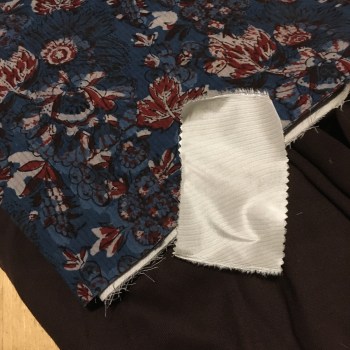
But I can find dark ground cottons, and while what I have is not documented reproduction, I am comfortable with it. The lining will be off-white plain weave wool because it’s winter. I don’t have documentation for this combination but among the fabrics on hand in my reduced-but-accessible Strategic Fabric Reserve, the wool has the best hand and the correct yardage, so wool it is. (It feels like brushed cotton, and was meant for a shift but needs must.)
Blue chintz lining in a man’s banyan, 1731 – 1760. Museum of London, 53.101/10
detail, banyan at left.
Newspaper ads for runaways show a fair range of fabrics: red baize; red calico; brown linsey; stamped linen; black and white calico. That last sounds so graphic– and, worn with a black calimanco petticoat, must have been striking. This same woman, Katey Norton, also took with her “an homespun Cotton tight bodied Wrapper” which is appealing indeed– and which I can picture. But that’s another patterning exercise.
I have a thing for hats– well, for bonnets, really. I know I made stays and a shift before I made anything else for the 18th century, but I might have made a bonnet before I made a proper gown. It’s a condition I inherited from my grandmother, and a great aunt who was a milliner, so there’s little to be done about it– except to dive in deeper.
Miss Theophila Palmer (1757-1848), oil on canvas, attributed to Sir Joshua Reynolds ca 1770. Pretty sure that’s a white “whalebone” or “skeleton” bonnet.
As people do more research and generously share it with me, I’ve come to realize that I need to synthesize what we are seeing. It’s a tricky thing, what with that single (known) extant bonnet at Colonial Williamsburg and only prints and images to go on. What I’ve done to compile a stack of references from newspaper ads (primarily Mid-Atlantic and New England colonies at the moment) and interfiled them with images. This has given me a much better sense of the change in shapes and construction over time, as well as the range of colours– yes, colours, available and popular.
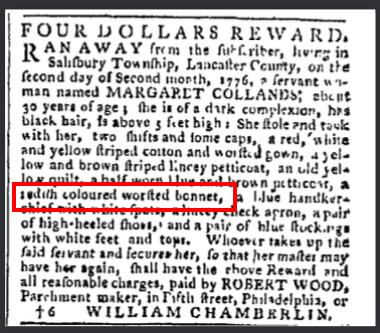
It’s not just that wool bonnets are a thing– there’s the ““a reddish coloured worsted bonnet” in the April 8, 1776 Pennsylvania Packet an ad for runaway Margaret Collands, and the “black durant” recommended in Instructions for Cutting Out Apparel for the Poor– but close reading shows that the colors are more varied than we’ve accept lately, but they vary by region and time period.
The Misses Waldegrave. Are blue bonnets *only* for children? Maybe.
There’s been a rule that “all bonnets are black silk,” which is too broad a statement. Most bonnets are black, that’s true. But in 1768, in Boston, a place where folks would have you think that black is the only colour bonnet you can ever have, you can have “Black, pink, blue and crimson sattin hatts and bonnets” (Joshua Gardner and Com. ad, Boston News-Letter, November 24, 1768).
Heck, if you shopped at Caleb Blanchard, you could have a green bonnet, too! Blanchard advertised “black, blue, green, white and crimson Sattin bonnets” in the Boston Gazette on December 18, 1769.
What does this mean? My SWAG is that roughly 60-70% of bonnets should be black. After that, blue, white, red and green would make up the balance. In Philadelphia, green bonnets– and green flowered bonnets– last longer in the ads. Philadelphia is also where I see more white bonnets, a brown silk bonnet, a diaper bonnet, a “queen’s grey” bonnet, and, in Trenton, a “lye coloured” bonnet. In Rhode Island, there’s a blue stuff bonnet. So yes, bonnets should mostly be black. But they can also be other colours.
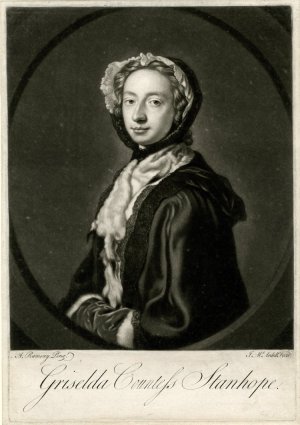
Griselda Countess Stanhope. Mezzotint engraving by James McArdell after Allen Ramsay. British Museum, ca 1760
Let’s take a closer look at Griselda, Countess Stanhope. She wears a hood over a fine white cap, as well as a hooded cloak. Around her neck, she wears a fur tippet, and her hands are snuggled into a muff. While most of the “common” women in the colonies wouldn’t rise to the Countess’s ermine tippet, they did have hoods.
Thomas Howe Ridgate’s inventory taken 19 June 1790 in Charles County Maryland includes “3 velvet and silk hoods,” while Mrs. Elizabeth Lawson’s inventory, taken 3 May 1766 in Prince Georges County Maryland includes one velvet hood and one “Allamod” hood. (She also has “1 old Striped Bonnet,” as well as 2 Womens New Capes, and 1 Womans Life everlasting Petticoat, which bears further investigation.)
Hoods appear fairly regularly in prints, worn over caps (as in Countess Stanhope), under hats, and even under bonnets, as in this print from the Victoria & Albert Museum.
January, engraving, ca. 1780. E.3520-1953. Victoria & Albert Museum
The mantelet hood worn over the bonnet, hood, and cap layers.
In the images above, I’m wearing a white cap, black silk hood, and black “stuff” bonnet, with a black silk mantlet over a silk neck-handkerchief. The hood needs some tweaking, size-wise, but the layers definitely recreate what we see in the print of “January.” The bonnet has an adjustable caul, so will easily fit over hair, cap, and hood; the hood has a drawstring closure at the neck that helps keep out the wind. Taken altogether, these layers are definitely insulating! Looking like an 18th century engraving is almost a bonus– but when you wear what they wore, you look like they did.
The last event of 2018 (for me) was the “March In” evening event at Valley Forge. My reasons for choosing events may be quirky: anything I can get to at Fort Ti, because I love that fort and landscape; MoAR events because they’re imaginative, not too far, and, bonus, I get to see my mom; anything immersive at which I’ll have tasks and a role; anything that gets me behind the scenes or gives me a new perspective on a site, museum, or event; anything that allows me to flex my interpretive muscles. March In gave me a new perspective, a new site, and a chance to expand my interpretive range. I loved it. My son, not so much. While I’d thought he’d enjoy it– he got us into this living history business, after all–since we’d visited Valley Forge every summer when we went to see my mom, and our parts would be small, progressive-focused scenarios.
Reader, he quit. Ten minutes before the park reopened to the public, as we stood in the dark on the Joseph Plumb Martin Trail, he told me he wanted to quit reenacting.*
No wonder I found the evening chilly.
I wasn’t too concerned about keeping warm after surviving and thriving in Princeton. The weather on December 19th seemed, if not balmy, seasonably pleasant, so I left off a layer or two from the Princeton list, skipping the third neck handkerchief. My bonnet this time was an old woolen “stuff” bonnet made back when my bonnet obsession first began. In the April 8 1776 Pennsylvania Packet, an ad for runaway Margaret Collands records that she was wearing “a redish coloured worsted bonnet.” My choice seemed pretty apt for winter in Pennsylvania, and, lined with linen, I can confirm my head stayed warm. My neck was not!
Griselda Countess Stanhope. Mezzotint engraving by James McArdell after Allen Ramsay. British Museum, ca 1760
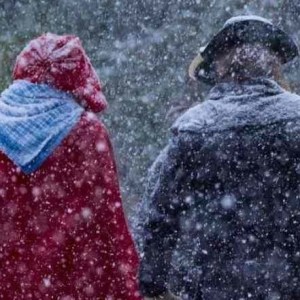
At Princeton, I solved the neck draft problem by tying my third neck handkerchief around the neck of my cloak hood (see above). When I came home from Valley Forge, I went shopping in the historical record to see what I could find: hoods. Close-fitting hoods, worn over caps. Some velvet, some, possibly, quilted. I also found bonnets with “quilted crowns,” which I think may describe quilted hoods.
_____________________
The title is taken from Tench Tilghman to John Cadwalder in Boyle, Writings from the Valley Forge Encampment, 1:26 “Our Men have all got comfortably covered in their Huts and Better quarters are not in the World…” Tench Tilghman to John Cadwalader, Valley Forge, 18 January 1778.
*More on this another time, but yes: he’s still alive and well and seems happy enough for an enormous 20-year-old home with a classic college break cold.
It’s obvious that the people I know and associate with understand the genius of They Shall Not Grow Old, and the importance– necessity– of seeing it. This is a brilliant public history project in the most public sense of all– and not only because it’s a movie made by Peter Jackson, which one hopes will attract a wide audience– but because the mini-documentary after the feature lays bare the bones of the making. Jackson’s explication feels at times as if he is speaking to you through his laptop camera on the best Skype connection you’ve ever had. Despite the occasional weirdness of that, it’s worth staying for, because it makes clear what makes the film powerful: research and meticulous attention to detail (plus phenomenal computing power and the genius of WingNut productions).
Royal Irish Rifles, Battle of the Somme
This film rests on research: 100 hours of footage from the Imperial War Museum, 600 hours of oral history audio. Jackson and his team immersed themselves in the media, and it shows. Their intention was to create a generic experience of the common soldier (I may well have teared up at that), so the description of the assault is generic– is it the Somme? Vimy Ridge? Ypres? It is all of them and none of them.
Now the magic of that choice is not that we hear anything about how a Lee-Enfield works, but rather about the minutiae of getting ready to go over the top. We are in the soldiers’ world, and that world is made up of mud, bread and jam, and tea. Yes, there’s talk of the packs and what they carry, but the descriptions of what the waiting was like, how the officers behaved and gave their orders, are what make the moments so immersive. The words match the abject terror on one private’s face, caught in a grimace more rictus than smile. At the same time, we do get descriptions of the logic of the shelling, what the shells contain, and how the mines work. Matched to footage showing what the veterans describe, we come to understand how terrifying those moments were– and then we hear how, once you go over the top, fear disappears as you walk towards the German lines. (The walking always astonishes me: but that’s how they did it, lines of soldiers walked towards the machine gun nests.)
But it’s the details of the getting ready and the tension of the waiting that make the assault so much more intense, as contrast always will. The assault itself, for which there is no footage because it was too dangerous to send cameramen over the top, is depicted with halftones from The War Illustrated, selected for their realism and lack of heroics. (Published in Britain, it was as much a propaganda tool as a documentary publication, though accuracy improved over time.)
We don’t get the “glory” of a battle. We don’t get heroics. We get descriptions of the most terrifying and dehumanizing “job of work” people (mostly men) are ever asked to do. And we get the aftermath, rendered small. In detail. The descriptions of wounds and deaths are moving, and the tireless work of the doctors, but then there is the desire for a cup of tea. Tea threads through the film, seeping into every aspect of the war. It is, after all, men living daily lives in the most outrageous conditions, where every banal desire– dry feet, strawberry jam, a safe place to defecate–is thwarted by the conditions that make those desires so achingly large and yet dismissable. You have to enjoy what you have and can achieve and laugh at what you cannot, or you won’t survive. No one can ache endlessly.
What makes this film really work is the hyper-attentive focus on detail, on getting everything as right as possible, from the color of the uniforms to the accents giving the soldiers voice. The point of the research is not detail for details’ sake, but immersion. Only when there is nothing to notice– nothing that seems amiss, an entirely seamless world–can we fully enter the other, another time, place, culture. That is what we are seeing: another culture, with its own language, mores, habits and taboos.
This is what we are trying to recreate when we reenact the past: we are reviving a lost culture. To do that correctly and well, we need to apply the same level of care and understanding and empathy visible in Jackson’s film. We need to make sure that the details are correct not because the public will call us out on errors, but because the oversights are disrupting. The difference between a well-researched, highly detailed impression that does not focus on “Want to know how a musket works?” and one that’s musket-centric and approximates the past with “If they’d had it, they would’ve used it” is not actually of quality or necessarily or care. The difference is that one allows both the enactor and the audience to more fully enter the past. It’s like a bubble of time we can step into, one where we get as close as we can to how the people of the past saw, thought, felt, smelled. The other, often excused with “The public can’t tell the difference,” remains performative and distant, only half-reaching the past.
The public can tell the difference. They can tell when what they are seeing comes closer to the past, engages with the material in detail and in attitude, and creates attitude, worldview, empathy rather than a recitation of facts. To reenact the past, we must inhabit it, from the color of the wool to accent of the speech, to the taste of the food. The moments we recreate are specific in time, and, when they embody everything you can know about that moment, help us reach across time to understand both the past and the moment in which we stand.
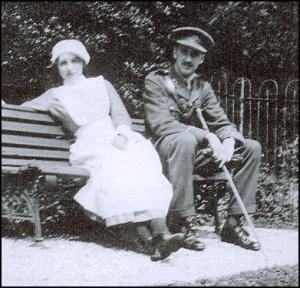
Vera Brittain and her brother, Edward, in 1915. Testament of Youth was my gateway drug to World War I.
I am the last person to tell you I get close to this ideal of detail. I strive for it, and do the best I can to be whatever character I’ve selected. I write this not from the position of someone who has mastered the past, but as someone who has seen technique and principles applied to one medium– film– that are applicable to living history, exhibit design, public programming, and writing. Jackson’s film illustrates the power of knowing details and the power of caring about those details not for trivia’s sake but for the Tommy’s sake. Those specific details serve to create the “everymen” of the War. The research to find which regiments are shown, to get the shoulder badges right, to find how what speech an officer is reading, prove the power of the archives. The past is there, waiting for us, in acid free boxes. We can restore the dignity and humanity of the people of the past by reading their words. Specificity creates archetype.
At the end, Jackson encourages the audience to ask their family members about their history, to find out what stories there are, to find out how the Great War touched them. He reminds us that those memories die with the people who carry them, unless we ask and write them down (or record them). That is perhaps the greatest public history lesson of all: that the past touches us all through the people we know and love, and that by knowing those stories, we can understand not only our family stories, but the history we all share.









 Kitty Calash