Gattinoni red brocade party dress, Rome, 1950s Augusta Auctions Lot: 155 October 24, 2018.
One of the best things about auction sites (when compared to museum sites) is that you get far more images of the objects, and often from unusual but helpful angles. This is true for furniture– good auction sites will post photographs of the undersides of sofas and desks, a level of detail museums simply lack the time for. For clothing, construction details aren’t always noted in the record, so we rely on images. This is where the auction sites can really be a boon: turn me round, baby.
Interior, showing black mesh boned corset w/ attached black petticoat. Gattinoni red brocade party dress, Rome, 1950s Augusta Auctions Lot: 155 October 24, 2018
I don’t know if I’d go as far as “boned corset” (well, I wouldn’t) but the boned bodice provides a lot of interior structure to this gown. The box pleats give the brocade skirt structure and fullness, but rely on the petticoat for the full silhouette. The interior structure probably didn’t provide enough support to allow the dress to be worn without additional undergarments– bra, panty girdle, even another petticoat– though it’s hard to say without knowing the original owner and feeling the dress. (Think of the boned bodices in late 19th century bodices: we know those weren’t enough to create the proper silhouette.)
It’s a wonderful look at the interior of a vintage dress, though, and one that makes replicating this garment (and look) so much easier.
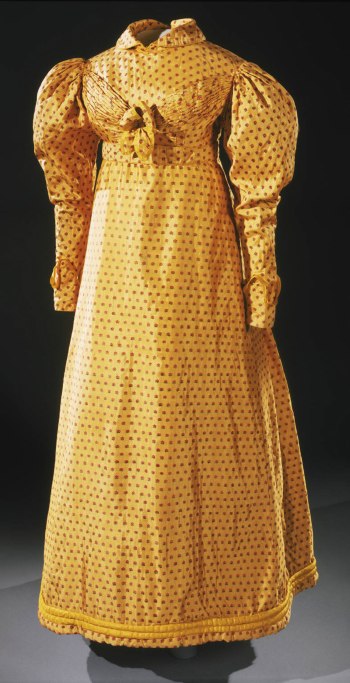
The best things turn up when I’m looking for something else entirely. First came the miniature, now in a private collection, with the lovely carnelian or coral jewelry and the bright yellow dress. I’ve got some yellow cotton with a red and black print pattern in the cupboard, so this dress seemed within reach.
And then, while looking for something else, I found the right fabric! Not that I can buy it, mind you. It’s already owned and in use, in a gown at the Philadelphia Museum of Art. And not that I haven’t spent some quality time searching the interwebs for similar fabric, which can be found if you look hard enough. Fortunately, better sense prevailed and no cupboard will burst with an additional five yards of block printed silk.
Woman’s Day Dress, English, ca. 1820. Yellow silk brocade exported from India. Philadelphia Museum of Art. 1996-164-1a,b
Still, the fun bit is finding two such similar thoughts, one in paint and one in cloth, without even looking. that means there are more bright yellow Federal or Regency gowns out there. All it will take is the looking.
Lot 1159 Antique Gold, Carbuncle Garnet, and Diamond Bracelet. Yes, those are rose-cut diamond flies.
First come the jewelry sales, the big guns like Sotheby’s leading the way with sales as crazy as Marie Antoinette’s jewelry (Royal Jewels from the Bourbon Family of Parma, technically, though it sounds more like a delicious lunch than a sale), but the smaller houses play, too. Skinner’s sale closed December 5, Freeman’s earlier, but later than Sotheby’s. These are not sales I bid in, but they are places to see things you’d might not otherwise see. Garnet bracelets with rose-cut diamond flies? Not something I see gracing the wrists of my fellow Metro riders or grocery shoppers.
Lot 7, Contemporary painted tin hat trade sign, 20th Century. 7″ x 13.25″
Once the serious stuff has sold, the fun begins: the toys! Pook and Pook’s two-day toy sale begins December 7th, and you might call it whimsies and toys, since it begins with shop signs. Who doesn’t want an enormous tin hat? What’s the point, you ask? Why look, if you don’t collect? Because you can collect– information, screen caps of reference images, ideas for things to make, and a visual reference library to fill in the blanks of what you read. The steam engine that breaks in The Railway Children seemed crazy to me as a child, and I assumed it was just a model of a steam locomotive. But no: there were steam toys and accessories, from lighthouses in moats with Indians in sailboats to working looms to….steam locomotives.
Day Two, Lot 521, Large Bassett Lowke live steam train locomotive and tender, 3 1/2″ gauge, engine – 13 1/2″ l.
The darling thing even looks like Percy, filling in the gaps of the origins of Thomas the Tank Engine, Edwardian children’s stories, and the wonders of the steam age (which you can replicate, if you choose). Hard to believe, in our age of safety, that steam engines might be de rigueur in the parlors of well-to-do Victorian and Edwardian families. (Perhaps your childhood was not as full of E. Nesbitt, Kenneth Grahame, and Arthur Ransome as mine, but if your mother’s primary caregiver was born in late 19th-century Great Britain, you might grow up with an attachment disorder and a taste for fabulist literature of the early 20th century.)
Day One, Lot 230, German dressmaker and milliners shop room box.
And then there are the dioramas or room boxes, many, if not most, German. These early 20th-century displays give us a sense of the kinds of craft or hobby activities people enjoyed, front-facing dioramas. I think you either “get” them, or you don’t; not everyone wants a miniature world to control or fantasize about, but from the perspective of someone trying to understand what the past looked like, these can provide a three-dimensional view of what are usually only black and white images. Are they perfectly correct? No. But they do give us a sense of the kind of visual stimulation people encountered and enjoyed shopping and playing.
Day One, Lot 220, Papier-mâché milliner’s model doll.
There are dolls, always divisive (they’re creepy or cute, few folks fall in between) and they have they own usefulness. None in this Pook sale tell us much about early toys, but there are a couple of early 19th century examples to remind us of what children played with in the past, and how new fashions were disseminated. In the case of the milliner’s model doll at left, we get a good sense of the Apollo’s knot hairstyle, and a pair of red slippers I would love to have. The back view is equally useful, for it is only with three-dimensional objects (dolls or sculpture) that we can get a complete sense of a hairstyle or costume. With enough looking, you can extrapolate, but there’s nothing like being able to see the past in the round. That’s even better than the telephone-book-thick catalogs from Sears and J.C. Penney that arrived before the holidays in decades past.
I no longer remember where in the wilds of the interwebs I found this charming servant, but find her I did, three years ago. I probably came across her researching servants, and found her striking (since she is), so saved the image while moving on to Pyne or Krimmel for more geographically appropriate sources. Still, I’d picked up a remnant of brown and pink printed cotton at Genesee, and had a start to this ensemble.
A scrap of that print was in my pocket when my dear friend (formerly m’colleague) and I went took the train down to New York for a fabric spree. We went in late June (Genesee was early that year), trying to use up vacation time so we didn’t lose it before the end of the fiscal year– any year I didn’t have a hip replacement, I tended to lose a week of vacation so we were motivated to take time off.
I remember that my favorite dress demonstrated a peculiar friendliness, and required a safety pin for modesty’s sake. I remember m’colleague being overwhelmed in the crosswalks at Herald Square, and taking her hand to get her through the sea of bodies and cars. (She grew up in a very small town in northern Rhode Island, where apple orchards were within walking distance; I grew up on the north side of Chicago, taking the bus to the Loop.) But at Mood, I found the fabric that I knew would make the petticoat.
Pink tropical weight wool, don’t ask me how much a yard. I don’t remember, but it was certainly more than I’d paid for any fabric before, with the exception of silk dupioni I bought for a wedding dress. Madness, I thought– but beautiful madness. I started on the short gown (see above) with an extant European garment as inspiration (probably found through Sabine’s work); then I started on the petticoat.
And promptly dropped the project while I changed my life completely. The short gown I finished, and wore as a housekeeper for some Wednesday afternoon programs, but I never managed to get that petticoat finished– until this past week. The pink and black bonnetneeded an ensemble, and half of it was present, in the form of the Spencer.
But what I wanted to do was to recreate that plate, short gown, cap, and all. I’m still short the black silk apron, and my cap will always be Anglo-American, but I got close enough to be satisfied that I reached the goal I set three years ago. What I did discover in trying to replicate this image was slightly unexpected, and entirely useful. Just as fashion images are exaggerated today, so too were they exaggerated in the past. M’lady in the image at top is elongated– I’m nearly six feet tall, and I cannot achieve her length. Granted, the waist on my short gown is lower than hers, but still: she’s drawn as if she has the proverbial “legs up to here.” What’s useful about this, and about trying to recreate images from the past, is that these exercises reveal some of the foibles and preferences of the past, which help us see past the filter of the present and get closer to understanding the past.
No idea how I lost that pin. Photo by Mike Cirilo.
Part five: portraying Widow Weed
I almost prefer first person interpretation, largely because it catches visitors a little off-guard, excites their curiosity, and allows me to use more humor in conversation than third person. This time, though, I found that despite the research and thinking I’d put into this portrayal, I couldn’t synthesize the material fast enough to fully immerse myself in first person, having over-scheduled the days leading up to Occupied Philadelphia.
Over the course of talking to 1200 to 1500 people, I was able to synthesize the material, and refine my spiel. Talking about how the remedies could be (relatively) easily made in the kitchen, using ingredients drawn from kitchen gardens, South America, the Caribbean, India and Southeast Asia allowed me to talk about trade networks and the British Empire– a reasonable segue to complaining about a port closed thanks to Mr. Nevell, and a way to explain the effect that has on the city.
One of the most interesting aspects of this portrayal is how well women engaged with it– and enjoyed hearing about a woman with her own business. True, Drunk Tailor was steering women my way, but they also seemed to gravitate on their own. As much as I prefer in situ interpretation over the science fair table style, a table (or counter) offers enough of a barrier to make people feel comfortable approaching. On-street interactions are different, but somehow, indoors, people sometimes react as if one was perfume-spraying staff on a department store cosmetics floor.
Photo by Mike Cirilo, saucer chip by me.
Not that scent wasn’t an excellent way to engage people! I couldn’t let visitors taste the remedies, but they could smell them, offering the opportunity to play “What’s that smell?” (non-feline edition) and talk about how people use the flavors they’re accustomed to in their medications and treatments. My cats never cared for bubble-gum flavored amoxicillin, but it’s bigger hit with toddlers than the straight-up medicine flavor would be. So, too, with tooth powders past: cinnamon, mace, and nutmeg are the blue raspberry of the yesteryear– though the tooth powders smell much better than they taste. I cannot recommend a weekend of use unless you wish to feel sad each time you clean your teeth.
Mr Nevell finds himself on the list of members of the Company of Carpenters
Drunk Tailor used the relationship between Thomas Nevell and Elizabeth Weed (their third marriage each) to move people around the main room of Carpenters Hall, and to some comic, as well as interpretive, effect. It’s far easier for him to say, “Six months in, six months left, of her mourning” as a means of explaining the grey and black palette of my clothes, allowing me to avoid the “You look like you’re ready for Thanksgiving!” lead in from the public. Confiding in the public that he’s had his eye on me for while lets them in on a secret, and visitors enjoyed trotting over to warn me about his interest, and that’s he’s sold his tools! I am always happy to tell them he’s just the kind of man my mother warned me about, adapting a banter we have used in multiple scenarios. While it’s broad, and nothing like how we really are together, it’s playful enough to engage the public, relax them, and get them comfortable asking questions.
The man on the left talked to me longer than anyone else
There are, as always, things I’d like to change about this presentation. Although I’d like to work on it enough to be more comfortable in first person, I’d miss the third-person ability to refer to 1849 cholera maps and general epidemiology. I definitely need to add a couple inches to the hem of the gown, up my cap game, and trim the mantelet. I’d like to find a wooden box, and add a proper mortar and pestle to the kit– my stainless steel one is perfect for home, but won’t work in public. But on the whole, I’m pleased to have an impression of a woman roughly my age, who can interact well with a character roughly Drunk Tailor’s age. Onward to refinements.





 I no longer remember where in the wilds of the interwebs I found this charming servant, but find her I did, three years ago. I probably came across her researching servants, and found her striking (since she is), so saved the image while moving on to


 Kitty Calash