Citizens of Boston

Tags

, , , , , , , , ,

John Collet, May Morning, 1761-1770. Museum of London

John Collet, May Morning, 1761-1770. Museum of London

I find myself involved in an event scheduled for August 10 in Boston, though I know this could go awry because I worked for a number of years with DC, the organizer of this extravaganza. He’s got a style all his own, and for a taste of the madness, you can see him here (~5:26) with unmistakable and inimitable mannerisms, at Louisbourg.

While the Adjutant is arranging and training the militia, the event still needs civilians, and as the interpretive consultant, my task is to create the context of the day and hammer into DC’s head that when organizing something like this, you can hardly over-communicate, though having been on the receiving end of his phone calls, actually, you can… but that’s where I come in with the editor’s sharpened pencil and cut, cut, cut.

Mr S has signed right up for this event, though he lacks suitable garb, and thus it will soon be time to break out the wool broadcloth. I really liked Sharon’s waistcoat-conversion suggestion, and happily Wm Booth had a lovely dark-green wool remnant of just enough yardage for a skinny man’s frock coat that very morning. Add the brass buttons in the stash, and I thought we were off and headed for 1770 with a regression to 1763.

Except… in doing more looking at 1760/1763 images, I began to wonder if it was better to beat the green linen into an earlier coat, consider it a lesson learned, and move on, since it is only a one-day event. (I saw some small remnants of that same green linen in the Adjutant’s stash, and perhaps I can get them for cuffs.)

My logic is this: it can be tricky to walk a coat backwards in time, especially in sleeve width, and Mr S is in serious need and want of a lovely coat for Battle Road. (Except yes, heh heh, he needs it by July 14 for an event at Washington’s HQ in Cambridge. There’s not even time for gnashing of teeth!) I don’t think it means more sewing, really, it only means penance with alterations and begging for fabric scraps. It also mean focusing, and letting the Monmouth-acquired cuts on my fingertips heal.

John Collet, Scene in a London Street, 1770. YCBA, B1981.25.110

Mr S will be just one of a number of men who will be militia in the morning and civilians in the afternoon. In thinking about the Boston street of 1763, I’m reading the Boston Gazette and Country Journal (which DC had not done beyond the main articles…) and looking at images from London. Maybe the scene won’t be as chaotic, since it is a happy celebration, but it needs to be busy, and populated with men, women, and children of various ages, races, and class levels. There’s a nice way to search for “street” at the Yale Center for British Art, and you get a sense of the crowds and busy-ness of the 18th century street.

To that end, I have asked my silk-gown friends, and I plan to be the cherry seller. (I should so like to have that done by Sturbridge to acquire some patina, but doubt I shall.) For the Young Mr, I see runaway apprentices as a possibility. In the Boston Gazette of August 8, 1763, There is a 16 year old mulatto fellow, “large of his age,” who had on “a brown camblet coat with red lining, a white linnen and a mixt colour’d flannel vest” as well as a blue great coat with yellow metal buttons and leather breeches. There won’t be leather breeches by August, but a camblet coat lined in red may be possible.

To Wash or Not to Wash

Tags

, , , , ,

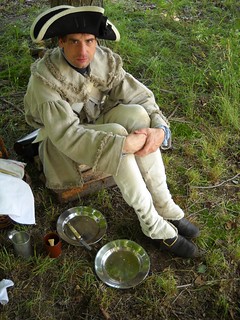
Mr S and his waistcoat at Monmouth

Mr S and his waistcoat at Monmouth

Sometimes I can almost hear, “Good God woman, what are you thinking?!” but so far I have only seen it in a man’s eyes. This is usually in regard to laundry.

I erred once in asking if one wanted his hunting shirt laundered, and I had planned only on cold water and hand washing, as the item seemed a bit crunchy and crumpled to my eye and hand. But, no, some other woman had washed that shirt some time ago, and it had taken considerable time—years—to reestablish fringe from fluff.

Well patinated now, formerly embarrassingly white.

Now, I give you Mr S’s waistcoat and overalls. Mr S’s waistcoat was completed on the New Jersey Turnpike in November 2011 while headed to Fort Lee. Since then, it has a acquired a smattering of powder specks, a patina of grunge, a stain or two of greasy beaver (curry, actually) and, most recently, spots of toothpaste. This is where I draw the line: the toothpaste spots must go, as they are inauthentic.

Shirts, shifts, stockings, aprons, and waistcoat

One doesn’t want one’s clothes too clean for reenactments or living history events: you’re “living” in the pre-detergent era, but that doesn’t mean you should never wash your clothes. We know that the armies employed women to wash clothing, and we know that linens–shirts, shifts, and drawers–were washed more frequently than outerwear like breeches, waistcoats, and gowns. It’s not so different from today, when we don’t clean business suits as often as we launder shirts or underwear. Still, we do clean our clothes, and there comes a point when those overalls will get washed. Right about when you figure you need gloves to handle them…

Two Words: Bed Sack

Tags

, , , ,

The Young Mr outside our tents

The Young Mr outside our tents

I’m making one. Or two. Whatever: I’m making them for famille Calash. Sleeping on straw and a sleeping pad is better than either alone, but I find with the arthritis that I need more warmth and more cushion than I used to require. True, I am self-padded, but the steel prosthesis does feel—it is only an illusion, but I feel this—closer to the surface, and thus colder, than bone. This makes for a Cranky Kitty, and it is far better for all concerned that Madam Commissariat be a Happy Kitty. I will forgo chairs and tables and other clutter—it is both authentic and pleasant to be unburdened—but I like to sleep well.

There’s a simple enough pattern in one of the Packet books, but the gist of the thing is this: Enormous Market Wallet. Interior common tent dimensions are about 6×6 or 6×7 feet, so you need to end up with something along the lines of 3×6 or 4×6 or 6×6 feet. The Packet suggests four pieces of ticken, each 30 x 80 inches, aiming for a finished size of 42×72 inches, with an center slit four inches wide and a couple feet or so long. (I used the 18th Century New England Life market wallet instructions for a guide in making ours, and will use the same idea for bed sacks.)

I’m not yet aware of extensive documentation of these for Continental troops, but there is one reference in a West Point waste book (see here, footnote three). Since we don’t allow fire in the tents, I am willing to compromise on cotton ticking for these, and (ssshh!!) machine sewing the seams, with a hand-finished slit edge. I might even borrow the serger from work to make really quick work of this business. They will truly hardly be seen, so although I know I am cutting corners, I don’t feel too wretched about it.

18th Century Sno-Cones

Tags

, , , , , ,

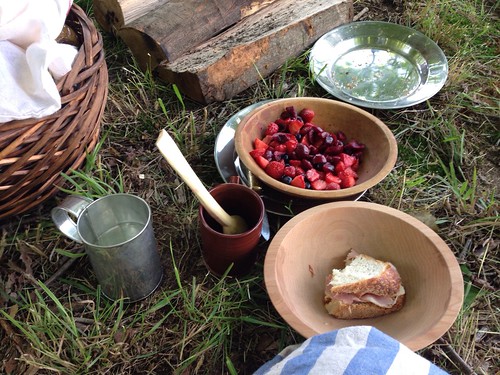
Nooning Saturday. Sandwiches and fruit

You may not have seen the Mad Men episode about the Sno Ball campaign, but chances are good you remember Sno Cones in paper cups from street vendors or Woolworth’s. On a hot August afternoon in Chicago, they were a treat waiting for the insufferably delayed Number 11 bus. On a warm New Jersey night, one can be inspired.

When the Wemrock Orchards truck came through camp Saturday evening, we bought another bag of ice—20 pounds!—and added ice to our pitchers. The Young Mr started crunching ice cubes, and The Adjutant observed, “You’re following the label’s advice: ‘Ice is Food’.” Mr S and I looked at each other and said, “I wonder if you could make a shrub slushy?” But what to beat the ice with? Musket butts were considered and rejected. And suddenly the Young Mr said, “We have a mallet!”

Indeed we do: Mr S made us a whacking great mallet with an enormous head. We ran to the tent to fetch the mallet and the flask of shrub, wrapped two handfuls of ice in the cleanest white cloth we had, laid it on Table (a clean, flat piece of firewood) and wielded the mallet. Just a small amount of shrub (recipe here) will do; it’s pretty potent stuff, even when non-alcoholic. I did not whack long enough, but shrub over crushed ice is a delicious, if highly unlikely for a common soldier, treat. The Adjutant is correct: the ice needed more whacking. But when he said, “I guess someone will have to make a mallet for the unit that’s flat on one side and serrated on another,” I figured we’d been accepted, crazy snow-cones and all.

Monmouth Overview

Tags

, , , , ,

Cricket!

Yes, I’m tired, but what a great weekend. Even Cricket seems to have been happy. (Yes, I know pugs don’t smile and I know brachycephalic dogs have a hard time breathing, and Cricket was hot, but he did also seem pretty happy to be out in a field under a tree.) The worst of it was getting there: what should have been a 4-5 hour trip took 7 and a quarter hours, thank you New Jersey Turnpike shore traffic. Even people who left New England at 10 had 6-hour journeys, so leaving earlier would not have helped. Also, we would not have been ready as there were very last-minute gear and food assemblies required. This lengthy journey did allow us the chance to play an extended game of “what the hell is that smell?” The unfortunate winner turned out to be Mr S, who guessed cat pee, but that’s a story for another post, or perhaps for Jackson Galaxy.

Mr S on “Chair” made from stacked firewood. It works.

After erecting tents in the gloaming, including one we’d not been able to check out at home due to heavy work schedules and slight matter of incessant rain, we crashed in our clothes on straw beds and made it to Saturday. Saturday brought coffee, thank goodness, and thanks to Tew’s Company’s willingness to share their fire. (Fire good.) I finally found the camp kitchens on the map, but never walked out to them—happy trails militia folks, but the earthen kitchens were too far from our part of the Continental camp to be really practical. So we made like light infantry and perched on firewood under a tree, ate cold rations and scammed off the hat regiment.

Coming off the field, Sunday

There were plenty of sutlers, but I did not buy 5 yards of the cross barred white and blue at Burnley & Trowbridge to replicate the oyster seller gown because really, first I have to make the black heart cherry gown. I did buy a new hat and ribbon, and pair of more appropriate shears, and most satisfying of all, shoes. I have Burnley and Trowbridge shoes, and while the width is fine and narrow, the length is not and arch support is absent. By the end of a day, my feet and I are miserable, which reduces my stamina and increases my hip pain. (I have arthritis, and had my right hip replaced 2-and-a-half years ago; I’m not that old, but my femoral heads have high mileage.) On the recommendation of several friends, and despite the rubber heels, I tried Flying Canoe shoes. Though a trifle wide, the length was right and I was sold. They vastly improved my outlook and stamina, so were worth the heel cap compromise, with many thanks to my mother for an early birthday present she doesn’t yet know she bought me.

Starting to pack

So, topics for this week in some form and combination:

  • 18th century sno-cones
  • A sense of belonging
  • Future menu plans
  • The public and the spectacle
  • Monmouth Battlefield State Park Visitor Center Design
  • Shopping & Visiting
  • Bed sacks
  • There will be laundry

In the meantime, pictures are on Flickr. Lesson for today: Do not turn your back after giving a man your camera.