Saturday Afternoon in the Park with Kitty

Tags

, , , , , , , ,

The strawberries and cream hat, with pinballs and pincushions

Last Saturday, I enjoyed a beautiful late summer afternoon on the lawn at Van Cortlandt House Museum in the Bronx. Built in 1748 for Frederick Van Cortlandt and his family, the house served as Washington’s headquarters in 1776, and again in 1783.

was  The Van Cortlandt House, dating from 1748, is the oldest building in the Bronx.CreditTony Cenicola/The New York Times

It’s an idyllic site, and waking up to the sound of cricket bats and Canada geese, a visitor could be fooled into thinking you were not in the Bronx at all. Mist rose above the cricket pitch when I woke up, a large flock of geese picking at the grass. It was Netherland come to life, men beating bats on their cleats and laughing. I’m really grateful to Mrs M. for the place to sleep and chance for adventure.

This trip was a remarkable cultural experience for me, and one I really needed. Growing up on the north side of Chicago, I was used to urban density and scale, so after two years in Northern Virginia suburbs, a dose of urban life was welcome. It was all the more welcome because instead of spending my time judged by cats, I got to play with dogs (and earned a sore bicep for all the stick and giraffe throwing I did for one). The trip to Stew Leonard’s was remarkable, after the tame mercantile experiences of tiny Rhode Island, and even Wegman’s paled in comparison. It was a good set up for thinking about mercantile enterprises, impulse purchases, and the ways merchants (including milliners) and shop owners needed to keep customers coming back, tempting them with new goods. (Or, in the case of Stew Leonard’s, singing cows and/or milk cartons.)

More bonnets, most of which are available on Etsy

I managed, somehow, to finish a red silk satin quilted petticoat in time (lined with red “stuff” from Burley and Trowbridge, it was not too bed-covering like until the late afternoon) to dress up the Nancy Dawson dress. I didn’t manage to locate my sleeve ruffles in time ( stitched on a garment ) but in other regards, I was pleased with how this turned out.

Bathroom selfie, but you can see that sweet silk petticoat

Dressing my clothes up– that is, moving them up the social ladder– can be a challenge, but good accessories make a big difference. Eventually I will get a finer apron made, one with a ruffle, but for now, that has to wait.

With Lark, perhaps the sweetest little rescue pup I’ve ever met.

I have a trip to Philadelphia to make, bottles to label, and receipts to write. Elizabeth Weed returns to Carpenters Hall this weekend as part of the Occupied Philadelphia programming.
Bag and Baggage

Tags

, , , , , , ,

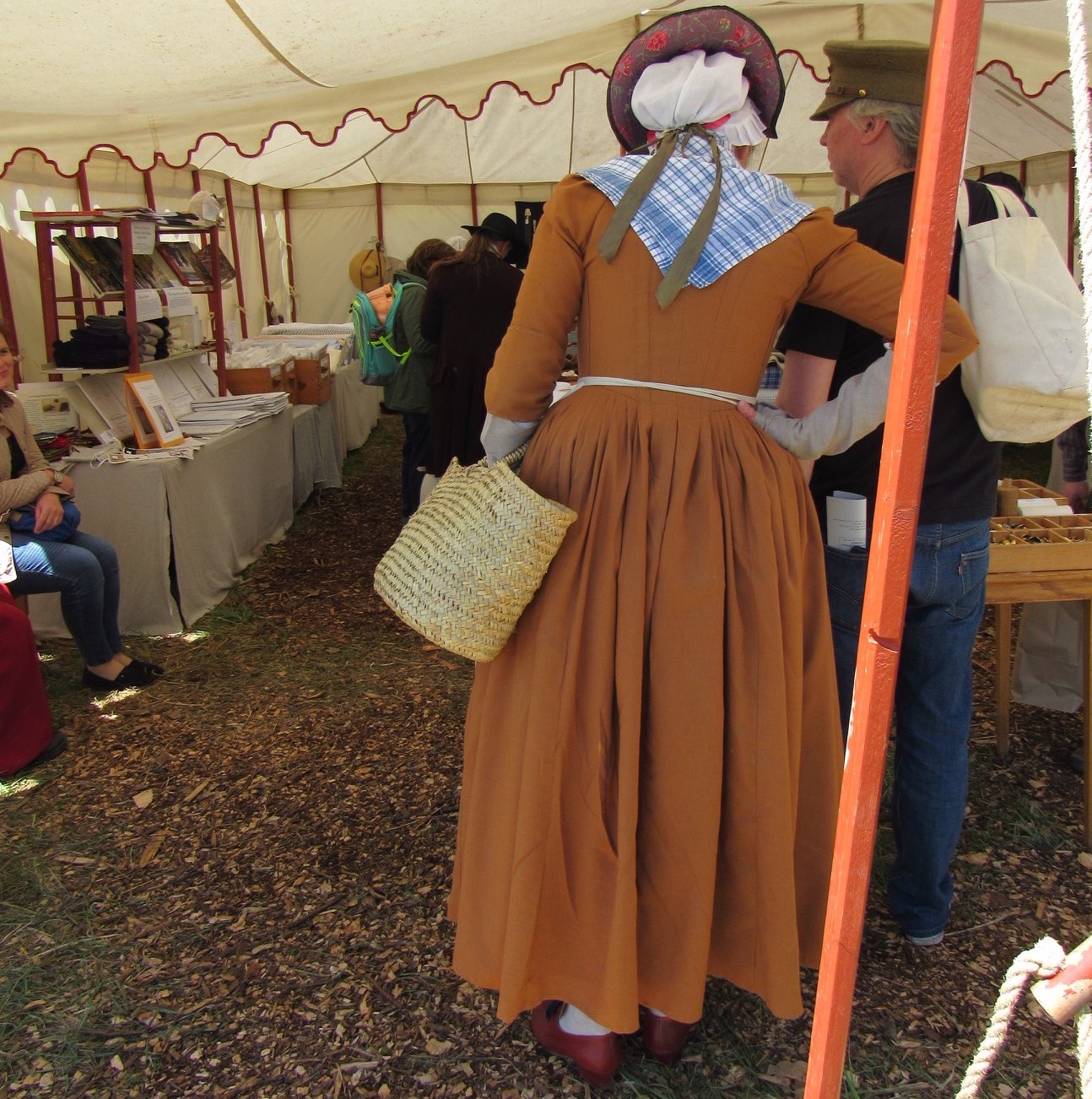
Shopping with a basket at Fort Fred. (photo by Denise Wolff)

The subject of carrying things at living history events never seems fully resolved. There were the fireworks I like to call Basketgate, and in the four years since, more women have been carrying frails than firm-sided baskets. But here’s the thing: baskets were not used as purses. They were used for shopping, and for babies (thanks, Ruth!), not for toting about one’s personal effects. That’s what pockets were, and remain, for.

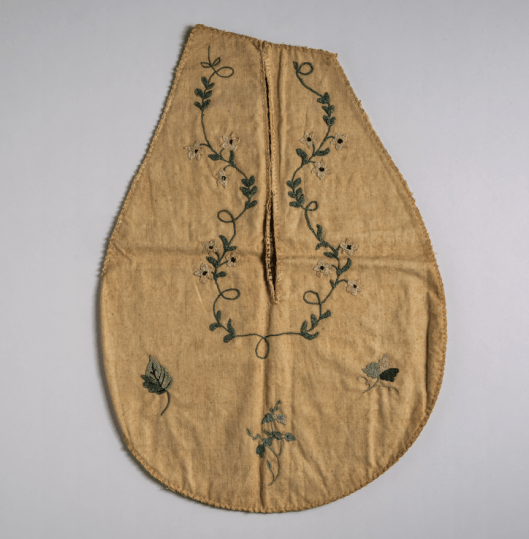
Pocket, silk on linen, ca. 1780. Martha Elizabeth Spach (probably). MESDA 2400.

18th century women were not cursed with the tiny pockets of today’s fashionable jeans. No, they had voluminous pockets capable of holding a vast array of items: pocket journals, purses (like our wallets), game tokens, an orange, keys, and almost anything else you can think of. The pocket shown in the image is 15″ long by 11″ wide, which is a fairly typical size, though some were even larger. When I made these, I described them as “large enough for a puppy,” and Facebook wouldn’t let me post them. There is now a full-length book on The Pocket and I look forward to reading it next year, when my ILL will finally request it ($50 being too dear for my budget). In the meantime, the Victoria and Albert Museum will get you started if pockets are new to you.

So, baskets for shopping and pockets for personal things. What else might you use to convey something from one place to another?

Paul Sandby RA, 1731–1809, British, London Cries: A Man with a Bundle, Old Clothes, undated, Watercolor on medium, cream, slightly textured laid paper, Yale Center for British Art, Paul Mellon Collection

A wallet, of the kind reenactors call a “market wallet,” though that was not the period term. You can read about these in an article by Charles LeCount. The man in the watercolor has a very full wallet over his shoulder, demonstrating the larger end of the wallet spectrum.

And to carry your money in? A purse or pocketbook, sometimes in leather, sometimes in flame stitch, and sometimes in silk.

Which one you choose depends on who you portray, and where. Silk wallets or pocketbooks belong to a particular class and the ones in museum collections are often from France. Flamestitch wallets are reasonably common in North America among people with the time to make them. The really neat thing about these is that the patterns show regional differences, so you can tailor your choice to your place. (I lack the patience, skill, or time to really make headway on mine, but in addition to a wonderful custom pattern, I found kits here.) I have a leather one I love, made by this fellow craftsperson and friend.

Miser’s purse, early 1800s, maker unknown. Purchased 2002. CC BY-NC-ND 4.0. Te Papa (GH009865)

Your coins? A purse. (we call these miser’s purses, though long purse or ring purse might also be used. The forms originates in the 17th century, and although it is most popular in the 19th century, it does appear in the 18th century. It’s just not common, so no, not everyone should have one. A simple bag will do for those with coins they wish to keep wrangled.

Servant Returning from the Market, 1739, Jean-Baptiste-Simeon Chardin. Louvre Museum,
MI 720

A bag, a pillow case, or even a tied cloth, as seen in the painting by Chardin.

There are lots of options for carrying chattel, lumber, and personal items, and most leave your hands free. But for women, the first place to start is tie-on pockets, and for men, the pockets in your coat. After all, the pocket bags in a typical Henry Cooke frock coat will hold a six pack between them. 

If you like this content, please consider supporting me by making a pledge to my Kickstarter.

“Now Selling at Prime Cost”

Tags

, , , , , , , ,

Although I’ve portrayed a milliner before, the earliest iteration has been as a shopkeeper in August, 1804, so I thought it best to refresh my knowledge of what 18th century milliners advertised. (Deep dives into bonnets help me focus on bonnets, but necessarily what else was being sold.)

Pennsylvania [Philadelphia] Packet, January 15, 1772.


One of my favorite ads is from the January 15, 1772 Pennsylvania Packet. Mary Symonds of Philadelphia published an extensive list of goods, many of which will lead you down a rabbit hole. Three of the listings had particular appeal.

“Womens’ and childrens’ black and coloured silk, Dunstable and chip hats, and bonnets”

“Black and coloured silk” almost surely encompasses the range of colored silk bonnets seen in Boston advertisements, but what’s the difference between Dunstable and chip hats? Price, of course. What most of us think of, or call, “chip” hats should be called Dunstable or simply straw.

Chip hats like the one above in the Snowshill Wade Costume Collection, were made of plaited (woven) thin strips of wood, more like flat baskets or chair seats.

Straw hats, like the one above (also in the Snowshill Wade Costume Collection) are clearly finer than chip and do not need to be covered. The earliest description of the distinctions between hat types that I’ve found thus far is from 1815, in “An Encyclopæaedia of Domestic Economy, Comprising Such Subjects as are Most Immediately Connected with Housekeeping etc etc” which goes into some detail.


The most entertaining discussion I found was in  The Sessional Papers Printed By Order Of The House Of Lords, Or Presented By Royal Command, In The Session 4 And 5 Victoriae And The Session 5 Victoriae 1841. The recorded exchange resonates with current discussions of tariffs on imports, but the really revelatory bit is this:

Class distinctions expressed in materials and apparel are eternal.

“Tobines” were new to me (or at least forgotten) and have nothing at all to do with the bishop of Providence. Thankfully, Textiles in America has the answer: “A wide variety of dress materials from fine silks to silk and worsted, and linen and cotton combinations that have warp-float patterns of small flowers or intermittent stripes and dots.” (p 367). Once you’ve seen it, you realize you’ve seen it before.

Berch papers, Nordiska Museet.

“Childbed baskets” were also a new concept to me, but The Female Reader, Or, Miscellaneous Pieces in Prose and Verse; Selected from the Best Writers, … for the Improvement of Young Women illuminated the term; the current equivalent is a layette set that includes bedding, and goes beyond the crocheted sweater, cap and booties some of us came to fear receiving. (Mint green acrylic? really?)

It’s a wide range of goods for women to buy (including small accessories for the men and boys in their families), and somewhat beyond the bonnets-hats-jewelry-trimmings we typically associate with milliners. While I don’t have any plans to start manufacturing chip bonnets or making up childbed baskets, I am definitely intrigued by the possibility of expanding my “offerings.”

Making Plans….

Tags

, , , , , ,

I have set my sights on being at Van Cortlandt House Museum’s Second Annual History and Culture Fair on Saturday, September 21. This is a bit of a stretch: It’s farther than Philadelphia, where I’m scheduled to be the following weekend at the Museum of the American Revolution– and I want tweak that impression and its material culture a bit, too. Still: setting up a ca. 1777-1780 milliner and mantua maker or merchant display has been on my to-do wish list for years, and I’m pretty sure I can pull this off as long as I modify/upgrade items already in my closet.

There are enough images to provide good inspiration and ways to start accessorizing.

Several prints  from the British Museum provide guidance.

It’s clear– as I knew already– that my accessory game requires major upping. But this is solvable! It’s not ideal, being in a situation where I can’t buy new fabric, and I don’t have the time to make up the fabric I do already have in the garment styles I need. This is no time to start a new patterning project!

So this means making accessories to upgrade a gown and petticoat already on hand and known to fit (though they should be fit-tested once again before committing!).

Which dress? Why, Nancy Dawson, of course. She’s the brightest and most stylish gown I have. Thankfully, I have upgraded my cap collection, and could even– probably– manage a new cap in the time allotted.

So what do I need? A well-decorated, possibly floofier cap, a LBB (™) of the kind worn in “The Rival Milleners”, a breast knot or bow, a new fine silk or cotton apron, and some kind of sleeve treatment.

The maid in the back of “A Morning Visit,” carrying in the tea tray, demonstrates the more understated upgrades I think I will be able to manage in the time I have. In a year, a trimmed silk gown can happen. In a month, it cannot.

The main upgrade I’d like to make is to add a red silk quilted petticoat, since they appear in so many prints with cotton print gowns, including a print of Nancy Dawson herself.

Miss Nancy Dawson, aquatint print. Victoria and Albert Museum. E.4968-1968

I almost assuredly have red silk in my stash: the question is, can I find it, back it, and quilt it in time? Probably not. So there are choices to be made, like the sensible one of simply upgrading sleeve finish and apron and adding bow knots.

Those are just the upgrades I hope to make to my personal kit! I need a dome top trunk (underway; I need the one I have for Elizabeth Weed), and there are inventory items to make that have been on the list for a while.

All of this has to get done while I’m splitting my 55-60 hour weeks between commissions and a retail gig (which I am trying to streamline!).

Once again, I start down the path of madness. Won’t you join me? I think it’ll be a blast!

Memento Mori/Memento Vivere

Tags

, , , , , , ,

Late August is the time when kids go back to school, and nostalgia  grows for summers past and the months just gone, and for what you didn’t get done that you wanted to. It’s a time for transitions and remembering, when we’re on the verge of a fresh start. Even at my age, decades out of school, fall represents a fresh start, a time to begin something new. Now it’s more painful to drop my son at the airport than it was to take him to his first day of kindergarten: I won’t see him again until Thanksgiving or Christmas, depending on his class schedule. So to distract myself, I turned to a new-old project: the circular reticule with a pasteboard center.

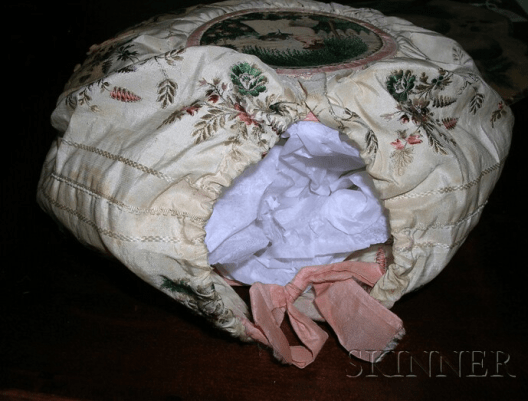
I’ve been working on a version of the abolitionist reticules made in the 1820s, but recently came across some delightful earlier reticules offered by Skinner, one of a lady and a lamb, and one a Memento Mori.

My disused painting skills just stretch to the naive style of early nineteenth century schoolgirl painting, though it is hard to capture the full style when one has a modern eye. (Once you’ve seen Picasso and Warhol, can you ever go back?)

If/when I make another of these, I’ll definitely make some changes in techniques and materials, starting with the inscription. (Where is my historically correct ink? Where are the pen nibs?) For now, though,I’m happy enough and even ok with the off-centeredness of the painting on the circle. Lesson learned: do not rush through a project without planning all the steps.

I figure I’ll even it out a bit when I attach the bag.

I still have to paint the opposite side, and then decide what silk to use for the bag (I have some embroidered silk that I’m saving for a 1790s ball gown, but should have enough for a bag) and whether or not to line it. The catalog descriptions don’t mention linings, and the images appear to show only a layer of silk, with no lining.

It’s hard for me to wrap my head around an unlined anything, and for embroidered silk, a lining will help keep whatever I’m carrying from tangling in the threads on the wrong side of the fabric.

This isn’t a quick project, and I have to put it aside to work on commissions, but it does give me something to look forward to working on– a small memento vivere, if you will.