• Home
  • Completed Costumes/Impressions
  • Emma and Her Dresses
  • Free Patterns and Instructions

Kitty Calash

~ Confessions of a Known Bonnet-Wearer

Kitty Calash

Tag Archives: 19th century clothing

Can’t Type: Sewing!

23 Wednesday Jul 2014

Posted by kittycalash in Clothing, Events, Living History, Making Things, Reenacting

≈ Comments Off on Can’t Type: Sewing!

Tags

19th century, 19th century clothing, Federal style, Genessee Country Village Museum, milliner, millinery, millinery shop, Regency, Salem event, tailcoat

What has kept me so busy I can’t blog? Mostly preparing for the millinery shop in Salem, which I am really looking forward to!
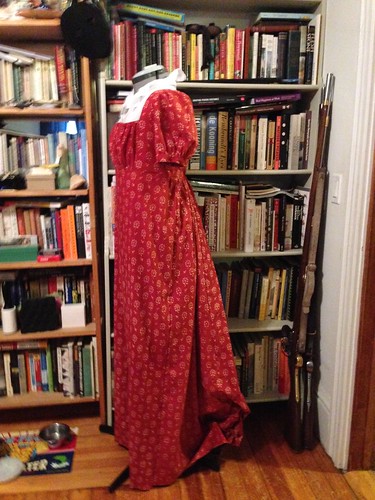
Cassandra attempts a Regency Wedgie

In just about a week, I managed a gown, now needing only a hem.  This based on the roller-printed serpentine stripe gown at Genessee Country Village and Museum, documented nicely at the 19th US site.

This was an easy gown to build up from a shoulder and back piece, once I did the math to scale it up to my size, and with the generous help of Sew 18th Century, who gave me the sleeve pattern I started from. This isn’t a drawstring sleeve, so the gown is not an exact copy of the GCV&M gown. I’m OK with that, since–as far as I can tell– it fits. It may be a little large, but that’s what an apron or sash is for. No, I don’t know when I’ll get the apron made.
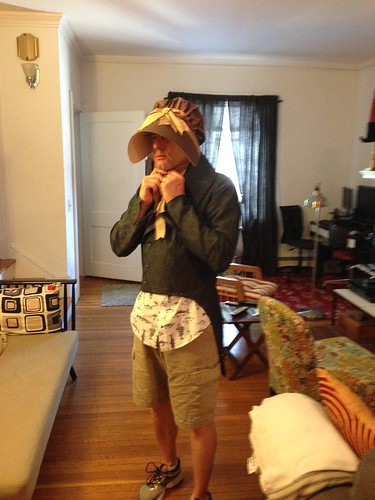
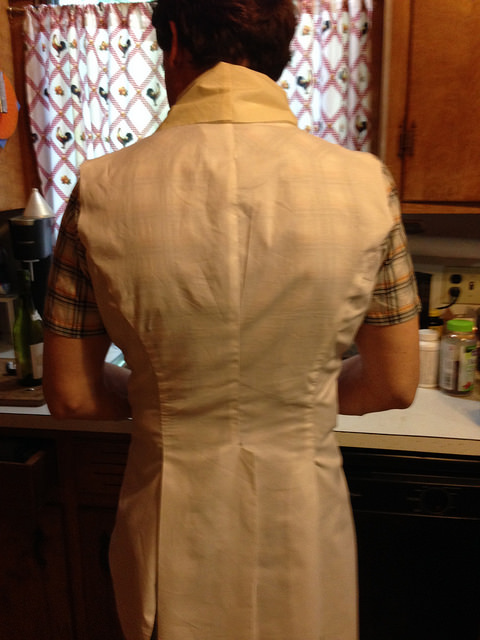
Mr S saves time by modeling *both* coat and new bonnet

There should also be a coat, and many bonnets.

Mr S’s coat seems to be working, and is now faced on the right side, leaving the left, the sleeves, and just a few buttons. He was excited about helping with button manufactory until he realized that the largest tool required was patience. But what are facings and buttons and buttons holes, among friends?
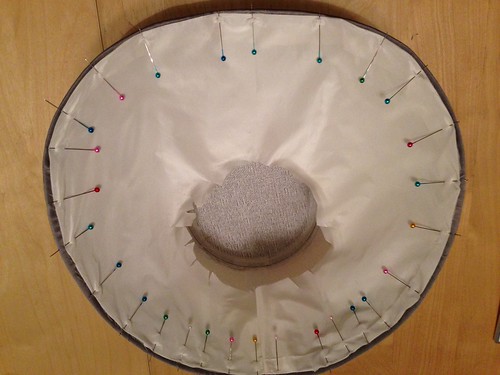
Bonnet Number I Forget

Another bonnet is in the works- can you ever have too many? I think not. It is in the prickly phase, while I work this evening on taking apart a waistcoat that must be altered for the Young Mister for this weekend at Stony Point. Bouncing between 1779 New York and 1812 Salem, when one is also considering 1765 and preparing for 1800 can make telling time a little challenging!
Share this:

  • Share on Facebook (Opens in new window) Facebook
  • Share on Pinterest (Opens in new window) Pinterest
  • Email a link to a friend (Opens in new window) Email
  • Share on X (Opens in new window) X
Like Loading...

Six Toiles, a Coat and a Bonnet

07 Monday Jul 2014

Posted by kittycalash in Clothing, Events, Living History, Making Things, Reenacting

≈ 2 Comments

Tags

1812, 19th century clothing, bonnets, frock coat, living history, menswear, Salem event, sewing, tailcoat

14557116394_73c2d5ea9f_zYes, six toiles.
That’s how many it took to get a coat pattern to fit Mr S the way I thought it should. I finally built the pattern around a sleeve and arm scye that I knew worked and suited the period. From there, I built out the back, altering the center back seam curve to suit Mr S’s figure. Arm scyes are still hard for me to figure out, although sleeves are often my favorite part of a garment. I like how flat pieces become three dimensional in a sleeve, and I enjoy setting sleeves– go figure.

Thanks to the three-day holiday weekend and sitting out a parade to pad stitch, I have a coat body.

IMG_1725
IMG_1727

I’m not thrilled about the size of the lapels, though I have found extant examples and fashion plates showing lapels this size, and sleeves, too. While I’ve pinned up the sleeves in the back, thinking there’s too much fabric there, I can also see from the images that the subject’s posture was not the best– and that was the moment when I realized that I really did want a mannequin for menswear as the subjects are hard to catch at any age, and variable in posture and wiggliness. They also object to being pinned accidentally.

But there is at least a coat body on the way to being done, so I took a break and made a bonnet, which is really the point here <ahem> milliner’s, not tailor’s, shop, after all.

IMG_1738

Pasteboard brim, blue silk taffeta lined with white silk taffeta (they had new things at the fabric store, very exciting!), trimmed with silk ribbon from Wm Booth and paper flowers from the V&A.

Now, more bonnets, two waistcoats, a gown, an exhibition, a lecture, and Stony Point are all that stand between me and the milliners’ shop in Salem…

Share this:

  • Share on Facebook (Opens in new window) Facebook
  • Share on Pinterest (Opens in new window) Pinterest
  • Email a link to a friend (Opens in new window) Email
  • Share on X (Opens in new window) X
Like Loading...

Fashionable Friday: Floral Embroidery Galore

27 Friday Jun 2014

Posted by kittycalash in Clothing, Frivolous Friday, History, Museums, Research

≈ Comments Off on Fashionable Friday: Floral Embroidery Galore

Tags

18th century clothes, 18th century clothing, 19th century clothing, Bostonian Society, Costume, Events, exhibits, fashion, Massachusetts, museum collections, Museums, style

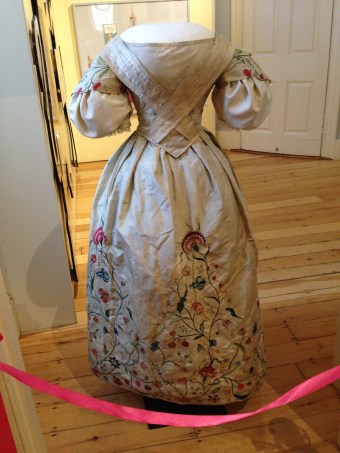
Colonial Wedding dress altered 1830

Elizabeth Bull Price’s Wedding Dress. Bostonian Society, 1910.50.35

On Tuesday evening, sensibility won over sense as my friend and I boarded the T for Boston to make a long day longer. The trip was worth it, though, for the One Night Only engagement of Elizabeth Bull’s wedding dress at the Bostonian Society. In truth, I bought the tickets for the event before I was even back at work and navigating our Fair City on my own– and who wouldn’t? That dress is amazing! (Tons more images of the embroidery are in the catalog record.)

Perhaps even more wonderful than the 14-year-old ElizabethBull’s needle skills is that the dress remains with us today. Kimberley Alexander and Tricia Gilrein reminded us on Tuesday of the many ways this dress, and other remnants of Bull’s wardrobe (oh, the petticoat, and the wonderful kerchief) connect us to the past in surprising ways. Elizabeth Bull was wealthy, married to Roger Bull, a Church of England official 22 years her senior: though they lived in Boston, they were British. (They were married in the 1730s, and Elizabeth died in 1780 at about 67.)

It’s a little hard to see past the 1830s alterations, but the embroidery of the gown helps chart that course, as well as the petticoat. As important to remember is that this wedding gown was not white: it has faded from a celadon green to its current off-white color. Wedding dresses weren’t white in the 18th century, or even long into the 19th, and it’s helpful to remember that as we look at what remains and reconstruct this in our mind’s eye.

It’s easy to forget we were British first here in the United States, and that the American War for Independence did not have a foregone conclusion. We forget, too, that churchmen and their wives were socialites as much as they were people of the cloth. Put Mr Collins out of your mind, and remember (my favorite minister & fashion maven) Reverend Enos Hitchcock and his pink satin waistcoat and suits of black silk.

Photograph of the altered gown. Bostonian Society, 1910.0050.057

Photograph of the altered gown. Bostonian Society, 1910.0050.057

Like many 18th century gowns, this one was remodeled in the 19th century, its shape altered to reflect the current fashion. We are lucky to have so much preserved, not just in the gown but also in the petticoat. Paths to understanding of women’s education, the customs and habits of Boston’s colonial elite, and the persistence of past can all be found within this object.


Share this:

  • Share on Facebook (Opens in new window) Facebook
  • Share on Pinterest (Opens in new window) Pinterest
  • Email a link to a friend (Opens in new window) Email
  • Share on X (Opens in new window) X
Like Loading...

Coat Tales

23 Monday Jun 2014

Posted by kittycalash in Clothing, Events, Fail, Living History, Making Things, Reenacting, Research

≈ 6 Comments

Tags

1812, 19th century clothing, fashion, Federal style, fitting, Fitting and Proper, frock coat, menswear, Norah Waugh, Regency, Salem event, style, tailcoat

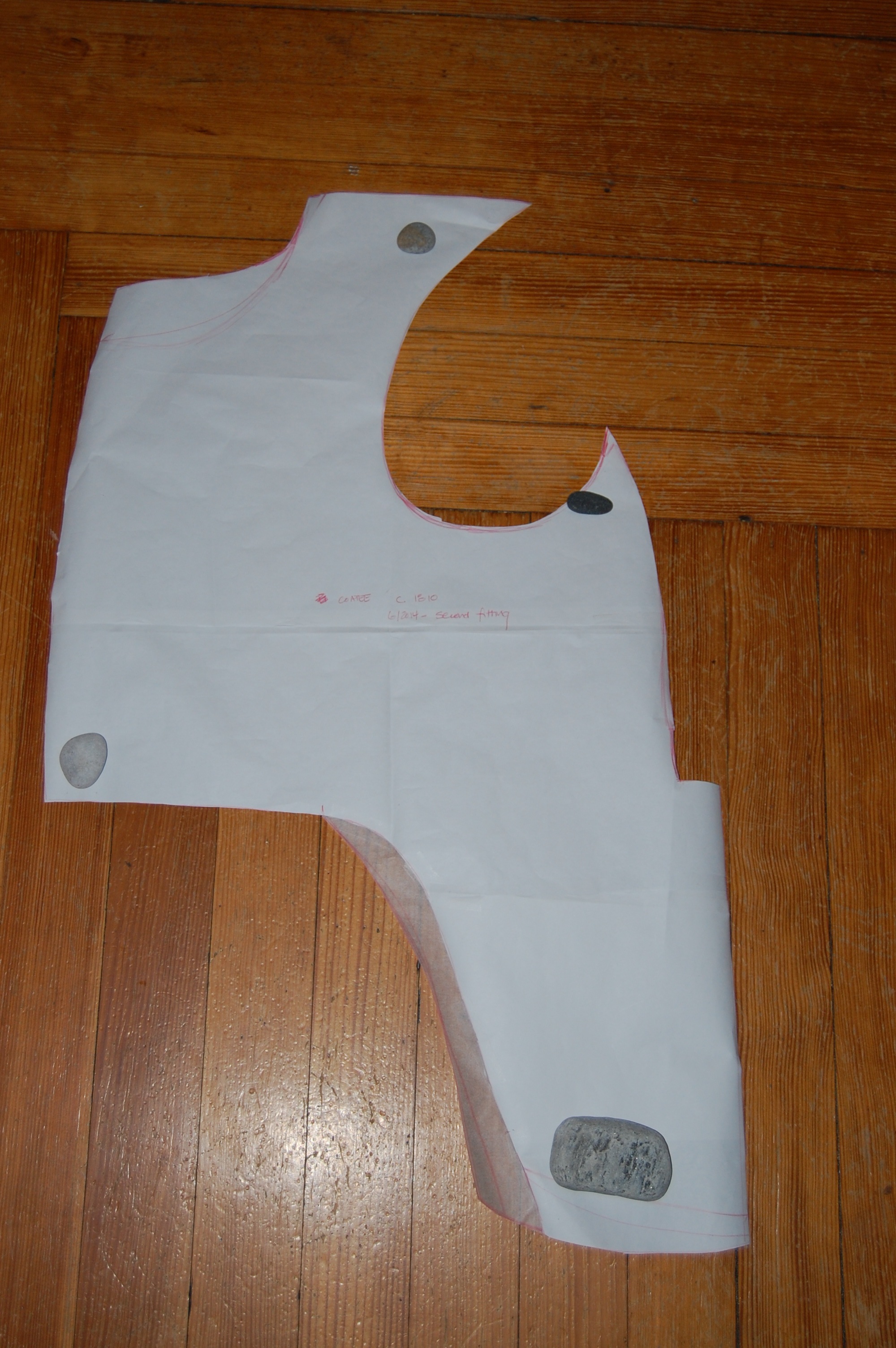
Coat pattern version 3

Coat pattern version 3

As the Salem Maritime Festival approaches, my anxiety increases.

Whatever will those ‘gentlemen’ wear? Coats and waistcoats, and thank goodness I finished the Young Mr’s shirt and his farm trousers still fit. He has promised to be a very annoying runaway apprentice, and I have promised to chase him from the miilliners’ shop with a broom, but before any of that can happen, ‘gentlemen’ will need new waistcoats and coats.

I got out Fitting and Proper, and took a look at that coatee pattern. It’s a little earlier than I want, so I also looked at The Cut of Men’s Clothes. In truth, I did not draft up a pattern from scratch. I had a commercially available pattern that I’d purchased when it first came out, one that purported to be historically correct, researched, and came from a reputable company.

Toile number 3. One more fitting to go...

Toile number 3. One more fitting to go…

Well…so I guess the issue with the pattern is that the gentlemen in my household are not of the typically boxy build one may see streaming past tourist sites in Boston, or even lumbering across a field in historical uniforms. My gentlemen are built for the Light Infantry, so when I finished the first muslin (or toile) of the coat and fitted it to Mr S, I removed inches–yes, inches–of material along the side and center back.

I suspected this would be necessary when I first traced the pattern pieces, but went ahead because you really have to mark up a toile on the body in question to get the fit correct. Maybe it’s just this many toiles because I’m inexperienced.

Center back pattern, version 3

Center back pattern, version 3

In any case, the armscye and upper shoulder seam were re-drafted, the drape and sweep of the tails, the width of both side and center tails, the side seam of the body, and both seams on the center back piece, which originally had a flat center back seam (I ask you!), a shorter shoulder seam, and a different side seam.

I’ve left the tail length short and after toile number 4, will mark the final tail length for both gentlemen (luckily we are at a sweet spot where this fits Mr S well and the Young Mr passably, so that with minor adjustments for the lad, a second coat could be made at some time).

I still don’t believe the tail pleats entirely, but lack the time this week to draw them from an original. They still seem too wide, though I have taken an inch or more off every tail edge.

The last thing to really wrangle, after bringing the under arm seam back up, is the sleeve; the upper arm is too long, reflecting the fact that the basis for this sleeve is my Spencer sleeve, which traces its origin to Mr Cooke’s linen suit coat pattern. Both Mr S and the Young Mr have shorter humeri and femora, which put the elbow crook on their forearms which looked rather silly and uncomfortable.

In the end, the pattern I had proved useful only in saving me from the math of enlarging a pattern from a book– it got me full-scale immediately, so that I could proceed to fitting–but this project will, when it finished, reflect multiple fittings and four pattern drafts.

If there is a moral to this story, it is this: Almost nothing will fit straight out of the book or the envelope, so leave plenty of time for catching your subject and fitting muslins.

Another moral may be, “Buy muslin in bulk,” which I did thanks to a clearance sale. I’ve already used 2 yards off the bolt I bought Saturday afternoon.

Share this:

  • Share on Facebook (Opens in new window) Facebook
  • Share on Pinterest (Opens in new window) Pinterest
  • Email a link to a friend (Opens in new window) Email
  • Share on X (Opens in new window) X
Like Loading...

Gentlemen Prefer Blue

19 Thursday Jun 2014

Posted by kittycalash in Clothing, History, Living History, Museums, Research

≈ Comments Off on Gentlemen Prefer Blue

Tags

1812, 18th century clothes, 18th century clothing, 19th century, 19th century clothing, Blue wool coat, common dress, common people, fashion, menswear, museum collections, Rhode Island, Rhode Island Historical Society, RIHS Museum Collection, style

Blue wool coat c. 1800. RIHS Museum Collection 1968.38.1

Blue wool coat c. 1800. RIHS Museum Collection 1968.38.1

Continuing the theme of wool coats that will make you itch in August, I present you with another Rhode Island coat. This coat has features I’m more familiar with: a smooth sleeve head, slightly fuller tail pleats, and tail pockets (I love secret pockets). The notched collar with its fine beak-like points makes me think this is later than 1790-1800, as the style heads in the direction of the white wool coat from yesterday’s post.

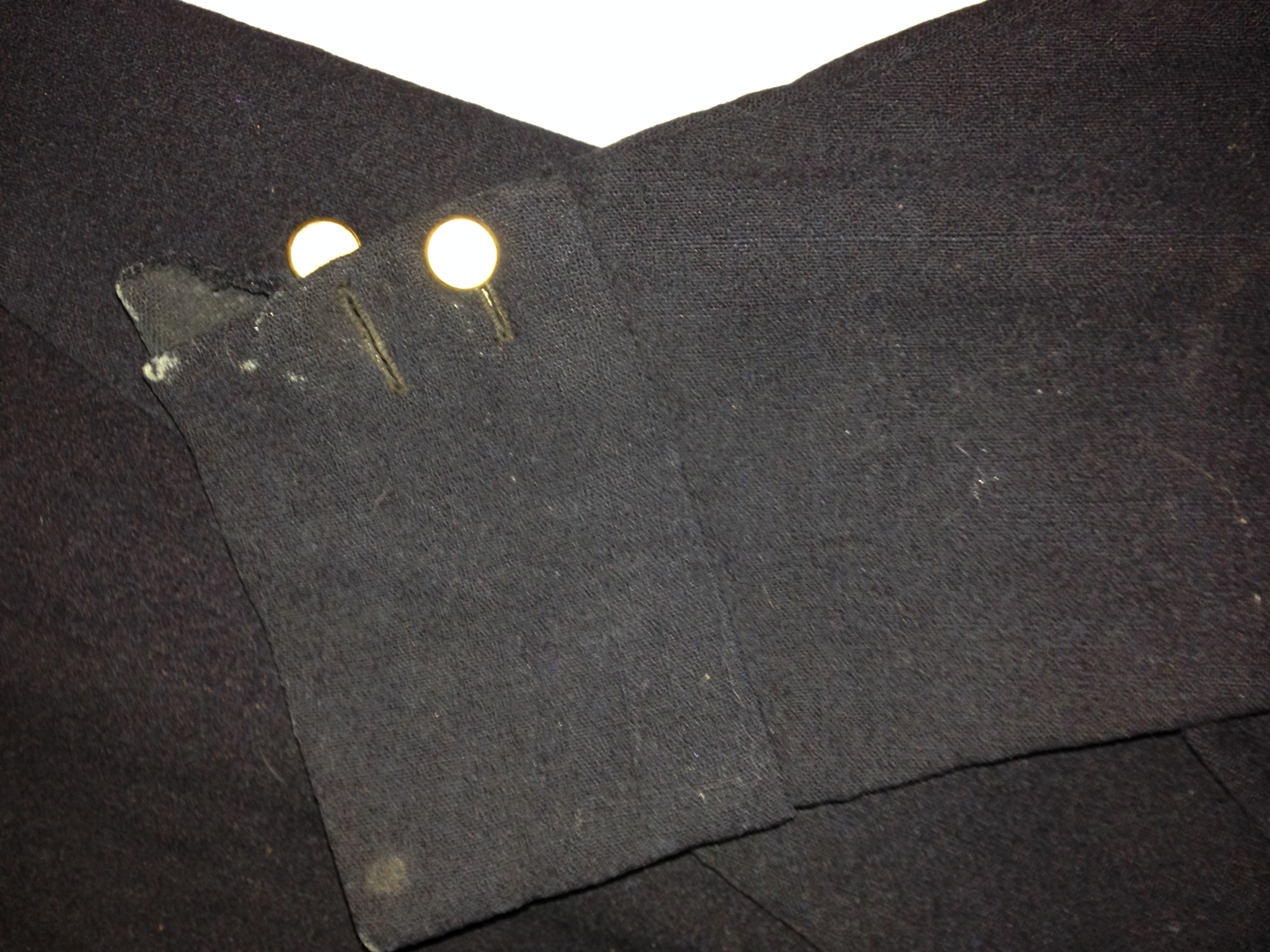
Slit cuff with two buttons, RIHS Museum Collections, 1968.38.1

Slit cuff with two buttons, RIHS Museum Collections, 1968.38.1

There’s no waist seam, so we can be pretty certain that this coat is earlier than 1818, if not 1810. Another telling measure of age is cuff treatment. This slit cuff seems to start in the 1780s or 1790s and persist into the early 19th century, (and beyond: gentlemen, check your coat sleeves and you’ll see what I mean).

That’s an awfully long range, 1780s to forever, but the smooth sleeve head and lack of waist seam help narrow the time frame. I’d hazard– and this is a hazardous business– ca. 1805 date for this coat, which would give me leeway for a common man to wear this into 1812, though make it more difficult for him to wear it in 1799/1800. (You can look back in fashion, but high style on the lower sorts is a tricky business and requires a lot of thought.)

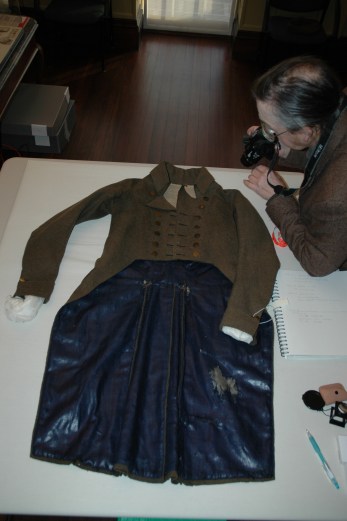
1925.11.1A, RIHS Museum Collection

1925.11.1A, RIHS Museum Collection

For travel to 1790-1800, I have another coat in mind, though it will probably be a long time before I get it made. This, too, has classic markers of its time, though the collar’s stand-and-fall style makes me think it is closer to 1790 than to 1800.

The lining of this coat is a particular treat: every time I’m able to pull this out for viewing (and since it’s boxed right now, that’s not happening), that blue glazed wool is a treat. The wear mark on the left proper tail lining is intriguing, too: sometimes those start as moth holes and progress, and sometimes they’re wear that’s later found to be delicious and expands by chomping. (Wool and silk and protein, and delicious treats for pests.)

I find these coats really exciting, and often feel a little “Make All the Coats,” but of course I can’t, not quickly, anyway. And these two don’t really solve my August in 1812 problem, as the clock ticks on…but I think there is a solution, thanks to Sharon Burnston and Fitting & Proper.

Share this:

  • Share on Facebook (Opens in new window) Facebook
  • Share on Pinterest (Opens in new window) Pinterest
  • Email a link to a friend (Opens in new window) Email
  • Share on X (Opens in new window) X
Like Loading...
← Older posts
Newer posts →

Archives

wordpress statistics

Creative Commons License
Kitty Calash blog by Kirsten Hammerstrom is licensed under a Creative Commons Attribution-NonCommercial-ShareAlike 4.0 International License.

Website Built with WordPress.com.

  • Subscribe Subscribed
    • Kitty Calash
    • Join 621 other subscribers
    • Already have a WordPress.com account? Log in now.
    • Kitty Calash
    • Subscribe Subscribed
    • Sign up
    • Log in
    • Report this content
    • View site in Reader
    • Manage subscriptions
    • Collapse this bar
 

Loading Comments...
 

    %d