• Home
  • Completed Costumes/Impressions
  • Emma and Her Dresses
  • Free Patterns and Instructions

Kitty Calash

~ Confessions of a Known Bonnet-Wearer

Kitty Calash

Tag Archives: 19th century

Stay Thy Hand

02 Monday May 2016

Posted by kittycalash in Clothing, Fail, Making Things

≈ 7 Comments

Tags

18th century, 18th century clothes, 19th century, 19th century clothing, Costume, dress, fail, sewing, stays
IMG_6784

Stays. They’re infrastructure: absolutely necessary, a major time commitment, and decidedly unsexy. I am in dire need to two new pairs, one for late 18th century use and one for early 19th century, and each with deadlines looming.

I can manage 19th century attire and Genesee with the chopped-and-dropped corded stays I already have, but New Jersey will not happen at all unless new stays are made. It was like a weekend of penance chez Calash, two straight days of stay mocking up and making.

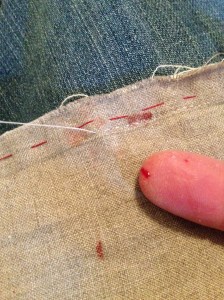
Of course I bled on them. That’s how I know they’re mine.

IMG_6786

And let’s get this out of the way: I thought backstitching the back seam was a little more difficult on this side, but ascribed it to sore fingers. Wrong! I failed to notice that I was stitching through all the layers, and not leaving one free to fold over and finish.
IMG_0806

A glass of cider and an hour later, I’d rectified the error. These are now fully bound along the bottom edge, and ready for the top edge binding. Somewhere there’s coutil for the straps, and then numerous hand-sewn eyelets later, I will have a finished pair of hand-sewn stays.

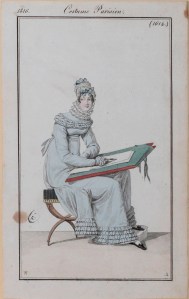
New stays deserve a new gown, and since I found this lovely image, I know what that new gown should look like (as well as a portfolio).  Happily, there’s a dress in Cassidy’s book that will serve as a reasonable basis for recreating this image. I’m still pondering the portfolio, and what it might be made of: paper or leather covered pasteboard? As the clock ticks down to June, I suspect I will be using a portfolio I already have on hand.

And then there are the the 18th century stays, with their history of woe.

File_000

I’ve gotten this far with the new 18th century pair, and an interesting business it is. I altered the front side pieces and the stomacher, but cannot see the back well enough (even with a camera and a mirror) to adjust it by myself, so further changes will have to wait until I have some assistance.

The tabs aren’t right in the back, and while the advice is to shorten the stays when the tabs flare this way, I found the fronts were still too low, once again riding at nipple-cutting height. Finally it occurred to me that the problem– slippage–might actually be one of waist. I lengthened the fronts half an inch and nipped the waist in, and found the fit more pleasing.  I suspect the back pieces need to be trimmed a bit before they’ll fit (they’re stitched closed in this version, so you know they’re too big).

Another weekend of work awaits– with focus, those early 19th century stays may be done by then, if there are no more finger injuries.
Share this:

  • Click to share on Facebook (Opens in new window) Facebook
  • Click to share on Pinterest (Opens in new window) Pinterest
  • Click to email a link to a friend (Opens in new window) Email
  • Click to share on X (Opens in new window) X
Like Loading...

After Dark: Bedtime for Kitty

14 Thursday Apr 2016

Posted by kittycalash in Events, History, Living History, Museums, Research

≈ 6 Comments

Tags

19th century, After Dark, candles, chamber pots, experimental archaeology, hygiene, interpretation, John Brown House Museum, lighting, living history, Rhode Island history, sleep patterns

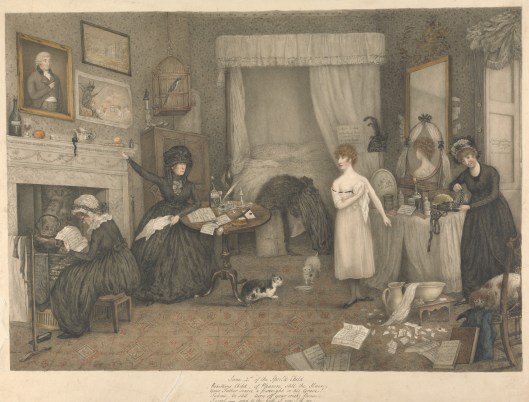
Lewis Vaslet, 1742–1808, The Spoiled Child, Scene II, ca. 1802, Watercolor with black ink and gray wash over graphite on moderately thick, slightly textured, cream wove paper, Yale Center for British Art, Paul Mellon Collection. B1977.14.4342

Lewis Vaslet, 1742–1808, The Spoiled Child, Scene II, ca. 1802, Watercolor with black ink and gray wash over graphite on moderately thick, slightly textured, cream wove paper, Yale Center for British Art, Paul Mellon Collection. B1977.14.4342

In just about a week, we’re running a pilot program in the historic house where I work (tickets available here). After Dark, or What Cheer Night, are programs we’ve wanted to do for a couple of years, but all good things take time.

Error
This video doesn’t exist

I’ve drawn the lot chosen to talk about getting ready for bed and sleeping: lighting devices, bedding, washing, chamber pots* and what people wore to bed. While already in possession of candles and candlesticks, and the proud new owner of exhibition and interpretation grant-funded LED candles, there are things I needed to make. Of course.

Print made by Guillaume Philippe Benoist, 1725–ca. 1770, French, Pamela Swooning, after having discovered Mr. B. in the closet, He (frighted) endeavouring to recover her, Mrs. Jervis wringing her hands, and screaming, 1745, Etching with stipple engraving on medium, slightly textured, cream laid paper, Yale Center for British Art, Yale Art Gallery Collection, Gift of the Library Associates.

Print made by Guillaume Philippe Benoist, 1725–ca. 1770, French, Pamela Swooning, after having discovered Mr. B. in the closet, He (frighted) endeavouring to recover her, Mrs. Jervis wringing her hands, and screaming, 1745, Etching with stipple engraving on medium, slightly textured, cream laid paper, Yale Center for British Art, Yale Art Gallery Collection, Gift of the Library Associates.

A banyan, for one thing. And you know that will (one hopes) be followed in short order by a night cap. After all, you can’t talk about Pamela if you haven’t got a banyan and a cap in the house. That’s a simple and relatively fun project to tackle when brain capacity is somewhat limited: some piecing, straight seams, setting in facings and sleeve linings can all happen before I must assault the collar.

IMG_6554
Piecing it together, as the eventual wearer is taller than available fabric.

Collars are devilishly tricky for me sometimes– oddly, a pad-stitched collar set onto a tailored jacket seems easier to me than a bedgown collar– but I suspect the eventual recipient will manage to enjoy the garment no matter what minor construction errors a tipsy milliner or half-seas over housemaid might make (not, of course, that I am either of those things).

It’s been a fascinating exercise in having a staff-and-docent study group that has taken a decidedly feminist bent (calling Our Girl History!) as we explore what happened in Providence After Dark. Brothel riots in 1782. Warnings by the Baptist Church not to visit the “theatre, circus, or Green Cottage” on pain of punishment. No, I do not yet know what or where the Green Cottage is, but the best researchers I know are working on it. Is this the 18th century answer to the Green Door? We can but hope.

Reading The Coquette? Thomson’s The Seasons? Come experience an 18th century house on a night when people will know what you’re talking about! Or you can watch  that questionable housekeeper prepare a room for the night while she talks about sleep patterns and shares tips for 18th century pest control.


*Pro tip: put it on a chair. I fully expect to run an intimate workshop some evening called “Will Humiliate Self for History, or, Everything you ever wanted to know about the 18th century, but were too well brought up to ask.”

Share this:

  • Click to share on Facebook (Opens in new window) Facebook
  • Click to share on Pinterest (Opens in new window) Pinterest
  • Click to email a link to a friend (Opens in new window) Email
  • Click to share on X (Opens in new window) X
Like Loading...

Frivolous Friday: Something Fishy

08 Friday Apr 2016

Posted by kittycalash in Frivolous Friday, History, Making Things

≈ 2 Comments

Tags

18th century, 19th century, entertainment, fishing, fishing tackle, Frivolous Friday, hobbies

Fishing Tackle kit, Winterthur Museum, 1961.0492 A-Y

Fishing Tackle kit, 1820-1860 Winterthur Museum, 1961.0492 A-Y

The best things turn up when I’m looking for something else (in this case, the shell-printed pocket). These serendipitous finds always lead someplace interesting, in this case, to historical fishing (and my personal interest in historical hunting prints).

It’s a pleasantly refined sporting activity, suitable for ladies and gentlemen, with the pleasant result of dinner– presuming you manage both to catch a fish and not fall in. Standing up in boat seems unwise, and that hat surely casts an incredible and unmissable shadow on the water, but Morland’s party has caught a fish nonetheless.

Always something new to learn, and heaven knows I need yet another line of inquiry to pursue with all the others…though this might at least be a useful pursuit, if only in the meditative quality of an afternoon spent outdoors catching nothing.

George Morland, 1763–1804, British, A Party Angling, 1789, Oil on canvas, Yale Center for British Art, Paul Mellon Collection B2001.2.22

George Morland, 1763–1804, British, A Party Angling, 1789, Oil on canvas, Yale Center for British Art, Paul Mellon Collection B2001.2.22

Share this:

  • Click to share on Facebook (Opens in new window) Facebook
  • Click to share on Pinterest (Opens in new window) Pinterest
  • Click to email a link to a friend (Opens in new window) Email
  • Click to share on X (Opens in new window) X
Like Loading...

Spring Spencers

01 Monday Feb 2016

Posted by kittycalash in History, Literature, Research

≈ 5 Comments

Tags

19th century, 19th century clothing, Ackermann's Repository, fashion, fashion plates, Federal style, Research, resources

Spencers are not unlike bonnets, in my mind. They’re more work than a bonnet, sure, but compared to the layer cake that is an English gown, a Spencer is a batch of cupcakes.

I’ve fondled more silks than I may care to admit (oh, remnant table, how I love thee), and often picked up and put down a small length because it was patterned. Not enough for a gown, just enough for a Spencer. But Spencers are always solid.

No, they’re not.

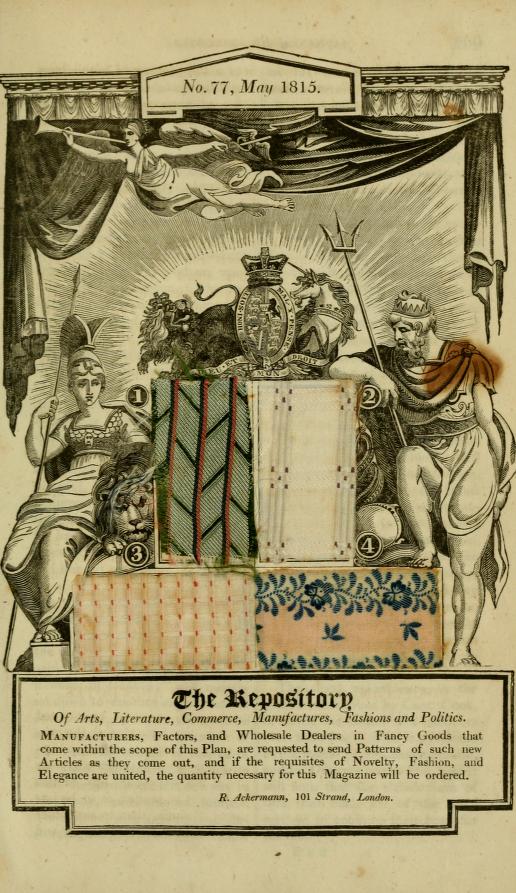
Allegorical Wood-Cut, with Patterns of British Manufactures. May, 1815. Ackermans's Repository of Arts, etc. Volume 13.

Allegorical Wood-Cut, with Patterns of British Manufactures. May, 1815. Ackermans’s Repository of Arts, etc. Volume 13.

It’s a Homer-quality forehead-slapping moment.

Caption, Allegorical Wood-Cut of British Manufactures. Ackermans's Repository of Arts, etc. Volume 13, May, 1815. page 298

Caption, Allegorical Wood-Cut of British Manufactures. Ackermans’s Repository of Arts, etc. Volume 13, May, 1815. page 298

Not only are there extant cotton roller-print Spencers, and wild printed cotton Spencer ensembles in North American collections, there’s print evidence of patterned silks for Spencers. Somehow, until I came across this plate and the description in Ackermann’s, I could not make the leap from cotton to silk.

Despite the existence of this.

My sole defense is that one patterned Spencer is still a zebra among horses.

But additional evidence, in the form of recommendations for spring in Ackermann’s? The zebra’s looking a little more like a horse.

Want more Ackermann’s? You know you do. The links are better sorted here.

Many, many thanks to Mr B for the tip!

Share this:

  • Click to share on Facebook (Opens in new window) Facebook
  • Click to share on Pinterest (Opens in new window) Pinterest
  • Click to email a link to a friend (Opens in new window) Email
  • Click to share on X (Opens in new window) X
Like Loading...

Fashionable Furniture, or, The Glories of the Past

30 Saturday Jan 2016

Posted by kittycalash in Art Rant, History, Research

≈ 2 Comments

Tags

19th century, Ackermann's Repository, fashion, Federal style, furniture, historic interiors, style

include window drapes.

Ackermans's Repository of Arts., etc. April, 1817.

Ackermans’s Repository of Arts., etc. April, 1817.

Every now and then, someone argues with me that the historic house where I work would not have had window curtains or drapes. Sometimes they like to expand that argument to “there were no curtains at all” in early Federal America. The reasoning is usually that textiles were too expensive to “waste” on window dressing. If you know me, you know this kind of argument is a Bad Idea. The public fight (I was angrily accosted by a now-former docent during a public presentation) is known as The Great Curtain Kerfuffle, and resulted in my reply that the owner of the house could very well afford anything he pleased. Fabric is Money.*

There’s another iteration of my argument: Color is Money.

Ackermans's Repository of Arts., etc. April, 1817. page 244

Ackermans’s Repository of Arts., etc. April, 1817. page 244

Those of us who shop at IKEA are not going to have “the most fashionable style of decoration” in our 1817 homes. The Willings and Binghams of Philadelphia were models for the  most fashionable families of Providence, and while well before this 1817 plate, the Binghams were recorded draping their chairs with orange and red silks. In early 19th century Providence, the John Innis Clark family had silk covers on their sofas and chairs in 1808, and plenty of carpets and curtains in their Benefit Street home from the 1790s on. 

“Crimson is very rich, but blue is handsomer,” wrote Eliza Ward to her sister, Mrs John Innis Clark, in the 1790s. Curtains and covers were fringed (Mrs Hazard Gibbes was blue and yellow). Windows were dressed, and younger, less affluent relatives received hand-me-down curtains. In 1803, Elizabeth Watters in Wilmington, North Carolina was having a carpet “wove in true Scotch taste in imitation of Highland plaid.”

John Phillips (1719-1795) Oil on canvas by Joseph Steward,1794-1796. Sack Gallery, Hood Museum of Art, Dartmouth College.

Some carpets, no? Maybe the new mantra is Carpets are Money.

But quite aside from an obvious display of wealth, what we have to realize about these images and letters is that they are depicting a world that looks very different from our own. Color sensibilities, tolerance for pattern mixing, non-matchy-matchy sewing and dressing. We have to abandon our 21st century aesthetic sensibilities when we dress ourselves or our spaces for the past, and really embrace the vivacity of that world. Sensory overload, perhaps, but getting closer to what the world of the past looked like will help us see– in every sense– the way the people of the past did.

*I may or may not have made additional statements afterwards to the effect that of course wealthy Americans squatted naked in the corners of their well-appointed mansions gnawing raw meat until Benjamin Franklin invented fire and fabric. I should be sorry about that, but I don’t seem to be.

Share this:

  • Click to share on Facebook (Opens in new window) Facebook
  • Click to share on Pinterest (Opens in new window) Pinterest
  • Click to email a link to a friend (Opens in new window) Email
  • Click to share on X (Opens in new window) X
Like Loading...
← Older posts
Newer posts →

Archives

wordpress statistics

Creative Commons License
Kitty Calash blog by Kirsten Hammerstrom is licensed under a Creative Commons Attribution-NonCommercial-ShareAlike 4.0 International License.

Website Built with WordPress.com.

  • Subscribe Subscribed
    • Kitty Calash
    • Join 621 other subscribers
    • Already have a WordPress.com account? Log in now.
    • Kitty Calash
    • Subscribe Subscribed
    • Sign up
    • Log in
    • Report this content
    • View site in Reader
    • Manage subscriptions
    • Collapse this bar
 

Loading Comments...
 

    %d