• Home
  • Completed Costumes/Impressions
  • Emma and Her Dresses
  • Free Patterns and Instructions

Kitty Calash

~ Confessions of a Known Bonnet-Wearer

Kitty Calash

Tag Archives: 19th century

More than Just a Pretty Hat

04 Wednesday Jun 2014

Posted by kittycalash in Clothing, History, Living History, Research

≈ 2 Comments

Tags

1812, 19th century, 19th century clothing, fashion, living history, milliner, millinery, millinery shop, Reenacting, Research, resources, Rhode Island, Salem event, style

While pretty hats were pretty important parts of the milliner’s trade, many more things were sold in a millinery shop.

Colonial Williamsburg’s Margaret Hunter shop is probably the best-known living history milliner’s shop, and they provide a nice definition and explanation of the trade. But that’s never enough: what’s the primary source information for New England milliners?

While there is documentation of a Rhode Island milliner in the 1830s, and even a thesis on her work, Sew 18th Century and I are working on an earlier shop. I started with Rhode Island newspaper advertisements, because I like the sound of “lately arrived from Providence,” and because I understand that context.
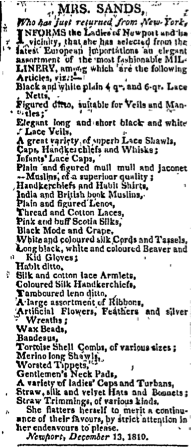
The Rhode-Island American, December 25, 1810. III:20, p. 1

The Rhode-Island American, December 25, 1810. III(20), p. 1

Here is Mrs. Sands, just returned from New York to Newport and vicinity, with a long list of things for sale, “selected from the latest European importations, an elegant assortment of the most fashionable MILLINERY.. viz,:–” (you have the love the punctuation, which is like the Chicago Manual of Style on New Republic crack)

What is she selling? In addition to what we think of as traditional millinery, the “variety of ladies’ Caps and Turbans, Straw, silk and velvet Hats and Bonnets; Straw Trimmings of various kinds,” listed at the bottom of the ad, Mrs. Sands carries:

  • Lace Shawls
  • Caps, Handkerchiefs and Whisks;
  • Infants’ Lace Caps
  • Plain and figured mull mull and jaconet
  • –Muslins, of a superior quality;
  • Handkerchiefs and Habit Shirts,
  • India and British book Muslins,
  • Plain and figured Lenos,
  • Long black, white and coloured Beaver and Kid Gloves;
  • Silk and cotton lace Armlets,
  • A large assortment of Ribbons,
  • Artificial Flowers, Featehrs and silver Wreaths
  • Tortoise Shell Combs of Various sizes;
  • Merino long Shawls
  • Worsted Tippets
  • Gentlemen’s Neck Pads

Whew! That’s a lot of stuff, and many different kinds of things, though all broadly in the ‘accessories’ or supplies range. I am delighted to see Habit Shirt on the list, as I buy my chemisettes, and I am intrigued by the range of handkerchiefs and by the Tortoise Shell combs, in part because I did not buy an assortment of them at a shop in western Rhode Island a month ago (kicks self).

Newport Mercury, December 11, 1811. L:2593, p.1

Newport Mercury, December 11, 1811. L(2593), p.1

In the December 21, 1811 Newport Mercury, Mrs Sands again advertised her goods lately arrived from New York. This is a less exhaustive, but no less interesting, list. “Ladies elegant green velvet mantles, with and without spencers” is particularly intriguing for a Spencer fan, and not particularly clear to me.
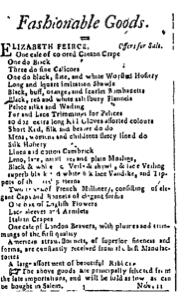
November 21, 1812. Essex Register

November 21, 1812. Essex Register

In Salem, which is where we will be in August, Elizabeth Pierce advertises her “Fashionable Goods” for sale. She, too, has a long list of things she will sell, from Canton crapes to imitation shawls, hosiery, lace sleeves and armlets, one box of English flowers, and American Straw bonnets.

I suspect that just as retailers do today, milliners of the late 18th and early 19h century probably had an assortment of things designed to bring buyers in to shop (new bonnet styles), and small items to tempt them into impulse purchases (English flowers). You can’t buy a new bonnet every week, but you can refresh an old one.

Share this:

  • Share on Facebook (Opens in new window) Facebook
  • Share on Pinterest (Opens in new window) Pinterest
  • Email a link to a friend (Opens in new window) Email
  • Share on X (Opens in new window) X
Like Loading...

Mail Call!

05 Saturday Apr 2014

Posted by kittycalash in Events, History, Living History, Making Things, Reenacting

≈ 3 Comments

Tags

19th century, common people, creative writing, Events, historical fiction, letter writing, letters, living history, Making Things

writing letter0001Gentle Readers, would you be writers?

You can join the fun this year by providing mail for the HMS Acasta‘s mail bag at the Jane Austen Festival. Maybe you can’t go, but why shouldn’t your letter?*

Read more here about the suggestions for types of letters, and the characters to whom you may write. It’s on my list of neat things to try to get done.

*Hot tip: Jo Baker, author of Longbourn, will be there. Creative writing, author talks and dressing in high-waisted gowns? Why am I not going? (Because I have too much to do in July!)

Share this:

  • Share on Facebook (Opens in new window) Facebook
  • Share on Pinterest (Opens in new window) Pinterest
  • Email a link to a friend (Opens in new window) Email
  • Share on X (Opens in new window) X
Like Loading...

Bust darts from Hell

05 Tuesday Nov 2013

Posted by kittycalash in Clothing, History, Making Things, Research

≈ 6 Comments

Tags

19th century, bust darts, details, dress, Events, fashion, museum collections, patterns, sewing, Spencer

Spencer ca. 1800. MMS 1991.239.2

It all started out so well, in the muslin, but in the wool, not so much. I cut up a remnant, proving that a yard and a quarter of 60” fabric is enough for a Spencer, even for my arm length (but not less, thanks to that arm length and a respect for the grain).

The pattern I’m using has bust darts, which I haven’t sewn in years. They took some tweaking with the steam iron.

In 18th century clothing, one doesn’t see bust darts; there are some above the bust, shaping gowns at the robings, but for the most part they aren’t needed. Think cones, thanks to the stays. And later in the 18th century, a lot of work is done by gathers and drawstrings, as in the white and black  ca. 1800 French spencer at the Met.

Spencer ca. 1818-1819. MMA 1982.132.3

Spencer ca. 1818-1819. MMA 1982.132.3

But if you’ve got an endowment of the non-fiscal kind, and you want your military-inspired garment to fit smoothly over your endowment, what do you do?

In this example, you hide the bust dart under braid and buttons. Check out that diagonal seam—and that the fabric appears to have been cut on the bias.
Brilliant, right? Gain ease by using the stretchy quality of the bias and hide the shaping under decorative elements.

Here’s an extreme detail.

Spencer, 1813. MMA C.I.39.13.48

Spencer, 1813. MMA C.I.39.13.48

In the garment below, of wool, three bust darts of the same length help shape the front. And again, decorative braid hides the shaping. 

It’s only cataloged as “wool,” with no weave given. There is a detail image of the darts and braid as well; I think that might be serge, and not superfine broadcloth. Still, three bust darts help achieve a smooth fit.

The Swedish Spencer at the museum in Lund has but one grainy photo: it’s hard to imagine that it doesn’t have bust darts, but the photo leaves much to the imagination.

Share this:

  • Share on Facebook (Opens in new window) Facebook
  • Share on Pinterest (Opens in new window) Pinterest
  • Email a link to a friend (Opens in new window) Email
  • Share on X (Opens in new window) X
Like Loading...

Letters for Service

25 Friday Oct 2013

Posted by kittycalash in History, Literature

≈ Comments Off on Letters for Service

Tags

19th century, examples, instruction manuals, letter writing, letters

The Letter, oil on canvas by Pietro Longhi. MMA 14.32.1.

The Letter, oil on canvas by Pietro Longhi. MMA 14.32.1.

Sew 18th Century wrote me the loveliest letter, and ever since I have been remiss in my epistolary duty. To better prepare myself, I took a look at a lovely little imprint at work, The Fashionable American Letter Writer: or, The Art of Polite Correspondence (Providence: Edward and J.W. Cory. 1833) which is thus far the earliest letter writing manual I have found in that collection. Below you will find some examples about servants, or for servants.

Letter XXV.—Recommending a Man Servant.
Sir—
The bearer has served me with integrity and fidelity these three years, but having a desire to settle in New-York, he left my house about a week ago, and by a letter received from him this day, I find you are willing to employ him on my recommendation., and it is with the greatest pleasure that I comply with his request. His behavior while with me was strictly honest, sober, and diligent, and I doubt not but it will be the same with you. I have sent this enclosed in one to himself, and if you employ him, I hope he will give satisfaction.
I am, sir, your humble servant,

Letter LXX.—From a young Woman just gone to service, to her mother in the country.
Dear Mother—
It is now a month that I have been at Mr Wilson’s. My master and mistress are both worthy people, and greatly respected by all their neighbors. At my first coming here I thought every thing strange, and wondered to see such multitudes of people in the streets; but what I suffer most from is, the remembrance of yours and my father’s kindness; but I begin to be more reconciled to my state, as I know you were not able to support me at home. I return you a thousand thanks for the kind advice you was so good as to give me at parting, and I shall endeavor to practice them as long as I live. Let me hear from you as often as you have an opportunity. With my duty to you and father, and kind love to all friends, I remain ever,
Your most dutiful daughter,

Letter LXXI.—The Mother’s Answer.
My Dear Child—
I am glad to hear that you reside in so worthy a family. You know that we should never have parted with you had it not been for your good. If you continue virtuous and obliging, all the family will love and esteem you. Keep yourself employed as much as you can, and be always ready to assist your fellow servants. Never speak ill of anybody; but when you hear a bad story, try to soften it as much as you can. I am in great hopes that all the family are kind to you, from the good character I have heard of them. If you have any time to spare from your business, I hope you will spend some part of it reading your Bible, and other religious books. I pray for you daily, and there is nothing I desire more than my dear child’s happiness. Your father desires his blessing, and your brothers and sisters their kind love to you. Heaven bless you, my dear child, and continue you to be a comfort to us all, and particularly to
Your affectionate mother,

Share this:

  • Share on Facebook (Opens in new window) Facebook
  • Share on Pinterest (Opens in new window) Pinterest
  • Email a link to a friend (Opens in new window) Email
  • Share on X (Opens in new window) X
Like Loading...

A Swedish Spencer

11 Friday Oct 2013

Posted by kittycalash in Clothing, Historical Sew Fortnightly, Making Things

≈ 3 Comments

Tags

19th century, Costume, Historical Sew Fortnightly, plans, sewing project, Spencer, wool

The Swedish Spencer

The Swedish Spencer

Because I lack good sense, I have fixated upon this Spencer from a museum in Lund. I have inflicted it upon people who have no particular interest in women’s wear, and extracted opinions on the fabric. Shameless, really. But I love the simplicity of this garment, and have therefore closed my eyes, written a check for some Kochan & Phillips bottle green broadcloth so that I can pet the wool to cheer myself up while patterning this beast.

To be fair, I have a Spencer half-patterned, and need “only” to work on the sleeves and collar. I have a sense, from examining a friend’s frock coat, of how to construct this stand-and-fall collar. Pad stitching, here I come. I enjoy the challenge of sleeves and hope this will not break me of that. So far, I have not been able to find a photo of the back of this lovely garment, so I’ll have to extrapolate from other examples.

I’d thought about making this for the Historical Sew Fortnightly # 21: Colour Challenge Green, but it took me too long to commit to the K&P wool, and at that price, you can bet I’ll make a careful muslin. While I’m not certain when or where I will wear this, I already know that I will wear it with my black petticoat and green boots, and will have to make a shirt to go under the petticoat, which will be its own challenge.  

Puffy sleeves aren’t my thing, and they won’t fit under these trim Spencer sleeves, but there is at least one extant example of a long-sleeved shirt-like garment. I expect I will feel about chemisettes much the way I feel about caps…but in the end, it will be worth all the tiny hems and the muslins. After all, the Spencer has a huge bonus: it closes with clasps so there are no buttonholes!

Share this:

  • Share on Facebook (Opens in new window) Facebook
  • Share on Pinterest (Opens in new window) Pinterest
  • Email a link to a friend (Opens in new window) Email
  • Share on X (Opens in new window) X
Like Loading...
← Older posts
Newer posts →

Archives

wordpress statistics

Creative Commons License
Kitty Calash blog by Kirsten Hammerstrom is licensed under a Creative Commons Attribution-NonCommercial-ShareAlike 4.0 International License.

Website Built with WordPress.com.

  • Subscribe Subscribed
    • Kitty Calash
    • Join 621 other subscribers
    • Already have a WordPress.com account? Log in now.
    • Kitty Calash
    • Subscribe Subscribed
    • Sign up
    • Log in
    • Report this content
    • View site in Reader
    • Manage subscriptions
    • Collapse this bar
 

Loading Comments...
 

    %d