• Home
  • Completed Costumes/Impressions
  • Emma and Her Dresses
  • Free Patterns and Instructions

Kitty Calash

~ Confessions of a Known Bonnet-Wearer

Kitty Calash

Tag Archives: art

Frivolous Friday: Puppy in a Poke (bonnet)

30 Friday May 2014

Posted by kittycalash in Clothing, Frivolous Friday, Research

≈ 1 Comment

Tags

19th century clothing, art, dogs, engravings, fashion, Frivolous Friday, John James Chalon, resources, style

Plate 11, Twenty-four Subjects Illustrating the Costume of Paris

Plate 11, Twenty-four Subjects Illustrating the Costume of Paris

Like most humans, I have whimsical tastes and occasional outbreaks of covetousness. Today, while looking for images of milliners, I found this book for sale online, and while I cannot dream of owning it, I am delighted by this image, and by the others shown on the bookseller’s site. The British Museum has a copy, but only a few images online; Yale has a copy at the Center for British Art, but no images online.

John James Chalon, (more images here) who made this engraving, also made the classic image of the milliner’s shop, and that was where my search began.

La Marchande des Modes

La Marchande des Modes

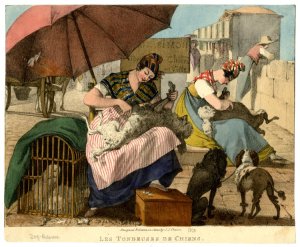
Searching a little more only improved the results… Dog groomers! I have got to get hold of this book.
AN01035992_001_l

Les Tondeuse de Chiens

While these engravings satisfy my delight with the absurd, more seriously, they provide some insights into daily life in the 1820s. It’s not the United States, but it’s a helpful place to start, because despite the humour in these, there isn’t a layer of satire that has to be peeled off before we can begin to understand the image.

Full-on satires, like those of Hogarth, Rowlandson and Gilray, can be hard for us to interpret: we’re so far away, we no longer get the joke, so the joke is now on us if we take what is shown for exact truth. The prints in “Twenty-four subjects exhibiting the costume of Paris” have a gentler humour.  

I don’t think I’m ready to portray a 19th century dog groomer, but I am stunned that I never considered how long they’ve been around. How many other everyday occupations do we overlook when we think of the past?


Share this:

  • Click to share on Facebook (Opens in new window) Facebook
  • Click to share on Pinterest (Opens in new window) Pinterest
  • Click to email a link to a friend (Opens in new window) Email
  • Click to share on X (Opens in new window) X
Like Loading...

Visual Illiteracy

23 Wednesday Apr 2014

Posted by kittycalash in Art Rant, Clothing, Fail, Research, Snark, TV Review

≈ 4 Comments

Tags

art, Banastre Tarleton, Captain Tallmadge, Colonel Tarleton, dragoons, helmets, light, museum collections, National Gallery, paintings, Research, Revolutionary War, Turn

Banastre Tarlteon by Joshua Reynolds

Portrait of Sir Banastre Tarleton (1754-1833) by Joshua Reynolds, 1782. National Gallery (UK)


See update below!

By 9:00 on Sunday, I was asleep and missed “Turn,” which Mr S wasn’t even watching because, as he declared, “It’s just a bad show.” On Monday evening, I made it through the opening of the show and gave up for good. But those minutes made me think of the Banastre Tarleton portrait by Sir Joshua Reynolds, and the suggestion on Twitter that “Turn” had no historical consultant.

It occurred to me, as I stared at the rather curious headgear worn by Captain Tallmadge (I think it’s stretch lycra over a “Roman” gladiator costume helmet glued to a baseball cap visor and edge-taped with gold foil) that perhaps the people doing the costumes simply lacked visual literacy. This could explain the refugees from Fort Lee who looked like they stepped out of an Emma Lazarus poem, and it could explain the very unfortunate helmet.

Tarleton_notes

Let us look at Banastre Tarleton, hunky bad boy of the British dragoons: he came to mind on Monday night, and what visual relief he is.

Note the light edge of the visor: this is a highlight. The leading edge of a polished surface will shine, and helmets, even of leather, will be reflective. Over time, the edges will polished by wear if not on purpose. I cannot speak to the helmet habits of the horse-mounted, but I know from paintings, and that edge is a highlight.

The Boys last July. Look, shiny, not-taped visor edges.

The Boys last July. Look, shiny, not-taped visor edges.

Reynolds painted what he saw, and just as the Young Mr’s cheekbones are reflecting light off the underside of his visor and Mr S’s helmet edge is shining in the direct light, so too is Colonel Tarleton’s helmet edge shining.

(Yes, there are both mounted and unmounted dragoons within a unit; but I just can’t help feeling that an officer would be mounted more often than he has appeared to be thus far.)

ETA: Heather has graciously pointed out a very nice blog on Turn, which is doing a far more even-handed and informed job of watching and commenting on the show. Thank you, Heather!

Share this:

  • Click to share on Facebook (Opens in new window) Facebook
  • Click to share on Pinterest (Opens in new window) Pinterest
  • Click to email a link to a friend (Opens in new window) Email
  • Click to share on X (Opens in new window) X
Like Loading...

Behind the Scenes, Below Stairs

21 Monday Oct 2013

Posted by kittycalash in History, Museums, Research

≈ Comments Off on Behind the Scenes, Below Stairs

Tags

Adriaan de Lelie, art, art history, Clothing, common dress, common people, family portrait, portraits, Rijksmuseum, servant girls, servants

Jonkheer Gijsbert Carel Rutger Reinier van Brienen van Ramerus (1771-1821), met zijn vrouw en vier van hun kinderen, Adriaan de Lelie, 1804

Jonkheer Gijsbert Carel Rutger Reinier van Brienen van Ramerus (1771-1821), met zijn vrouw en vier van hun kinderen, Adriaan de Lelie, 1804

Perhaps because I just finished Longbourn and have just started Year of Wonders, servants are on my mind.

In the family portrait at left, the servants are visible (just) to the right of the tree.

The man and woman almost literally mirror the main subjects, Carel Rutger Reinier van B can Ramerus and his wife, positioned as they are in opposite relationship to each other. The servants, too, are surrounded with life, carrying a child and dogs and game.

servants

The woman is holding the infant of the van Ramerus couple, and even without Google Translate (that’s “four of their children”) we can figure this out. How? Because the child is held away from her body, and faces forward. It is a slightly odd arrangement, with the infant so peripheral to the main image, but we’re fortunate, because this composition allows us to see the servants.

Class distinctions are clear in the dress: the female servant wears a cap, kerchief and short gown, the male servant-gamekeeper, perhaps–wears breeches and a jacket from the pervious century, as well as a cocked, and not a tall, hat.

It does remind me strongly of the imperative to continue a family line, and the lot of women to breed and produce male heirs. For all that I love the past, I know I could not live there easily.

Share this:

  • Click to share on Facebook (Opens in new window) Facebook
  • Click to share on Pinterest (Opens in new window) Pinterest
  • Click to email a link to a friend (Opens in new window) Email
  • Click to share on X (Opens in new window) X
Like Loading...

‘Visual Arts Crush’

21 Wednesday Aug 2013

Posted by kittycalash in Art Rant, Museums, Research

≈ Comments Off on ‘Visual Arts Crush’

Tags

art, art history, Art Institute of Chicago, historic interiors, history, miniature rooms, miniatures, Museums

I’ve been following the Times’ “Arts Crush” series, and one of the best, and best-written, in the series has been Holland Cotter’s piece on poetry and the MFA. Cotter’s writing is always elegant and accessible, with an amazing ability to render high concepts simply. (I wish he’d taught my graduate seminars in art theory…) The series inspired me to think about my first visual arts crush, and how it still resonates today.

I grew up on the North Side of Chicago, in the actual city, not Ferris-Bueller-land. By the time I was in high school, I had a pretty free-range existence thanks to the Chicago Transit Authority, and rode the bus anywhere and everywhere, even up to the southern edge of Bueller-land, also known as Evanston.

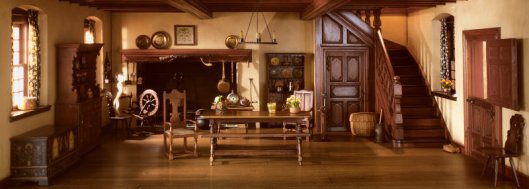
Mrs. James Ward Thorne American, 1882-1966 A17: Pennsylvania Kitchen, 1752, c. 1940. Art Institute of Chicago

Mrs. James Ward Thorne
American, 1882-1966
A17: Pennsylvania Kitchen, 1752, c. 1940. Art Institute of Chicago

Thanks to the CTA, and to the car my family drove only on weekends, and plenty of field trips in school, we visited most of the museums in the city: the Museum of Science and Industry, the Shedd Aquarium, the Chicago Historical Society, the Field Museum and the Art Institute of Chicago. That’s where I found my very first crush.

Mrs. James Ward Thorne American, 1882-1966 A3: Massachusetts Dining Room, 1720, c. 1940. Art Institute of Chicago.

Mrs. James Ward Thorne
American, 1882-1966
A3: Massachusetts Dining Room, 1720, c. 1940. Art Institute of Chicago.

There’s a lot to love in the AIC, from classic Impressionists to post-war Abstract Expressionists, but when I was in grade school, what really made an impression on me were the Thorne Rooms. The Thorne miniature rooms are meant to be the most accurate 1/12 scale representations of historical interiors. It will not surprise you that I pressed my 10-year-old nose against the glass of the early Pennsylvania rooms, or the high-style Rhode Island rooms, wishing desperately that I could shrink and slip through that solid membrane and inhabit the world the rooms depicted.

Mrs. James Ward Thorne American, 1882-1966 A11: Rhode Island Parlor, c. 1820, c. 1940. Art Institute of Chicago

Mrs. James Ward Thorne
American, 1882-1966
A11: Rhode Island Parlor, c. 1820, c. 1940. Art Institute of Chicago

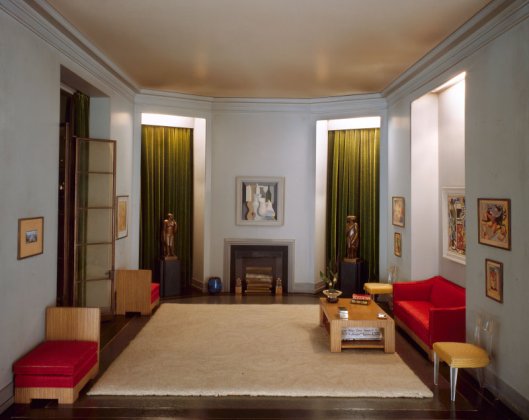
My mother and I would play a game: Which is your favorite room? Which one would you like to live in? And even if the rooms filled with tiny ball-and-claw feet were my favorite, or the chestnut-panelled keeping rooms, the one I wanted to live in (because somewhere there would be a telephone and a radio, and behind the tiny door, a well-appointed bathroom) was the Art Deco apartment. We were fairly certain this was a room you never saw in “Bringing Up Baby,” maybe the room on the other side of the bathroom where the leopard was kept.

Mrs. James Ward Thorne American, 1882-1966 A37: California Hallway, c. 1940, c. 1940. Art Institute of Chicago.

Mrs. James Ward Thorne
American, 1882-1966
A37: California Hallway, c. 1940, c. 1940. Art Institute of Chicago.

Accuracy and anarchy: those contradictory impulses have guided most of my life, from the work I made as an artist, to the work I do now. Getting details right, from citations to what’s on a table for a 1799 tea, matters; but once that’s set in motion, life takes over, the metaphorical leopard is loose, and we’re off to see what life was really like in all its emotive glory in 1799.

Mrs. James Ward Thorne American, 1882-1966 E-15: English Drawing Room of the Modern Period, 1930s, c. 1937. Art Institute of Chicago.

Mrs. James Ward Thorne
American, 1882-1966
E-15: English Drawing Room of the Modern Period, 1930s, c. 1937. Art Institute of Chicago.

And it all started in the basement of the Art Institute of Chicago, imagining what it would be like to live in each of the tiny worlds that ring the walls of the Thorne Rooms gallery.

Share this:

  • Click to share on Facebook (Opens in new window) Facebook
  • Click to share on Pinterest (Opens in new window) Pinterest
  • Click to email a link to a friend (Opens in new window) Email
  • Click to share on X (Opens in new window) X
Like Loading...

Faces from History

13 Thursday Jun 2013

Posted by kittycalash in Living History

≈ 1 Comment

Tags

art, art history, portraits, Reenacting

Admiral Peter Rainer, MFA  04.1757

Admiral Peter Rainer, MFA 04.1757

Captain of HM 54th Reg't of Foot.

Captain of HM 54th Reg’t of Foot.

Meet Admiral Peter Rainier, painted sometime between 1778 and 1787. The curious thing about Admiral Rainier is that I know someone who looks uncannily like his portrait.

We found portraits in our collection that look like people we know, and there are people on the street who look like they stepped out of Sandby or Hogarth drawings, even if they’re not in period dress. Take a look: you’ll see it too.

Share this:

  • Click to share on Facebook (Opens in new window) Facebook
  • Click to share on Pinterest (Opens in new window) Pinterest
  • Click to email a link to a friend (Opens in new window) Email
  • Click to share on X (Opens in new window) X
Like Loading...
← Older posts
Newer posts →

Archives

wordpress statistics

Creative Commons License
Kitty Calash blog by Kirsten Hammerstrom is licensed under a Creative Commons Attribution-NonCommercial-ShareAlike 4.0 International License.

Website Built with WordPress.com.

  • Subscribe Subscribed
    • Kitty Calash
    • Join 621 other subscribers
    • Already have a WordPress.com account? Log in now.
    • Kitty Calash
    • Subscribe Subscribed
    • Sign up
    • Log in
    • Report this content
    • View site in Reader
    • Manage subscriptions
    • Collapse this bar
 

Loading Comments...
 

    %d