• Home
  • Completed Costumes/Impressions
  • Emma and Her Dresses
  • Free Patterns and Instructions

Kitty Calash

~ Confessions of a Known Bonnet-Wearer

Kitty Calash

Tag Archives: Bostonian Society

Compare and Contrast

28 Sunday Jan 2018

Posted by kittycalash in Clothing, Events, Living History, Reenacting

≈ Comments Off on Compare and Contrast

Tags

18th century clothes, 18th century clothing, Boston Massacre, Bostonian Society, Events, living history, women's history, women's work

2016's 1770
2016’s 1770
2018's 1770
2018’s 1770

Boston Massacre planning is underway for everyone involved at every level, including me.

I’ve made changes to what I plan to wear, in part because I have a newer gown that fits better and keeps me warmer, and because I have learned more, and looked at more, in the intervening time. Since 2016, I’ve made/upgraded a quilted petticoat (in a bronze silk, a color documented to Rhode Island quilted ‘coats), settled in to wearing my cap tied under my chin, and made both a new apron and a new bonnet.

2017's 1777
2017’s 1777
2018's 1770
2018’s 1770

Cap and bonnet shape and shoes help make time period distinctions between 1777 and 1770; if I could find the wool I made the gown from, I would add the cuffs it desperately needs. The heeled shoes skew earlier than 1770, but they are the only heeled shoes I have….if the weather is wretched, I will wear the flats for safety and comfort.

2016's Bonnet
2016’s Bonnet
2018's Bonnet
2018’s Bonnet

The bonnet, which I affectionately call “Lampshade,” is meant to have the shape of pre-1770 bonnets as seen in Sandby’s illustrations, and which I have been working on for a while.

Martha Collins, Thomas Sandby’s Cook. watercolor on paper by Paul Sandby, 1770-1780. RCIN 914339

I know from reading the standards that the understanding of mitt material has evolved, and my time this morning looking for an elusive apron shape raises questions for me as well. Here’s Martha Collins, painted by Paul Sandby. What’s that black thing on her arm? A mitt? An arm warmer? Is it knit, or woven? There’s always more to figure out, and more to make.

Cuffs on my gown don’t seem like a big enough deal to warrant buying wool for a whole new gown (with only six weeks to go), so my choices are live with no cuffs, alter the red gown of 2016’s event to fit properly, or initiate an extensive search for the scraps left over from the green gown…which may or may not be buried in storage. Tick tock.
Share this:

  • Click to share on Facebook (Opens in new window) Facebook
  • Click to share on Pinterest (Opens in new window) Pinterest
  • Click to email a link to a friend (Opens in new window) Email
  • Click to share on X (Opens in new window) X
Like Loading...

Massacres and Mondays

07 Monday Mar 2016

Posted by kittycalash in Events, History, Living History, Museums, Reenacting, Research

≈ Comments Off on Massacres and Mondays

Tags

authenticity, Boston, Boston Massacre, Bostonian Society, commemoration, interpretation, living history, Massachusetts, Research

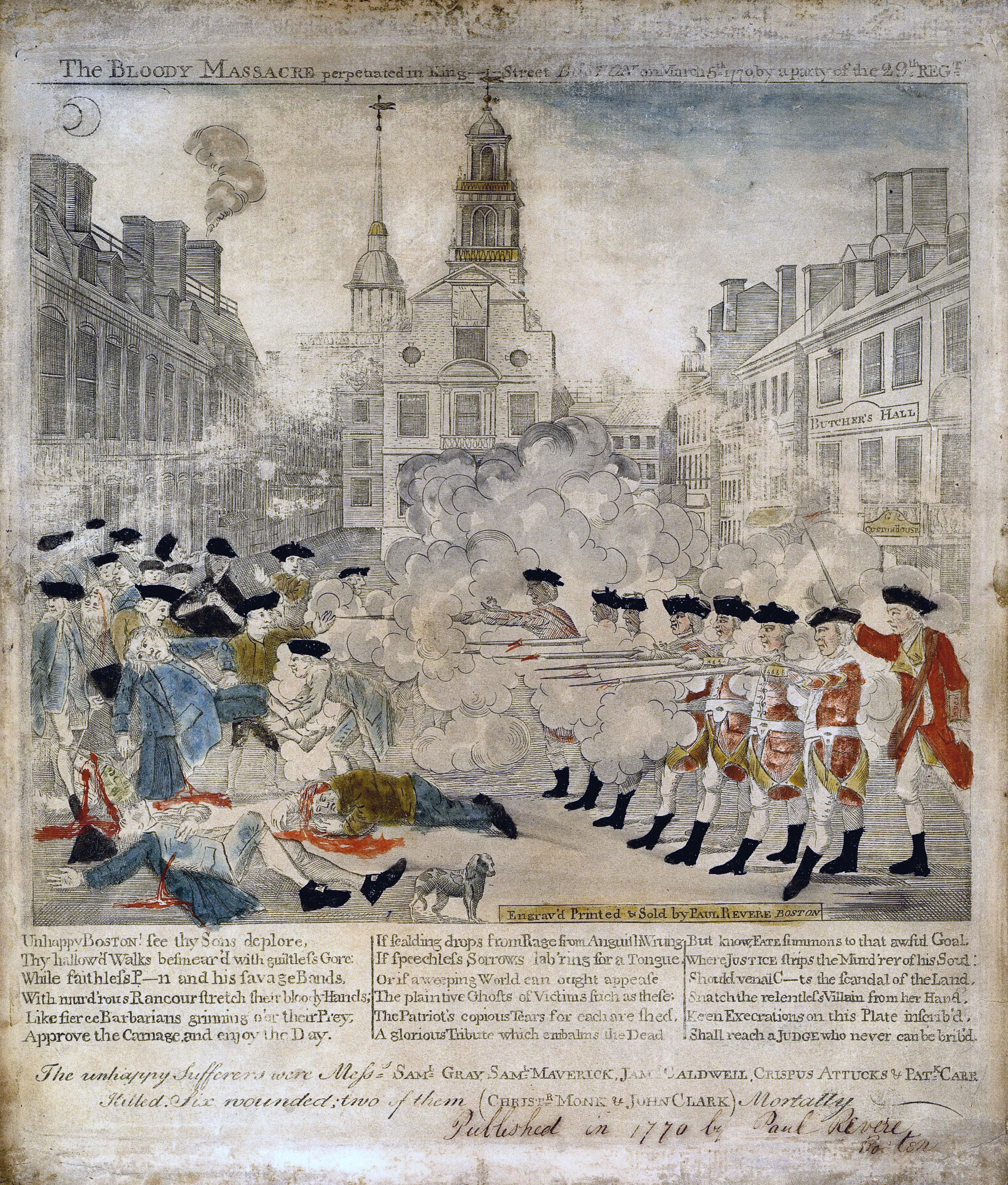
March 5, 1770: Sound familiar? The Boston Massacre.

Happened on a Monday, by the way: how ironic is that?

But here’s the thing: if the Monday is emphasized, the Massacre stands out. Focusing on the normal makes the unusual ever much more so. And in the case of Monday, March 5, 1770, the usual is actually unusual.

Paul Revere, “The Bloody Massacre in King-Street, March 5, 1770.” Boston, 1770

Over the course of the month leading up to Saturday’s event, Drunk Tailor and I spent a lot of time talking about the night watch, peddling, food supplies to Boston, population, and what I might call “the texture of everyday life” in a meeting at work. Any reading you do forces you to realize that the key to the Massacre is how very abnormal everyday life had become in Boston that winter.

Edward Langford, disaffected nightwatchman. Boston Str

Edward Langford, disaffected nightwatchman. @BostonStrolls on Twitter

By 1770, Boston was an occupied city: Ferguson comes to mind, or Ramadi. Soldiers and watchmen patrol the streets, civil and martial structures clash, and the Sons of Liberty chafe under this control– or attempt at control. Scuffles, fights, brawls, break out. A boy is shot to death– accidentally– and tensions mount higher.  Sailors and soldiers alike commit acts of vandalism. Women are assaulted. Normal isn’t normal anymore, and Boston was always expensive to live in. Even in a city occupied by “friendly” forces, gathering supplies and going about one’s daily business became harder.

People are scared. This is a tense city. Lots of people are just trying to survive. Lots of those people are children. Roughly 16,000 people, and if the estimates are correct, 2,000 soldiers and 4,000 men (white, African, other, free, indented and enslaved), which means about 4,000 women and 8,000 children under 16. Let that one sink in: lots of children, lots of teenagers. I don’t know about you, but a city with a large population of teenagers is going to be tense under the best of circumstances, even in an era before the rise of youth culture. Hormones, man. The kid can’t help it.

So imagine this: instead of a mobile monument and a commemorative ritual that substitutes fists for muskets, the Massacre commemoration expands to include the day, and not just the night. Monday and a Massacre.

Townspeople hurry home as dark falls. Women lug laundry back to customers or to the washhouse, or trundle barrows home, empty, after a day of hawking cats’ meat, oysters, or fish. Tired cordwainers trudge the streets, hoping for meat at supper. A mother scavenges firewood to warm her rented rooms, keeping an eye out for the watch. Those are not Mr Hutchinson’s fence posts, truly.

Photo by Tommy Tringale (Claus' Rangers, 2nd NH, 3rdMA and HMS Somerset)

Photo by Tommy Tringale (Claus’ Rangers, 2nd NH, 3rdMA and HMS Somerset)

Women look over their shoulders, nervous at the sound of hobnailed shoes on the streets. Older men skirt closer to buildings, out of the way of soldiers in the street. Apprentices mock an officer, a sentry responds.

Insults, a scuffle, a boy knocked down. A mob, soldiers, a woman shoved, shots fired, men killed and wounded, blood on the snow.

Murder in the midst of the mundane. More horrifying (in truth, I have never heard Boston so silent as I did on Saturday night) within its context than set apart.

The Women of the 2017 Boston Massacre commemoration. Photo by Drunk Tailor at the behest of Our Girl History

The Women of the 2017 Boston Massacre commemoration. Photo by Drunk Tailor at the behest of Our Girl History

The benefits?
A more complete picture of life in 1770 that puts the events of the evening of March 5, 1770 into deeper context and thus a sharper contrast.
A recognition that history isn’t just about men and conflict.
Understanding that what made living under occupation so hard was more the living– trying to be normal–than the occupation.
And, yes: more for women to do.

Share this:

  • Click to share on Facebook (Opens in new window) Facebook
  • Click to share on Pinterest (Opens in new window) Pinterest
  • Click to email a link to a friend (Opens in new window) Email
  • Click to share on X (Opens in new window) X
Like Loading...

Mansplained in the Museum+

21 Friday Nov 2014

Posted by kittycalash in Museums, personal, Snark

≈ 7 Comments

Tags

Boston, Bostonian Society, Council Chamber

+ Edited to correct typos and to add this link to Sheldon Cohen on Divorce in Providence County, 1749-1809.

I’ve been at a conference the latter half of this week, peering inside the workings of Cambridge and Boston cultural institutions, and most enjoyably, hearing about authenticity and disruption at the Bostonian Society: let’s get this party started!

Except: there I was in the elegantly and intelligently* done “Seat of Power” exhibition in the Council Chamber, pulling the label out from the chair seat to read about a Boston woman shopkeeper in the 18th century when a man had to explain it to me, with a special “feminist” bent that was supposed to, somehow, make this disruption of my visit okay.

I had been telling a young woman next to me, also part of the conference, that I wasn’t sure if this woman was the Boston woman who had been widowed three times and accumulated a great deal of wealth despite the interference of her husbands, and despite the property laws of the time.

The man, not part of the conference, needed to tell me that of course the woman had owned nothing herself, that being the regrettable law of the time, but in balance it was okay, because men were required to care for, and pay for the keep of, their wives and children.

Reader, this is where I made my mistake: I engaged.

“Not always,” I said. “There are certainly examples of divorce and bigamy, and women unable to get their bigamist husbands to pay heir children’s keep.”

“Oh, those were the exceptions. Men were even imprisoned and beaten for not neglecting their families.”

“Except when they advertised that they would not be a responsible for their wife’s debts, and forswore them; we see that in newspapers of the time. So it’s not universal.”

Do you hear the warning klaxon here? Because I surely missed it.

“I’m a history teacher, and I know. You cannot use the extreme exceptions of 1% of the population to justify your absolutist argument. You can’t make statements like that.”

Well, obviously I can: any of us can be as wrong as we care to be, whenever and wherever we like, if our skins are thick enough.

I replied that I thought I was trying to qualify his statement, and nothing more: that he had taken the absolutist position and I was interested in sticking up for the “predominately” and “mostly by not always” corners of history.

It devolved from there until I finally thanked him, told him he’d surely shown me the error of my ways, and I appreciated his comments.

He reemphasized his point that our forefathers had been wrong; I said they’d been right by their lights and in their time, and that it was important to remember that.

His rejoinder was that it was wrong, of course, and women should have rights, etc. etc.

Gentlemen: let me tell you now that this approach will not endear you to the ladies. These are bad pick up lines.

So there it was, mansplained in the museum, by a feminist history teacher.

It’s enough to make me stop talking to people. And best of all: I think he was a reenactor I’ve met before, unable to recognize me because I am a woman, and not a soldier. Also, no bonnet.

May your day be amused by this anecdote, even as I puzzle over it. References to divorce articles later– I am in a cafe before another session.

*thanks to T. S. Eliot for binding these words together in my mind for ever

Share this:

  • Click to share on Facebook (Opens in new window) Facebook
  • Click to share on Pinterest (Opens in new window) Pinterest
  • Click to email a link to a friend (Opens in new window) Email
  • Click to share on X (Opens in new window) X
Like Loading...

Fashionable Friday: Floral Embroidery Galore

27 Friday Jun 2014

Posted by kittycalash in Clothing, Frivolous Friday, History, Museums, Research

≈ Comments Off on Fashionable Friday: Floral Embroidery Galore

Tags

18th century clothes, 18th century clothing, 19th century clothing, Bostonian Society, Costume, Events, exhibits, fashion, Massachusetts, museum collections, Museums, style

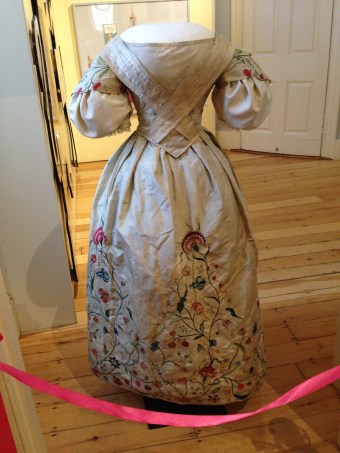
Colonial Wedding dress altered 1830

Elizabeth Bull Price’s Wedding Dress. Bostonian Society, 1910.50.35

On Tuesday evening, sensibility won over sense as my friend and I boarded the T for Boston to make a long day longer. The trip was worth it, though, for the One Night Only engagement of Elizabeth Bull’s wedding dress at the Bostonian Society. In truth, I bought the tickets for the event before I was even back at work and navigating our Fair City on my own– and who wouldn’t? That dress is amazing! (Tons more images of the embroidery are in the catalog record.)

Perhaps even more wonderful than the 14-year-old ElizabethBull’s needle skills is that the dress remains with us today. Kimberley Alexander and Tricia Gilrein reminded us on Tuesday of the many ways this dress, and other remnants of Bull’s wardrobe (oh, the petticoat, and the wonderful kerchief) connect us to the past in surprising ways. Elizabeth Bull was wealthy, married to Roger Bull, a Church of England official 22 years her senior: though they lived in Boston, they were British. (They were married in the 1730s, and Elizabeth died in 1780 at about 67.)

It’s a little hard to see past the 1830s alterations, but the embroidery of the gown helps chart that course, as well as the petticoat. As important to remember is that this wedding gown was not white: it has faded from a celadon green to its current off-white color. Wedding dresses weren’t white in the 18th century, or even long into the 19th, and it’s helpful to remember that as we look at what remains and reconstruct this in our mind’s eye.

It’s easy to forget we were British first here in the United States, and that the American War for Independence did not have a foregone conclusion. We forget, too, that churchmen and their wives were socialites as much as they were people of the cloth. Put Mr Collins out of your mind, and remember (my favorite minister & fashion maven) Reverend Enos Hitchcock and his pink satin waistcoat and suits of black silk.

Photograph of the altered gown. Bostonian Society, 1910.0050.057

Photograph of the altered gown. Bostonian Society, 1910.0050.057

Like many 18th century gowns, this one was remodeled in the 19th century, its shape altered to reflect the current fashion. We are lucky to have so much preserved, not just in the gown but also in the petticoat. Paths to understanding of women’s education, the customs and habits of Boston’s colonial elite, and the persistence of past can all be found within this object.


Share this:

  • Click to share on Facebook (Opens in new window) Facebook
  • Click to share on Pinterest (Opens in new window) Pinterest
  • Click to email a link to a friend (Opens in new window) Email
  • Click to share on X (Opens in new window) X
Like Loading...

Archives

wordpress statistics

Creative Commons License
Kitty Calash blog by Kirsten Hammerstrom is licensed under a Creative Commons Attribution-NonCommercial-ShareAlike 4.0 International License.

Website Built with WordPress.com.

  • Subscribe Subscribed
    • Kitty Calash
    • Join 621 other subscribers
    • Already have a WordPress.com account? Log in now.
    • Kitty Calash
    • Subscribe Subscribed
    • Sign up
    • Log in
    • Report this content
    • View site in Reader
    • Manage subscriptions
    • Collapse this bar
 

Loading Comments...
 

    %d