• Home
  • Completed Costumes/Impressions
  • Emma and Her Dresses
  • Free Patterns and Instructions

Kitty Calash

~ Confessions of a Known Bonnet-Wearer

Kitty Calash

Tag Archives: cleaning

Mopping Up Action

05 Tuesday Apr 2016

Posted by kittycalash in Events, History, Living History, Museums, Reenacting

≈ 4 Comments

Tags

18th century, authenticity, barracks, cleaning, common people, common soldier, interpretation, living history, women's history, women's work, work
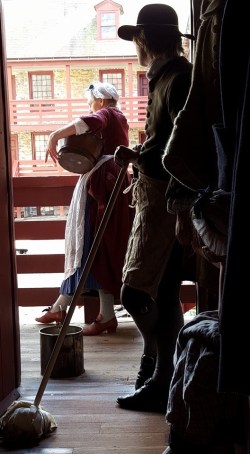
Photo by Asher Lurie

Photo by Asher Lurie

This past weekend, I took my show on the road down 95 to Trenton’s Old Barracks Museum, where once again, soldiers’ rooms needed cleaning. Hannah Glasse exhorts servants (housemaids and housekeepers) to clean household rooms daily, and I can tell you this: if you’re cleaning 18th century spaces using period techniques, daily is the way to go.

Unpaved streets and sidewalks meant people tracked significantly more mud and grit indoors, and soldiers would have brought the parade ground indoors every time they crossed a threshold. Not a pretty thing– and then there’s the straw mattresses (to be changed monthly at a minimum), wool uniforms, skin, hair, and vermin that could accumulate as well. Filth: a major contribution to ill health if not managed properly.
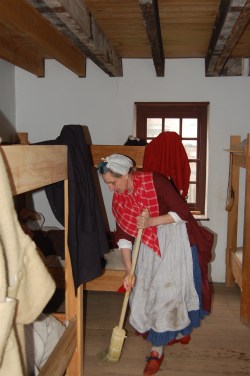
DSC_0348

Brandy-new broom sweeps clean. Photo by Drunk Tailor

Being possessed of a particularly detail-oriented mind, I went in search of a more 18th-century correct broom at an affordable price and found a broom enthusiast on Etsy who agreed to make and priority mail custom brooms just in time for the trip to New Jersey. On the whole, I’m very pleased with these. They make a satisfying sound as they move across the floor, and draw a fair quantity of dirt. Turns out that strewing wet sand on the floor before you sweep is remarkably effective and absolutely the way to go. The damp sand keeps the dust down and is swept out the door with the filth without harming the floor.
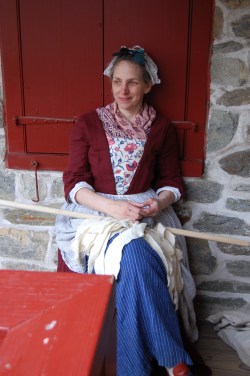
Mop making: surprisingly contemplative.

Mop making: surprisingly contemplative. Photo by Drunk Tailor

After sweeping, mopping. Once again, I used the lavender-infused vinegar in the mop water (though I forgot to strain the solution this time). The mixture has a unique but not unpleasant smell, and as the floors dry, the room retains the odor, a sure indication of cleanliness.

This weekend was also the first run for a new wool scrap mop, which was proven the best mop yet. Many thanks to my secret source for the contribution to the effort. It’s clear that mops could easily have been made by binding rag strips to pole handles, and whether made by poor house inmates or soldiers, mop making is cheap, low-tech busy work.

Share this:

  • Click to share on Facebook (Opens in new window) Facebook
  • Click to share on Pinterest (Opens in new window) Pinterest
  • Click to email a link to a friend (Opens in new window) Email
  • Click to share on X (Opens in new window) X
Like Loading...

Women’s Work

04 Monday Apr 2016

Posted by kittycalash in History, Living History

≈ 2 Comments

Tags

barracks, cleaning, history, interpretation, military events, women's history, women's work

Paul Sandby (1731-1809) A kitchen scene circa 1754 Pen and ink and watercolour | RCIN 914332

Paul Sandby. A kitchen scene circa 1754. pen and ink and watercolour | RCIN 914332

The irony is not lost on me: I do stereotypical women’s work as I struggle to bring a feminist interpretation to a traditionally male hobby: 18th century living history or reenacting.* Even as it irks me, I enjoy being busy and believe in the importance of the everyday, the mundane, the lulls. Life moves pretty fast, as the saying goes, and the moments when you think nothing’s happening are often the most important.

Everyday work is what most of us do, and most of us will be remembered not at large, like Abigail Adams, but writ small, like Bridget Connor. But we matter, and the roles we play and the work we do matters, too, to the people close to us, and the details of our lives– not just the mugs, chairs, and shoes, but the vacuum cleaners and the way we live our lives– would matter to us in two hundred years if we were recreating 2016. So why do we skip over the domestic details?

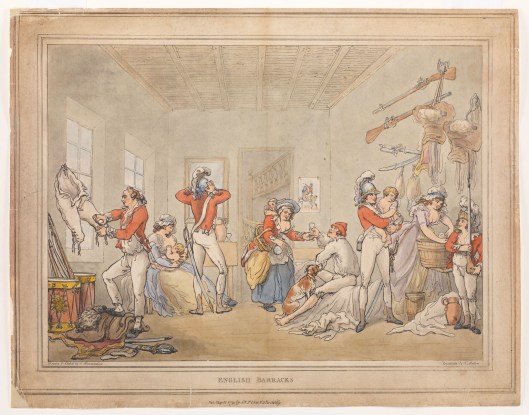
EnglishBarracks_Malton

English barracks/ drawn & etch’d by T. Rowlandson ; aquatinta by T. Malton. [London] : Pub. Aug. 12, 1791, by S.W. Fores, N. 3 Piccadilly. Lewis Walpole Collection

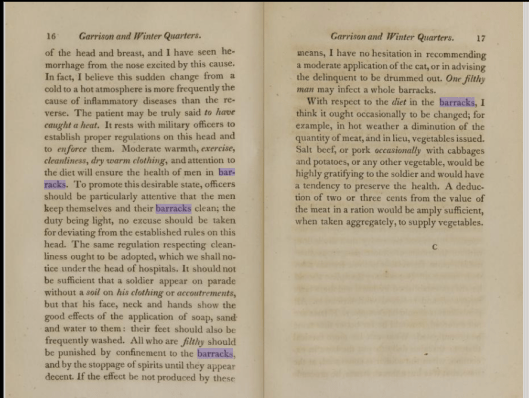
Look: if  mopping barracks is good enough for Kubrick, it’s good enough for me, especially when you consider that the military understood the importance of hygiene in the 18th century, and that there are multiple treatises to be found on the subject, freely available online. Keep them barracks clean.


Observations on the means of preserving the health of soldiers and sailors : and on the duties of the medical department of the Army and Navy

Observations on the means of preserving the health of soldiers and sailors : and on the duties of the medical department of the Army and Navy

So I clean barracks, as a means of bringing the everyday back to life, because daily life, even in the military, is in fact remarkably mundane and domestic, centered not around the glory of battles but around the minutia of cleaning barracks, washing clothes, and preparing food.

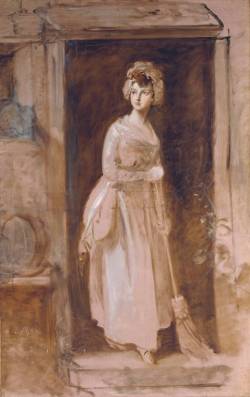
Thomas Gainsborough, The Housemaid. 1782-86. Tate Museum, Presented by Rosalind, Countess of Carlisle 1913, N02928

Thomas Gainsborough, The Housemaid. 1782-86. Tate Museum, Presented by Rosalind, Countess of Carlisle 1913, N02928

Is this also the feminization of masculine space? Perhaps it is, in the way that our culture associates indoor domestic tasks with women. Either way, maintaining hygiene and cleanliness within a military environment is  documentable in detail and a critical, if sometimes overlooked, area of interpretation.

* I use living history to describe the re-creation of daily life. Re-enacting or enacting [the past] is, I think, better used for events of either military or date-place-and-time specific historical commemorations.

Share this:

  • Click to share on Facebook (Opens in new window) Facebook
  • Click to share on Pinterest (Opens in new window) Pinterest
  • Click to email a link to a friend (Opens in new window) Email
  • Click to share on X (Opens in new window) X
Like Loading...

Flopsy Mopsy

16 Wednesday Mar 2016

Posted by kittycalash in Events, History, Living History, Making Things, Reenacting, Research

≈ 8 Comments

Tags

18th century, cleaning, common people, Fort Ticonderoga, interpretation, living history, mops, women's history, women's work

Mop sellers, red chalk on paper, Paul Sandy, 1759. Museum of London 65.59/5#sthash.EaUTT9dg.dpuf

Mop sellers, red chalk on paper, Paul Sandy, 1759. Museum of London 65.59/5

They’re pretty consistent: mops appear to be made of fibers attached to a handle. These look like they’re simple string mops. A stick and string? A stick and rags strips? Something along those lines. But what kind of string? What kind of fiber? How was it attached?

I’ll confess that I have been too lazy to search collection for extant mops– no, seriously, if someone offered me an 18th century mop my first reaction after “Absolutely!” would be, “Wait a second…how can there be anything left of an 18th century mop? My own mops don’t last all that long….” so I assumed no such critter exists in captivity (feel free to prove me wrong, I could use an assist here). Instead, I went ahead with the daft notion of replicating what I saw in images.

Sandby helpfully supplies us with mop sellers who carry fuzziness on a stick. Most likely wool, since sheep were plentiful and cotton expensive in this period. But maybe not. In any case, a simple business.

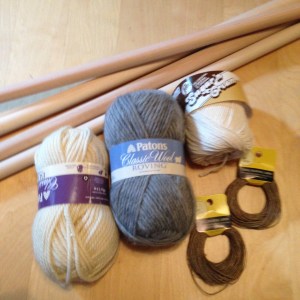
Supplies assembled

Supplies assembled

After work on Saturday, I went mop-top-shopping. It was not one stop. An internal rant developed about how companies can call anything “wool” that is less than 100% wool, but I managed to contain myself and with enough hunting turned up hero cord, 100% wool yarn and 100% cotton yarn as well as dowels. Sadly, I could not find wool roving in any color but grey. So, making a mop from craft and hardware store supplies is a pretty easy thing, especially when you don’t have many tools to complicate the business.

IMG_6275

This is not my first rodeo where string is concerned, so I wrapped the yarn around a cutting board just the way you’d make a pom pom. How else will you get it all the same length (more or less)? The result: a somewhat sad hank in search of purpose, tied off in the more-or-less middle of the strands.

Temporarily secured
Temporarily secured
Tied off with hemp cord

Secured temporarily with a rubber band, I tied the hank to the dowel with hemp cord. Then I turned the wool (and later cotton) back over itself, and tied it off again. I pulled as tight as I could manage, much to the chagrin of my now-blistered pinky finger. Small price to pay, though, for two new entrants in the experimental archaeology of cleaning. As I looked at the images in Sandby’s drawing and in the prints, I was pretty confident the mops are not tied off again in this second way, but one band didn’t seem secure enough. So, yet another compromise, but one that I hope will result in less hilarity from losing mop heads in the midst of washing floors.

Wool...
Wool…
...and cotton
…and cotton

Now, if I would but turn my attention to the lint, string, and yarn scattered about my floor at home…

Share this:

  • Click to share on Facebook (Opens in new window) Facebook
  • Click to share on Pinterest (Opens in new window) Pinterest
  • Click to email a link to a friend (Opens in new window) Email
  • Click to share on X (Opens in new window) X
Like Loading...

Mopping Up

14 Monday Mar 2016

Posted by kittycalash in Living History, Making Things, Research, Uncategorized

≈ 4 Comments

Tags

18th century, cleaning, common people, Fort Ticonderoga, interpretation, living history, mops, women's history, women's work

A City Shower. Oil on canvas by Edward Penny, 1764. Museum of London

A City Shower. Oil on canvas by Edward Penny, 1764. Museum of London

Springtime sadness is best remedied by scouring[1], so in the best Scandinavian fashion, I have been looking into 18th century cleaning. Dem barracks, right?

First of all, were you wondering about what exactly they “smoked and cleansed” smallpox victims’ rooms with? Brimstone and frankincense.[2] Now you know what Edward Langford would wake up smelling when the house next door was free of smallpox.

But what about those floors? They need to be cleaned. Swept, yes, and scrubbed with sand. But also mopped, and the doorstep mopped.

Tit for Tat. stipple etching, London, Printed for R. Sayer Map, Chart & Printseller N° 53 Fleet Street, as the Act directs Novr 24. 1786. British Museum 1861,0518.958

Tit for Tat. stipple etching, London, Printed for R. Sayer Map, Chart & Printseller N° 53 Fleet Street, as the Act directs Novr 24. 1786. British Museum 1861,0518.958

I have a broom and a whisk broom, and can substitute a kettle for my sad bucket[3] but I lack a suitable mop. Lack never deterred me, whether of skills, knowledge, or supplies, so off to the interwebs and library I went.

I started with Foul Bodies, the 2009 monograph by Kathleen M. Brown. Nothing on floors, sadly.

I remembered the 10th Massachusetts Orderly book from 1782, that was more helpful.

Some part of the Camp and about the long Barracks in particular is relaxing into nastiness. Regimental QuarterMasters have been ordered to have them Clean and keep them so. An Officer of each Company has been ordered to visit the Barracks every day and to Confine & Report those who throw bones of meat Pot Liquor or filth of any kind near the Barracks. Yet all this has been done and no report has been made. it is hatefull to General Howe to Reitterate orders as it ought to be shamefull those who make it necessary.

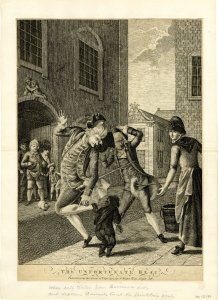
The Unfortunate Beau, etching, Publish'd as the Act directs 12th Sept 1772, by S.Hooper, No.25 Ludgate Hill. British Museum 1991,1214.20

The Unfortunate Beau, etching, Publish’d as the Act directs 12th Sept 1772, by S.Hooper, No.25 Ludgate Hill. British Museum 1991,1214.20

Nastiness. Those barracks sound noisome, don’t they? We can’t have that.

So let’s cast out the bones, sweep the floors of the branches and dirt and grit the men have brought in, and mop them, too, now that it’s spring.

Mop, you say?

What did mops look like the in 18th century?
And how on earth will we acquire one?

Tune in next time for another exciting installment of “historical cleaning instead of cleaning my own house.”


[1] Dude, I have scrubbed baseboards with a toothbrush. Not one of my finer moments, but a memorable one.

[2] Kathleen Brown, Foul Bodies: Cleanliness in Early America. (New Haven: 2009) p. 129

[3] Really really: I meant it when I said keep the bucket wet.

Share this:

  • Click to share on Facebook (Opens in new window) Facebook
  • Click to share on Pinterest (Opens in new window) Pinterest
  • Click to email a link to a friend (Opens in new window) Email
  • Click to share on X (Opens in new window) X
Like Loading...

Sweeping Clean

30 Saturday Nov 2013

Posted by kittycalash in Making Things, Reenacting

≈ 4 Comments

Tags

cleaning, Holidays, weekend

Sweeper 1746, Etching with some engraving Harris Brisbane Dick Fund, 1953 MMA 53.600.588(56)

This is how we’ve spent our time off: quite a bit of cooking, though I did much in advance (the oven is large enough to cook only a turkey and nothing else, at one time), and even more cleaning and clearing and rearranging. After all, my mother will arrive in three weeks, which is not very much time at all when you have working weekends along the way.

with any luck, there will be a tidied up office/ironing room in which I could sew out of the way of certain felines, but at this point I’d settle for folded laundry and calmer cats. They remain convinced that cleaning is an exercise in cat assassination, though they can offer no proof that any cats have ever succumbed to death by vacuum cleaner.

Servant Girl Plucking a Chicken
Follower of Nicolas Bernard Lépicié, French, 1735–1784
MFA Boston, 65.2650

Living history, reenacting, historic costuming: whatever you want to call what we do most weekends, it runs to a lot of gear, in the end. The year we took my mother to Fort Lee, she remarked on how much baggage we had. “You’ve got lives in two centuries,” she said, and it’ true. We just about do. So how to store all that stuff, while making more and improving what you do have, is a challenge. Most reenactors I know have somewhat cluttered houses, or at the least houses where the historical items are integral to the decor. That is probably the most rational tactic, since most of us love what we do and enjoy how chairs or mugs remind us of fun, if challenging, weekends.

We have tried to be ruthless this weekend chez Calash, channeling deaccession rules (duplicate? unrelated? irrelevant? away it goes!) and hoping that when we are done we will have only what is necessary, useful, and beautiful. Or, at the least, a clean house to survive my mother’s eye.

Share this:

  • Click to share on Facebook (Opens in new window) Facebook
  • Click to share on Pinterest (Opens in new window) Pinterest
  • Click to email a link to a friend (Opens in new window) Email
  • Click to share on X (Opens in new window) X
Like Loading...
← Older posts
Newer posts →

Archives

wordpress statistics

Creative Commons License
Kitty Calash blog by Kirsten Hammerstrom is licensed under a Creative Commons Attribution-NonCommercial-ShareAlike 4.0 International License.

Website Built with WordPress.com.

  • Subscribe Subscribed
    • Kitty Calash
    • Join 621 other subscribers
    • Already have a WordPress.com account? Log in now.
    • Kitty Calash
    • Subscribe Subscribed
    • Sign up
    • Log in
    • Report this content
    • View site in Reader
    • Manage subscriptions
    • Collapse this bar
 

Loading Comments...
 

    %d