• Home
  • Completed Costumes/Impressions
  • Emma and Her Dresses
  • Free Patterns and Instructions

Kitty Calash

~ Confessions of a Known Bonnet-Wearer

Kitty Calash

Tag Archives: common dress

Floral Arrangements

28 Friday Jun 2013

Posted by kittycalash in Clothing, Living History, Making Things

≈ 9 Comments

Tags

18th century clothes, common dress, fashion, hats, silly cat photos, style

By popular request, flowers.

The pieced lining. Click for larger versions.

I debated with myself about whether or not it was OK to piece the lining, and then I figured that it was what I had, so I would make do. It was a hot mess, all freehand, and I was convinced of total failure until I started stitching the lining down just over the millinery wire. Then the shape began to pull tightly and behave better. If I were to do this again, and if I were to make recommendations to another hat fiend, here’s are two changes I’d suggest:

1. Make an actual tidy pattern of your hat circle on a large piece of paper (newspaper, wrapping paper, whatever).

2. Trim and tidy edges so you are piecing straight, radial lines and not curves or tangents; better yet, buy a new remnant and don’t piece. I was too afraid of ‘wasting’ my scraps, so I pieced on the tangent. It’s OK, but I could have made this a bit easier for myself.

Happy birthday, Mr S!

Beyond those minor points, this is easy; piecing and fitting on the fly got a little wonky. Also, though your mileage may vary, 4:00 AM may not be the best time to start new projects. Wait till 5:00, when your coffee has kicked in.

We had real, not printed fabric, flowers in the house on Tuesday, which was Mr S’s birthday. I chose peonies because they looked so Dutch, though you cannot see the little variegated petals here.

Kitty wishes to know if you are getting all your leafy greens, because he is.

Flowers for dessert.

Share this:

  • Share on Facebook (Opens in new window) Facebook
  • Share on Pinterest (Opens in new window) Pinterest
  • Email a link to a friend (Opens in new window) Email
  • Share on X (Opens in new window) X
Like Loading...

Weekend Update

24 Monday Jun 2013

Posted by kittycalash in 1763 Project

≈ 1 Comment

Tags

10th Massachusetts, 18th century, 18th century clothes, authenticity, common dress, Events, living history, Reenacting, Thomas Marshall's Boston Militia

Not the best weekend, but not the worst. Let’s start with the best parts, and perhaps the worst will be forgotten.

Drilling, 1758 style, at MMNHP

We went up to Minute Man on Saturday for the first of two rounds of early-period drilling for the 1763 event which will feature Marshall’s company of militia. One highway closing and a lack of period clothing later, we arrived. There was crossness, mostly occasioned by the closing of 95 northbound at Pawtucket, as we do not like to be late.

This early drill is pretty interesting, especially compared to von Steuben’s manual, developed nearly 20 years later. The early manual is almost baroque, and seems full of superfluous movements, described with superfluous words. In some ways, it reminds me of Morris Lapidus: Too much is never enough.

I sat under a tree and watched while re-pinning and re-basting Mr S’s bloody overalls, which must be done one week from Thursday, ready to be put on for a 7:30 AM departure for a parade on the North Shore, with a step off at 9:30. DC appeared, watched me sew, watched the drilling, got anxious as he always does, but was favored with the present of a rope work dice cup from one of the older members of the regiment. It’s a small kind of acceptance ceremony he performs.

Mariner’s cuff, adapted from a Costume Close Up coat.

After struggling with the utilitarian overalls, I felt the need for a more artistic pursuit. The horrid green frock coat seemed less horrid after staring at what was on display, so I brought it ought and made Mr S try it on all over again. It will still need altering to fit properly, but I think I can manage that better than I can making it into a waistcoat and making a new, proper frock coat. (Though I have some lovely wool, and a plan to have him turn out in that for next year’s Battle Road.)

With stripey-lined flap.

I found more green linen scraps in my stash, and then it dawned on me: If you haven’t got width, go vertical. With Koshka’s tutorial onscreen and Costume Close Up, I fiddled around with the scraps on Sunday morning, and came up with a mariner’s cuff adaptation. At this point, I figure this is a test garment, and whatever mistakes I make will turn out better on a broadcloth coat, and all buttons are recyclable. It’s a bit of a lie, this coat, since it’s got to be 1775 in July and 1763 in August. For a one-off event, it’s madness to make a totally correct outfit when I haven’t got exactly what is wanted for July. That short wool coat will be murder in August– so wonky cuffs and alterations it is.

The Young Mr might get a blue linen unlined short jacket: I have proven I can make those, there’s one in a Sandby drawing from 1759, and though I dearly want to make him a short, laborer’s coat in brown camblet with a red lining, I haven’t got a suitable pattern yet. With a 34 inch chest, he’s a tough one to fit.

Share this:

  • Share on Facebook (Opens in new window) Facebook
  • Share on Pinterest (Opens in new window) Pinterest
  • Email a link to a friend (Opens in new window) Email
  • Share on X (Opens in new window) X
Like Loading...

Citizens of Boston

21 Friday Jun 2013

Posted by kittycalash in 1763 Project, Events, Living History, Research

≈ 2 Comments

Tags

1763, 18th century clothes, Boston, Clothing, common dress, living history, Peace of Paris, Reenacting, Research, Seven Years War

John Collet, May Morning, 1761-1770. Museum of London

John Collet, May Morning, 1761-1770. Museum of London

I find myself involved in an event scheduled for August 10 in Boston, though I know this could go awry because I worked for a number of years with DC, the organizer of this extravaganza. He’s got a style all his own, and for a taste of the madness, you can see him here (~5:26) with unmistakable and inimitable mannerisms, at Louisbourg.

While the Adjutant is arranging and training the militia, the event still needs civilians, and as the interpretive consultant, my task is to create the context of the day and hammer into DC’s head that when organizing something like this, you can hardly over-communicate, though having been on the receiving end of his phone calls, actually, you can… but that’s where I come in with the editor’s sharpened pencil and cut, cut, cut.

Mr S has signed right up for this event, though he lacks suitable garb, and thus it will soon be time to break out the wool broadcloth. I really liked Sharon’s waistcoat-conversion suggestion, and happily Wm Booth had a lovely dark-green wool remnant of just enough yardage for a skinny man’s frock coat that very morning. Add the brass buttons in the stash, and I thought we were off and headed for 1770 with a regression to 1763.

Except… in doing more looking at 1760/1763 images, I began to wonder if it was better to beat the green linen into an earlier coat, consider it a lesson learned, and move on, since it is only a one-day event. (I saw some small remnants of that same green linen in the Adjutant’s stash, and perhaps I can get them for cuffs.)

My logic is this: it can be tricky to walk a coat backwards in time, especially in sleeve width, and Mr S is in serious need and want of a lovely coat for Battle Road. (Except yes, heh heh, he needs it by July 14 for an event at Washington’s HQ in Cambridge. There’s not even time for gnashing of teeth!) I don’t think it means more sewing, really, it only means penance with alterations and begging for fabric scraps. It also mean focusing, and letting the Monmouth-acquired cuts on my fingertips heal.

John Collet, Scene in a London Street, 1770. YCBA, B1981.25.110

Mr S will be just one of a number of men who will be militia in the morning and civilians in the afternoon. In thinking about the Boston street of 1763, I’m reading the Boston Gazette and Country Journal (which DC had not done beyond the main articles…) and looking at images from London. Maybe the scene won’t be as chaotic, since it is a happy celebration, but it needs to be busy, and populated with men, women, and children of various ages, races, and class levels. There’s a nice way to search for “street” at the Yale Center for British Art, and you get a sense of the crowds and busy-ness of the 18th century street.

To that end, I have asked my silk-gown friends, and I plan to be the cherry seller. (I should so like to have that done by Sturbridge to acquire some patina, but doubt I shall.) For the Young Mr, I see runaway apprentices as a possibility. In the Boston Gazette of August 8, 1763, There is a 16 year old mulatto fellow, “large of his age,” who had on “a brown camblet coat with red lining, a white linnen and a mixt colour’d flannel vest” as well as a blue great coat with yellow metal buttons and leather breeches. There won’t be leather breeches by August, but a camblet coat lined in red may be possible.

Share this:

  • Share on Facebook (Opens in new window) Facebook
  • Share on Pinterest (Opens in new window) Pinterest
  • Email a link to a friend (Opens in new window) Email
  • Share on X (Opens in new window) X
Like Loading...

To Wash or Not to Wash

20 Thursday Jun 2013

Posted by kittycalash in Clothing, Events, Living History, Reenacting

≈ 2 Comments

Tags

18th century clothes, Clothing, common dress, laundry, Reenacting, Revolutionary War

Mr S and his waistcoat at Monmouth

Mr S and his waistcoat at Monmouth

Sometimes I can almost hear, “Good God woman, what are you thinking?!” but so far I have only seen it in a man’s eyes. This is usually in regard to laundry.

I erred once in asking if one wanted his hunting shirt laundered, and I had planned only on cold water and hand washing, as the item seemed a bit crunchy and crumpled to my eye and hand. But, no, some other woman had washed that shirt some time ago, and it had taken considerable time—years—to reestablish fringe from fluff.

Well patinated now, formerly embarrassingly white.

Now, I give you Mr S’s waistcoat and overalls. Mr S’s waistcoat was completed on the New Jersey Turnpike in November 2011 while headed to Fort Lee. Since then, it has a acquired a smattering of powder specks, a patina of grunge, a stain or two of greasy beaver (curry, actually) and, most recently, spots of toothpaste. This is where I draw the line: the toothpaste spots must go, as they are inauthentic.

Shirts, shifts, stockings, aprons, and waistcoat

One doesn’t want one’s clothes too clean for reenactments or living history events: you’re “living” in the pre-detergent era, but that doesn’t mean you should never wash your clothes. We know that the armies employed women to wash clothing, and we know that linens–shirts, shifts, and drawers–were washed more frequently than outerwear like breeches, waistcoats, and gowns. It’s not so different from today, when we don’t clean business suits as often as we launder shirts or underwear. Still, we do clean our clothes, and there comes a point when those overalls will get washed. Right about when you figure you need gloves to handle them…

Share this:

  • Share on Facebook (Opens in new window) Facebook
  • Share on Pinterest (Opens in new window) Pinterest
  • Email a link to a friend (Opens in new window) Email
  • Share on X (Opens in new window) X
Like Loading...

Frivolity

29 Wednesday May 2013

Posted by kittycalash in Clothing, Making Things

≈ 5 Comments

Tags

18th century clothes, chintz, Clothing, common dress, fashion, jacket, Revolutionary War, sewing, strategic fabric reserve

chintz jacket

Detail, back neck and neckhandkerchief

Well, not all that frivolous, but pretty frivolous for someone who has been doubled down on a uniform production and class prep.

The remnant of chintz has turned into a nearly finished jacket, which is good. All that remains to do is the hem, and once the lining has been trimmed that shouldn’t be too hard. The pattern is an adaptation of the JP Ryan jacket pattern, with sleeve and length adjustments. It’s plain enough to pass, and with a striped “lincey” petticoat, will answer for New York-New Jersey servant wear. I have my eye on Monmouth.

checked linen bagAlso for Monmouth, the first of two checked linen bags. Small enough for toothbrush, comb, and other toiletries necessary in this century but out of place in 1778, these bags should help make camp packing lighter weight and more authentic. Hope so anyway, or what’s that backstitching and overcasting for, fun?

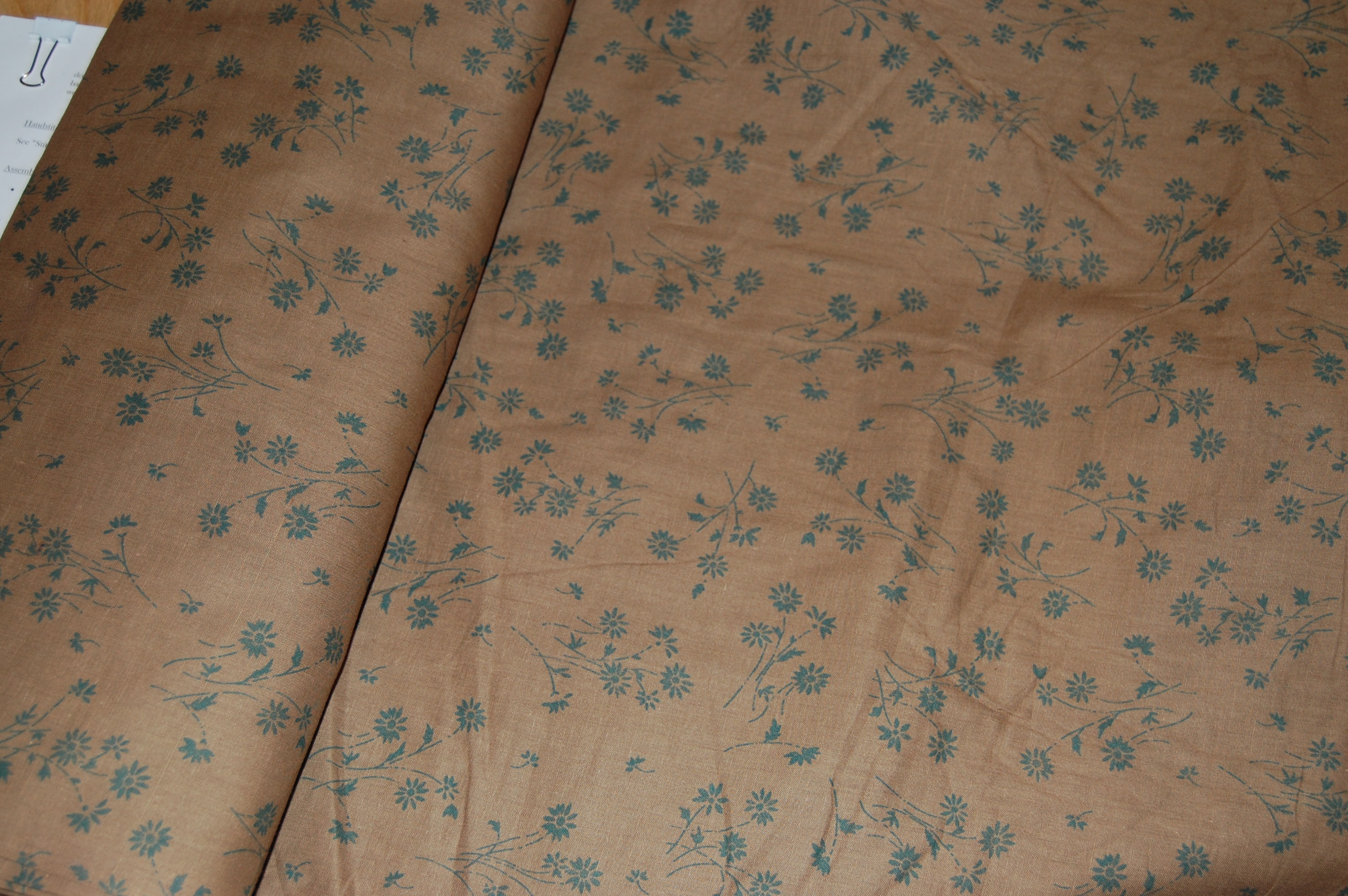
JoAnn Cotton fabric.

I watched it for six months.

And, finally, on a whimsical trip to Jo-Ann for plastic drawers, the remnant table was half off. The fabric I’ve been watching since it was $7/yard was $1.50 a yard. I got all 8 yards for $12. I see a dress of some kind in this fabric, though it will require caution to wear. 100% cotton, this will burn. Which century or decade? Not sure yet. But I like it, and that’s enough to start with, when you’re feeling frivolous. (And yes, I did read that article in the Times about hoarding, but this is Strategic Fabric Reserve purchasing, not hoarding.)

Share this:

  • Share on Facebook (Opens in new window) Facebook
  • Share on Pinterest (Opens in new window) Pinterest
  • Email a link to a friend (Opens in new window) Email
  • Share on X (Opens in new window) X
Like Loading...
← Older posts
Newer posts →

Archives

wordpress statistics

Creative Commons License
Kitty Calash blog by Kirsten Hammerstrom is licensed under a Creative Commons Attribution-NonCommercial-ShareAlike 4.0 International License.

Website Built with WordPress.com.

  • Subscribe Subscribed
    • Kitty Calash
    • Join 621 other subscribers
    • Already have a WordPress.com account? Log in now.
    • Kitty Calash
    • Subscribe Subscribed
    • Sign up
    • Log in
    • Report this content
    • View site in Reader
    • Manage subscriptions
    • Collapse this bar
 

Loading Comments...
 

    %d