• Home
  • Completed Costumes/Impressions
  • Emma and Her Dresses
  • Free Patterns and Instructions

Kitty Calash

~ Confessions of a Known Bonnet-Wearer

Kitty Calash

Tag Archives: common soldier

The View from Ft Lee

25 Monday Nov 2013

Posted by kittycalash in Events, Living History, Reenacting

≈ 2 Comments

Tags

10th Massachusetts, 2nd Rhode Island, Brigade of the American Revolution, common soldier, Events, Reenacting, Revolutionary War, The Public

To the South.

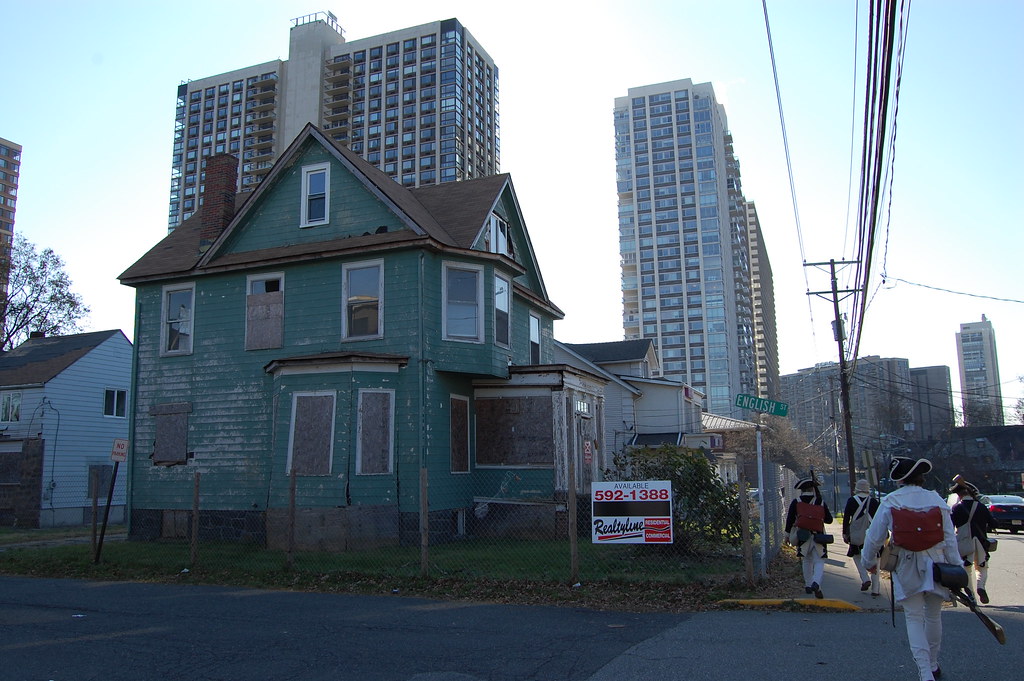
Silver and shimmering, there’s Manhattan Island: you can hear the train whistles from the New Jersey shore, this century always intruding on the past. To be honest, this event makes me as nuts as it makes me happy (the 32 pound gun did, finally, go off after four tries). There’s something slap-dash about it, this last event of the season (or the first of next, as the BAR commander would have it). The range and quality of impressions is astonishing but it’s a small, manageable event that’s good for trying things out, and for first-time-users.

Which could bring me to the highlight of the day for someone close to me, but suffice it to say that what happens in the blockhouse stays in the blockhouse and I haven’t seen a particular teenage boy that excited, like, ever. He stayed excited, too, until he finally fell asleep somewhere on I-95 northbound.

Mourn Arms at the end of the Day.

I like the predictable ritual of Fort Lee: it’s always cold, the sun fades around noon and the light is always pale by the afternoon, the guns are always fired, and the blockhouse is always lost. There’s a ceremony up in the town and the square always smells delicious, the kettles are always full of mysterious stew with some charcoal bits mixed in and the kid always has three bowls full.

There are always a lot of photographers stalking the ‘wily and elusive reenactor’ at this event; there’s a Fort Lee photo club and they come every year. Unlike Tower Park, there’s no touching, just long-lens stalking. It’s a little weird and I try not to laugh but the lengths they go to do are funny, somehow, though it’s just someone else’s hobby and obsession.

The comments in the public are always revealing. This year’s prize goes the gentleman who told his son muskets are slow to fire and hard to use because they’re breech loading. I think few people have much experience with the physical world, and we would be well-rewarded for spending some time thinking about larger themes in our interpretations, as I’m not convinced people come with much context for what they’re told or what they see.

The Four in Brown, portraying Colonel Moses Little’s 12th Continental Regiment.

Mr S could not remember the name of the regiment they were portraying when I asked him to remind me: the best he could do was “Colonel Sanders’ Regiment,” which was thankfully taken in good spirits when confessed, but you have to know that a man who has managed to get potato on his hat is, well, let’s call it befuddled with hunger. We were probably all a little punchy with cold when the conversation turned to the overheard remark that there would be parakeet [parapet] firing. I asked how many parakeets it took for a four pound gun: four. And then we were off on a flight of fancy noting that loading the guns with the birds would clean the barrels on the way down, and that a parrot, beak forward and in flight, had a fine and aerodynamic profile, but it is damned hard to load the birds tail-first. [Insert squawking noises and some broadcloth-sleeved arm flapping.] After this, we had a demonstration of a simple rapid-fire musket exchange principle which I believe may have been employed to some good effect in the blockhouse.

On the way down, we had spotted a woman driving with a small parrot on her shoulder, loose in her small car, with a cage in the back, so the day really began on a parrot and parakeet theme, though the Free Men of the Sea were parading in Plymouth. All in all, a very typical, slightly surreal Fort Lee.

Share this:

  • Share on Facebook (Opens in new window) Facebook
  • Share on Pinterest (Opens in new window) Pinterest
  • Email a link to a friend (Opens in new window) Email
  • Share on X (Opens in new window) X
Like Loading...

Headed for the Hudson

22 Friday Nov 2013

Posted by kittycalash in Events, Reenacting

≈ Comments Off on Headed for the Hudson

Tags

10th Massachusetts, 2nd Rhode Island, authenticity, Brigade of the American Revolution, common soldier, Fort Lee, living history, Reenacting, Revolutionary War

Fort Lee: It’s a mixed bag.

Fort Lee is a mixed bag: the site is very urban, authenticity levels vary, the activities sometimes get off schedule, and I don’t think anyone knows for certain what goes into the stew pot. Still, it’s an easy there-and-back dash, and all of us are going now that Sunday’s swim meet is cancelled.

After all, the Young Mr has an agenda. After being told at the Fort that “they didn’t have grapeshot then,” we found a reference in the Jeremiah Greenman diary to grapeshot being fired on the Continental troops at Fort Mifflin in 1777. He’s fastened on this and looks forward to moving that conversation forward…

And I’m just happy to have a day outside to look forward to. It’s a little dull without a fire and tent, but the event has its quirky charms, and I can always bring a book or work on shirts.

Share this:

  • Share on Facebook (Opens in new window) Facebook
  • Share on Pinterest (Opens in new window) Pinterest
  • Email a link to a friend (Opens in new window) Email
  • Share on X (Opens in new window) X
Like Loading...

How many men and a tub?

16 Saturday Nov 2013

Posted by kittycalash in Laundry, Living History, Research

≈ Comments Off on How many men and a tub?

Tags

10th Massachusetts, 18th century, 18th century clothes, authenticity, common people, common soldier, laundry, living history, washing

The Laundry
Louis-Adolphe Humbert de Molard (French, Paris 1800–1874)
1840s, Salted paper print Credit Line: Gilman Collection, Purchase, Ann Tenenbaum and Thomas H. Lee Gift, 2005
2005.100.1241

How many men does it take to know what kind of wood a laundry tub should be made of?
For now, one woman. Yes, I’ve got a new obsession.

It started innocently enough with an exchange about future laundry tubs and an existing tub described as large, made of pine, and badly shrunken. Somehow I found myself burning to know, What is the appropriate wood for a laundry tub made in southeastern New England between 1775 and 1785?

Luckily I work in the kind of place where you might find an answer to that kind of question. In the Miscellaneous Manuscripts Collection, I found George Dods Cooper Accounts (MSS 9001-D Box 4). Mr Dod worked as a cooper in Providence between about 1790 and 1820, so he’s later than I need for this specific application, but I’m not sure the form changes radically before 1850, so Mr Dods seemed like a good place to begin.

While I did not find the hoped-for a receipt for purchases of specific kinds of wood, I did find that Dods was coopering with both iron and wooden hoops, and that he was making barrels, tubs and buckets of unspecified kinds of wood as well as cedar tubs.

1813 Mr Holroid
Nov 19
Sating 4 iron hoops on a Poudering Tub 0=6 0
Sating 6 Wooden Do- on another – Do- 0=3 0

1810
Oct 3 Satting 3 hoops on a large cedar tub 1 firking hoop 0=1-6

1813
July 6 Sating 2 hoops on a Cedar tub 0=1-0

–George Dods Papers, MSS 9001-D Box 4, Folder 2, RIHS Library.

Poudering or powdering tubs were used for salting meat; satting is how Mr Dods spelled setting, and the firking is a firkin. His spelling was idiosyncratic but consistent.

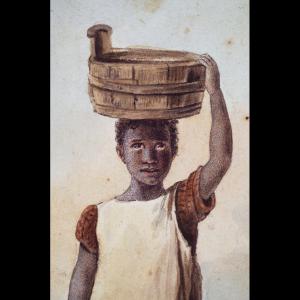
Enslaved Girl 1830 Origin: America, Virginia, Arlington County Primary Support: 6 x 4 1/8in. (15.2 x 10.5cm) Watercolor, pencil, and ink on wove paper Museum Purchase Acc. No. 2007-34,1

Enslaved Girl, 1830
America, Virginia, Arlington County
Watercolor, pencil, and ink on wove paper
Museum Purchase Acc. No. 2007-34,1

So, 1813: a cedar tub. But was it for laundry? I found well buckets and house buckets, ‘poudering’ tubs and pounding barrels, barrels for meat and rum and ‘flower,’ cedar tubs and a ‘tub for Cora,’ but no tub specifically described as a laundry, washing or dish tub.

Searching local library and special collections databases using the appropriate Library of Congress subject terms proved fruitless as well, though eventually I ended up at Williamsburg, where I found an 1830 watercolor drawing of an enslaved girl with a tub on her head. (They call it a tub; you and I might call it a piggin.) This at least confirmed the persistence of the tub style seen in the 1785 British Encampment drawing. I suppose that’s something.

Domestic Engineering and the Journal of Mechanical Contracting, Vol. LX No. 6, page 160. 1912

But still, questions persisted: first, what wood would be right, and secondly, what size should the tub be? There was the thought that pine might not be right, since reputable coopers are making tubs from oak and cedar. Finally did what most of us do when frustrated now: I did a very simple Google search and ended up at Google Books with Domestic Engineering and the Journal of Mechanical Contracting, Volume 60. 

This journal helpfully informed me that Wooden tubs are made out of 1- 1/4 inch white pine grained or dovetailed together at the ends and held together by means of iron rods and went on to explain that Great latitude was generally allowed in the making of wooden tubs as they were usually made on the premises by the carpenter who had no standards to follow. No standards! Doesn’t that explain a lot.

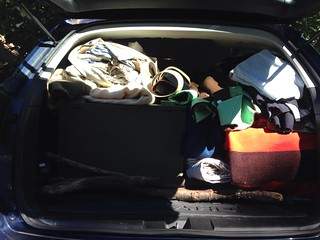
Fully loaded for Saratoga

Do I have any clearer direction? Well, clear as mud, maybe. It appears that one could have a tub of unspecified wood, hooped with wood or metal, in which one could do laundry. Or one could follow Domestic Engineering, and consider the current pine tub acceptable, if perhaps in need of mending. (I have not seen it, so I do not know.) I suppose the question is really whether or not all of this business will fit into the supply wagon known as our Subaru.

Share this:

  • Share on Facebook (Opens in new window) Facebook
  • Share on Pinterest (Opens in new window) Pinterest
  • Email a link to a friend (Opens in new window) Email
  • Share on X (Opens in new window) X
Like Loading...

Laundry!

12 Tuesday Nov 2013

Posted by kittycalash in Events, Living History, Reenacting, Research

≈ 2 Comments

Tags

10th Massachusetts, 18th century, 18th century clothes, authenticity, Clothing, common soldier, laundry, Research, washing

James Malton, 1761-1803, A Military Encampment in Hyde Park, 1785, Watercolor with pen in black ink, with traces of graphite on moderately thick, moderately textured, beige, laid paper, Yale Center for British Art, Paul Mellon Collection

James Malton, 1761-1803, A Military Encampment in Hyde Park, 1785, Watercolor with pen in black ink, with traces of graphite on moderately thick, moderately textured, beige, laid paper, Yale Center for British Art, Paul Mellon Collection

I’ve been thinking about laundry, and not just because I did wash yesterday, but also because I’m committed now to learning more about the women of the 10th Massachusetts (dude, it’s on paper). Since I won’t be able to get up to the Mass Archives or MHS until the holiday break, one place I can start is with the material culture of army women’s lives. This is also helpful as I am thinking about asking for a laundry tub for Christmas. (I had an aunt who got a toilet seat for Mother’s Day, and my husband once gave his siblings fire extinguishers for Christmas, so you cannot deny that we have a proud history of gift-giving.)

There’s a lot to love in the detail above, and while there are some things I don’t think you’d find in the 10th Mass camp — from red coats to chairs, even broken–we can still find useful information. After all, if your chair is broken, you have more of a leg to stand on for having a chair.

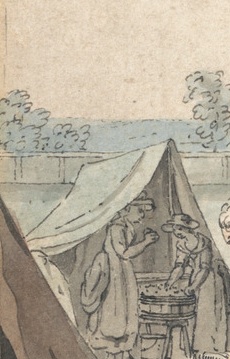
The buckets and washtubs have wooden hoops: that’s a fine detail, and one I appreciate, with my very particular bucket. That means, though, that the washtubs I have in mind might not work, as they have metal bands. My bucket man took a long time to get my bucket right, and he doesn’t make washtubs…but maybe the local man would consider trying a smaller tub. Hard to know, but size will be an issue. It appears there may be two sizes of tub in the image above: a larger tub on the makeshift table at left, and a smaller one on the broken chair.

Detail, James Malton, 1761-1803, A Military Encampment in Hyde Park, 1785, Watercolor with pen in black ink, with traces of graphite on moderately thick, moderately textured, beige, laid paper, Yale Center for British Art, Paul Mellon Collection

Detail, James Malton, 1761-1803, A Military Encampment in Hyde Park, 1785, Watercolor with pen in black ink, with traces of graphite on moderately thick, moderately textured, beige, laid paper, Yale Center for British Art, Paul Mellon Collection

The improvised clothesline is a reassuring detail, being pretty much what I have in mind for our camps, pending some riverbank logging. These taller sticks would then join our kettle or musket-rack sticks as part of the permanent equipage carried by the Subaru baggage train.

We’d been talking about doing a cold wash at work, where a friend was advocating NOT digging a pit and boiling laundry on the lawn, so these washing women intrigued me: none of them are boiling clothes. In fact, there’s no fire to be seen! But look again at where those kettles are. In the detail above and again at left, note a large kettle adjacent to every washtub. Could it be that water was boiled in a larger (enormous) kettle, and dipped into these smaller kettles? The other thing to note is that this seems to be family-based washing  and not regimental-scale washing. Given that I’d probably only have two shifts and four shirts to wash on a good day (they’re wearing their shirts, you see), could this model work?

None of the reenactments we see achieve anything like the scale of the events or activities we’re trying to recreate. Very few of us can cook with five pounds of flour, and there are never enough guys to make up a full brigade in the field. Those truths don’t mean we should skimp or cut corners, but they do mean that we should cut our coat to our cloth. Smaller scale washing could still convey the hassle, necessity, and gender division of the work.

Share this:

  • Share on Facebook (Opens in new window) Facebook
  • Share on Pinterest (Opens in new window) Pinterest
  • Email a link to a friend (Opens in new window) Email
  • Share on X (Opens in new window) X
Like Loading...

Longbourn: Book Review

19 Saturday Oct 2013

Posted by kittycalash in Book Review, Literature

≈ 6 Comments

Tags

18th century, book review, common dress, common people, common soldier, literature, servant girls, servants

The Chocolate Girl is adapted for the cover of Jo Baker’s new book

 On Sunday, I read the NYT review of Jo Baker’s new book, Longbourn. As soon as I finished the review, I ordered the book, which arrived Wednesday evening. By 2:00 AM Thursday, I had finished it.

I like Austen, but my favorite Austen novel is Mansfield Park, not Pride & Prejudice. The BBC and other adaptations sometimes make the world of her novels seem too cloistered, too precious, and too refined to me. (Mrs Hurst Dancing can be a helpful corrective.) So of course I was captivated by the premise of Longbourn: “The world of the people who laid the fires, cooked the meals and fetched the horses for Jane Austen’s Bennet family.”

The story was engaging–heck, I stayed up until 2:00AM  to find out how it ended–and while I found it slightly romantic for my taste, on the whole, the world was believable.

For one thing, there is plenty of mud. And Sarah the housemaid must clean the mud off the Bennett girls’ petticoats. The hauling of water, laying of fires, and the chill and exhaustion the maids feel is pretty well rendered. Baker addresses the question I’ve always had, How did servants tolerate servitude? by portraying Sarah’s struggle with resentment and resignation to her lot.

I thought, too, that the way Baker described women as “breeding” was also good; she referred as well to Elizabeth Bennett’s “dark, musky” armpits, and that seemed a nice way to slip in historical hygiene information. But women in English gentry were valued for their breeding capabilities: the need for a male heir didn’t die with Henry VIII, and it is much of what drives, or drove, the plot of Downton Abbey. For women, the past was a smaller world, and Sarah’s life is particularly small. Her carriage rides help define the very real confinement of her world.

There are a few slips: backpack instead of knapsack once or twice, but not many. It feels well-researched, well imagined, and believable. I don’t want to wreck it for you, so I won’t go into too much…there are some classic plot twists and devices that I put up with because they’re so typical of the literature of the period. I particularly enjoyed that Sarah reads from Mr Bennett’s library, including Pamela. It was a nice way to reinforce Wickham’s creepiness, and the echoes between the novel derived from a novel, in which  fictional characters read real novels, delighted me. (Being a fictional character myself.)

Jo Baker’s not Hilary Mantel-– this isn’t the kind of writing where the language stops you cold and sentences leave you breathless with awe, but for historical fiction derived from Jane Austen, Baker’s book is excellent and well-written.

Share this:

  • Share on Facebook (Opens in new window) Facebook
  • Share on Pinterest (Opens in new window) Pinterest
  • Email a link to a friend (Opens in new window) Email
  • Share on X (Opens in new window) X
Like Loading...
← Older posts
Newer posts →

Archives

wordpress statistics

Creative Commons License
Kitty Calash blog by Kirsten Hammerstrom is licensed under a Creative Commons Attribution-NonCommercial-ShareAlike 4.0 International License.

Website Built with WordPress.com.

  • Subscribe Subscribed
    • Kitty Calash
    • Join 621 other subscribers
    • Already have a WordPress.com account? Log in now.
    • Kitty Calash
    • Subscribe Subscribed
    • Sign up
    • Log in
    • Report this content
    • View site in Reader
    • Manage subscriptions
    • Collapse this bar
 

Loading Comments...
 

    %d