• Home
  • Completed Costumes/Impressions
  • Emma and Her Dresses
  • Free Patterns and Instructions

Kitty Calash

~ Confessions of a Known Bonnet-Wearer

Kitty Calash

Tag Archives: Costume

The Difference is…

28 Friday Feb 2014

Posted by kittycalash in Art Rant, Clothing, Museums

≈ Comments Off on The Difference is…

Tags

18th century clothes, authenticity, collections management, Costume, fashion, fashion plates, museum collections, Museums, sewing, style

I make this look good.

Robe à la Polonaise ca. 1775 British silk Length at CB: 56 in. (142.2 cm) Purchase, Judith and Gerson Leiber Fund, 1981 MMA 1981.314.1

Scrolling through Pinterest lately, I was struck by how different two presentations can make one gown look.

Above, a lovely Ikat-type silk gown with en fourreau back and trim, center front closing and probably a little closer to 1778 or 1780 than 1775.

It’s presented on a mannequin that supports the gown for photography and allows us to see it clearly, from the trim at the neck to the pleats down the back and the pleasant fullness of the skirt.

The gown is shown, we get the details.

And then, in another image, another view.

Robe à la Polonaise ca. 1775 British silk Length at CB: 56 in. Purchase, Judith and Gerson Leiber Fund, 1981 MMA 1981.314.1

In this image, the gown (and its companion) have been styled and accessorized, fichus, hats, ribbons, sashes. The skirt is more fully and completely supported, showing off the silk to even better effect. We lose the trim and pleating details, but the gown is much more attractive in this view.

This is not meant to criticize the images or the handling of the costumes, but to point out that you have to look past the plain record shots in museum databases, and see the gown as it would have been worn. Working with database images, and re-creating garments from those images, requires a leap of imagination.

The more you look (at database photos, exhibition photos, extant garments, fashion plates, other re-creations) the better you will be able to imagine the garment as it might have been, and to make it yourself.

To be fair, original garments cannot always be mounted in stylish and appropriate fashion, but they can still tell us something. The more you look, the more you’ll see.
Share this:

  • Share on Facebook (Opens in new window) Facebook
  • Share on Pinterest (Opens in new window) Pinterest
  • Email a link to a friend (Opens in new window) Email
  • Share on X (Opens in new window) X
Like Loading...

HSF #2: Innovation

03 Monday Feb 2014

Posted by kittycalash in Clothing, Historical Sew Fortnightly, History, Living History, Research

≈ 6 Comments

Tags

19th century clothing, authenticity, bonnets, Costume, fashion, fashion plates, Historical Sew Fortnightly, Quakers, Rhode Island history, sewing, silk taffeta, style

For this challenge, I initially thought I’d be working on the compere fronts for a silk sacque, but then I took another look at the calendar and realized March was awfully close! Instead, I opted to spend the past week working to better understand the Quakers, especially Quakers in Rhode Island, in advance of a program in early March. (I did do #1, Make Do and Mend, but do you need to know about re-stitching a petticoat binding?)

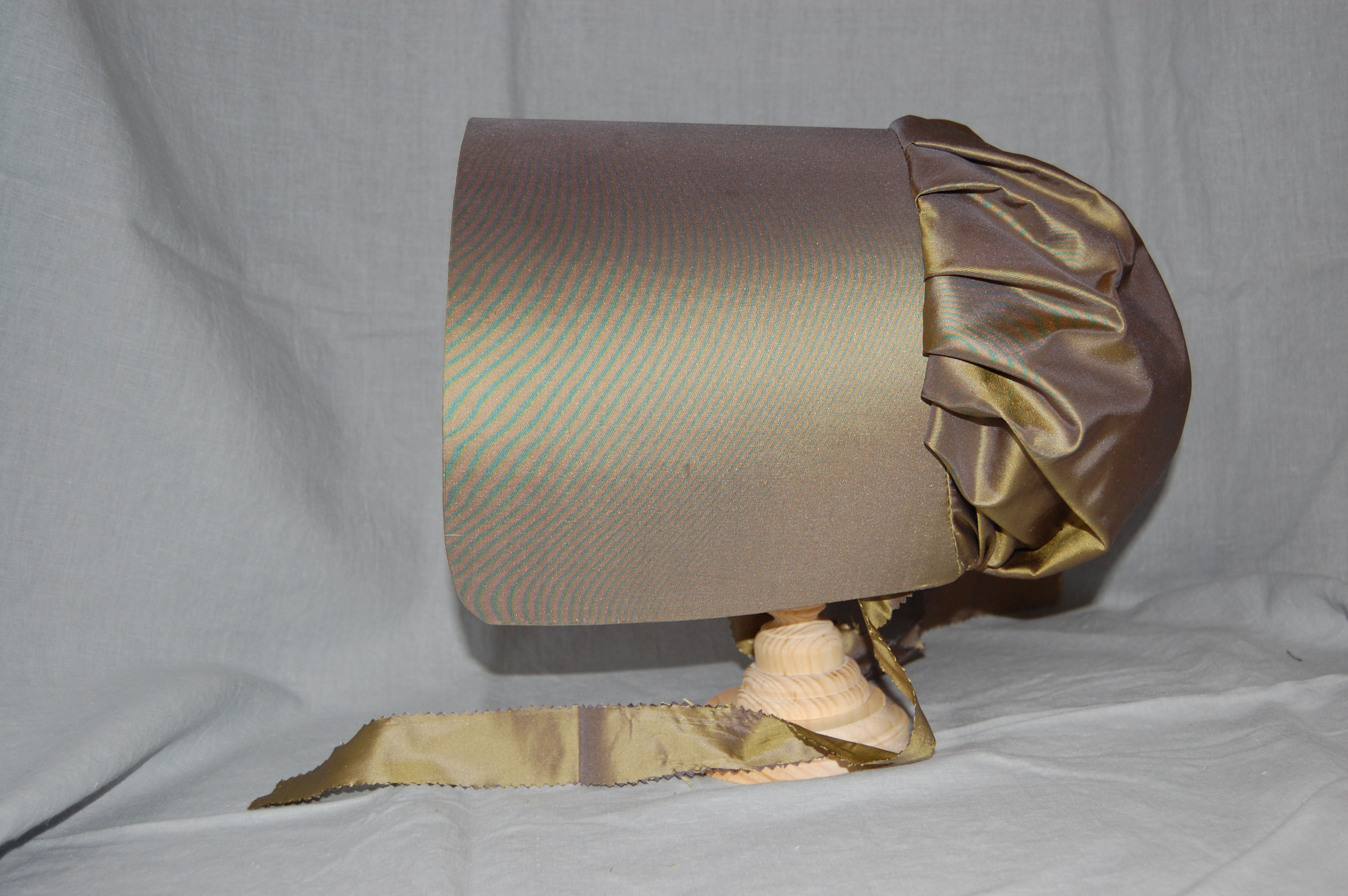
'Quaker' bonnet

‘Quaker’ bonnet

To help get myself out of a sewing rut and panic, and a general malaise, I made a bonnet. A ‘Quaker’ bonnet. Bonnets are like cupcakes: delicious, sugary, but lower in calories and committment than a full garment.

Quaker bonnet ca. 1800, Nantucket Historical Association, 1928.54.7

Quaker bonnet ca. 1800, Nantucket Historical Association, 1928.54.7

Quaker women in the late 18th and early 19th century did not, as far as I can tell, wear the black ‘sugar scoop’ bonnet we now associate with Quakers.

There are numerous entries in Amelia Gummere about bonnets, and types of bonnets, and the reflection of particular sects of Quakers in the pleating of the bonnet caul. But early in the 19th century, at the dawn of the Age of Bonnets, Quaker and non-Quaker styles seem to have been closer.

Fashion Plate: Promenade Dresses, 1801. Museum of London. 2002.139/1397#sthash.YsOpwKG2.dpuf

Fashion Plate: Promenade Dresses, 1801. Museum of London. 2002.139/1397#sthash.YsOpwKG2.dpuf

The fashion plate from the Museum of London presented a style that I thought I could approximate, and that made sense to me for 1800-1810ish, but I chose an olive green silk (actually yellow and black sort-of-changeable taffeta) because I have seen Quaker bonnets in olives and tans, especially earlier bonnets. Going with a color that was less distinctive, and a form that was undecorated, seemed to me to strike the best balance between plainness and style in this time period.

I chose this for innovation because the new bonnet forms of the early 19th century are departures from the full, round, pudding-on-the-head styles of the late 18th century, and the Quakers took it a bit further. In standardizing the appearance of their bonnets (simple, unadorned, eventually ossified in form and signaling sect in pleat patterns), the Quakers were innovators in clothing as  outward symbol and sign of inner faith and affiliation.

There’s your rationalization, how about some facts?

The Challenge: HSF # 2, Innovation

Fabric: Sort-of-changeable black and yellow silk taffeta in olive green for the body and ribbons, white linen for the caul lining and brim interlining, white poly taffeta for the brim lining, and pasteboard for the brim.

'Quaker' bonnet, view two.

‘Quaker’ bonnet, view two.

Pattern: Modified Kannik’s Korner Bonnets, View E

Year: ca. 1803

Notions: Thread, PVA (acid-free white glue for book binding)

How historically accurate is it? Well, white poly taffeta aside, pretty accurate. All hand-stitched and assembled in a period method. Gentlewomen can disagree about accuracy of style, but we could call this a plain bonnet ca. 1803 and be safe. After March, I can decorate the bonnet. The poly will remain, so, well, 60%? (How many points from Gryffindor for using the right weave in the wrong fiber?)

Hours to complete: Five, perhaps? These are quick, so five would be from start to finish, not including agonizing in advance.

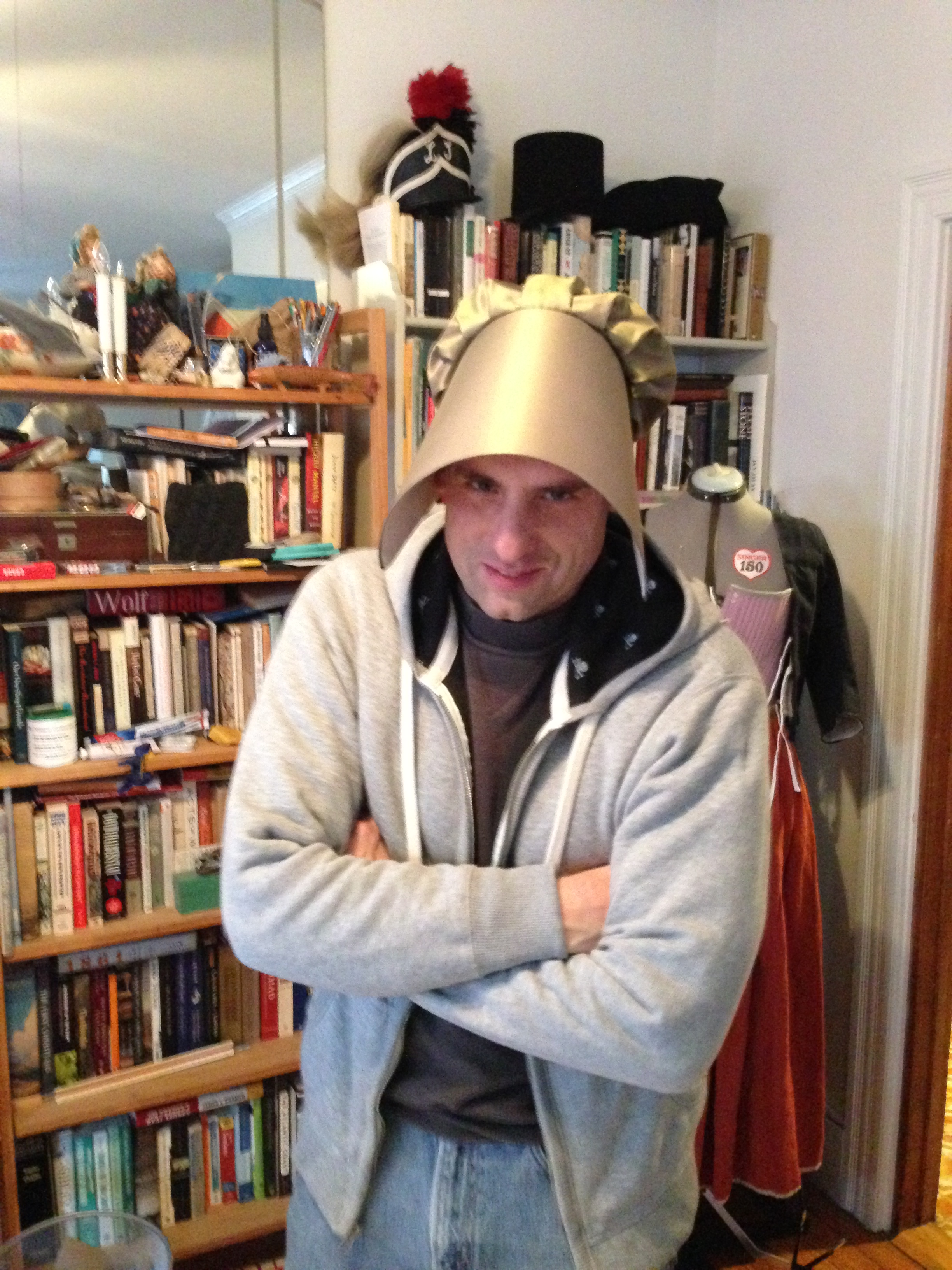
Mr S's day took a bit of turn.

Mr S’s day took a bit of turn.

First worn: First by Mr S, who wasn’t feeling well, but to be carried along by me on March 7.

Total cost: All supplies came from the Strategic Fabric Reserve and chip board depot. It takes so little of anything to make a bonnet…maybe $2.50 in silk, $3.00 in linen, .50 in chipboard, so $6.00? (The silk came from the remnant table at $10/yard, chipboard is $2.00 a sheet, and linen about $12/yard.)

Share this:

  • Share on Facebook (Opens in new window) Facebook
  • Share on Pinterest (Opens in new window) Pinterest
  • Email a link to a friend (Opens in new window) Email
  • Share on X (Opens in new window) X
Like Loading...

Temporal Anxiety

24 Friday Jan 2014

Posted by kittycalash in Clothing, Fail, Living History, Making Things

≈ 1 Comment

Tags

18th century clothes, anxiety, Clothing, Costume, dress, Events, fashion, Making Things, Pierrot jacket, sewing, style

First draft, heading towards a Pierrot jacket.

I like to have a selection of things to wake up and panic about at 4:00 AM, don’t you? If it isn’t sewing, it’s some weird noise I think the car is making, whether the post office has lost a package, or if that noise is not the cat but instead a pending disaster. My brain generously provides me with a Whitman’s Sampler of anxieties.

To start with, that ball. For one thing, Mr S will probably have to wear his Saratoga coat, which means anything nice that I have won’t match him, temporally. For another, anything nice I think I could make in time is French and not American. So I have temporal and geographic anxiety disorder about something that is supposed to be fun. But there is this jacket I think I could make (and want to make), so I started playing with the pattern in my “sketching in muslin” method.

I haven’t got a lot of the purple, but I might have enough.

I know this is not party wear. I know KCI says jackets like this were worn with white muslin petticoats. But I note that this woman in a Pierrot is not wearing a white muslin petticoat, and I carry on. My other option is my brown wool gown, and perhaps I will wear that.

Mr S still needs a frock coat, so that has to be patterned and fitted; his breeches are still being sewn. He’ll need a wool coat no matter what, but whether it will be done by February is up for grabs.

The last two parts of my current crazy are a program in Newport on early March, with an early date of 1813, and programs in late March in Providence, which I have yet to develop. At least in Newport I don’t have to create the program, just dress and deliver.

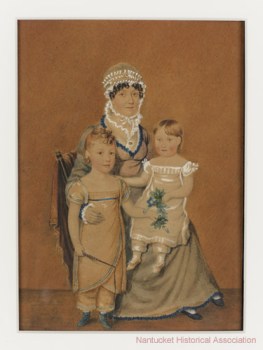
Portrait of Sarah Comstock Coffin and Children, ca. 1815. Nantucket Historical Association, 1917.0034.001

Portrait of Sarah Comstock Coffin and Children, ca. 1815. Nantucket Historical Association, 1917.0034.001

1813 is a fun place to start, and I have been looking at images for inspiration.

At right, Mrs Coffin  is a nice example of a New England woman in 1815, wearing the kind-of cross-over, v-neck, apron-front gown I’m thinking of making. I have some fabric reminiscent of a gown at the V&A, and I have some purple sheer cotton, as well as some green silk, so there’s a whole set of what-ifs? to enjoy.

Because that’s the rub: I enjoy all this planning and fretting and picking over details. I just wish it let me sleep a little longer some days.

Share this:

  • Share on Facebook (Opens in new window) Facebook
  • Share on Pinterest (Opens in new window) Pinterest
  • Email a link to a friend (Opens in new window) Email
  • Share on X (Opens in new window) X
Like Loading...

Pinner Aprons

23 Thursday Jan 2014

Posted by kittycalash in Clothing, History, Laundry, Making Things, Reenacting, Research

≈ 3 Comments

Tags

18th century clothes, apron, Clothing, common dress, Costume, fashion, laundry, Paul Sandby, pinner apron, style, watercolors

Mr & Mrs Thomas Sandby. Watercolor by Paul Sandby. RCIN 917875, Royal Collection Trust.

Mr & Mrs Thomas Sandby. Watercolor by Paul Sandby. RCIN 917875, Royal Collection Trust.

On Saturday, Sew 18th Century and I went out for lunch and fabric shopping. Along the way, I brought up pinner aprons, and that I’d seen them in British prints. She said, “You should blog about that!” and I went back to check my sources. Fail! There was an English print after a French original, and that doesn’t count!

So I shelved that idea, and went about looking for more Paul Sandby images of soldiers and maids and tents, and found instead Mr and Mrs Thomas Sandby. Ahem. Pinner apron alert.

Fluke, right? Well, no, not exactly.

Lady Chambers and child. Watercolor by Paul Sandby, RCIN 914409. Royal Collection Trust.

Lady Chambers and child. Watercolor by Paul Sandby, RCIN 914409. Royal Collection Trust.

Because here is Lady Chambers and child, with Lady Chambers in a pinner apron.

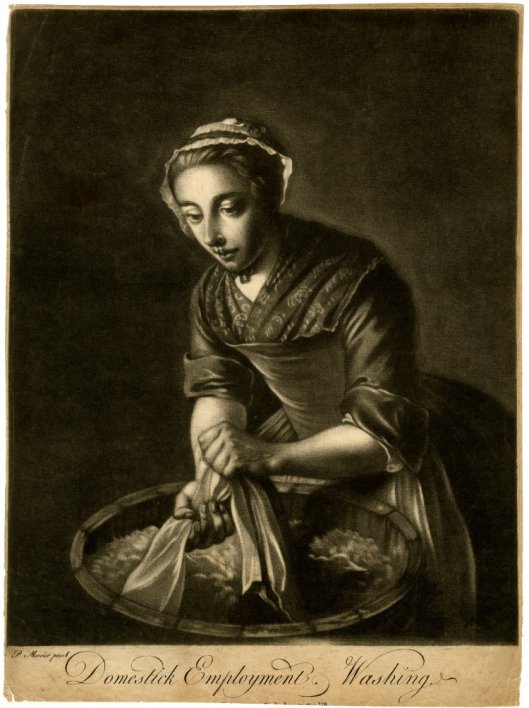
The thing to note, though, is that “apron” here is a decorative, almost ceremonial garment made of black silk, while the maid engaged in Domestick Employment is wearing a working garment of [probably white] linen.

Domestick employment, washing. Mezzotint by Richard Houston after Phillipe Mercier, 1736-1775. British Museum 1876,0708.23

Domestick employment, washing. Mezzotint by Richard Houston after Phillipe Mercier, 1736-1775. British Museum 1876,0708.23

Well, can I wear a pinner apron as a Continental army laundress or not? Probably not, though I will be going back through all the images of laundering I can find. It would be so useful and protective a garment!

No, instead, it looks as if the black silk pinner apron was a fashion adopted by the British upper class probably in imitation of the aprons worn by young girls. These fleeting, black silk accessories were probably adapted to some other use when the fashion had fallen from favor. (You could make a lot of mitts out of one of those.) Sadly, I don’t care enough about the elite to go chasing inventories and more images, but someone else can. I think I have seen a few other examples of this style, but cannot immediately place them. My sense is that these are not common.

I’m much more interested in laundresses and maids. Doesn’t she look sassy? We could call her Bridget. 

A country girl, full-length, facing front, leaning against a fence & a tree. Watercolor by Paul Sandby. RCIN 914438. Royal Collection Trust

A country girl, full-length, facing front, leaning against a fence & a tree. Watercolor by Paul Sandby. RCIN 914438. Royal Collection Trust

Share this:

  • Share on Facebook (Opens in new window) Facebook
  • Share on Pinterest (Opens in new window) Pinterest
  • Email a link to a friend (Opens in new window) Email
  • Share on X (Opens in new window) X
Like Loading...

So Hip

02 Thursday Jan 2014

Posted by kittycalash in A Silk Sacque, Clothing, Making Things, Reenacting

≈ 5 Comments

Tags

10th Massachusetts, 18th century clothes, 18th century clothing, Costume, fashion, patterns, questioning my sanity, sacque, sewing, silk taffeta, style

I don’t always feel the need to enhance my anatomy; in fact, I rarely do, but then I started on the sacque. Ah, the sacque. I nearly abandoned the whole business but then I thought I’d look pretty silly dressed as the maid, or for George Washington’s funeral instead of his birthday party.[1]

I also don’t want to have a house littered with UFOs, because that is what my knitting stash is for. In order for the sacque to look right, I need hips. HIPS.

And while I planned to make panniers AKA pocket hoops, a simpler and easier solution occurred to me. Hip pads: I’d seen them on Sharon’s site and thought I could at least try a pair. They’d help my poor fake quilted petticoat (FQP, long story[2]), which will come in handy for a party in February. So I spent my New Year’s Day making hips and playing a bit with the sacque silk.

Half hipped, or me, right after my hip replacement.
Whole hipped: symmetrical, and wide.

To make the hips, I started out by laying a piece of muslin against Cassandra, and tracing a waist arc. I worked between the muslin and paper to create a paper pattern, and then made up a muslin, which I filled with polyester stuffing and then tested under the FQP. Better, no?

Then I added the seam allowance to the paper pattern (which you can download here and print at 100% if you have a waist in the 30 inch range and want enormous hips yourself) and cut four more of linen.

After three episodes of Death Comes to Pemberly[3], I had hips. They weren’t quite the same size, but my right hip is larger or higher or something, so I put the smaller one on the right and the larger on the left to balance my own deficiencies.

The alteration to the silhouette is pretty amazing, though Mr S did laugh. Perhaps this figure is an acquired taste.


[1] All I have right now to wear with the Celebration Spencer is a black petticoat, so I’d be rocking the 1799 George-is-Dead look.

[2] The story is that I have a real one basted onto a frame but I cannot fit both the frame and a sofa in the apartment. We chose sofa. I am sad but comfy.

[3] I’m ambivalent. Though I do love Trevor Eve, I wondered why there was not more changing of dress for various times of day

Share this:

  • Share on Facebook (Opens in new window) Facebook
  • Share on Pinterest (Opens in new window) Pinterest
  • Email a link to a friend (Opens in new window) Email
  • Share on X (Opens in new window) X
Like Loading...
← Older posts
Newer posts →

Archives

wordpress statistics

Creative Commons License
Kitty Calash blog by Kirsten Hammerstrom is licensed under a Creative Commons Attribution-NonCommercial-ShareAlike 4.0 International License.

Website Built with WordPress.com.

  • Subscribe Subscribed
    • Kitty Calash
    • Join 621 other subscribers
    • Already have a WordPress.com account? Log in now.
    • Kitty Calash
    • Subscribe Subscribed
    • Sign up
    • Log in
    • Report this content
    • View site in Reader
    • Manage subscriptions
    • Collapse this bar
 

Loading Comments...
 

    %d