• Home
  • Completed Costumes/Impressions
  • Emma and Her Dresses
  • Free Patterns and Instructions

Kitty Calash

~ Confessions of a Known Bonnet-Wearer

Kitty Calash

Tag Archives: fashion plates

Under the Green Umbrella

06 Saturday Jun 2015

Posted by kittycalash in Clothing, Research

≈ 5 Comments

Tags

19th century, 19th century clothing, British Museum, Costume, fashion, fashion plates, menswear, Metropolitan Museum of Art, museum collections, Museums, style, umbrellas

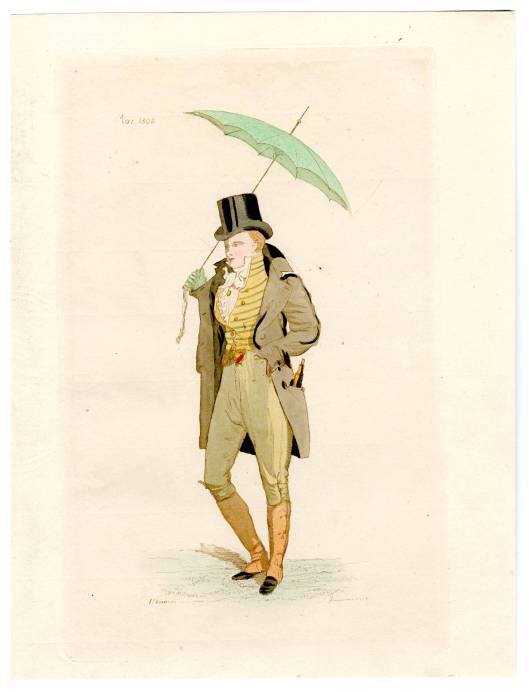
May, 1802. Gift of Woodman Thompson, Costume Institute Fashion Plates, Metropolitan Museum of Art

May, 1802. Gift of Woodman Thompson, Costume Institute Fashion Plates, Metropolitan Museum of Art

How do you like this gentleman? He’s from the Met’s online collection of fashion plates, in Men’s Wear 1790-1829, Plate 032.

I know a gentleman with a similar waistcoat and a similar smirk who needs only the umbrella and spy glass to complete this picture.

In case you’re wondering, the Hull Museum (UK) has a page devoted to a brief history of the umbrella. While classically and stereotypically British, it certainly rains enough here to justify carrying one. The British Museum has 46 trade cards that include umbrellas, with a few pre-1800 examples.

Share this:

  • Click to share on Facebook (Opens in new window) Facebook
  • Click to share on Pinterest (Opens in new window) Pinterest
  • Click to email a link to a friend (Opens in new window) Email
  • Click to share on X (Opens in new window) X
Like Loading...

Good Enough Coat

05 Monday Jan 2015

Posted by kittycalash in Clothing, Events, Living History, Making Things, Research

≈ 3 Comments

Tags

1820s, 19th century clothing, fashion, fashion plates, Federal style, greatcoat, sewing, sewing project, style, tailoring, winter, winter coat

The great coat is nice, but how ’bout them gaiters?

Winter is firmly here, with the snow, fog and ice that marks the season in the Ocean State. It’s not fun weather for living in the past, though there’s not a lot of that happening right now. Even so, there’s a February program on the horizon and what better excuse for fastening on a garment and making it?

Even if I’ll likely spend the day in a kitchen interpreting life below stairs in 1820 (while the light infantry occupies my living room and denudes my kitchen), an early 19th century event on a winter weekend seemed a worthwhile excuse for making a greatcoat, and, eventually, gaiters.

IMG_2733

With no pattern, and only 2 and 3/4 yards of thick, soft, grey double faced wool*,  I’m adapting my standard Spencer pattern. I didn’t upsize this too much, because women didn’t have frock coats and waistcoats to wear under their greatcoats or Carrick [carriage?] coats or Reding cotes. (I’m too engrossed with sewing to parse garment names.) The skirts will be attached at the waist, with a belt to hide the seam. At my height, cutting a back in one piece takes yardage I do not possess. Happily, the Taylor’s Instructor describes Redingcoats or Habits for women with attached skirts.

It's a new collar shape.
It’s a new collar shape.
IMG_2732

The collar shape diverges from my usual 1790s collar, and is based on another fashion plate, this time from 1815. The program I’ll be doing with Sew 18th Century is set in 1820. As a maid, I think an 1815 coat is pushing it a bit, since red wool cloaks hold up well, but I’ll take any excuse for some tailoring, I suppose.

1815, with a round collar that can stand up.

I plan to use this button arrangement, too, stylish as it is in not-quite-double breasted. Bring on the button-making– we all have to go death’s head sometime, and this wool is too thick for covered buttons without much heartbreak.

IMG_2735
IMG_2736

The lower front pins are there from the moment when I realized the front was hanging strangely — because I had neither marked nor sewn the bust darts. That oversight, and the pain in my ear, do suggest that the delightful cold I’ve had for weeks may be affecting me more than I think– but that’s just another argument in favor of a cozy wool coat.

IMG_2737

The sleeve pattern (again, not upsized) is once again the old standby two-piece sleeve from Henry Cooke’s 1770s unlined man’s frock coat, so of course it fits well.

I’m hoping to stitch up the sleeves this evening, and set them later this week. I’m still pondering lining materials– there’s just enough silk “persian” to do the body and sleeves–but I have some twilled wool that would increase the warmth and still provide some ‘slip’ in the sleeves.

And those blue gaiters? They’ll come in time, from the scraps of blue wool a friend is making his first ditto suit from. I’ll spot him some remnant table chintz for a summer waistcoat, and expect greater sartorial splendor will grace the spitting stamp inspector in Newport this August in exchange for my blue wool ankles.

*Holy burned hair smell, Batman! Mr Cooke’s right when he says this almost feels like foam, but put a flame to it, and you might as well be smoking sheep.

Share this:

  • Click to share on Facebook (Opens in new window) Facebook
  • Click to share on Pinterest (Opens in new window) Pinterest
  • Click to email a link to a friend (Opens in new window) Email
  • Click to share on X (Opens in new window) X
Like Loading...

One Coat Two Coat Red Coat Green Coat

15 Saturday Nov 2014

Posted by kittycalash in Clothing, Making Things, personal

≈ 5 Comments

Tags

19th century clothing, broadcloth, Costume, dress, fashion, fashion plates, greatcoat, plans, Redingcote, style, winter, winter coat

1813 Bonnet of untrimmed velvet, Redingote of Merino
1817 Velvet bonnet and broadcloth coat

I cannot manage to find the button I need to sew onto my real-world everyday winter coat, but I’m pondering and plotting how much broadcloth a Redingote (Redingcoat or Redingcote) would require, and internally debating the merits of red versus green.

Greatcoats have their attractions, and while Mr S would undoubtedly enjoy the warmth of a greatcoat, with a February 14 program in the offing, I am pondering a greatcoat of my own.

I can rationalize [almost] anything, but a Redingcote is a stretch even for me, despite that February program (indoors). I suppose the real appeal of one of these coats, aside from the pleasure of handling delicious green or red wool, is the challenge of making one. I have even found a front view to aid in the patterning.

1813 Hat of velvet and broadcloth coat

What stops me? Some unfinished projects, and a certain feeling of unease about buying quantities of expensive wool. I have two yards of dark green broadcloth, but I’m pretty certain that I will need three to make even the shorter red coat. Without making a firm resolution, I had determined that I wanted to sew down my stash–and I suppose the answer is to sew it down, or put it on Etsy. Or to buy the wool, make the coat, and wear it in the winter. It would be a spur to winter program ideas, after all.

Now, if only I could find the missing button from my winter coat…

Share this:

  • Click to share on Facebook (Opens in new window) Facebook
  • Click to share on Pinterest (Opens in new window) Pinterest
  • Click to email a link to a friend (Opens in new window) Email
  • Click to share on X (Opens in new window) X
Like Loading...

Back Bump: The Regency Silhouette

03 Tuesday Jun 2014

Posted by kittycalash in Clothing, History, Making Things, Reenacting, Research

≈ 3 Comments

Tags

18th century clothes, 18th century clothing, authenticity, Costume, dress, fashion, fashion plates, history, living history, Making Things, Research, sewing

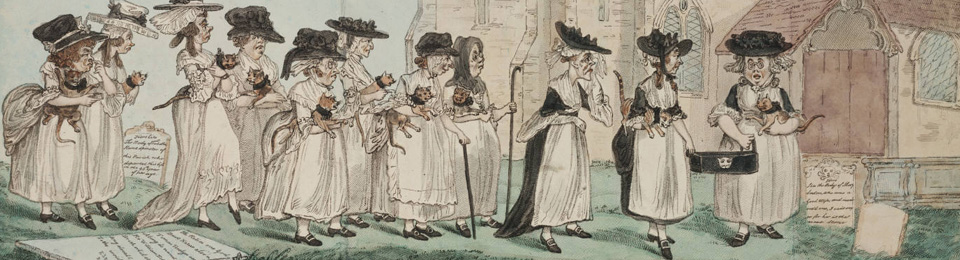
Ah! Quelle antiquité!!! Oh! Quelle folie que la nouveauté ... Engraving, 1797. 1892,0714.755 British Museuem

Ah! Quelle antiquité!!! Oh! Quelle folie que la nouveauté … Engraving, 1797. 1892,0714.755 British Museum

Regency, Federal, Early Republic:  we use these terms to cover (roughly) the period from 1790-1820, though technically the Regency period would mean only 1811-1820, when George IV served as Prince Regent, ruling for his incapacitated father, George III. In the United States, “Regency Costuming” is a bit of misnomer if you’re copying early American gowns, but it does serve as a handy short-hand we all tend to understand.

Grossly, the principles of dress are rooted in neo-classicism and republicanism rising from the American and French Revolutions. Specifically, we see a turning away from the heavily-boned, panniered, and formal gown styles to the looser, short-stayed, flowing, simpler gowns.  The transition is summed up for me in this satirical print.

So, you’re no longer side-to-side wide, baby: you gotta have back.

How do you get back? There are a couple of perfectly authentic tricks that do not require you to stuff a cat into the back of your dress, though you can do that if you want. The combination I have found to work is two-part: a small, crescent-shaped pad, and the method of pleating. How you deploy the pad and the pleats will give you the silhouette you desire.

First, though: which silhouette? In really the 1790s, the silhouette is rounder than you might think. It really is a round gown.

Ann Frankland Lewis, 1793. LACMA
The Frail Sisters, 1794

To get that look, I use a small rump pad, bustle pad, or bum roll (call it what you like), which is stitched to the inside of my petticoat.

Pad from the inside
Pad from the inside
Pad from the outside

That’s the white IKEA curtain petticoat I made during the extended snow days of last year, and which I have worn with the red curtain-along open robe and under the petticoat and open robe for What Cheer Day. The pad is the same natural light-weight linen I use for a many gown linings, filled with bamboo stuffing. If I’d had wool on hand in the small hours of the morning I made this pad, I would have used it, but all I had was bamboo in the rush to finish up and have something to wear for a photo shoot.

The other key factors are pleating styles and fabric weight. Pleats can add lift, but in general, the lighter the fabric, the more lift a small pad will give you.

Double and triple box pleats, exterior view
Double and triple box pleats, interior view

1780_1790
I’m particularly fond of the pleats used for the gown shown on page 75 of Nancy Bradfield’s Costume in Detail. I’ve used this as a guide several times, and I am very pleased with the results. They do vary, of course, depending on fabric weight, fibre, and length. Stiffer cottons, like the Waverly Felicity of the curtain-along gown, will make a round shape; tropical weight wool does fairly well, also, but the most amazing 1790s rendition I have achieved to date is the light-weight India print cotton short gown.

On Cassandra
On Cassandra
On me
On me

Now that’s 1790s back. The bustle-like shape surprised (OK, shocked) me, but on the whole, I think I’m pleased. So there you are: pad, petticoat and pleats: that’s how you get back.
Share this:

  • Click to share on Facebook (Opens in new window) Facebook
  • Click to share on Pinterest (Opens in new window) Pinterest
  • Click to email a link to a friend (Opens in new window) Email
  • Click to share on X (Opens in new window) X
Like Loading...

Roller Print Obsession

17 Saturday May 2014

Posted by kittycalash in Clothing, Research

≈ 5 Comments

Tags

day dress, dresses, Early Republic, fashion, fashion plates, Genessee Country Village Museum, Regency, Research, roller print cotton, style, Susan Greene Collection

Roller print day dress, 1810-1815. Susan Greene Collection, GCVM 90.25

Day dress of roller-printed cotton, 1810-1815. Susan Greene Collection, GCVM 90.25

Lately, I have developed an obsession with this roller-print day dress from the Greene Collection At Genessee Country Village Museum. I first encountered it on the 19th US Infantry’s website, a haven for those of us consumed with the early Federal everyday.

The 19th US site provides more photos and a drawing of the dress, so that if one were to become impossibly obsessed with the dress, one could recreate it. And if one were up late nights, one might consider how to create a copper-engraved roller for printing cotton.

Johann Klein dress, 1810

A more productive line of thought might be to consider this fashion plate, found during an early-morning Pinterest session. I think it gives us a sense of how rapidly fashion crossed the Atlantic (just as quick as engravings could be printed and bound into magazines, and boats could make the trip), and how avidly women copied the latest fashion.

That avidity would have been tempered by access to fabrics, but the resemblance between the dress at Genessee and the fashion illustration is striking, indeed.

Now, to find some fabric…

Share this:

  • Click to share on Facebook (Opens in new window) Facebook
  • Click to share on Pinterest (Opens in new window) Pinterest
  • Click to email a link to a friend (Opens in new window) Email
  • Click to share on X (Opens in new window) X
Like Loading...
← Older posts
Newer posts →

Archives

wordpress statistics

Creative Commons License
Kitty Calash blog by Kirsten Hammerstrom is licensed under a Creative Commons Attribution-NonCommercial-ShareAlike 4.0 International License.

Website Built with WordPress.com.

  • Subscribe Subscribed
    • Kitty Calash
    • Join 621 other subscribers
    • Already have a WordPress.com account? Log in now.
    • Kitty Calash
    • Subscribe Subscribed
    • Sign up
    • Log in
    • Report this content
    • View site in Reader
    • Manage subscriptions
    • Collapse this bar
 

Loading Comments...
 

    %d