• Home
  • Completed Costumes/Impressions
  • Emma and Her Dresses
  • Free Patterns and Instructions

Kitty Calash

~ Confessions of a Known Bonnet-Wearer

Kitty Calash

Tag Archives: fashion

Still More Sacques

29 Tuesday Oct 2013

Posted by kittycalash in A Silk Sacque

≈ Comments Off on Still More Sacques

Tags

10th Massachusetts, 18th century clothes, authenticity, Colonial Williamsburg, fashion, Museums, Reenacting, sacque, sewing, silk taffeta

1770-1780, Colonial Williamsburh 1999-247,A-C
ca. 1770 Colonial Williamsburg, 1993-330,A
ca. 1755 (Silk), dress remodeled ca. 1770. Colonial Williamsburg 1990-12,1
ca. 1750, altered ca. 1775, Colonial Williamsburg 1989-330,1
ca. 1775, remade late 19th century, Colonial Williamsburg, 1955-428,1
1770-1780, Colonial Williamsburg CW 1991-472, A-C

I’m particularly interested in remodeled gowns, not that I have the patience to make a ca. 1750 or 1760 gown and then re-make it, even though I suppose it would be the path to the greatest authenticity. In figuring out “what next” now that the pleats are stitched down and secured to the lining, and the front panels cut, and one even pinned, awaiting a seam, I looked at the sack/sacque in Costume Close Up. It’s both tiny and a polonaise, so it’s not the best example for me to follow, but when you’re trying to understand construction before you totally screw up  take the next steps, you look at whatever details you can.

That led me back to Colonial Williamsburg’s collections database, which I try to avoid because they don’t have stable permalinks to their records. However, they have good cataloging and an amazing collection, so it’s hard not to end up back there.

I feel a little more confident in thinking of a ca. 1770- 1775 gown with a compère front. A compère front is a false stomacher, where there are two halves sewn to either side of the opening in the bodice. The sides then button closed. Button, and not pin, people: sweet. I will gladly trade you a week of sewing buttonholes for a wardrobe failure today (Of course, I’m not sure whether a compère front is accurate for a ball gown, but I very much want to avoid a pin explosion at a public gathering.)

Trim is another tricky area: in my regular, 21st century life, I am not someone who wears ruffles and lace or even many colors other than black, brown, grey and red. When I chose the cross-barred fabric, it was a choice really grounded in who I am, and in my love of things architectural, bold, and elegant. (Thanks to my Dad and my education, I now wonder, can one make a Miesian sacque? Let’s find out.)

Serpentine trim, no matter how appropriate and accurate, is not for me. I like the simple trim on the purple gown (padded furbelows), and will probably replicate linear, and not serpentine, trim.

Share this:

  • Share on Facebook (Opens in new window) Facebook
  • Share on Pinterest (Opens in new window) Pinterest
  • Email a link to a friend (Opens in new window) Email
  • Share on X (Opens in new window) X
Like Loading...

Sacque Rationalizations

28 Monday Oct 2013

Posted by kittycalash in A Silk Sacque

≈ 1 Comment

Tags

10th Massachusetts, 18th century clothing, authenticity, Costumes, fashion, gown, LACMA, living history, Museums, Reenacting, sacque, sewing, silk taffeta

Sacque-Front
Sacque-Back

Before I get any farther along in the process of making a sacque (and I have not made much progress) I thought I should start to really look at gowns, and try to understand them.

Not only do I need to understand how they’re made, I want to understand how they change over time, and what’s appropriate for different time periods and situations. This will, or could, have some bearing on what I make for the gentleman accompanying me to the celebrations for which this gown is being made. If I start from Mr S, whose best coat right now is the 1777 Saratoga private’s coat, then I ought to have nothing better than a second-hand sacque several years out of date, and that is reaching indeed.

SacqueBySacque_back
What good fortune it is that the LACMA dress seems to be a gown in flux! This is the brown silk cross-barred gown with an assigned date of ca. 1760, which seems to have been abandoned in mid-alterations. Trim down the rights and left fronts ends abruptly at the waist, and two halves of what might have been a compère front lack any trim but boast plenty of holes. The front skirts come close together, but it’s hard to tell if they are meant to nearly close, or if the gown is fitted to a mannequin that’s too small and not adequately padded out.

Replicating a gown in mid-alterations would be interesting, but not what you’d wear to a ball, so I kept looking. In Hamburg there is another cross-barred sacque-back gown from about this era. There are similarities and differences, and never as much information as you’d like to have. Who owned and wore these? Who made them? When and where were they worn? We’ll never know, but at least with two similar gowns one can fill in some details for another, or help us understand them both.

The serpentine trim on the pink gown in Hamburg makes clear how unfinished or mid-alteration the brown gown in LA really is despite the visual interest created by the fabric itself.

Sacque_by_SacqueFront

So, what to do for my gown? And when will it be from? LACMA is hedging their bets with ca. 1760. I think Hamburg is pushing it a bit late with ca. 1775, but a ca. 1770 date for a gown based on the two seems reasonable. That would mean that the coat Mr S wears should also be ca. 1770, or newer than his green linen coat and older than his Saratoga coat. And luckily, I already have a plan, some fabric, and a pattern as a place to start.

While the ball itself has no date per se, it is in celebration of Washington’s Birthday, which puts it after 1775 at the earliest (think transfer of command of the Continental Army in Cambridge). Does that make a ca. 1770 gown too early? It would depend, I think on how one imagined the ball and oneself. If you’re a frugal woman who has lost much in the war, you’ll remake your gown; should the flounces become the shirred cuffs of later gowns? Could the kind-of compère front of the LACMA gown be a stomacher cut in half and stitched to the sides, with the pin hole indicating where trim had been removed from a once-was stomacher? Is it reasonable to make a compère front for a ca. 1770 gown? I want one mostly to avoid the stomacher angst I always seem to have, and in a way it marks a place between stomacher-front and front-closing gowns.

These unprovenanced gowns stand without the particular context and personality of their owners; the fun and the challenge for us, as costumers and reenactors, is in trying to bring our personalities to the fact-based garments we create.

Share this:

  • Share on Facebook (Opens in new window) Facebook
  • Share on Pinterest (Opens in new window) Pinterest
  • Email a link to a friend (Opens in new window) Email
  • Share on X (Opens in new window) X
Like Loading...

Catastrophic Wardrobe Failure

17 Thursday Oct 2013

Posted by kittycalash in 1763 Project, Clothing, Events, Fail

≈ 3 Comments

Tags

18th century, 18th century clothes, Costume, failure, fashion, living history, sewing

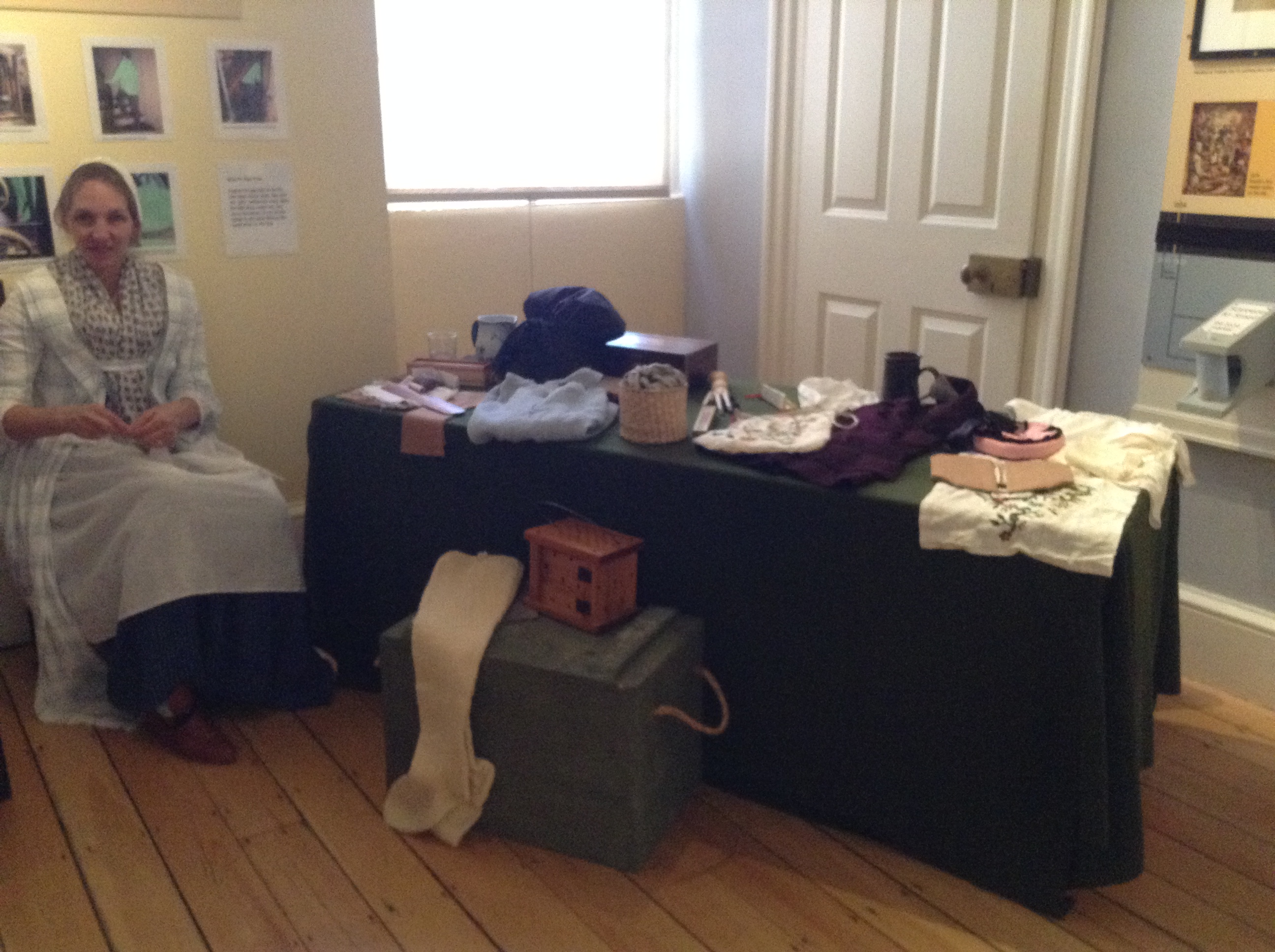
Table at the Bostonian Society, infant stays to the lower right.

Table at the Bostonian Society, infant stays to the lower right. Photo courtesy Sew 18th Century

Several weeks ago now, Sew 18th Century and I went up to Boston to be part of the People of 1763 event at the Bostonian Society. I hope she knows how grateful I was and am to her for her help and thoughtfulness in preparing an excellent table of examples. The infant’s stays were, by far, the most interesting thing people found all day. (While Sew 18th Century ate her lunch, I did hear about how a woman from California was appalled there were not more Boston terriers in Boston, and when I suggested that perhaps the financial district wasn’t where you’d find dogs, in general, but that the Common and the Garden might have more dogs and terriers in particular, I got to see cellphone pictures of her Boston terriers. I’m still intrigued by this conversation.)

Too big, and destined for re-making

Before total failure. Photo courtesy Sew 18th Century.

But all day I fought with my gown, which proves you should not wear something in public until you have fully tested it at home. Finally, packing out, the fronts and the straps separated with a flourish of leaping pins, and all decorum was lost. I began to wonder about exactly what had prompted earlier male compliments on the gown, especially when I discovered the loose stay lace at the top of my stays…and then found the lace had come untied and was unlacing itself from the bottom up! And of course, while outside looking for my husband (reportedly carried off by bears), my hat and cap blew off, and since the gown was coming undone, they were all the harder to catch, adding to the wardrobe mayhem and my discomfiture.

I have since re-looped and double-knotted the stay lace, so I hope it will not come undone again at the base (and of course I had no bodkin handy that day). But still, there were other, “bigger,” issues, to be explored tomorrow.

Share this:

  • Share on Facebook (Opens in new window) Facebook
  • Share on Pinterest (Opens in new window) Pinterest
  • Email a link to a friend (Opens in new window) Email
  • Share on X (Opens in new window) X
Like Loading...

Always the Lady’s Maid, Never the Lady…

26 Thursday Sep 2013

Posted by kittycalash in Clothing, Events, Living History, Museums, Research

≈ Comments Off on Always the Lady’s Maid, Never the Lady…

Tags

18th century clothes, common dress, dress, fashion, John Brown House Museum, maids, servants, What Cheer Day, widows

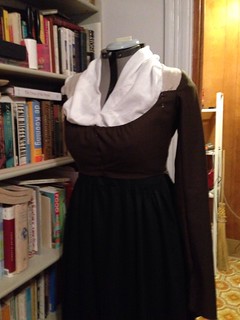
Testing the bodice and sleeve

but that’s fine, actually. I like to get dirty. The red Virginia cloth dress is now clay-splashed, and while it was made especially for the “People of 1763” event, it may no longer work. Fine for cherry-sellers, fine for hand-bill hawkers, it will not do for a lady’s maid, and I don’t especially want to clean it. Hope I can get my stays wrangled back into shape and that my cross-barred gown fits…but if not, I’ll be a recently promoted lady’s maid.

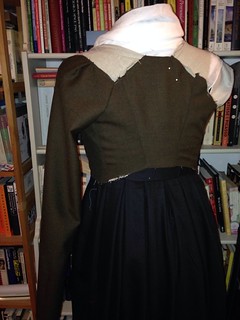
From the back.

My other upcoming role as a maid will be at the John Brown House Museum, on October 5. This has required quite a bit of thinking and stewing about appropriate clothing and realistic background. I finally settled on a black-and-brown combination of petticoat and open robe, with the style of the open robe based on Paul Sandby drawings and extant garments, but determined by the scant three and a quarter yards of brown worsted that I was able to find.

Winter, 1795. The British Museum, 2010,7081.509

Winter, 1795. The British Museum, 2010,7081.509

The bodice back is based on the 1795-97 cross-front gown from Museum of Costume in Bath shown in The Cut of Women’s Clothes. The front is meant to be transitional: a little bit of gathering at the neck, but not a great deal, with the edges still pinning closed. The sleeves are long and slim, and will button at the wrist once I’ve gotten the length worked out.

The skirt will pleat, with fullness centered on the back triangle and decreasing to the front. For the black petticoat, I used the double inverted box pleat of the 1790s open robe in Costume in Detail. As you might imagine or just plain hope, they work! I’ve also made a small pad to help lift the skirt in the back and create the right profile; I’m thinking of adding buttons and loops so that it can migrate from gown to gown.

Share this:

  • Share on Facebook (Opens in new window) Facebook
  • Share on Pinterest (Opens in new window) Pinterest
  • Email a link to a friend (Opens in new window) Email
  • Share on X (Opens in new window) X
Like Loading...

Chemisettes

16 Monday Sep 2013

Posted by kittycalash in Events, Making Things, Museums, Research

≈ 1 Comment

Tags

1800 event, 18th century clothing, bib and tucker, fashion, John Brown House Museum, patterns of fashion, Rhode Island, Rhode Island Historical Society, style, What Cheer Day

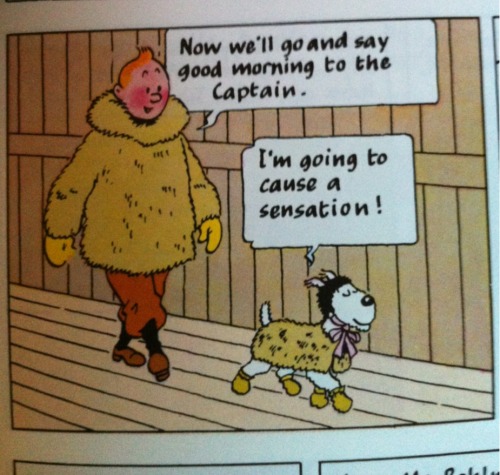
The Shooting Star: Snowy in his “best bib and tucker.”

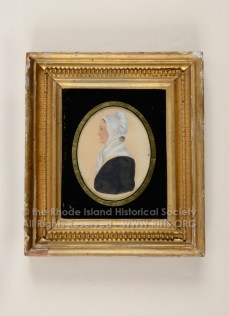
Chemisette or tucker? By the time The Shooting Star was published in 1941-42, “bib and tucker” had wandered away from their original meanings. Tuckers were worn under women’s and girl’s bodices, taking on the role of neck handerchiefs or fichus, and what some people like to call “modesty pieces,” though the phrase always makes me think of the front panel of desks.

Janet Arnold includes chemisettes in Patterns of Fashion I, and you can buy a very nice one indeed from Cassidy at her Etsy store. (Reviewed here, and modeled, too!) But can you have one in Rhode Island in 1800? That is, of course, the question.

Hannah Weaver Peckham, RIHS 1958.3.2

Hannah Weaver Peckham, RIHS 1953.8.2

Turns out you probably can. Scrolling through the miniatures gallery, there was Hannah Weaver Peckham in her best tucker, and Miss Rhodes, while later, is also sports a chemisette or tucker. (Mrs Peckham looks a bit cranky, doesn’t she? Perhaps her busk is poking her.)

What you’d call it remains an open question.

The 1933 Oxford dictionary we have in the office defines “tucker” as “A piece of lace or the like, worn by women within or around the top of the bodice of the 17-18th C.”

Phoebe Smith Rhodes, RIHS  1918.3.6

Phoebe Smith Rhodes, RIHS 1918.3.6

The same dictionary tells me “chemisette” is 1807, from the French, diminutive of chemise. “1. A bodice, more or less like the upper part of a chemise. 2. An article, usually of lace or muslin, made to fill in the open front of a woman’s dress 1844.”

While I think that one could, in Rhode Island in 1800, wear a garment that filled in the upper part of a bodice, I’m not sure what one wold call that garment. The simplest thing to do is to wear a white kerchief  like Phoebe Smith Rhodes. Have I ever settled for the simplest thing? Not if I can help it.

Share this:

  • Share on Facebook (Opens in new window) Facebook
  • Share on Pinterest (Opens in new window) Pinterest
  • Email a link to a friend (Opens in new window) Email
  • Share on X (Opens in new window) X
Like Loading...
← Older posts
Newer posts →

Archives

wordpress statistics

Creative Commons License
Kitty Calash blog by Kirsten Hammerstrom is licensed under a Creative Commons Attribution-NonCommercial-ShareAlike 4.0 International License.

Website Built with WordPress.com.

  • Subscribe Subscribed
    • Kitty Calash
    • Join 621 other subscribers
    • Already have a WordPress.com account? Log in now.
    • Kitty Calash
    • Subscribe Subscribed
    • Sign up
    • Log in
    • Report this content
    • View site in Reader
    • Manage subscriptions
    • Collapse this bar

Loading Comments...

    %d