• Home
  • Completed Costumes/Impressions
  • Emma and Her Dresses
  • Free Patterns and Instructions

Kitty Calash

~ Confessions of a Known Bonnet-Wearer

Kitty Calash

Tag Archives: history

History Camp Next Weekend!

21 Saturday Mar 2015

Posted by kittycalash in Events, History, History Space, Living History, Museums

≈ Comments Off on History Camp Next Weekend!

Tags

conference, history, History Camp, History Space, living history

Gradient--Boston2015

Where will you be on March 28th, now that the LTB muster is cancelled? How about HistoryCamp 2015? You can register here for free if you volunteer or for a nominal fee otherwise.

You can check out sessions here, but I know there’s a really good one on living history…because I’ll be presenting along with Elizabeth Sulock of Newport Historical Society in the Risky Business: Living History Events in Tradition Museums session. There’s a lot of other good stuff, too, so if you’re in the area, why not register so you can check it out?

Share this:

  • Click to share on Facebook (Opens in new window) Facebook
  • Click to share on Pinterest (Opens in new window) Pinterest
  • Click to email a link to a friend (Opens in new window) Email
  • Click to share on X (Opens in new window) X
Like Loading...

Glaciers in the House

19 Thursday Mar 2015

Posted by kittycalash in History, Museums

≈ 6 Comments

Tags

historic house museums, historic interiors, history, interpretation, museum practice, Museums

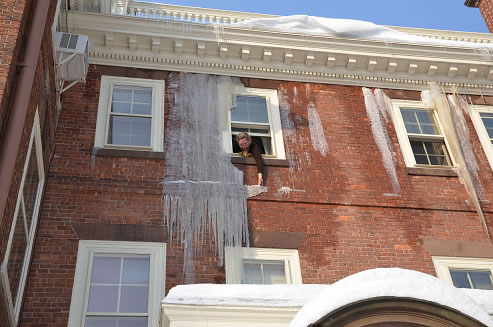
IceDamFeb2015

I don’t mean the ice dams and icicles that plagued the house and streaked the service ell’s windows as they melted: I mean change.

I’m reading The Half Has Never Been Told (it kept selling out, so I only just got a copy), and thinking about the representation of a past that people would rather forget, and sometimes actively deny in the North– and the South, as you will tell from reading African-American History Fail.

Change in historic houses can be glacially-paced, as staff and docents alike resist changes to interpretation. Resistance to change is usually about comfort and confrontation, especially when the change is large.

I get that: Oh no, new stuff to learn. What was wrong with what we did before? But docents and staff get comfortable and loose sight of the context of the content they present. They say some interesting stuff.

Most jaw-dropping of all: Sometimes I like to pretend I’m Mrs Owner of the House. That one was creepy, to me. But it did give me some insight into the “ooh, wish I lived here” backwardly aspirational tour motivation.

How would you feel if living here meant you owned and traded slaves? Defended the slave trade in Congress? If a small girl had the care of your horses? We don’t ask those specific questions, but I think we need to. Slavery is slavery.

In the 1790 census of Rhode Island, there are 948 slaves, representing 1.3% of the population. That would be 13,000 people of Rhode Island’s total population today, less than the city of Central Falls (19,383 in the last census, and one of our smallest towns).

We think it’s a small number, but to those 948 people, being enslaved was everything. I don’t necessarily want to make our visitors feel personal guilt about slavery– that’s up to them–but I do want to them to think about what slavery meant, and what it did, as an economic system.

I want visitors to understand that the beauty of the house they see is built in part on the ugly and forced exploitation of a class of people. If they relate that to the rest of the world they inhabit today, even better. I think we owe at least this much to every site where enslaved people worked or lived.

Share this:

  • Click to share on Facebook (Opens in new window) Facebook
  • Click to share on Pinterest (Opens in new window) Pinterest
  • Click to email a link to a friend (Opens in new window) Email
  • Click to share on X (Opens in new window) X
Like Loading...

Less is More

25 Tuesday Nov 2014

Posted by kittycalash in Events, Food, Living History, personal, Philosophy, Reenacting

≈ 3 Comments

Tags

10th Massachusetts, authenticity, Events, food, history, interpretation, living history, military events

Though it may seem contrary to previous posts, there are times when I really believe less is more, and that’s when we’re out in the field.

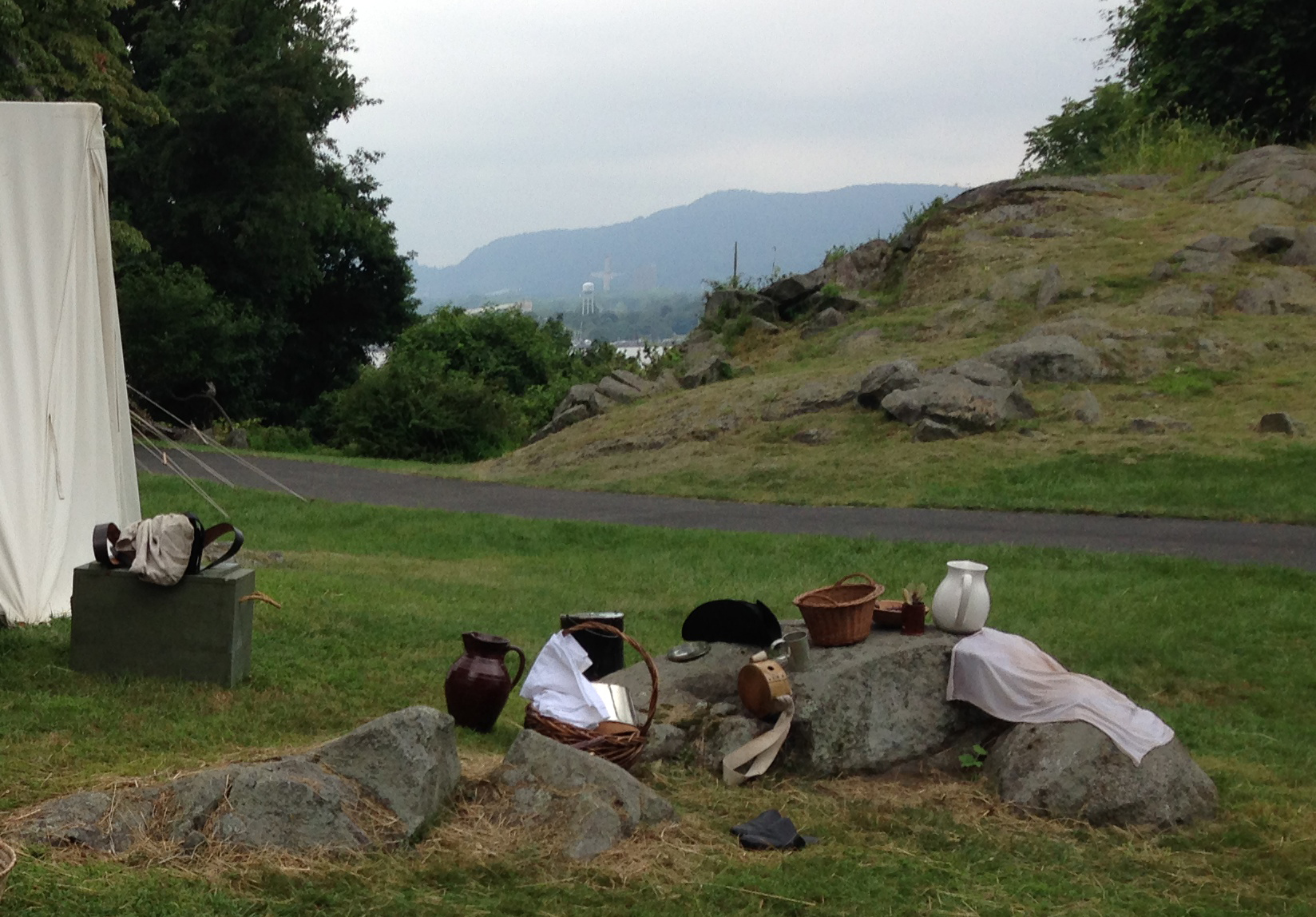
Each year I’ve tried to improve our kit and impression by replacing or removing items, mostly to increase our accuracy but also to reduce what we carry. The less we have to carry, the less I have to pack and clean and think about and the more I can think about the history. This iteration of “What the heck can I quit?” was prompted by reports of a conversation with someone I respect, which caused me to rethink what we were hauling along and how I could change it.

The Box of Doom with the Pitcher of Inaccuracy

The Box of Doom with the Pitcher of Inaccuracy

We have stripped away most of what we used to bring for the comfort of the kid; as he has grown up, he’s needed less to feel comfortable and “at home.” We traded ground pads for bed sacks* very quickly, and we never had any iron to begin with. I’ve tried to keep within seasonal and historical cooking guidelines, but the largest hurdle and heaviest literal burden is the wooden cooler box.

Feeding the Young Mr is a tricky thing: he likes what he likes, and he likes a lot of it. What he likes are carrots, apples, and meat. There’s some swapping that can be done with seasonal fruit, but the largest hurdle is meat: if I can scrap fresh, needs-to-be-kept-cool meat, I can leave the cooler box at home. (At this moment, several gentlemen are suddenly feeling empty inside, with a taste of ash in their mouths. Dirt stew, boys: it’s coming.)

No iron, but what goes into the kettle?

I had gotten about as far as pease porridge when, in a completely costuming context, I came across links to The Sewing Academy.

The squeamish and childless may writhe at the handouts on dealing with nursing babies, hygiene, and winter clothes for children, but these Civil War resources have utility for all of us trying to be more accurate in our portrayals of the past.

I had not thought about packing frozen meat and storing it underground, and though I like the idea very much, it will not suit in cases where digging is forbidden. But it is certainly a way around the cooler box, and one I’m willing to entertain. (Check “No Refrigeration Required.”) “The Progressive Questions” help sketch out a responses to a variety of situations.

“Quoth the Mavens” contains this excellent definition: A truly progressive mind-set tries to figure out the logic of what was indeed used, rather than rationalizing modern logic into a period situation.

There’s nothing more to add to that pithy statement, but a renewed sense of dedication to accuracy and “less is more” thinking.

*As accurate as my attitude would be after resting arthritic bones on the ground, no one really needs to experience that. Call it a safety measure.

Share this:

  • Click to share on Facebook (Opens in new window) Facebook
  • Click to share on Pinterest (Opens in new window) Pinterest
  • Click to email a link to a friend (Opens in new window) Email
  • Click to share on X (Opens in new window) X
Like Loading...

Pushing Interpretation Forward

18 Tuesday Nov 2014

Posted by kittycalash in Events, History, Living History, Museums, Philosophy, Reenacting

≈ 7 Comments

Tags

18th century clothes, anarchist guide to historic house museums, authenticity, common people, common soldier, exhibits, first person interpretation, historic interiors, history, interpretation, living history, Reenacting, Revolutionary War

Dare I say progressing?

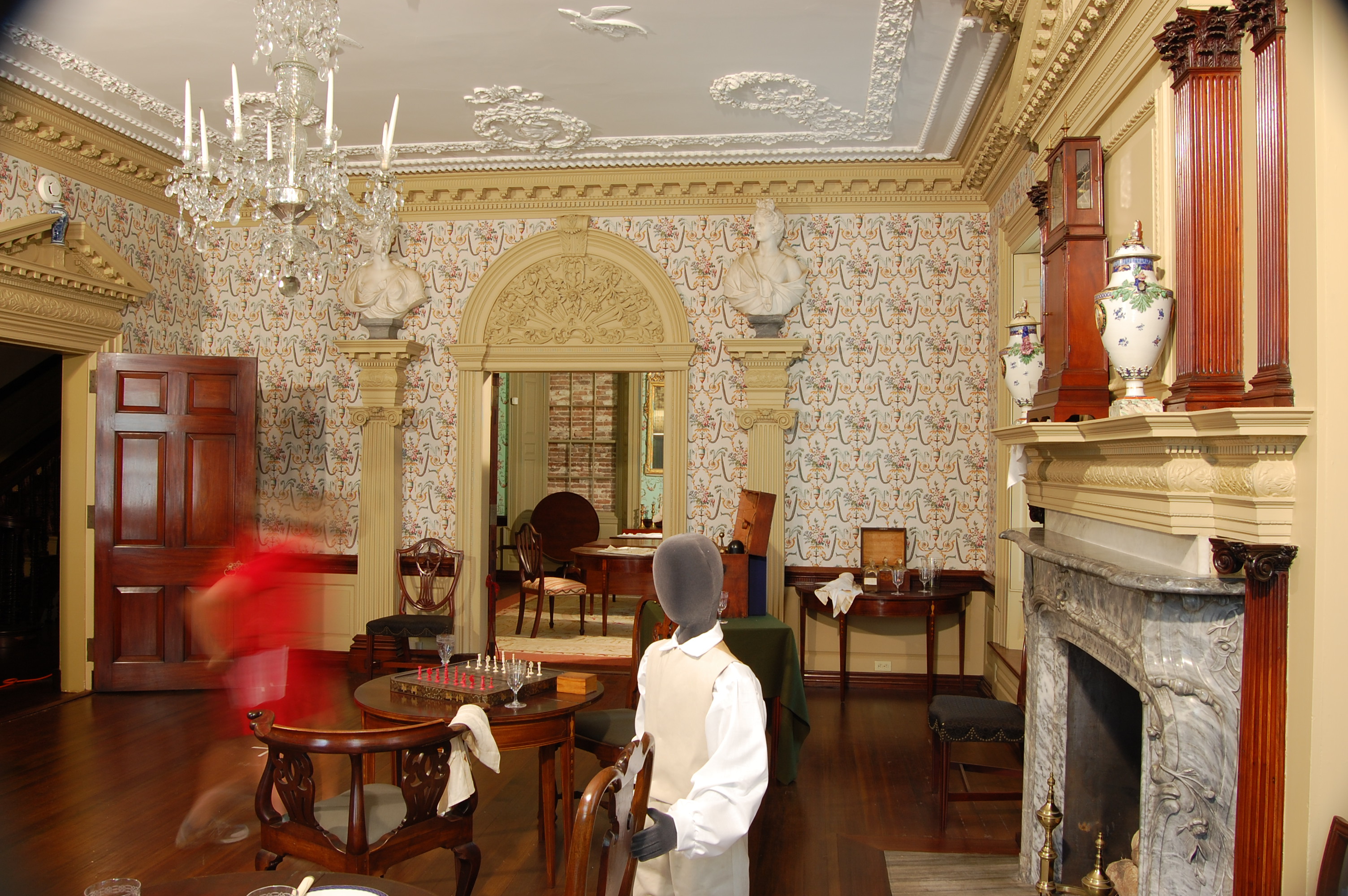
servant mannequin in 18th century room

That’s no ghost, that’s my kid

In the past decade, museums, particularly historic house museums, have been challenged to refresh and reinvent their interpretations and presentations. The most notable challenge has come from the Anarchist Guide to Historic House Museums (AGHHM), and the Historic House Trust of New York’s executive director, Franklin Vagnone.

I re-read a number of Vagnone and Deborah Ryan’s papers recently (including this one), thinking not just about What Cheer Day in a historic house, but about reenacting, living history, and costumed interpretation.

To make a historic house museum (HHM) seem more inhabited and real takes a lot of stuff: clothes, dishes, shoes, stockings, toys— all the stuff that surrounds us now, but correct for the time of the HHM, and arranged in a plausible manner, not like a sitcom set, where chairs before a fireplace face the visitor and not the hearth.

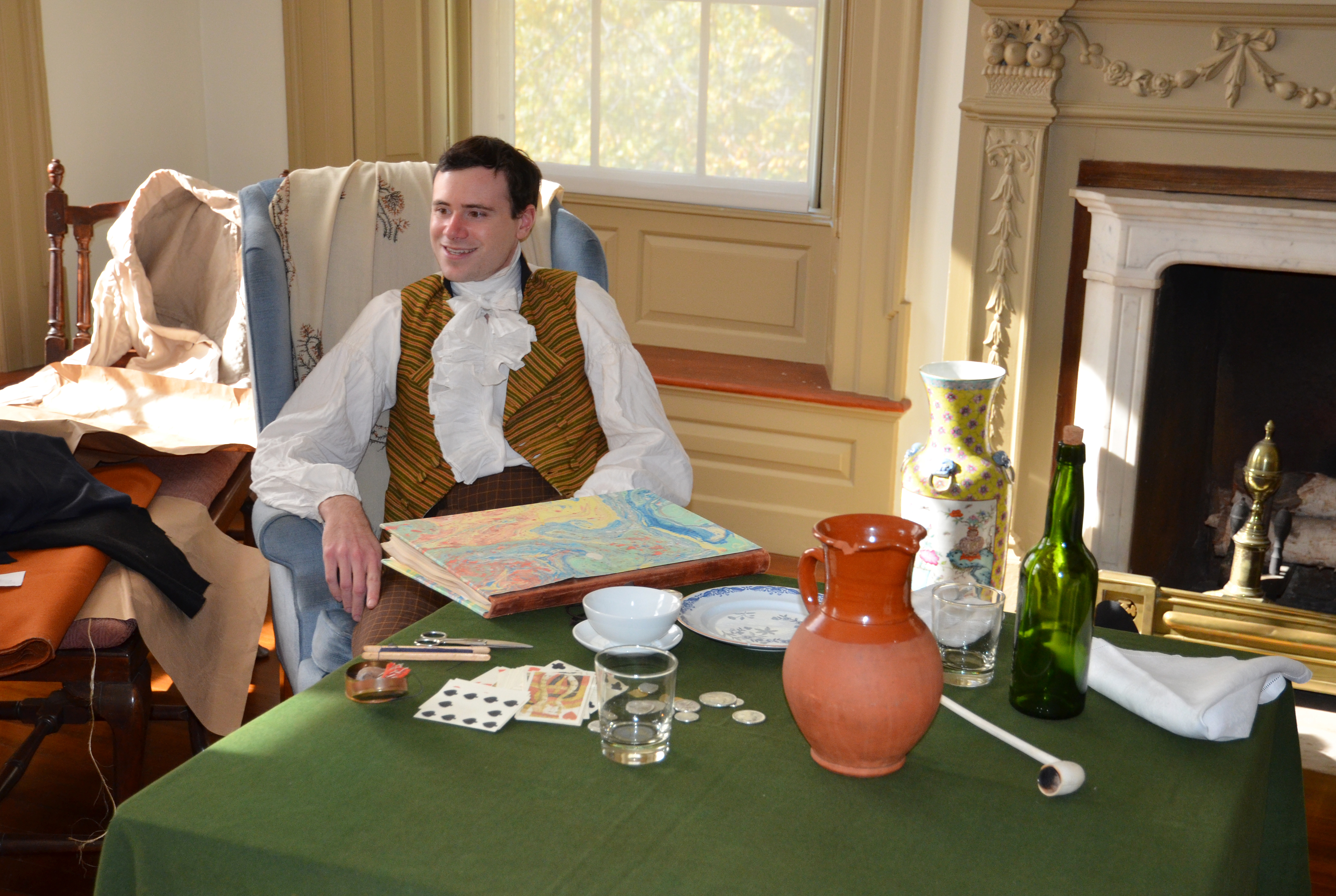
Man with cards, glasses and pipe in 18th century room

Stuff makes a house

To a degree, this is set-dressing, but set-dressing for a still-life, or real life, if the habitation will be by costumed interpreters. It has to be accurate to be authentic, whether it’s a HHM or a living history event that is striving to create a moment, or series of moments, in time– immersive moments.

We cannot step into the past unless we believe the representation we’re seeing, and that’s true no matter where we are: that’s why fabric matters, sewing techniques matter, tent pins and kettles and canteens matter. The world is made up of tiny details that we do actually notice without even knowing it: we see more than we realize, faster than we think. We’ll trip on the different, and stop.

A variety of coats can tell a variety of stories

A variety of coats can tell a variety of stories

But what we want to do, as interpreters, is to have the visitor catch the right difference: not the one about which canteen and why, but the larger interpretive point. In one hypothetical example, wooden canteens are a way to talk about defense contracting and supplying the American army, just as over-dyed captured coats are a way to talk about the American Revolution as an international, and not just a civil, war.

An encampment is, in a way, a neighborhood of HHMs turned inside out, with each regiment a separate family within the larger neighborhood. Each regiment tells a story about itself and its history, and is a lens through which visitors see the larger story.

14999323655_5d9dcf2259_o

That’s why accuracy matters: you don’t want to debunk Ye Olde Colonial craft in camp, or cotton-poly polonaises (poly-naises?) worn by purported women on the ration: you want to focus on the larger interpretive point. When not everyone plays by the same rules, it is better to focus on your own accuracy and authenticity and to ignore Ye Olde Annoyances.

Tell the larger story, the story of your own regiment’s people: that’s your interpretive goal.

Share this:

  • Click to share on Facebook (Opens in new window) Facebook
  • Click to share on Pinterest (Opens in new window) Pinterest
  • Click to email a link to a friend (Opens in new window) Email
  • Click to share on X (Opens in new window) X
Like Loading...

Authenticity Measur’d in Moments

30 Thursday Oct 2014

Posted by kittycalash in Events, Fail, History, Living History, Philosophy, Reenacting

≈ 10 Comments

Tags

authenticity, historic houses, history, living history, military events

Chopping wood: it takes  a lot to cook and to keep warm in 1799

Chopping wood: it takes a lot to cook and to keep warm in 1799

In the post-What Cheer Day aftermath, when I was very tired and two houses were very messed up, I started thinking about why I bothered with living history. What exactly is this thing, and why I do it? Those questions made me think about the very best moments I have had in this business of re-creating the past in cloth and smoke and time.

In no particular order:

1. Going up to the field at Coggeshall Farm to call the boys down to dinner after spending all day in the kitchen. I was desperate to get out, and finally knew first hand how limited women’s lives could be in the 18th century, especially non-elite women.

2. Running upstairs at the John Brown House with Eliza, giggling over a joke to be played on Mr Mason. I don’t know what Mr C thought of it but I felt twelve years old, silly, carefree and light. John Brown’s housekeeper surely never felt that way, but a naughty maid might have, and for an instant I knew what it was to have no responsibilities.
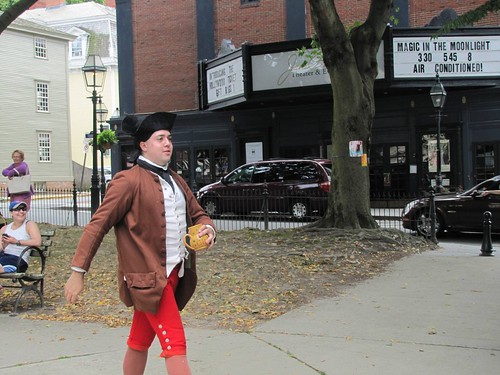
We didn’t even notice the background at the time

3. Chasing the Young Mr, a wayward apprentice, across the street; mobbing Mr Howard’s house; and arguing with the Stamp Inspector, all during the Stamp Act Protest in Newport It was not until I looked at the photos that I realized we really had been in front of a theatre, and that there were actual cars! A friend confirms that he, too, forgot about the cars, to the point of nearly being hit whilst running to Mr Howard’s house.

4. Assembling with a group of friends to take tea with Mrs Silsbee in Salem, sorting ourselves into a group on the sidewalk and venturing out, only to meet Mrs Silsbee on the street. That is the most Jane Austen/Mrs Gaskell I have ever felt. The wretched cobblestones do not count, as they were from the 20th century, but walking out on the wharf, and meeting a friend who brought an umbrella as the rain began was also very Austen-esque.

Perhaps more Gaskell than Austen, here

Perhaps more Gaskell than Austen, here

None of these are military events, and the majority of them happened this year, in past three months. I think this may be because we have been to fewer military events, and I expect the concentration is due, in part, to finally getting better at this practice. They are also site-specific, and trending toward first-person interpretation.

Coats

Those coats.

For reasons explained better by the NPS and in the excellent study of NPS-Reenactor relationships, no battle reenactment can ever capture the truth of the war it attempts to recreate, and that is true even when the battle takes place on the same site, at the same time of year, and even when soldiers are dressed in as-close-as-possible replicas of the uniforms worn at that battle, on that field, on that date, 236 years earlier, and no one has brought a spinning wheel or tent chandelier to camp.

I respect the notions of moveable monuments and performances as commemoration. I like military history, I like war memorials: there is not a competition between civilian and military reenactments. But military events have not yet had the power to transcend experience for me.

My best guess as to why military events are not transformative for me is that, to this point, the business remains too much like camping in funny clothes. As I experiment more with 18th century methods of cooking appropriate rations, and as I strip away the gear we carry into the field, the military events are better (as at Bennington). But I already know how limited women’s perspectives could be (see item 1), and while Bennington was instructive in how ridiculously different the experiences of men and women could be, the military events remain more instructive experiences for the men.

18th century camp

Domesticity in the Field

Why? Because the specificity of site plays out at those events in the battle, and not in the camp. The point at Bennington and at Saratoga and at Stony Point was to use the site as it had been used. The men experienced the landscape in ways as close as possible to what soldiers and militia had actually seen. And women stayed in camp and got smoke in their eyes, cut up vegetables, or washed clothes, which is pretty much what happens at any outdoor event where we can have a fire and, with differences in technology, is pretty much what I do when I get home from work every day.

All that leaves me wondering what to make of military events, and what I want to do in the coming year. No matter how much of this is “for the public,” it still has to be rewarding for the practitioner.

Share this:

  • Click to share on Facebook (Opens in new window) Facebook
  • Click to share on Pinterest (Opens in new window) Pinterest
  • Click to email a link to a friend (Opens in new window) Email
  • Click to share on X (Opens in new window) X
Like Loading...
← Older posts
Newer posts →

Archives

wordpress statistics

Creative Commons License
Kitty Calash blog by Kirsten Hammerstrom is licensed under a Creative Commons Attribution-NonCommercial-ShareAlike 4.0 International License.

Website Built with WordPress.com.

  • Subscribe Subscribed
    • Kitty Calash
    • Join 621 other subscribers
    • Already have a WordPress.com account? Log in now.
    • Kitty Calash
    • Subscribe Subscribed
    • Sign up
    • Log in
    • Report this content
    • View site in Reader
    • Manage subscriptions
    • Collapse this bar
 

Loading Comments...
 

    %d