• Home
  • Completed Costumes/Impressions
  • Emma and Her Dresses
  • Free Patterns and Instructions

Kitty Calash

~ Confessions of a Known Bonnet-Wearer

Kitty Calash

Tag Archives: interpretation

Massacres and Mondays

07 Monday Mar 2016

Posted by kittycalash in Events, History, Living History, Museums, Reenacting, Research

≈ Comments Off on Massacres and Mondays

Tags

authenticity, Boston, Boston Massacre, Bostonian Society, commemoration, interpretation, living history, Massachusetts, Research

March 5, 1770: Sound familiar? The Boston Massacre.

Happened on a Monday, by the way: how ironic is that?

But here’s the thing: if the Monday is emphasized, the Massacre stands out. Focusing on the normal makes the unusual ever much more so. And in the case of Monday, March 5, 1770, the usual is actually unusual.
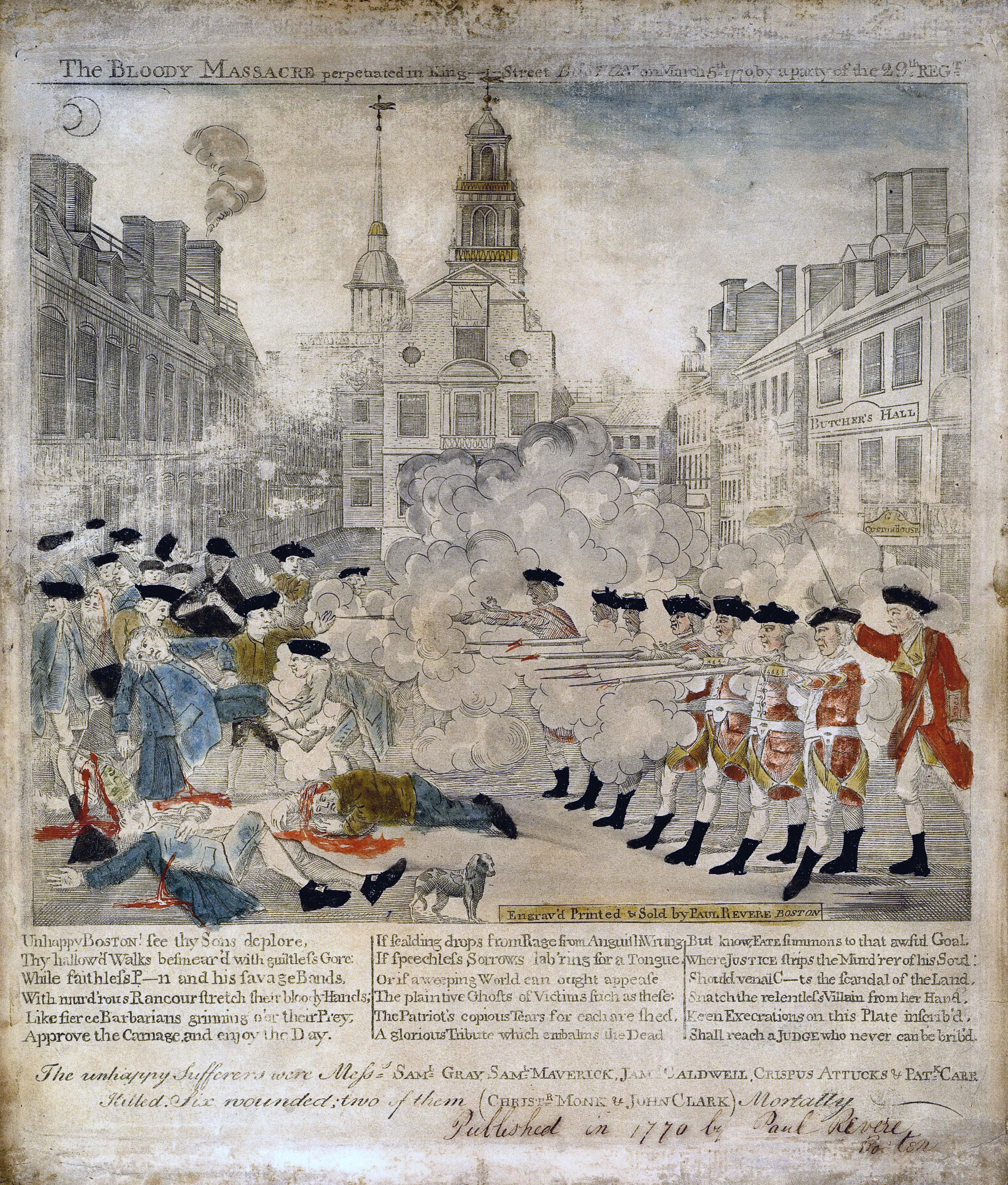
Paul Revere, “The Bloody Massacre in King-Street, March 5, 1770.” Boston, 1770

Over the course of the month leading up to Saturday’s event, Drunk Tailor and I spent a lot of time talking about the night watch, peddling, food supplies to Boston, population, and what I might call “the texture of everyday life” in a meeting at work. Any reading you do forces you to realize that the key to the Massacre is how very abnormal everyday life had become in Boston that winter.

Edward Langford, disaffected nightwatchman. Boston Str

Edward Langford, disaffected nightwatchman. @BostonStrolls on Twitter

By 1770, Boston was an occupied city: Ferguson comes to mind, or Ramadi. Soldiers and watchmen patrol the streets, civil and martial structures clash, and the Sons of Liberty chafe under this control– or attempt at control. Scuffles, fights, brawls, break out. A boy is shot to death– accidentally– and tensions mount higher.  Sailors and soldiers alike commit acts of vandalism. Women are assaulted. Normal isn’t normal anymore, and Boston was always expensive to live in. Even in a city occupied by “friendly” forces, gathering supplies and going about one’s daily business became harder.

People are scared. This is a tense city. Lots of people are just trying to survive. Lots of those people are children. Roughly 16,000 people, and if the estimates are correct, 2,000 soldiers and 4,000 men (white, African, other, free, indented and enslaved), which means about 4,000 women and 8,000 children under 16. Let that one sink in: lots of children, lots of teenagers. I don’t know about you, but a city with a large population of teenagers is going to be tense under the best of circumstances, even in an era before the rise of youth culture. Hormones, man. The kid can’t help it.

So imagine this: instead of a mobile monument and a commemorative ritual that substitutes fists for muskets, the Massacre commemoration expands to include the day, and not just the night. Monday and a Massacre.

Townspeople hurry home as dark falls. Women lug laundry back to customers or to the washhouse, or trundle barrows home, empty, after a day of hawking cats’ meat, oysters, or fish. Tired cordwainers trudge the streets, hoping for meat at supper. A mother scavenges firewood to warm her rented rooms, keeping an eye out for the watch. Those are not Mr Hutchinson’s fence posts, truly.

Photo by Tommy Tringale (Claus' Rangers, 2nd NH, 3rdMA and HMS Somerset)

Photo by Tommy Tringale (Claus’ Rangers, 2nd NH, 3rdMA and HMS Somerset)

Women look over their shoulders, nervous at the sound of hobnailed shoes on the streets. Older men skirt closer to buildings, out of the way of soldiers in the street. Apprentices mock an officer, a sentry responds.

Insults, a scuffle, a boy knocked down. A mob, soldiers, a woman shoved, shots fired, men killed and wounded, blood on the snow.

Murder in the midst of the mundane. More horrifying (in truth, I have never heard Boston so silent as I did on Saturday night) within its context than set apart.

The Women of the 2017 Boston Massacre commemoration. Photo by Drunk Tailor at the behest of Our Girl History

The Women of the 2017 Boston Massacre commemoration. Photo by Drunk Tailor at the behest of Our Girl History

The benefits?
A more complete picture of life in 1770 that puts the events of the evening of March 5, 1770 into deeper context and thus a sharper contrast.
A recognition that history isn’t just about men and conflict.
Understanding that what made living under occupation so hard was more the living– trying to be normal–than the occupation.
And, yes: more for women to do.
Share this:

  • Share on Facebook (Opens in new window) Facebook
  • Share on Pinterest (Opens in new window) Pinterest
  • Email a link to a friend (Opens in new window) Email
  • Share on X (Opens in new window) X
Like Loading...

Change the Question

01 Tuesday Mar 2016

Posted by kittycalash in History, Living History, Reenacting, Research

≈ 5 Comments

Tags

authenticity, history, interpretation, living history, Research, resources

photo courtesy Drunktailor

photo courtesy Drunktailor

Lately, I have felt like a street preacher exhorting people to change their ways.

Feel the power of the primary source.

Behold the possibility in the unknown.

Surrender to uncertainty.

It’s not for everybody, I know. But rethinking reenacting will change not just you and your appearance, but the way you “do” history. The more you dig in, the more you question and change, the more engaged you’ll be—and the more engaged your visitor will be. The more fun you have, the more fun the public will have.

“That’s great, Aunt Kitty,” you say. “But how am I supposed to do that? I’ve already learned rabbtre sous le main and buttonholes and pinning my stomacher and making soap. What more can I do?”

Stop asking how. Start asking why.

Look, I get it. Those 18th century skills are hard to acquire. Tons of people have better skills than I do, and I willingly and happily admit my general incompetence.

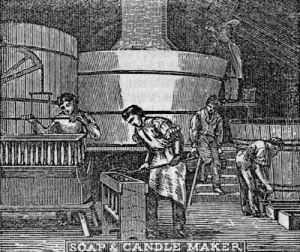
The Soap Boiler and Candle Maker. Popular Technology or, Professions and Trades.

The Soap Boiler and Candle Maker. Popular Technology or, Professions and Trades.

Take soap. I cannot make soap. I know that it takes lye and tallow and heat. I know it is slimey and hot and dangerous and vaguely disgusting. (I’ve done my time with tallow candles, thanks.) So I respect the soap.

But honestly, so what? is the question I ask when y’all tell me how to make soap. I want to know why you’re making soap.

Are you selling it? What will you wash with it? How often do you do laundry? Do you share the soap? And if you’re selling soap, how do people know to come to you? Why is your soap better than, say, Bono Brown across the river? He’s cheaper by a penny, why is your soap so special? If you do sell it, what do you do with the money? Are you married? Does your husband drink the profits?

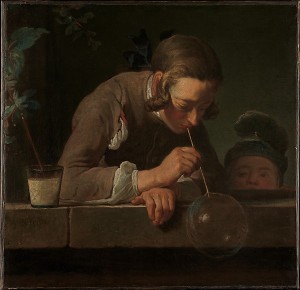
Jean Siméon Chardin (French, Paris 1699–1779 Paris) Soap Bubbles, ca. 1733–34 Oil on canvas; 24 x 24 7/8 in. (61 x 63.2 cm) The Metropolitan Museum of Art, New York, Wentworth Fund, 1949 (49.24)

Jean Siméon Chardin
Soap Bubbles, ca. 1733–34
The Metropolitan Museum of Art, New York, Wentworth Fund, 1949 (49.24) Soap bubbles I can do.

Tell me a story. Tell me why you’re doing something, or why it was done in the past, not just how. Then I might give a damn. But telling me only how a musket works, and not why you have it and where you got it and what you’ll do with it and whether the sergeant yelled at you the last time you failed to clean it and the punishment you got when you failed AGAIN to clean it…. Well, you see what I mean.

Change the question, change the answer, change how people see history.

Share this:

  • Share on Facebook (Opens in new window) Facebook
  • Share on Pinterest (Opens in new window) Pinterest
  • Email a link to a friend (Opens in new window) Email
  • Share on X (Opens in new window) X
Like Loading...

Writing for the Weekend

25 Thursday Feb 2016

Posted by kittycalash in Events, History, Living History, personal, Reenacting, Research

≈ Comments Off on Writing for the Weekend

Tags

first person interpretation, interpretation, living history, Rhode Island history, servants, What Cheer Day, women's history

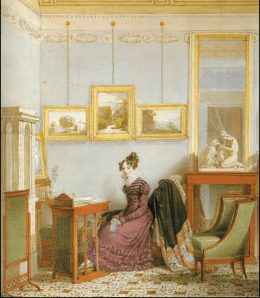
Johann Ender, Woman at her writing desk ca 1820

Johann Ender, Woman at her writing desk ca 1820

or, Women’s History at Washington’s Crossing

I haven’t dropped the peddling question, I promise! But I’m busy writing a paper for this coming weekend’s women’s history conference (yes, I know: but I’ve read that procrastination fuels creativity, so those digressions into the Canton voyage of the Ann and Hope were totally worth it).

Georg Friedrich Kersting: Briefschreibende Dame im Biedermeier Interieur, 1817

Georg Friedrich Kersting:
Briefschreibende Dame im Biedermeier Interieur, 1817

If you’re curious about the process I go through developing characters for living history programs, or best practices for women of the Revolutionary War-era armies, among other topics, there are some tickets left, and you can register online here.

But before I can compile what I’ve found about food markets in 18th century Boston, I have to go back to writing for this weekend.

Those Providence servants don’t research and describe themselves, and the housekeeper is particularly unreliable.

Share this:

  • Share on Facebook (Opens in new window) Facebook
  • Share on Pinterest (Opens in new window) Pinterest
  • Email a link to a friend (Opens in new window) Email
  • Share on X (Opens in new window) X
Like Loading...

Peddling a Myth

23 Tuesday Feb 2016

Posted by kittycalash in Events, Fail, History, Living History, Reenacting, Research

≈ 13 Comments

Tags

18th century, Boston, common people, Events, fail, interpretation, Research, Revolutionary War

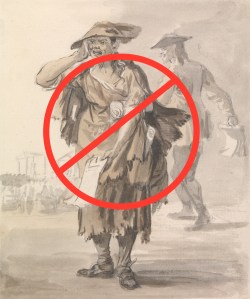
Paul Sandby RA, 1731–1809, British, London Cries: Last Dying Speech and Confession, ca. 1759, Watercolor over graphite on medium, cream, slightly textured wove paper, Yale Center for British Art, Paul Mellon Collection

Paul Sandby RA, 1731–1809, British, London Cries: Last Dying Speech and Confession, ca. 1759, Watercolor over graphite on medium, cream, slightly textured wove paper, Yale Center for British Art, Paul Mellon Collection

Every now and then, I reach the dammit! point of my research, where I am forced to realize that Everything I Assumed Was Wrong. I try to make those moments a cause for celebration, even though they’re often deeply frustrating. Do not pass GO, Do not collect $200, Go directly to the Library.

What now?

Well… Boston ain’t London. And the North American colonies ain’t Great Britain. The business structure, the size of the cities, is different. Distribution of goods is different, thanks to tariffs and non-import/export laws. Which means?

Peddling. It’s not a thing. Or it’s a very difficult thing to document.
Which means that all the things I’d thought about doing for the Massacre (day or night) are probably wrong. (Remember, this is when we celebrate!)

Hey, I’m not the only one rethinking my approach.

But there it is: I’ve looked in the Boston Selectmen’s Minutes for 1768-1771, and while there is plenty of small pox (yay!) and many lemons being imported (yay! punch!) and there are licenses being granted for selling strong drink in inns and houses, there are no peddlers licenses. There are no licenses for street vendors of any kind. Hmmmm….

I’ve also read the Dublin Seminar publications Itinerancy in New England and New York (1984) and Life on the Streets and Commons, 1600 to the Present (2005). Not looking good here for street vendors and hawkers pre-1800.

While I never particularly trust early 20th century monographs and articles without footnotes, the somewhat entertaining Hawkers & walkers in early America : strolling peddlers, preachers, lawyers, doctors, players, and others, from the beginning to the Civil War informed me that street vending was not common in North American British Colonies, and in fact, was not commonly seen until after 1800.

What the ever-loving heckers?

I found peddlers’ licenses in Philadelphia for 1770: all men. But so far, nothing in Providence, Boston, or Newport (or Connecticut). The theory is that itinerant sales people didn’t pay taxes the way merchants did, and that merchants therefore lobbied against them. In Providence, the earliest mention I’ve found thus far is a lobster and fish man at the Great Bridge in 1818.

Just as the watch of Boston differed from the watch in London, so too, it seems, did the petty retailers. I still can’t quite believe there were no street peddlers and hawkers in colonial cities, but I’ll need a new way to approach this question.

Share this:

  • Share on Facebook (Opens in new window) Facebook
  • Share on Pinterest (Opens in new window) Pinterest
  • Email a link to a friend (Opens in new window) Email
  • Share on X (Opens in new window) X
Like Loading...

The Devil is in the Details

21 Sunday Feb 2016

Posted by kittycalash in History, Living History, Movie Review, Philosophy

≈ 1 Comment

Tags

authenticity, interpretation, living history, progressive reenacting

durer_hare

The Hare. Watercolor on paper by Albrecht Durer, 1502. The Albertina, Vienna.

The Witch. I had to go see it after Mr JS sent me a link to this article, and of course I was captivated. (I also needed a break after what was very nearly the Worst Week Ever, starting Wednesday at 4:30AM.)

“The recreation of farm life in 1630s Massachusetts is so complete it pulls you into the pocket universe that exists inside the characters’ minds. As you experience their fear, you experience your own. The barrier between you and the people on film disappears, and their terror consumes you. And that is how you make a scary movie!”

That pocket universe: that’s what some of us are after when we go about this living history business, creating a world so seamless (or so meticulously hand-seamed) that you, the interpreter, appear to inhabit the past and the present simultaneously.¹

So how does it work? How did it work in The Witch?

Here’s Eggers on authenticity:

“…authenticity for the sake of authenticity doesn’t really matter. To understand why the witch archetype was important and interesting and powerful—and how was I going to make that scary and alive again—we had to go back in time to the early modern period when the witch was a reality. And the only way I was going to do that, I decided, was by having it be insanely accurate.”

Got that? Authenticity for the sake of authenticity doesn’t really matter.

But the only way to make the witch powerful was to be “insanely accurate.”

The only way to make living history powerful is to be <ahem> insanely accurate.² If we’re not, the points where we are not accurate will stand out, the spell will be broken, and the visitor will be lost. The real thing is the right thing for your time and place. Context: It really does matter. 

That means that just because you perfectly replicated a silk gown from a French fashion plate it may be wildly incorrect for the streets of Providence, Boston, or Philadelphia– much less a military camp– even if it’s the same year as the event you’re attending. It means that just because you got every buttonhole perfect on your 1765 frock coat, it won’t be right for an 1803 funeral if you’re only 30.

Don't take an anecdote to a data fight.

Don’t take an anecdote to a data fight.

When you’re wearing and carrying the right clothes and objects for your portrayal, you can focus less of the what and more on the why. As interpreters, re-enactors, enactors, whatever you want to call yourself, we lead the visitor to better questions and a better understanding of not just events but the meaning of the past if we are thoroughly convinced and convincing. And that only happens by questioning ourselves.

The Witch is a horror movie, and while it was tense, the world it portrayed felt pretty close and natural to me and to Mr JS. Maybe that’s because we spend so much time trying to understand that vanished world—it’s Roger Williams, baby—maybe because we engage in living history and material culture. I don’t know if it’s scarier for folks who don’t have that level of context, don’t assume a world where hierarchy, acceptance, succumbing to a higher power, is normal. Where everything is a matter of faith, and belief. It’s a tiny world, that past. We were so immersed in that world that walking out into the mall was a shock: colors, noises, smells. And the world was so immersive because the details were so correct.

Ultimately, what we do with living history is interpretation, and interpretation is provocation.³ But what should be provoked is not a question about what you have, but why you have it, and what you’ll do with it. And that only happens if you have the right thing.

………………….

1 Your mileage may vary. It’s my dream goal. “Man’s reach should extend his grasp” and all that.

2 That is, as accurate as possible, recognizing the limitations of modern materials and access to primary source documents. More on that later.

3 Freeman Tilden. Interpreting Our Heritage, Chapel Hill: 2007. p. 35

Share this:

  • Share on Facebook (Opens in new window) Facebook
  • Share on Pinterest (Opens in new window) Pinterest
  • Email a link to a friend (Opens in new window) Email
  • Share on X (Opens in new window) X
Like Loading...
← Older posts
Newer posts →

Archives

wordpress statistics

Creative Commons License
Kitty Calash blog by Kirsten Hammerstrom is licensed under a Creative Commons Attribution-NonCommercial-ShareAlike 4.0 International License.

Website Built with WordPress.com.

  • Subscribe Subscribed
    • Kitty Calash
    • Join 621 other subscribers
    • Already have a WordPress.com account? Log in now.
    • Kitty Calash
    • Subscribe Subscribed
    • Sign up
    • Log in
    • Report this content
    • View site in Reader
    • Manage subscriptions
    • Collapse this bar
 

Loading Comments...
 

    %d