• Home
  • Completed Costumes/Impressions
  • Emma and Her Dresses
  • Free Patterns and Instructions

Kitty Calash

~ Confessions of a Known Bonnet-Wearer

Kitty Calash

Tag Archives: living history

A Bonnet, Universally Acknowledged

11 Monday Feb 2019

Posted by kittycalash in Clothing, History, Living History, material culture, Reenacting, Research

≈ 2 Comments

Tags

1770s, 18th century clothes, American Revolution, authenticity, bonnets, Boston, living history, millinery, Research

Print made by James Caldwall, 1739–1819, British, A Ladies Maid Purchasing a Leek, 1772, Yale Center for British Art, Paul Mellon Collection

“It is a truth universally acknowledged that if a bonnet existed in the 1770s, it was black taffeta” has long been the rule reenactors have followed, particularly those wanting to adhere to the strictest standards of well-researched impressions based on primary source documents and period material culture. Truth examined is more subtle, showing that bonnet colours, materials, and shapes varied from decade to decade—and year to year—and that these factors seem to have varied by region. What worked in Boston would not be comfortable in the Carolinas, and people adjusted accordingly.

I was asked recently about Boston-area bonnets in the first half of the 1770s. My impression of this decade is that it is one in which there is a stylistic change in women’s headwear, as the “sunshade”* and “Bath” bonnet terms fade from use, giving way to plain “bonnet” or “chip” bonnets. These appear to have been made from “bonnet paper,” seen in both blue and white** in newspaper ads, though prints and paintings show brims in both boned and paper forms.
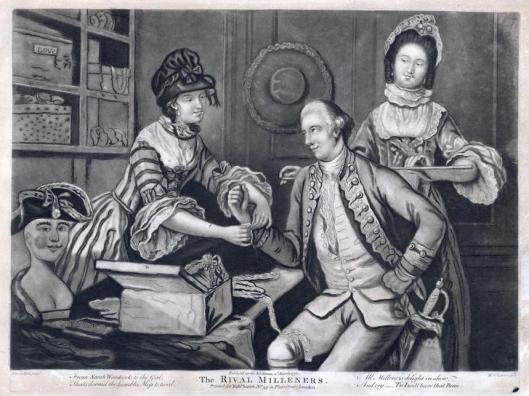
The Rival Milleners. Mezzotint after John Collet, 1772. Colonial Williamsburg Foundation, 1955-125

Brim shape and bonnet material— fabric and colour–  vary by period (and region). So let’s look at Boston in the first years of the 1770s. One tricky bit is that there are fewer indentured servants and enslaved people in Boston than elsewhere in the American Colonies in this period, so runaway ads are scarce, giving us fewer clues than we get in Pennsylvania and points south. Still, there are plenty of ads to help guide us.

As early as 1769, we see color variations, with the mention of “black, blue, green, white, and crimson bonnets” in Caleb Blanchard’s store. The year before, Joshua Gardner and Company advertised “black, pink, blue & crimson sattin hats and bonnets.” That means that on the streets of Boston and environs, by 1775, you’d see half-worn black, blue, green, white, crimson and pink satin bonnets.

The best statistics around for bonnets are currently tabulated for Pennsylvania, and definitely show the preponderance of bonnets are black (52 of 75 tabulated, or 69%). So don’t give up on black silk bonnets! They are the most common color. If we extrapolate these statistics, for a Pennsylvania event in the 1770s, of every 10 bonnets, seven should be black, one should be white, one should be green, and one should be blue. In larger groups, we’d also see red and brown bonnets, but again, just one in 20 or 30.

The Boston Gazette, April 4, 1774. Benjamin Franklin’s sister advertises “Sattins of the newest Fashion… for Bonnets.”

“A few sarsnet taffety bonnets,” in the Boston Evening Post, September 28, 1772.

For Massachusetts, statistics are more difficult to compile, given the dearth of runaway ads and the fact that I haven’t yet dived into inventory and probate records. Merchants’ ads give us some clues as to materials, and one thing I find is that “sattin” shows up, as well as “sarsnet taffety” or pelong. Sarsnet or sarcenet was a “think transparent silk of plain weave,” according to Textiles in America. Thicker than Persian, sarcenet was woven both plain and twill, and could be plain or changeable. Pelong is a kind of silk satin, again according to Textiles in America, and in The Dictionary of Fashion History, described as a kind of “thin silk satin,” but I have also seen it described as a ribbed silk. Joshua Blanchard advertised “Pelong sattins of all colours” in 1768. Where does that leave us with materials? Probably with the need for more bonnets to be made of silk satin than of silk taffeta, though the proportions are difficult to calculate yet.

Miss Theophila Palmer (1757-1848), oil on canvas, attributed to Sir Joshua Reynolds ca 1770.

What about shape? For those dressing a la mode, we are past the deep-brimmed, small-cauled “lampshade” of the 1760s, and into a smaller, tighter bonnet with a larger caul and more trimming. In the portrait of Miss Palmer, we see how the brim stands away from the face, and the caul or crown poufs up. “A Lady’s Maid Purchasing a Leek” and “The Rival Milleners” (aee above) both depict women in similarly tight-brimmed and round-crowned bonnets trimmed with bows. These are shapes that I am confident appeared almost universally (with variations) in the American colonies in the first years of the 1770s. Now, there are different shapes to be sure, but these seem to predominate. I do think we need to see more brims that wrap around the head, as seen in the 1774 mezzotint of George Whitefield (Anglo-America’s most popular preacher) and his followers.
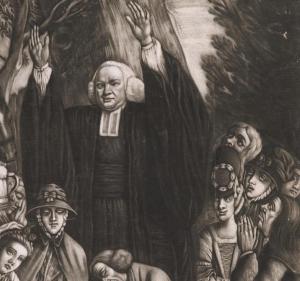
Detail, A Call to the Converted. Publish’d April 15, 1774, by W. Humphry . Lewis Walpole Library, 774.04.15.01+

So what’s the take away, if we are looking specifically at Boston and environs in the first half of the 1770s?

  1. Most bonnets (70%) were black, but a few white, green, crimson, and blue were seen.
  2. Most bonnets were made of silk satin, with others of taffeta or sarsnet (sometimes twilled silk).
  3. Most bonnets would have a shorter, higher brim that curves across the face just above eye level, with a high, rounded crown/caul and bow trims.
  4. Bonnet brims would vary between bonnet (paste) board and boned

Each place has a local style– which, if you think about it, is still true today. When I stand on the Metro platform in the red wool coat I bought in Providence, these folks know I’m not from here. The way we dress for the past should reflect the place and the time we are representing as best we can. And that means we need accessories to match those times and places, as well as clothes.

And yes, full disclosure, I sell researched bonnets on Etsy. If you want a bonnet for a particular time and place, that’s what I make.

* Known on this blog as “lampshade”
** Nope, don’t know what that means yet, haven’t looked into it
Share this:

  • Share on Facebook (Opens in new window) Facebook
  • Share on Pinterest (Opens in new window) Pinterest
  • Email a link to a friend (Opens in new window) Email
  • Share on X (Opens in new window) X
Like Loading...

Come Dancing

24 Thursday Jan 2019

Posted by kittycalash in Events, Museums, personal

≈ 2 Comments

Tags

dancing, Events, living history, MoAR, Museum of the American Revolution, Philadelphia

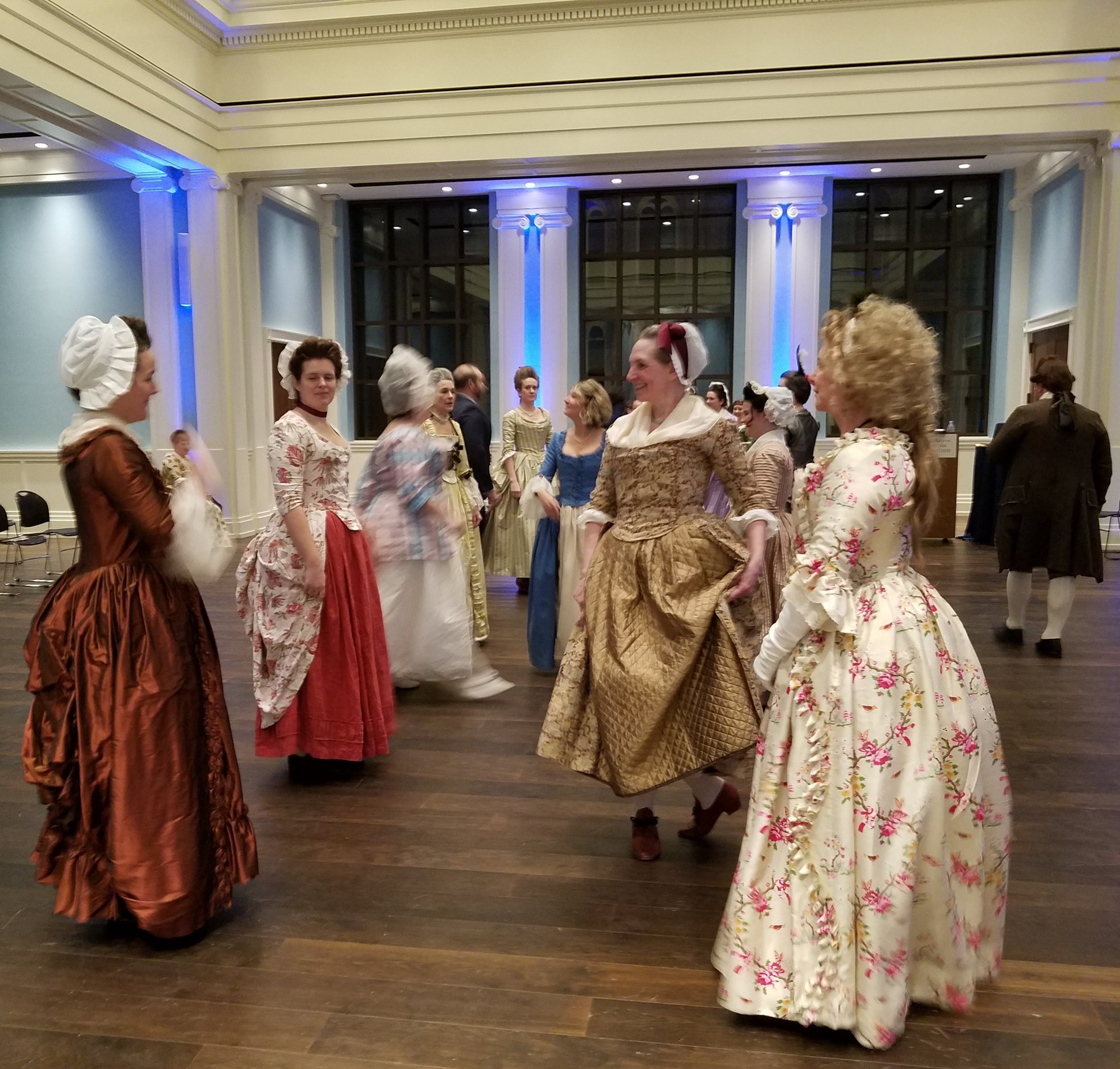
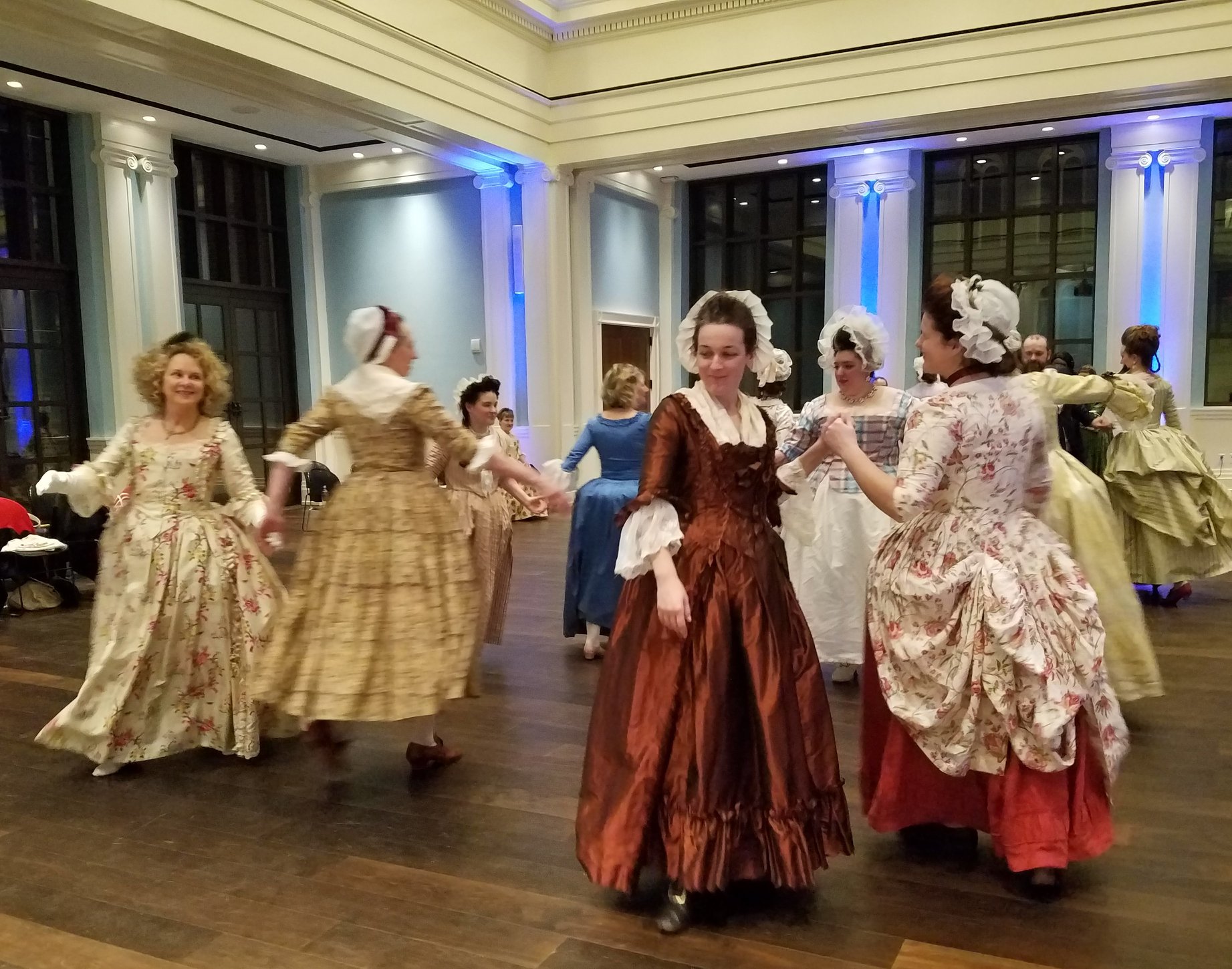
There haven’t been as many chances to dance as I’d like of late, so when I got the Museum of the American Revolution’s invitation to come dancing at their January History After Hours event, I said yes. Luckily, I had to be in Philadelphia for the next day anyway, so out came the 1780 appropriate dress and the fancier shoes, along with my resolve not to be a wallflower, and off I went. I very nearly made it on time, but I dressed as fast as I could, and managed to join the crowd with my dress pinned and my hair tamed.

As at past balls, I was rescued by a kind soul (and excellent dancer) who took me through the steps and saved me from my occasional pattern dyslexia. (Reversing can be tricky– they didn’t let me drive the forklift much in school because my brain sometimes struggles to process a mirror image.) But Miss V was a gracious partner, and reader, I confess: I greatly enjoyed myself.

One aspect of historical dancing that has always appealed to me is the relationship between classical ballet and traditional English country dances. While you won’t find tutus on Jane Austen’s dance floor, you will find balancé and glissade, and the use of positions. This connection between two things I love, and the way movement can connect us to the past, makes me enjoy these dances even more. Using steps I learned and practiced endlessly decades ago in a hobby I pursue today is a very personal reminder of the persistence of the past.

An evening of dancing, with the best dance caller and instructor I’ve yet had the pleasure to meet, was a welcome winter treat.


Many thanks to Miss G.J. for the use of the photos, and deep honours to Miss V.D. as a partner, and Mr. N.V d.M., dancing master.

Share this:

  • Share on Facebook (Opens in new window) Facebook
  • Share on Pinterest (Opens in new window) Pinterest
  • Email a link to a friend (Opens in new window) Email
  • Share on X (Opens in new window) X
Like Loading...

Living Deliberately

08 Tuesday May 2018

Posted by kittycalash in Living History, personal, Philosophy, Reenacting

≈ 7 Comments

Tags

domestic life, historic houses, interpretation, living history, personal, philosophy

WCD: The Original

A friend of mine recently wrote about replicating the domestic life of the past (specifically the 18th century) and how much meaning that had for her.

Being so deeply embedded in the rhythms of life there, it became my home in a very real sense that has never left me.

I read that quickly, and what I read was that the place she had spent so much time was home to her because the place never left her– she carried its rhythms and seasons within her. Perhaps that isn’t quite what she meant, but that’s the risk of writing: the reader reads what they need to.

It made me think of home, and of living deliberately, and of a very bad year I had a long time ago, before I even imagined doing living history, when I thought I would spend my life making new things, like cities and buildings. (This makes me think of an album I listened to at the time, More Songs About Buildings and Food, which seemed all the more important because I’d gone to RISD, too.

Food, in a Building, in Rhode Island

The year I turned 25 was particularly bad not because a man broke my heart, though that didn’t help, and not because I had a miscarriage, though that was the catalyst that led to the man breaking my heart, but because the miscarriage shattered my sense of purpose and self. Somehow, everything that I had ever wanted to be — a sculptor, an architect, a writer– was gone, and I didn’t know what to do or how to be. (Read The Year of Magical Thinking if you want a well-written take on this kind of loss.) I didn’t know what to do next, but the man who eventually broke my heart gave me a book to help me figure it out: Chop Wood, Carry Water

Chopping wood.

Two years ago, I wrote a piece called Zen and the Art of Living History, in which I extolled the virtue of the everyday: Embrace the everyday, bring everyone back into history. Since then, I’ve thought more about how history and historic house museums can be a catalyst for change, how domestic sites can create “homes for history,” where we can have the difficult conversations that must be had to make the change I think we need as a nation, and as humans. These changes are happening, slowly, in museums and at historic sites, but even at the personal level, there’s meaning and change to be had through the business of “doing history.”

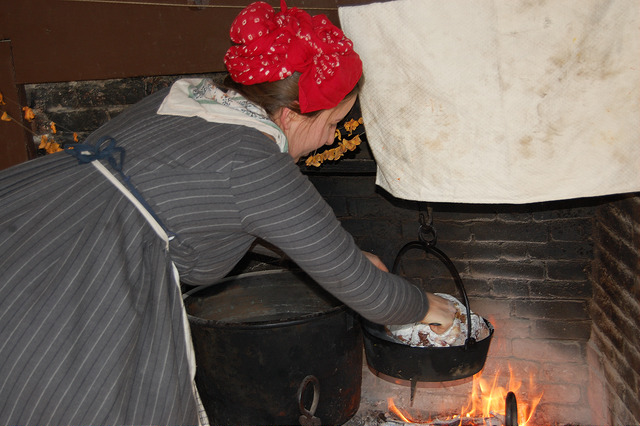
I suspect that among the reasons people really enjoy immersive, civilian (non-musket) events is because the work brings them into the rhythms of the natural world in a way that industrial life precludes or even prohibits. Consciously or not, interpreting the domestic life of the past forces us into mindfulness, into being as much as or more than doing. That’s the point of “chop wood, carry water:” to live deliberately. To cook without a clock, with only the color of the coals and the smell of the food to guide you; to notice the changing light because, as it fades, you must act to create light; to find the flaws and shifts in a floor as you scrub it, because there’s no machine between you, just your hands and a brush or a mop: all these tasks force you to be in the moment, noticing your environment, noticing yourself. You. A corporeal presence in a material world. How does that feel, moment to moment? Physically, emotionally: the challenge of living in the past is to live an unmediated life.

To go back to basics the way we do with civilian or domestic-site based living history brings us back to our base: we face our physical needs and the challenge of meeting them. We face emotional tests that help us imagine how people in the past endured– I often wonder how everyday people coped with “melancholia,” grief, and disappointment– and help us endure. It brings us home to ourselves, to our individual histories and our shared histories, and that’s what really matters. The connection to the everyday that we experience in a place in time puts us in a continuum with the people of the past, and gives us a place to be, a thing to do, a meaning. And that is what every one of us needs.

Share this:

  • Share on Facebook (Opens in new window) Facebook
  • Share on Pinterest (Opens in new window) Pinterest
  • Email a link to a friend (Opens in new window) Email
  • Share on X (Opens in new window) X
Like Loading...

Sandby in Salem (New Jersey)

01 Sunday Apr 2018

Posted by kittycalash in Events, History, Living History, Reenacting

≈ 9 Comments

Tags

common people, Hancock House, HM 17th Regiment, interpretation, living history, New Jersey

The Kitchen at Sandpit Gate (detail). Watercolor on paper by Paul Sandby 1754. Royal Collection Trust, RCIN 914331

The best times are always those when we are the least self-conscious– not that we can necessarily choose those times. Often they simply happen to us, but if we are lucky enough, we will notice, or someone else will record those moments for us. Last weekend, without even meaning to, we came as close as I may ever hope to get to recreating Sandby images of the Sandpit Gate kitchen.

Mistress F commanded the kitchen: I served as her reasonably able scullion, and, with assistance from Drunk Tailor and the company of the B’s, we managed to produce enough food for several dozen people.


IMG_3869
IMG_3866

(I baked the pound cake at home, but the egg and onion pies were made on site. I lack historically correct baking apparatus aside from one pie plate.) Cooking in the cabin at Hancock House reminded me of good times long ago— and not so long ago–and how much I enjoyed throwing refuse out a window, and using a soapstone sink. The weekend also brought to mind “show, don’t tell” as it applies to interpretation, and made me think again about how to create more immersive educational experiences for visitors, without becoming ritualistic.

IMG_3873
IMG_3878

There’s not much time to think those esoteric, grad-school-seminar thoughts when you’re in the midst of cooking, and that can actually be a relief. Instead, better to think of the light, and the landscape, and the time remaining until a pie is cooked through.

IMG_3871
At Sandpit Gate circa 1752. Royal Collection Trust, RCIN 914328


The landscape and the light: redemptive, all that space, the blue sky and the grasses. I thought of The Witch of Blackbird Pond, which I haven’t read in decades, for in some ways, the coast of New Jersey resembles the coast of Connecticut. It’s one of the first historical novels I remember reading– it is probably one reason I have ended up doing the work I do, and spending as much time as I did in New England. (You can read it here.) It’s not brilliant literature, and it was nearly two decades old when I read it, but it was certainly memorable.

Photos courtesy of HM 17th Regiment, Al Pochek, and Cape May Wren Photography.

Share this:

  • Share on Facebook (Opens in new window) Facebook
  • Share on Pinterest (Opens in new window) Pinterest
  • Email a link to a friend (Opens in new window) Email
  • Share on X (Opens in new window) X
Like Loading...

Didion, Despair, and Not Looking Back

31 Saturday Mar 2018

Posted by kittycalash in personal

≈ Comments Off on Didion, Despair, and Not Looking Back

Tags

don't look back, living history, personal, philosophy, why I left

Not everyone develops a relationship with a place that feels romantic, a relationship so intense, even when tortured, that when you leave, at last, as leave you must, you are torn apart by knowing the place abused you– and knowing you must go. Still: you love the place and cannot quite bear to not be there. It’s a complicated thing, and as with most tempestuous relationships, this tug of a place on one’s heart must be analyzed, objectified, studied, and understood. I thought I was making progress that way until I was given a chance to look back– don’t ever look back– and even though I did not look the basilisk full in the face, I was nauseated: waves of sadness and anger broke over me at reading a head line and image caption.

I stepped back to consider just what it was about the place and the situation that affected me so. Reading almost always helps. This time, I pursued literary criticism as a means to understanding. Van Wyck Brooks absent from the shelf at my local public library, I took hold of Joan Didion, and found myself rewarded.

“The Seacoast of Despair” described my place perfectly.

‘Happiness’ is, after all, a consumption ethic, and Newport if the monument of a society in which production was seen as the moral point, the reward if not exactly the end, of the economic process. The place is devoid of the pleasure principle.

Devoid of the pleasure principle? In Freudian psychology, the pleasure principle is the instinctive seeking of pleasure and avoiding of pain in order to satisfy biological and psychological needs. Specifically, the pleasure principle is the driving force guiding the id. Didion states, “To have had the money to build “The Breakers” or “Marble House” or “Ochre Court” and to choose to build at Newport is in itself a denial of possibilities; the island is physically ugly, mean without the saving grace of extreme severity, a landscape less to be enjoyed than dominated.”

Indeed. Mean with the extreme severity, a landscape to be dominated. Those phrases define the principles that shaped my relationships with a few denizens of Newport, who, in truth worked and did not live there, but who seemed fully to embody, embrace, and imbue their personages with non-pleasure principled forces drove them to dominate others, and to consume, for their own use, much of what they encountered. Didion described my experiences and observations of Newport in language better than I could ever hope to conjure.

Three years ago this week, I came to a realization, first on a drive to Newport, and then on a train to Boston. I saved the tweets from that train trip.

Screen Shot 2018-03-31 at 4.25.26 PM
Screen Shot 2018-03-31 at 4.19.39 PM

I went to Boston that Saturday–it snowed; the train was an early one–to make a presentation at History Camp on work that related to Rhode Island and to Newport history. Earlier in the week, I’d had a vision in Newport that unsettled and delighted me, and informed those tweets.

“There was a for sale sign on one property (Sotheby’s Realty, of course), and for an instant, I imagined walking into the house and owning it, starting a life completely different from the one I live, with different people and places.”

Between that vision on Bellevue and Saturday’s train trip, I had enough exchanges with the object of my desire to form a fuller notion of what that vision meant. That understanding led to the tweets, which I posted as #fiction to protect the vision, and the desire, from the reality of my seemingly-unalterable situation.

The miracle here is that I had a vision, and have very nearly carried it out, despite not fully understanding how much of my standing life I would have to burn down to achieve that kind of freedom. It had not occurred to me that moving and changing  to achieve what I wanted–to no longer have a secret, to grasp those lapels nearly every night when I arrive home from work, and taste that accent on every kiss– it had not occurred to me how much I would have to destroy, or leave behind, and that in doing so, I would leave bones of my former soul to be picked over by opportunists ready to exploit an opening.

The consumption ethic: they have grabbed what they could not get while I was still there, and they run their paws over the work without fully understanding it. And that is where I can take my sole pleasure: the schadenfreude of watching them strive and fail, or perhaps the pleasure of watching them reach and grasp. Either way, I know I cannot look back. Something might be gaining on you, and it’s best to outrun those monsters.

Didion, Joan. “The Seacoast of Despair,” p. 157-158.  Reprinted in We Tell Ourselves Stories in Order to Live, New York: Everyman’s Library, 2006.

Share this:

  • Share on Facebook (Opens in new window) Facebook
  • Share on Pinterest (Opens in new window) Pinterest
  • Email a link to a friend (Opens in new window) Email
  • Share on X (Opens in new window) X
Like Loading...
← Older posts
Newer posts →

Archives

wordpress statistics

Creative Commons License
Kitty Calash blog by Kirsten Hammerstrom is licensed under a Creative Commons Attribution-NonCommercial-ShareAlike 4.0 International License.

Website Built with WordPress.com.

  • Subscribe Subscribed
    • Kitty Calash
    • Join 621 other subscribers
    • Already have a WordPress.com account? Log in now.
    • Kitty Calash
    • Subscribe Subscribed
    • Sign up
    • Log in
    • Report this content
    • View site in Reader
    • Manage subscriptions
    • Collapse this bar
 

Loading Comments...
 

    %d