• Home
  • Completed Costumes/Impressions
  • Emma and Her Dresses
  • Free Patterns and Instructions

Kitty Calash

~ Confessions of a Known Bonnet-Wearer

Kitty Calash

Tag Archives: living history

The Society of Friends

09 Sunday Mar 2014

Posted by kittycalash in Clothing, Events, History, Museums

≈ 2 Comments

Tags

19th century clothing, fashion, living history, Newport, Newport Historical Society, Quaker dress, Quakers, reading, Rhode Island, Seventh Day Baptist Meeting House, style
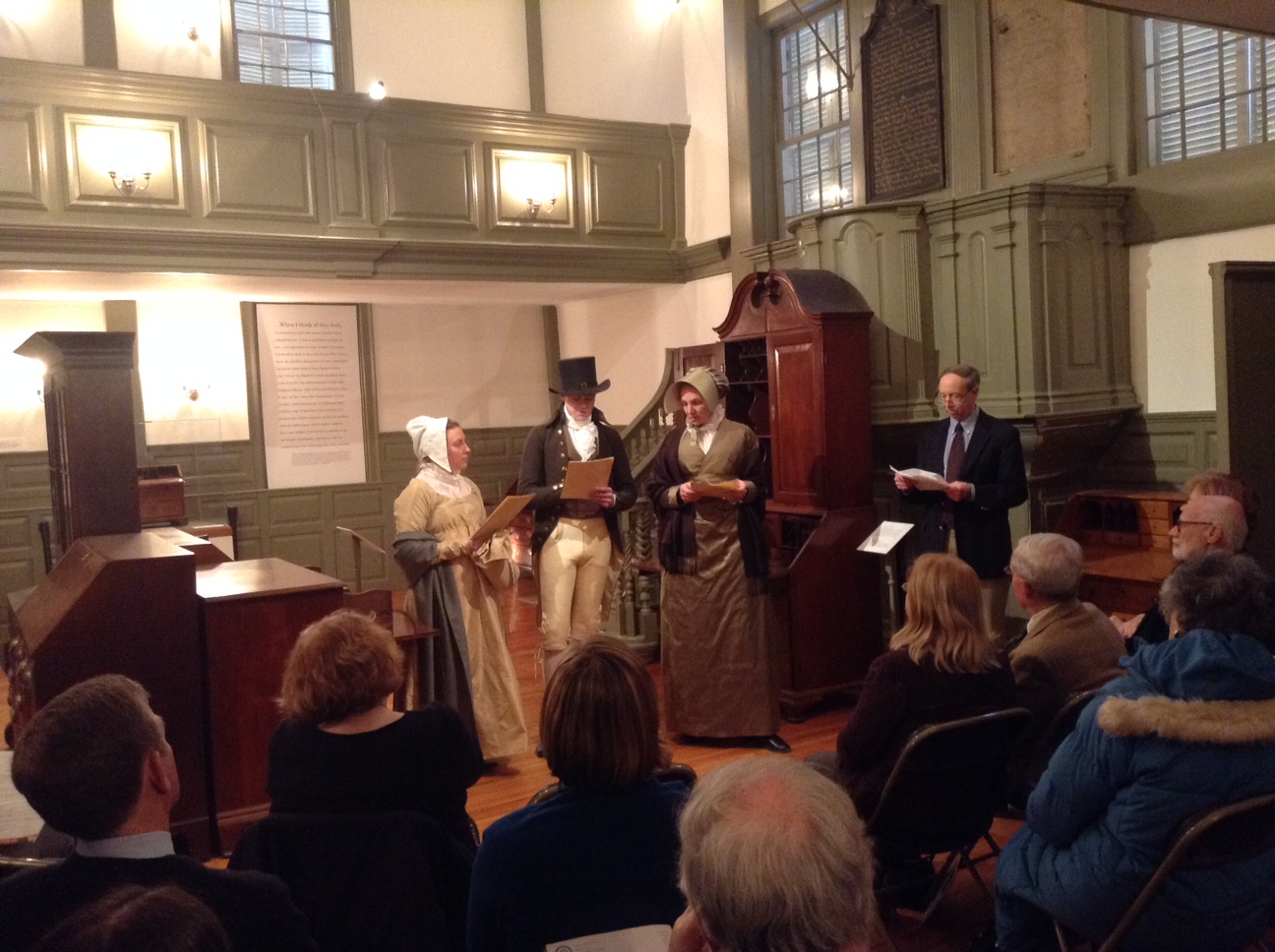
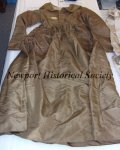
Courtesy Newport Historical Society

Courtesy Newport Historical Society

Last Friday, I joined my friends in Newport for a program at the Newport Historical Society.

We stood in the Seventh Day Baptist Meeting House behind the NHS’s headquarters building and read excerpts of letters from the Williams Collection.

This is a simple, elegant concept for a program, and works incredibly well if the correspondence have the gift for expression that these people did. Even quotidian details–the price someone wants to get for their dining set, the likelihood of moving one’s mother, who must be carried ‘as carefully as a box of China’–take on humor when read aloud.

Courtesy Newport Historical Society

Courtesy Newport Historical Society

The best letter might well have been the last one, read by Sew 18th  Century. The latest of the selection, the writer described a visit to Newport around 1844, arriving at the dock to the bustle of wagons, walking streets and finding a barber who knew the old fish hawker, the enormous jaw bone of a whale on a street corner, and even lifting the latch to walk inside the Seventh Day Baptist Meeting House where we were standing.

It was a lovely way to end the program, resonant with details the audience could connect with.

My dress turned out all right, and I managed to get it on and keep it on, which seemed a small miracle requiring only two pins.

When I tried it on at home, the front panel didn’t wrinkle, so I think I pulled it too tightly around me on Friday. I kept my bonnet on because I didn’t have time to make a new cap, so made do with the housekeeper’s cap from last fall. The chemisette was made by Cassidy, and saved me from the migratory ‘charms’ of a kerchief. The ‘shawl’ was a gift  Christmas from my mother, who rightly saw it as a scarf, but those who wish to keep warm do not quibble when they cannot find exactly what they want. Before I wear the dress again, I have to attend to interior seams of the skirt and scoot the cuffs down to lengthen the sleeves. Four yards of 48-inch wide silk was just enough, but needs a little tweaking when you’re a tall as I am.

Share this:

  • Share on Facebook (Opens in new window) Facebook
  • Share on Pinterest (Opens in new window) Pinterest
  • Email a link to a friend (Opens in new window) Email
  • Share on X (Opens in new window) X
Like Loading...

Who was Bridget Connor?

26 Wednesday Feb 2014

Posted by kittycalash in History, Living History, Research

≈ 5 Comments

Tags

10th Massachusetts, 18th century, Brigade of the American Revolution, common people, common soldier, Continental Army, genealogy, impressions, laundry, living history, orderly books, Research

Detail, James Malton, 1761-1803, A Military Encampment in Hyde Park, 1785, Watercolor with pen in black ink, with traces of graphite on moderately thick, moderately textured, beige, laid paper, Yale Center for British Art, Paul Mellon Collection. B2001.2.999

Detail, James Malton, A Military Encampment in Hyde Park, 1785. YCBA Paul Mellon Collection. B2001.2.999

Who knows? She’s hard to find, though I am told and have real hope that the microfilm of the Abbott orderly books that chronicle her misdeeds in wending its way to me down the dirty, salt-and-sand covered highways of southeastern New England.

Where have I looked for her and Francis Connor, whom I presume is her husband?

  • In every online vital record for the Commonwealth of Massachusetts.
  • In the National Archives microfilm of compiled records of Massachusetts soldiers in the 10th Regiment and the miscellaneous records.
  • In the Revolutionary War pension records index.
  • In the DAR index.
  • In the Soldiers and Sailors of Massachusetts.

Francis appears in Soldiers and Sailors of Massachusetts, for seven months’ service. That’s all I can find.

Well, crap, right? This genealogy stuff in Massachusetts is hard work—there are so many more people and towns than we have here in Li’l Rhody—but diligence and method pay off, and when you figure you’ve about exhausted the primary sources you can access for now,[1] you turn to secondary sources.

Lest you think I dislike Deborah Samson, note that I found her life a useful source in thinking about Bridget, as well as Book of Ages and Jane Franklin Mecom’s life. I’ve also been re-reading Holly Mayer’s Belonging to the Army.

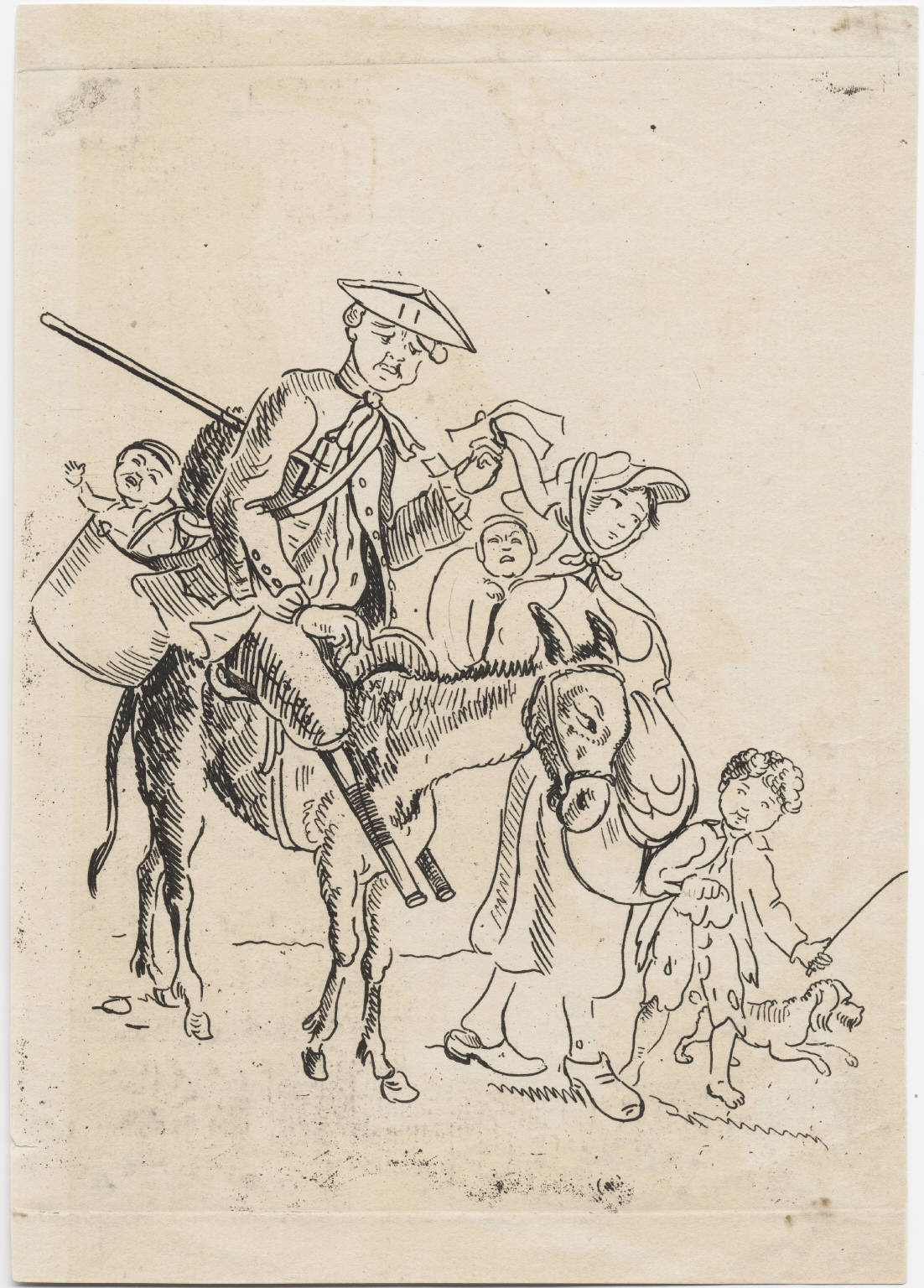
Crippled soldier with family. Etching, London (?) ca. 1760. Lewis Walpole Library, 760.00.00.16

Crippled soldier with family. Etching, London (?) ca. 1760. Lewis Walpole Library, 760.00.00.16

The common denominator: poverty, and the resulting lack of choices. This is useful for Bridget, because her story is probably one of necessity. Most women who followed the Continental Army, and worked for it, were from the lowest ranks. [2] These are women who would do what was necessary to survive, and as Mayer notes, “would rather steal than starve.” [3]

I’m not suggesting that Bridget, who would likely have received rations, needed to steal shirts to survive: I rather think she was attempting to leverage her position and profit by ill-gotten gains. But how did she end up in the Army to begin with? Massachusetts in 1782 is not New York in 1780, or Rhode Island in 1778.  What drove her to (presumably) follow Francis Connor?

Late in the war, maintaining troop strength is more difficult. The fervor of patriotism has cooled, and recruiting sergeants find it harder to fill the ranks.[4] There are bounties to be had, and the economy has suffered. Could Francis have been a property-less laborer who enlisted for the bounty? Nothing talks like cash. And, if the couple were tenants somewhere, without Francis’ income, Bridget might not have been able to maintain a home. Laundry doesn’t pay that much.

Why didn’t she stay with family? Could they have been indentured servants? Could they have been immigrants? My guess is that Bridget had no family, and if Francis had family, Bridget got on with them as well as she did with the officers of the 10th. I think she had nowhere to go, no way to survive without Francis.

Did they love each other? Did they like each other? Were they grifting together? I don’t know—but Francis Connor deserts the same day Bridget Connor is expelled from camp, so they’re bound together in some way. No matter what, Bridget was assuredly dependent on Francis.

Knowing so little about them opens up a world of possibilities, and the “opportunity” to do a great deal more research on the context of 18th century Massachusetts populations and enlistments. My best guess is that they’re an unpropertied laboring class couple from Boston, source of many of the relatively unstable and non-homogenous companies that made up the 10th Massachusetts. I also think they don’t have family, and might be former indentured servants. I have guesses about their religion and country of origin, which could be why the records are so hard to find. [5]

Looking for Bridget, and not finding her, leaves me with more and more questions, and I’m happy about that.


[1] She’s in the Abbott Orderly books, at least. Other Orderly Books to follow, as time and funds permit.

[2] Mayer, Belonging to the Army, page 122.

[3] Mayer, page 127

[4] How do you think Deborah Samson got in, passing as a boy? That’s 1782 for you.

[5] The Catholic Diocese of Rhode Island maintains separate historical vital records, and when we cannot find someone in the usual town records, we ask the genealogist if their family is perhaps Catholic or Quaker. Lack of evidence can be a suggestion of faith in my home state. But could these two be Irish Catholic in Massachusetts in 1782? I have no idea, but it seems a great stretch and a great question all at once.

Share this:

  • Share on Facebook (Opens in new window) Facebook
  • Share on Pinterest (Opens in new window) Pinterest
  • Email a link to a friend (Opens in new window) Email
  • Share on X (Opens in new window) X
Like Loading...

The Birth-Night Ball (a preview)

24 Monday Feb 2014

Posted by kittycalash in Clothing, Events, Living History, Reenacting

≈ Comments Off on The Birth-Night Ball (a preview)

Tags

10th Massachusetts, 18th century clothes, 18th century clothing, authenticity, common dress, common people, dress, fashion, Grand Ball, living history, patience, style

Fully done up.

Photos by a real photographer won’t be available for another two weeks (patience, Iago, patience) but  Mr S and I had a lovely time, high-heeled shoes excepted. The gowns were dramatic, the gentlemen dandy, and the dancing elegant, if bumpy at the start. There are some videos here, both of the assembled company dancing, and of the lovely minuet demonstration.

Selfie, and ready for bed!

I managed a phone photo just before I crashed into bed, and am generally satisfied with how the dressed-up laundress appeared. Clearly my laundry business is doing very, very well, or I have liberated some earrings from a client. One of the most challenging things about this event (aside from my over-thinking freak outs) was not having a persona to hold onto. We started reenacting as lower-class 18th century types, and spent some time as tenant farmers and maids. Mr S and I do not have clothes for the gentry, but can inch into the middling sorts when we want to.

That’s fine, and it’s comfortable– we’ve not yet really reached all the way down the lower sorts, either–but it does mean that when we’re presented with the opportunity to dress above our station, the need to really understand the new station kicks in, and delays the process.

I’ll finish that silk sacque someday, and sooner rather than later, but I’m glad I held off so I can really get the gown right, as well as the shoes, hair style, and other accessories.

Share this:

  • Share on Facebook (Opens in new window) Facebook
  • Share on Pinterest (Opens in new window) Pinterest
  • Email a link to a friend (Opens in new window) Email
  • Share on X (Opens in new window) X
Like Loading...

Consider the Collar

31 Friday Jan 2014

Posted by kittycalash in Clothing, Events, History, Museums, Research

≈ 5 Comments

Tags

18th century clothing, 19th century clothing, authenticity, dress, fashion, living history, museum collections, Museums, Newport, Newport Historical Society, Quakers, Research, Rhode Island, Rhode Island history, style

The Newport dresses seemed a little strange to me, in that the collar treatment was more like what I would expect to see on a pelisse than on a gown. But I am willing to be wrong, and delighted to be wrong if that’s how I will learn something.

Brown silk Quaker dress, Newport Historical Society, 20.4.1
Brown silk Quaker Dress, Newport Historical Society, D77
Morning dress, ca. 1806. American Cotton, wool. Length at CB: 54 in. (137.2 cm) Gift of George V. Masselos, in memory of Grace Ziebarth, 1976 MMA 1976.142.2
Morning dress ca. 1820. British. Cotton. Length at CB: 46 in. (116.8 cm) Purchase, Marcia Sand Bequest, in memory of her daughter, Tiger (Joan) Morse, 1979 MMA 1979.385.1

@silkdamask (that’s Kimberley Alexander’s twitter handle; she has a blog you might want to follow if you don’t already) posted a photo of the dress (above left) she imagined a young woman she’d been writing about might have worn. Housed at the Met, this embroidered American cotton and wool gown ca. 1806 has a cross-over bodice and collar.

Another day dress from the Met (above right) has a ca. 1820 date, but looks very much like the gown worn by Mrs Amelia Opie (she was a British Quaker) in this engraving after an 1803 portrait. (Other, similar gowns and portraits are pinned here.)

Amelia Opie (1769-1863). Engraving by Ridley after painting by [John] Opie, 1803. Massachusetts Historical Society, Photo. 81.490

Amelia Opie (1769-1863). Engraving by Ridley after painting by [John] Opie, 1803. Massachusetts Historical Society, Photo. 81.490

Nantucket and New Bedford  both hard large Quaker populations (remember Moby Dick?), and the Williams family in Newport had connections to New Bedford, so I looked in collections in Nantucket and New Bedford as well.

The gown below, now in the collection of the New Bedford Whaling Museum, was worn by Susan Waln Morgan Rodman (Mrs Benjamin Rodman), while pregnant; using a genealogy, we can establish pretty solid date ranges for the dresses at New Bedford Whaling Museum. It looks 1820s in style, and her first two children are born in 1821 and 1822.

Maternity gown worn by Susan Waln Morgan Rodman (Mrs Benjamin Rodman). New Bedford Whaling Museum, 1991.45.5.

Maternity gown worn by Susan Waln Morgan Rodman (Mrs Benjamin Rodman). New Bedford Whaling Museum, 1991.45.5.

A date range of 1820 to 1822 seems plausible. Susan Waln Morgan Rodman would have been about 20 with her first pregnancies. (Genealogies are on Google books.)

She seems to have kept up with style and to have liked clothes; a search for her name in the NBWM catalog returned some interesting items, though the catalog does not allow for linking to item records or searches. Mrs Rodman’s appears to have kept pace with style changes; that is, her wardrobe did not ossify in 1820-something, but evolved as fashions changed, and was appropriate for different situations.

Does that mean that all Quaker women kept pace with style changes? It’s hard to say; each of us today updates our wardrobe according to our fancy, our purse, our inclinations and our age. Are those Newport gowns going to turn out to look more like the Met gowns than I imagine? I don’t know, but it seems possible.

Share this:

  • Share on Facebook (Opens in new window) Facebook
  • Share on Pinterest (Opens in new window) Pinterest
  • Email a link to a friend (Opens in new window) Email
  • Share on X (Opens in new window) X
Like Loading...

Newport Friends

30 Thursday Jan 2014

Posted by kittycalash in Clothing, Events, History, Literature, Living History, Museums, Research

≈ 9 Comments

Tags

18th century clothing, 19th century clothing, authenticity, dress, fashion, living history, museum collections, Museums, Newport, Newport Historical Society, Quakers, Research, Rhode Island, Rhode Island history, style

Newport History, V 65, Part 1. Number 222.

Newport History, V 65, Part 1. Number 222.

I had a bit of a surprise when details emerged about the program Sew 18th Century and I will be doing in early March at her workplace. I’ve known about this since late October, but only started focusing on this last weekend, when I realized just how close March really is, and how much time I’ll be spending on well-chlorinated pool decks in February. I’m so glad I asked, because it turns out that we’re reading letters from a family of Quakers. I was not expecting Quakers, and had what is probably a completely inappropriate fabric in mind! (Off-white meandering red floral vines, to mimic a V&A gown.)

Still, there is no surprise that cannot be managed by research. There is an article about the family in Newport History, and they were kind enough to send it to me, and it arrived yesterday. Yay, mail in a small state! The article is helpful in providing context and family history, and there is even a photo, probably from a daguerreotype, of one of the women in the family.

Ruth Williams silhouette, Newport Historical Society, 91.14.4

So, what did Quaker women in Newport wear between 1800 and 1820? Lappet caps, for one thing. Lappet caps appear to have been a common cap in late 18th and early 19th century Rhode Island, and Ruth’s silhouette seems to bear that out.

These caps are also seen in many images of Quaker women, and borne out by the images in the collection where I work (sadly not appearing the catalog record, but still stable in the blog post on caps).

I can’t read letters in just a cap and a shift (it’s not that kind of event), so I need a dress. Newport Historical Society has two possibly Quaker gowns from the early 19th century, and they seem like plausible models.  But they raise questions quite aside from what you might find out by digging into provenance. What’s up with collars?

Brown silk Quaker dress, Newport Historical Society, 20.4.1
Brown silk Quaker Dress, Newport Historical Society, D77

The form, a brown or drab front-closing, high-waisted (but not too high) gown, with long sleeves and a pieced, shaped back, is consistent with images of Quaker women from the first quarter of the 19th century. The color and material (brown silk) is consistent with those images, and with earlier im,ages of Philadelphia Quaker women, and that all matches up with a gown that was worn by Sarah Brown of Providence. But the collar is curious, and without putting the garment on a dress form, it’s hard to tell exactly where the collar would fall, and how it would lie.

A Quaker's dress of greenish-brown taffeta American, Early 19th century. MFA Boston. 52.1769

A Quaker’s dress of greenish-brown taffeta
American, Early 19th century. MFA Boston. 52.1769

This gown at the MFA seems iconic to me, and I can imagine it underneath the white linen, cotton or silk kerchiefs and shawls of the portraits.

To learn more about Quaker aesthetics, I’ll be taking a trip down the hill to the RISD Library sometime this week, to look at books and articles. of particular interest is Quaker Aesthetics: Reflections on a Quaker Ethic in American Design and Consumption, 1720-1920. I’m also interested in an article by Deborah Kraak, Variations on ‘Plainness’: Quaker Dress in 18th Century Philadelphia. It’s not Newport, but at least it’s this continent.

I have read The Quaker: A Study in Costume, by Amelia Mott Gummere, and found it to be a pretty challenging work. It is possible that paint fumes made the writing seem more disjointed than it is, but I thought Gummere’s time-skipping references made it hard to follow the changes in Quaker dress in America, beyond what I do expect from a book published in 1901.

Share this:

  • Share on Facebook (Opens in new window) Facebook
  • Share on Pinterest (Opens in new window) Pinterest
  • Email a link to a friend (Opens in new window) Email
  • Share on X (Opens in new window) X
Like Loading...
← Older posts
Newer posts →

Archives

wordpress statistics

Creative Commons License
Kitty Calash blog by Kirsten Hammerstrom is licensed under a Creative Commons Attribution-NonCommercial-ShareAlike 4.0 International License.

Website Built with WordPress.com.

  • Subscribe Subscribed
    • Kitty Calash
    • Join 621 other subscribers
    • Already have a WordPress.com account? Log in now.
    • Kitty Calash
    • Subscribe Subscribed
    • Sign up
    • Log in
    • Report this content
    • View site in Reader
    • Manage subscriptions
    • Collapse this bar
 

Loading Comments...
 

    %d