• Home
  • Completed Costumes/Impressions
  • Emma and Her Dresses
  • Free Patterns and Instructions

Kitty Calash

~ Confessions of a Known Bonnet-Wearer

Kitty Calash

Tag Archives: Museums

Tripping in Richmond

20 Monday Aug 2018

Posted by kittycalash in Clothing, Events, History, Museums

≈ 5 Comments

Tags

art history, Costume, Federal style, Museums, Regency Society of Virginia, Travel, Virginia Museum of Fine Art

Visiting the Stately Home: an early touristic diversion

Friday night, Drunk Tailor and I waited until the worst of rush hour in NOVA was over and headed south to Richmond, surprised not to be engulfed in a terrific thunderstorm of the kind we are becoming accustomed to driving in. We had planned a weekend trip to see the Napoleon: Power and Splendor exhibition at the Virginia Museum of Fine Arts. It’s a traveling exhibit, but this is the first time I’ve been close enough to see it, and we had the added benefit of being able to attend in costume with the Regency Society of Virginia. (Reader: I required a new outfit.)

The idea of visiting a museum in costume is incredibly appealing, and all the more so when you can visit galleries of objects from the time period your costume replicates. Add to that the layer of traveling on the weekend in the clothes from the time when tourism first became a “thing” (at least among the monied classes), and you have a recipe for an excellent adventure.

(Somehow, while often at events together, Drunk Tailor and I are rarely seen “together,” so images like this are nice to have.)

If you are going to play the tourist, especially if you are visiting the “spoils” of the former emperor, you have to dress appropriately. American tourists today may travel in camo crocs and backwards baseball caps, but people in the past dressed for touring and it seemed appropriate to dress for this trip.

Admiring the panorama. (Cropped only to enhance periodicity)

This trip, with the fun of visiting in period clothes, reminds me of the books still in storage, and the books I have yet to read — one on early country house tourism— that document the changes in how people spent their time and consumed goods, and the reasonably concurrent rise of both the museum and the department store.

Raptures about the mounting, I think, but we might as well we shopping.

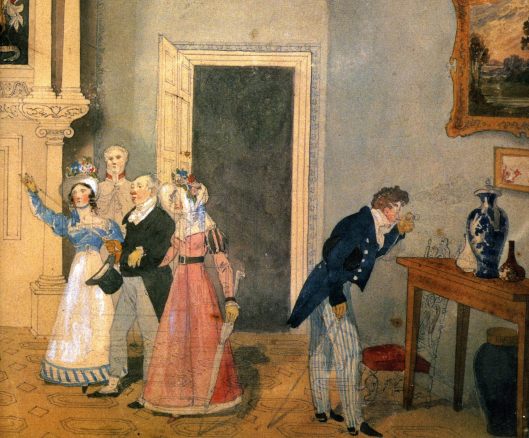
Peale and Zola have more in common than you might think, or at least Mr. Peale and Mr. Selfridge. These compendia of material goods are similarly structured — both organized around themes or types, whether ladies’ lingerie or Oceanic art– and have similar aims of edification and [cultural] consumption.

When your hat sees its cousin in a case….

All in all, an excellent trip, with much to see and talk about. After finishing our tour of the Napoleon exhibit, we lunched (another experience similar to the department store) and toured more of the museum, and had a day well spent.

Share this:

  • Click to share on Facebook (Opens in new window) Facebook
  • Click to share on Pinterest (Opens in new window) Pinterest
  • Click to email a link to a friend (Opens in new window) Email
  • Click to share on X (Opens in new window) X
Like Loading...

Pulling Back the Curtain

06 Wednesday Dec 2017

Posted by kittycalash in Museums

≈ 2 Comments

Tags

employment, hours, museum work, Museums, No Quarter Given, working conditions

The Artist in His Museum by Charles Wilson Peale. 1822. Coutesy Pennsylvania Academy of Fine Arts.

I read this blog post hoping to find some insights that might help me as I figure out what comes next. I found myself irked instead.

Be Prepared to Struggle.

3. Be prepared to struggle.
The museum education field is not for the faint of heart, or people who want a 9-5 job. One of my mentors advised me that the days are long, but the years are short. The hours will hurt, you will get tired of the near-constant balancing act, and you might even question if you’re making an impact. Hang in there. Find your network (local, regional, or national). Share your vulnerabilities with people you trust. Delegate if you can. Most of all, document your successes and create a portfolio that illustrates why your efforts matter.

What is hidden between those lines? Be prepared for your life to be subservient to the needs of the museum? Be prepared to give everything– but document all you do because you’ll need to prove your value, no matter how much you sacrifice?

Saint Catherine, by Bernardino Luini. State Museum of Azerbaijan. (c) Stourhead; Supplied by The Public Catalogue Foundation. You will not achieve sainthood by sacrificing your sanity to a job.

Why would you put your work ahead of your life? (YES, I KNOW that’s not exactly what that post is suggesting, but that’s how it often ends up.) Encouraging people to work hard is good, but telling them they should expect to, and will, suffer isn’t good. That feeds the beast that chews up and spits out eager, idealistic young people on a routine basis. The museum is definitely not going to tell you it loves you, or visit you in the hospital. You need the time to build your own life, a circle of friends or family, interests of your own to feed your soul. And that means you will need boundaries, and need to have some “evenings, weekends, and holidays” when work is not required or expected– though I know that those hours are required and that people have to work them because they need the money.

Sculpture Hall, after 1913 installation of ceiling lights and before 1928 installation of fountain, c.1920. St. Louis Art Museum

Museum education staff are on the front lines– certainly more so than the curatorial, research, or exhibition design staff– and their work is immediately recognized and experienced by visitors. Museum education staff include a wide range of folks, depending on the organization. Costumed interpreters, gallery guides, program managers and assistants to develop and run fun but educational activities for all ages, curriculum developers who work with teachers to ensure that museu visits and activities for school groups meet the local or common core standards, and lots more. Sometimes the education staff are paid less than the curatorial and collections staff– and they’re pretty underpaid to begin with. Education staff are, to a larger degree than collections staff, expected to work evenings, weekends, and holidays, often without holiday differential pay, and receiving “comp” time instead of overtime.

Now, all that said, the blog post also contains these points

1. Gain skills outside of your intended field.  Learn how to budget. Like, really budget. What would you do with $2,000? How about $250,000? Know the numbers, and know how to speak business. If this isn’t your comfort zone, join the club. Take free online courses (edX is my go-to), and expand your skillset to include some productive surprises.

Victoria and Albert Museum, interior view (South Court), late 19th century (V&A PH.1156-1905)

Guess what? Budgeting IS part of your intended field. Sure, educational methods for reaching kids is directly related, but there is hardly a museum job in the world that doesn’t need to deal with money to some degree. The better you understand the way a budget works, the way grant budgets work and what you need to account for, the better you will understand the place you work and why things are the way they are. (Translation: the better you will understand how you are being rewarded– or not.


2. Work hard, be nice.  One of the best things to do when you’re starting out (or moving up) is to do excellent work and share it with your peers, supervisors, friends, and anyone who can provide constructive feedback. The museum world is a teeny-tiny place, so be nice to everyone you meet.

Be nice. As a woman, I often hate hearing that. I’d rephrase this one to “Do the best work you can without killing or compromising yourself, and be generous to the people who help you.” Develop the radar that lets you know when your colleague is using you– and someone will, trust me. Eventually someone will take credit for your work (ask me how I know), or betray a confidence, or a boss will keep moving the goalposts for a promotion, raise, or title change.
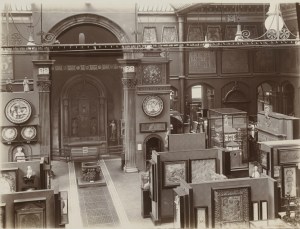
The North Court in the late 19th century. Museum no. E.1101-1989. © Victoria and Albert Museum, London

Museums aren’t easy to work in– there’s no field that’s always easy to work in– but we accept far too much because we love what we do. We are charmed, seduced, by the beauty of the objects, the mystery of the concepts, the scale of reach. But like a bad lover, museum administrators and boards can exploit our passion and use it against us. Don’t think they won’t.

If you don’t work in a museum, substitute your position title and/or field for the museum-specific words in this post. I believe everyone should be paid a fair wage, have decent working conditions, and the ability to have a robust and satisfying personal life as well as a job they find meaningful.

Share this:

  • Click to share on Facebook (Opens in new window) Facebook
  • Click to share on Pinterest (Opens in new window) Pinterest
  • Click to email a link to a friend (Opens in new window) Email
  • Click to share on X (Opens in new window) X
Like Loading...

Everything Old is New Again

19 Wednesday Jul 2017

Posted by kittycalash in Art Rant, Living History, Museums

≈ Comments Off on Everything Old is New Again

Tags

18th century, common soldier, interpretation, living history, Museums, Revolutionary War

I could be making bonnets. I could be applying for moar jobz. I could be finishing the soup that’s on the stove. But instead, I’m annoyed by a museum’s social media posting. For the sake of all that’s holy in history, is there nothing more to an 18th century soldier’s life than his weapon? Now, to the museum’s credit, only 50% of the posted images could truly be said to focus on the musket or some musket-related tool.

But what’s so damned annoying is that the organization in question, all brand-spanking new and on everybody’s “must-see” list, falls back on the same old tropes on social media, which makes me want to know more about their educational mission. If the social media message continues to reinforce the same messages (guns are important) instead of expanding to include a soldier’s daily life, or even his inner life, the public has trouble moving past that simple message to ask more questions.

Museums and their representatives cue the questions visitors ask by framing objects, writing labels, even aiming the lights, to focus on what the museum believes is important. Put guns front and center, that’s what the questions will be about instead of about hygiene, clothing, literacy, or diet.

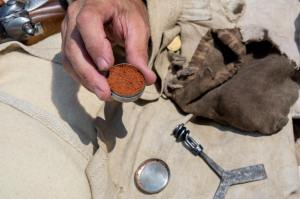
This image got me really excited, until I read the caption.

“Brick dust for polishing the brass elements on his weapon.” Dammit! It’s not tooth powder!

I understand full well that the museum’s interpretation of our national founding is far more inclusive than many museum visitors have previously encountered. I understand that the educational program currently lacks a permanent director, and is not yet fully fleshed out.

Museums are among the most trusted sources for information. Presentation matters. What museums emphasize matters. If museums — in their exhibits, programs, or marketing– continue to “give the people what they want,” the people will not know that they can want something different, or even that there is something different to want. Inclusivity is constant: in the galleries, in the labels, in the programming, in the staff, and in the marketing (which this museum did, in fact, do, masterfully, at a major train station).

But I’m picking on them for this post because they are the top of the game right now, and if they can do better in the galleries and in the train station, they can do better on social media. They’ve had some of the best female interpreters around working this month and the end of last, and yet the first social media post on that program is of a soldier, and focuses on his weapon. The past– and the present– deserve better.

Share this:

  • Click to share on Facebook (Opens in new window) Facebook
  • Click to share on Pinterest (Opens in new window) Pinterest
  • Click to email a link to a friend (Opens in new window) Email
  • Click to share on X (Opens in new window) X
Like Loading...

Becoming an Exhibit Prop

21 Tuesday Mar 2017

Posted by kittycalash in Museums

≈ 5 Comments

Tags

19th century clothing, Clothing, dress, exhibits, fashion, Federal style, Museums, sewing

We all have those Hamlet-like moments, don’t we?
How weary, stale, flat, and unprofitable | Seem to me all the uses of this world!

But in this case, I can attest to being and not merely feeling flat: lo, I am cutout exhibition furniture.

Thanks to Mr B’s casting call on behalf of the New-York Historical Society, a number of friends and acquaintances and I are now part of the scenery of the new exhibition, Saving Washington, up through July 30.

The behind the scenes of being a prop is pretty entertaining.

Mr H
Mr H
Steaming my shawl
Steaming my shawl

The changeable green-red sari gown was made for this photo shoot; we were asked to wear strong colors, and since the exhibit was meant to represent one of Dolley Madison’s “squeezes,” dressing up was in order– and hard for me to do, since most of my gowns are day dresses at best.

I started this November 22, and carried it on airplanes several times.

November 22: the madness begins
Sleeve salvation
Sleeve salvation

The sleeves appeared to be a complete failure at first, until I figured out I could pleat the design to form a smaller, graphic band at the bottom. Sometimes I start without knowing how a thing will turn out…including most days when I get out of bed.

December 9 completion level: wearable.

At least it was finished enough to wear to the photoshoot, and it appeared again, with a real hem and a ribbon to keep it on, in Salem last month. I’m pleased enough with the color, and how well it doesn’t go with most things to call this a success– and finished!

In situ.

Share this:

  • Click to share on Facebook (Opens in new window) Facebook
  • Click to share on Pinterest (Opens in new window) Pinterest
  • Click to email a link to a friend (Opens in new window) Email
  • Click to share on X (Opens in new window) X
Like Loading...

Sleeping on the Job

03 Friday Feb 2017

Posted by kittycalash in History, Living History, Museums, Research

≈ Comments Off on Sleeping on the Job

Tags

authenticity, common people, interpretation, John Brown House Museum, Museums, Research

img_9092

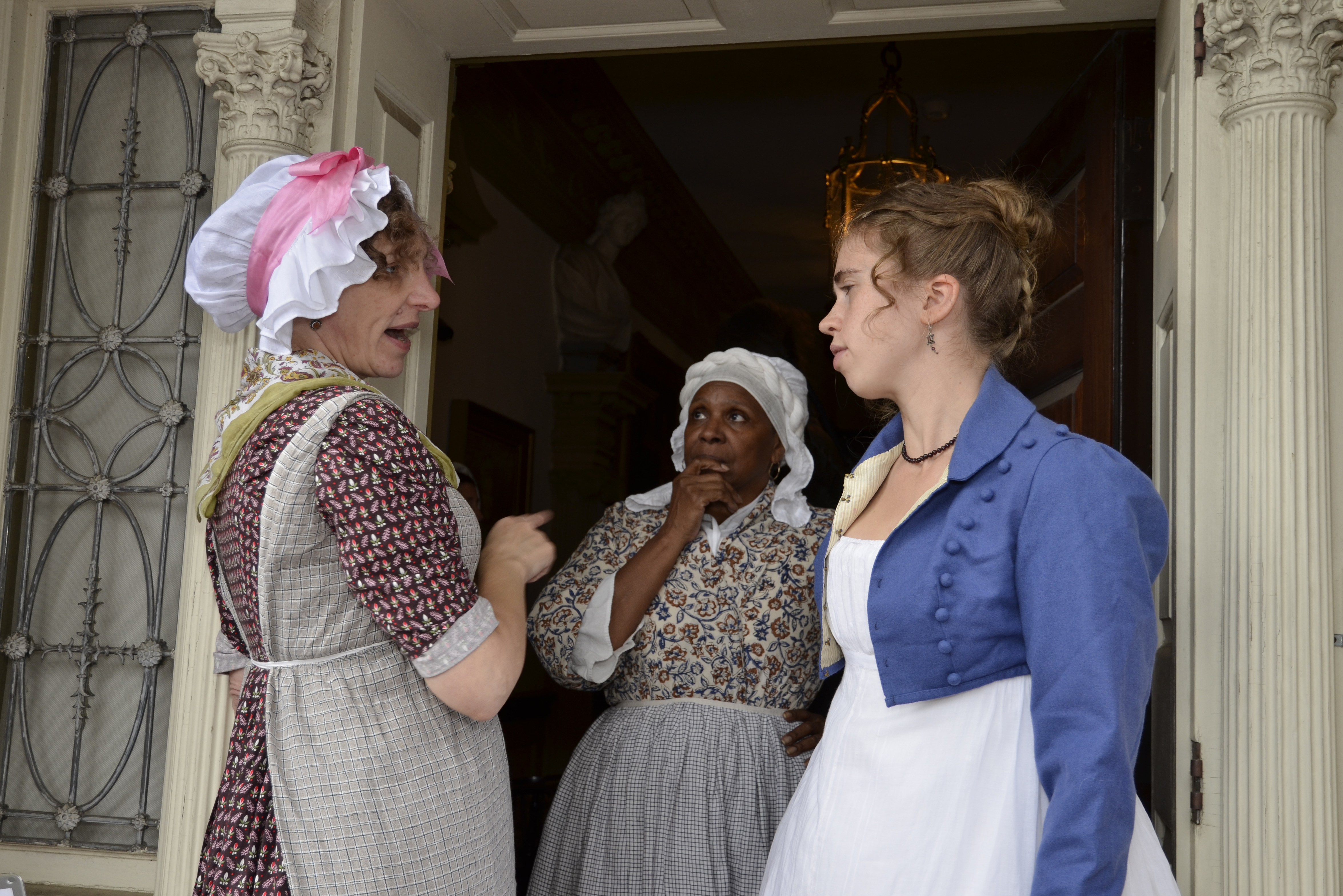
Last night, as I lay in the tester bed we slept in on What Cheer Eve, I wondered again what it was like to live and work in the house over the course of its life, and how the servants had been treated. In the late 18th and early 19th century, the notion of “service” was still evolving in New England. Help was common, and while northern and urban slavery existed, and we know the Browns traded in and owned enslaved people, we have no evidence of them in the house.

We know there was a white woman between 45 and 60, and four “all other free people,” we have names –Mary, Jonathan, and Gideon– for some of the people associated with the family, but don’t know their details. How did the Browns treat them? What was the relationship like? Were they invisible? Thanked? Chastised?

Goody Morris makes up a bed. Photograph by J. D. Kay

Goody Morris makes up a bed. Photograph by J. D. Kay

Diary entries that record “my babe takes tea with Ma’s Mary” suggests that there was some level of familiarity, and hints at the friendly relationship children and servants sometimes had in these houses, when both were seen as less civilized, less refined, and (clearly) less educated than the adult homeowners. Physically, service stairs kept chamber pots, laundry, food, servants, and children out of view, sequestered into smaller, dimmer, less-finished spaces.

Petulant Alice faces her first hurdle, Kitty and Goody Morris. Photograph by J. D. Kay

Petulant Alice faces her first hurdle, Kitty and Goody Morris. Photograph by J. D. Kay

We’ll never really know how the Browns really treated their servants, or felt about them; these are people who matter only enough to be remarked upon in passing. Perhaps even more frustrating is that we’ll never know what the servants thought of the Browns, of their businesses and moods, loves and appetites. These barely-documented people could tell us so much, if only the past could talk.

Share this:

  • Click to share on Facebook (Opens in new window) Facebook
  • Click to share on Pinterest (Opens in new window) Pinterest
  • Click to email a link to a friend (Opens in new window) Email
  • Click to share on X (Opens in new window) X
Like Loading...
← Older posts
Newer posts →

Archives

wordpress statistics

Creative Commons License
Kitty Calash blog by Kirsten Hammerstrom is licensed under a Creative Commons Attribution-NonCommercial-ShareAlike 4.0 International License.

Website Built with WordPress.com.

  • Subscribe Subscribed
    • Kitty Calash
    • Join 621 other subscribers
    • Already have a WordPress.com account? Log in now.
    • Kitty Calash
    • Subscribe Subscribed
    • Sign up
    • Log in
    • Report this content
    • View site in Reader
    • Manage subscriptions
    • Collapse this bar
 

Loading Comments...
 

    %d