• Home
  • Completed Costumes/Impressions
  • Emma and Her Dresses
  • Free Patterns and Instructions

Kitty Calash

~ Confessions of a Known Bonnet-Wearer

Kitty Calash

Tag Archives: Reenacting

Haversack Stashable Lunch Bag

11 Monday Nov 2013

Posted by kittycalash in Food

≈ Comments Off on Haversack Stashable Lunch Bag

Tags

Events, food, preparations, Reenacting

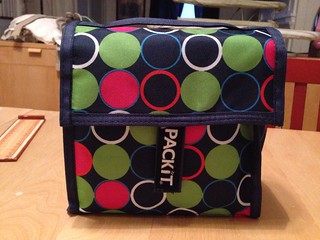
Found in the clearance aisle at Home Goods.

Mr S destroyed his lunch bag (zipper failure) and since I sew in a pre-zipper era, I declined to hunt up a new zipper and set it into the weird amalgamation that is the modern insulated lunch bag. I can’t even remember how old that lunch bag was, but it might have been six years old. So out we went for cat food (which happens a lot) and a lunch bag.

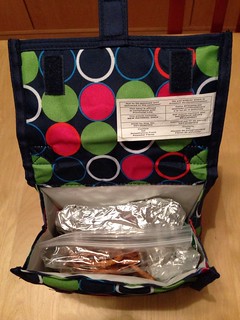
Just don’t get caught with tinfoil and plastic baggies if you’re eating in breeches.

This one seemed like it would be too small, but it does hold his entire lunch. And then I realized it would fit nicely into a haversack if one needed to pack a cold lunch on a hot day. You just have to be stealthy when opening the thing, at least until the velcro gets linty and quieter. This bag is lined with freezable something that serves as the ice pack, which does save space and should be more efficient and safer on a super-hot summer day (I’m looking at you, Cambridge in July.)

And, as ever, if you wrap your meal in tinfoil and baggies, hide it from the public. The best way to use it at an event would be to pull paper- or linen-wrapped period food from its hidden, chilled (shallow) depths. If you are not in the army, it goes in your market wallet, linen bag, or basket, not your haversack. Now, perhaps those cats can help me silence the velcro.

Share this:

  • Share on Facebook (Opens in new window) Facebook
  • Share on Pinterest (Opens in new window) Pinterest
  • Email a link to a friend (Opens in new window) Email
  • Share on X (Opens in new window) X
Like Loading...

Pouting over Putnam

30 Wednesday Oct 2013

Posted by kittycalash in Events, Fail, Reenacting

≈ 2 Comments

Tags

10th Massachusetts, Brigade of the American Revolution, Events, failure, food, living history, Reenacting

James Malton, 1761-1803, A Military Encampment in Hyde Park, 1785, Watercolor with pen in black ink, with traces of graphite on moderately thick, moderately textured, beige, laid paper, Yale Center for British Art, Paul Mellon Collection

James Malton, 1761-1803, A Military Encampment in Hyde Park, 1785, Watercolor with pen in black ink, with traces of graphite on moderately thick, moderately textured, beige, laid paper, Yale Center for British Art, Paul Mellon Collection

This Saturday is the BAR event at Putnam Park in Redding, CT. This is an event with an early set-up time, one of those “early enough to be worth packing the car Friday night” events, as Mr S will need to depart at the time he usually gets up. I’m pouting not because of the early departure time, but because I won’t be going.

The Young Mr has his first swim meet Sunday, so Saturday he’ll have to get his homework done. That means someone has to stay home, or he’ll sleep till noon and spend the rest of the day eating meat and playing video games, all normal for a 15-year-old, but not helpful when most of Sunday will be spent marinating in chlorine.

I did a strange and awful thing to my back in an altercation with the face plate of an UPS unit for a server, and find that two weeks on, I still have a mis-aligned rib and occasional searing pain when reaching for Amelia Simmons’ cookbook to find something for Mr S to take with him to Putnam Park. At first, it seemed that it would be like Fort Lee, where one does not cook.

However, it seems that a camp kitchen is planned and there could be cooking, if only someone could tend the fire during the tactical, but no. I will not be there to stir meat of any kind, in any way, and the gentlemen, if one can call them that, will have to scrounge in the corners of their haversacks, take pot luck from the Boy Scouts, or find other means of nourishing themselves. I’ve also been told that it might be as well for me not to lace up my stays and push my ribs around, though on the whole, I think I might be better off wearing them more often. No matter what, home I shall I be, and the gentlemen will have to shift for themselves. Having seen them in action, I have no doubt that they will do well for themselves, and I might still bake them a pie.

Share this:

  • Share on Facebook (Opens in new window) Facebook
  • Share on Pinterest (Opens in new window) Pinterest
  • Email a link to a friend (Opens in new window) Email
  • Share on X (Opens in new window) X
Like Loading...

Still More Sacques

29 Tuesday Oct 2013

Posted by kittycalash in A Silk Sacque

≈ Comments Off on Still More Sacques

Tags

10th Massachusetts, 18th century clothes, authenticity, Colonial Williamsburg, fashion, Museums, Reenacting, sacque, sewing, silk taffeta

1770-1780, Colonial Williamsburh 1999-247,A-C
ca. 1770 Colonial Williamsburg, 1993-330,A
ca. 1755 (Silk), dress remodeled ca. 1770. Colonial Williamsburg 1990-12,1
ca. 1750, altered ca. 1775, Colonial Williamsburg 1989-330,1
ca. 1775, remade late 19th century, Colonial Williamsburg, 1955-428,1
1770-1780, Colonial Williamsburg CW 1991-472, A-C

I’m particularly interested in remodeled gowns, not that I have the patience to make a ca. 1750 or 1760 gown and then re-make it, even though I suppose it would be the path to the greatest authenticity. In figuring out “what next” now that the pleats are stitched down and secured to the lining, and the front panels cut, and one even pinned, awaiting a seam, I looked at the sack/sacque in Costume Close Up. It’s both tiny and a polonaise, so it’s not the best example for me to follow, but when you’re trying to understand construction before you totally screw up  take the next steps, you look at whatever details you can.

That led me back to Colonial Williamsburg’s collections database, which I try to avoid because they don’t have stable permalinks to their records. However, they have good cataloging and an amazing collection, so it’s hard not to end up back there.

I feel a little more confident in thinking of a ca. 1770- 1775 gown with a compère front. A compère front is a false stomacher, where there are two halves sewn to either side of the opening in the bodice. The sides then button closed. Button, and not pin, people: sweet. I will gladly trade you a week of sewing buttonholes for a wardrobe failure today (Of course, I’m not sure whether a compère front is accurate for a ball gown, but I very much want to avoid a pin explosion at a public gathering.)

Trim is another tricky area: in my regular, 21st century life, I am not someone who wears ruffles and lace or even many colors other than black, brown, grey and red. When I chose the cross-barred fabric, it was a choice really grounded in who I am, and in my love of things architectural, bold, and elegant. (Thanks to my Dad and my education, I now wonder, can one make a Miesian sacque? Let’s find out.)

Serpentine trim, no matter how appropriate and accurate, is not for me. I like the simple trim on the purple gown (padded furbelows), and will probably replicate linear, and not serpentine, trim.

Share this:

  • Share on Facebook (Opens in new window) Facebook
  • Share on Pinterest (Opens in new window) Pinterest
  • Email a link to a friend (Opens in new window) Email
  • Share on X (Opens in new window) X
Like Loading...

Sacque Rationalizations

28 Monday Oct 2013

Posted by kittycalash in A Silk Sacque

≈ 1 Comment

Tags

10th Massachusetts, 18th century clothing, authenticity, Costumes, fashion, gown, LACMA, living history, Museums, Reenacting, sacque, sewing, silk taffeta

Sacque-Front
Sacque-Back

Before I get any farther along in the process of making a sacque (and I have not made much progress) I thought I should start to really look at gowns, and try to understand them.

Not only do I need to understand how they’re made, I want to understand how they change over time, and what’s appropriate for different time periods and situations. This will, or could, have some bearing on what I make for the gentleman accompanying me to the celebrations for which this gown is being made. If I start from Mr S, whose best coat right now is the 1777 Saratoga private’s coat, then I ought to have nothing better than a second-hand sacque several years out of date, and that is reaching indeed.

SacqueBySacque_back
What good fortune it is that the LACMA dress seems to be a gown in flux! This is the brown silk cross-barred gown with an assigned date of ca. 1760, which seems to have been abandoned in mid-alterations. Trim down the rights and left fronts ends abruptly at the waist, and two halves of what might have been a compère front lack any trim but boast plenty of holes. The front skirts come close together, but it’s hard to tell if they are meant to nearly close, or if the gown is fitted to a mannequin that’s too small and not adequately padded out.

Replicating a gown in mid-alterations would be interesting, but not what you’d wear to a ball, so I kept looking. In Hamburg there is another cross-barred sacque-back gown from about this era. There are similarities and differences, and never as much information as you’d like to have. Who owned and wore these? Who made them? When and where were they worn? We’ll never know, but at least with two similar gowns one can fill in some details for another, or help us understand them both.

The serpentine trim on the pink gown in Hamburg makes clear how unfinished or mid-alteration the brown gown in LA really is despite the visual interest created by the fabric itself.

Sacque_by_SacqueFront

So, what to do for my gown? And when will it be from? LACMA is hedging their bets with ca. 1760. I think Hamburg is pushing it a bit late with ca. 1775, but a ca. 1770 date for a gown based on the two seems reasonable. That would mean that the coat Mr S wears should also be ca. 1770, or newer than his green linen coat and older than his Saratoga coat. And luckily, I already have a plan, some fabric, and a pattern as a place to start.

While the ball itself has no date per se, it is in celebration of Washington’s Birthday, which puts it after 1775 at the earliest (think transfer of command of the Continental Army in Cambridge). Does that make a ca. 1770 gown too early? It would depend, I think on how one imagined the ball and oneself. If you’re a frugal woman who has lost much in the war, you’ll remake your gown; should the flounces become the shirred cuffs of later gowns? Could the kind-of compère front of the LACMA gown be a stomacher cut in half and stitched to the sides, with the pin hole indicating where trim had been removed from a once-was stomacher? Is it reasonable to make a compère front for a ca. 1770 gown? I want one mostly to avoid the stomacher angst I always seem to have, and in a way it marks a place between stomacher-front and front-closing gowns.

These unprovenanced gowns stand without the particular context and personality of their owners; the fun and the challenge for us, as costumers and reenactors, is in trying to bring our personalities to the fact-based garments we create.

Share this:

  • Share on Facebook (Opens in new window) Facebook
  • Share on Pinterest (Opens in new window) Pinterest
  • Email a link to a friend (Opens in new window) Email
  • Share on X (Opens in new window) X
Like Loading...

Saratoga Summary

23 Monday Sep 2013

Posted by kittycalash in Events, Living History, Reenacting

≈ 8 Comments

Tags

10th Massachusetts, 18th century, Brigade of the American Revolution, common soldier, living history, Reenacting, Revolutionary War, Saratoga, weekend

Mr S buttoning his overalls

Wow. Yet another learning experience up on the Hudson River this past weekend. It was as up-and-down a weekend as the rutted field in which we were camped, where walking felt more like swimming over the ground, and social calls were well nigh impossible. Also, we had considerable wind. By Sunday, Mrs P said we should feel grateful we never camp with a dining fly, because we knew it was wrong to feel smug that we hadn’t had to chase a fly down. Yes, every possible pun of “fly” got an outing.

Coats

The Coats, Grouped Around their Colors, Prepare for Action.

The coats turned out quite well, and there would have been one for the Young Mr if only I had not spent the past two weeks on a petticoat and patterning a gown for What Cheer Day at work. I have some regrets about that, just because they looked so very well in those unusual coats. They weren’t just a fashion statement, either: I know Mr Cooke answered a lot of questions about them, and I did, too (women ask women about the guys…). They’re a really good interpretive hook to talk about supplying the troops, and the differences in uniforms over time, and the kinds of documents historians and costume historians use in their work. Also, those coats are just plain handsome.


Down in the corner, in a lovely white gown, holding her hat on head, is Cassidy. The wind was hard on headwear.

The Battle, well, there was chaos on the public side of the battlefield, and it was difficult to see. The wrenching ground made visiting difficult (and we don’t have much of a parlor in our camp) so I did get to meet Cassidy in person but not much more.

Mr S, the Young Mr and I were grateful for Mr H’s excellent assistance with the fire.

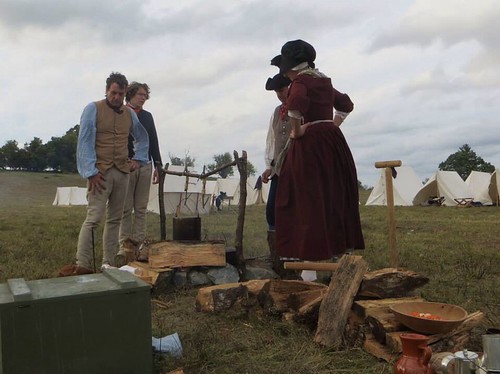
My friend Mrs H and her husband, Mr H,  and I walked back from the battlefield to work on dinner. I’m not sure what we’re contemplating here, but the kettle is on and we’re thinking about something (probably what to add next).

As you can see in the photo, we had no iron “s” hooks. I don’t know what box they’re in, but they weren’t in the kitchen box. Mr FC made us hooks from branches he discovered on the way back from his car. They held up well, and were even better and more authentic than the “s” hooks would have been. With this, we were all delighted and not at all smug.

After dinner and washing up, we participated in the hospital vignette for the public tours. (By ‘participate,’ I do sort of mean ‘first person bombed’ the scenario.) In working this out, the Adjutant wondered which of the men was the smallest and lightest. His first thought was the Young Mr, but Mr S and I soon disabused him of that notion, and after I said, “It’s you, Mr C,” and we determined that even skinny Mr S was 5 pounds heavier than Mr C, we had our victim: Mr C. He became the wounded captain carried up by Mr S, the Young Mr, Mr FC and Mr McC on a litter made from a tent and poles. I carried the lantern.

At the hospital tent, we demanded attention for our wounded captain, who had taken shot in the groin, ‘near the back.’ (We covered the wound with a coat.) The men and I were insistent upon the Captain receiving attention, despite the enlisted men requiring attention to their head wounds and amputations. Although he was given laudanum, and the ball removed (ba-thump, yes, we’re here all weekend, tip your waitress), the captain developed a fever. We demanded rum and water, but he vomited upon the very noisy private with a head wound, while down the line another private cried out, “Why, captain? Why did you do this to us?”

After he vomited, the captain’s delirium increased, and the doctor bled him. He called for his wife, and reached for me, though I am but the lowly woman with the army. I held his hand and stroked his head to ease his passing while he talked of his wife and his son, “with the angels now.” After he died, the men were summoned again to remove him from the hospital and they carried him away.

Ready to leave with the entire kitchen on my back and in my hands.

The captain’s story may have been too quiet and subtle for the public to see in the dark, but around us nurses and doctors were busy and patients were yelling, and the scene presented was one of chaos and misery (and some humor). I’ll have to analyze it more later, because there’s a strand for the reenactors and another for the public and it’s hard, sometimes, to know if they combine satisfactorily for all. I know we were pleased with our dying captain, and the boundaries it pushed for those of us newer to the first person world.

On Sunday–well, less said the better, perhaps–some of us failed to eat or drink enough and felt quite ill until mid-morning and a second cup of coffee. It’s a lesson in having protein bars stashed in pockets and haversacks, and in how wretched the soldiers and women must have felt, and how limited their decision-making capacities. That’s the argument for officers getting better food and accommodations: they make the decisions, so they need fuel and rest for their brains. The rest of us just go where we’re told.

Share this:

  • Share on Facebook (Opens in new window) Facebook
  • Share on Pinterest (Opens in new window) Pinterest
  • Email a link to a friend (Opens in new window) Email
  • Share on X (Opens in new window) X
Like Loading...
← Older posts
Newer posts →

Archives

wordpress statistics

Creative Commons License
Kitty Calash blog by Kirsten Hammerstrom is licensed under a Creative Commons Attribution-NonCommercial-ShareAlike 4.0 International License.

Website Built with WordPress.com.

  • Subscribe Subscribed
    • Kitty Calash
    • Join 621 other subscribers
    • Already have a WordPress.com account? Log in now.
    • Kitty Calash
    • Subscribe Subscribed
    • Sign up
    • Log in
    • Report this content
    • View site in Reader
    • Manage subscriptions
    • Collapse this bar
 

Loading Comments...
 

    %d