• Home
  • Completed Costumes/Impressions
  • Emma and Her Dresses
  • Free Patterns and Instructions

Kitty Calash

~ Confessions of a Known Bonnet-Wearer

Kitty Calash

Tag Archives: Reenacting

We Need to Talk

31 Tuesday Mar 2015

Posted by kittycalash in Fail, Living History, personal, Philosophy, Reenacting

≈ 8 Comments

Tags

living history, Reenacting, serious stuff, sexual harassment

If you’re reading this, you probably spend enough time on the interwebs to have picked up news about, oh, Bill Cosby and various Roman Catholic priests, and to know that sexual harassment and assault is both prevalent and under-reported in America. I don’t want to argue either of those topics, but I want to set the context for you, because sexual harassment, assault, and predation happen everywhere, even in reenacting circles; it certainly happens in cosplay: see here and here.

To be clear: I’ve only had issues with the public, not fellow reenactors, and the issues with the public involve non-sexual touching and drunken stupidity which I can avoid by never being alone in kit–which means I skip some events (Tower Park, I’m looking at you).

Most of us think of reenacting and reenactments as safe places and spaces: we do not expect to encounter predators at the museum or historic site, and I want to emphasize that, as far as I know, the visitors are not the ones being preyed upon. It’s mostly younger reenactors, and it’s rare, but it happens. And I think there are several pieces to the “why” of this.

Sometimes people are completely different away from their homes and families. Whatever secret obsessions they have may be indulged when they’re engaged in fantasy play far away from their homes. These guys (and they are usually guys) are pretty rare, and they are identifiable. The best defense against them is to monitor the vulnerable; young people who have a safety net around them are much less attractive. Once this kind of predator is identified, they have to be confronted.

Men will sometimes act more aggressively masculine (macho) in the presence of other men. There’s a defensiveness that comes to fore when women want to play in that sphere, and men will sexually harass or even assault women in an attempt to maintain dominance over what they perceive as their turf. Think of the firehouse sexual harassment cases, or what we’ve heard about at the military academies or even in some art school departments.This may be what’s behind a couple of the other stories I’ve heard.

Here’s the EEOC’s definition of sexual harassment:

It is unlawful to harass a person (an applicant or employee) because of that person’s sex. Harassment can include “sexual harassment” or unwelcome sexual advances, requests for sexual favors, and other verbal or physical harassment of a sexual nature.

  • Harassment does not have to be of a sexual nature, however, and can include offensive remarks about a person’s sex. For example, it is illegal to harass a woman by making offensive comments about women in general.
  • Both victim and the harasser can be either a woman or a man, and the victim and harasser can be the same sex.
  • Although the law doesn’t prohibit simple teasing, offhand comments, or isolated incidents that are not very serious, harassment is illegal when it is so frequent or severe that it creates a hostile or offensive work environment or when it results in an adverse employment decision (such as the victim being fired or demoted).
  • The harasser can be the victim’s supervisor, a supervisor in another area, a co-worker, or someone who is not an employee of the employer, such as a client or customer.
  • Although the law doesn’t prohibit simple teasing, offhand comments, or isolated incidents that are not very serious, harassment is illegal when it is so frequent or severe that it creates a hostile or offensive work environment.

And in case you’re thinking, “Well, these folks are volunteers! That’s different,” in Illinois, at least, it is not. An Illinois ruling found that a volunteer can be considered an employee, and is therefore covered under Title VII.

How do we stop this? If the best defense is a good offense, what do we do?

  • Name the behaviour. Call the harasser out on his behaviour, state it to him, be specific.
  • Insist that women are equal to men, even in this masculine and militarized context.
  • Make clear the behavior is the issue. Say what you have to say, and repeat it if he persists. (If you are being harassed by a woman, kindly switch the pronouns; yes, it can happen. The incidents I have in mind involve male harassers.)
  • Listen to the people who tell you they have been harassed or assaulted. Don’t judge them.
  • Report harassment to your unit commander, or another trusted person, in case it’s your commander harassing you. Report harassment to a board member or your unit, umbrella organization or museum/site.

Want more information on sexual harassment? Here’s a fact sheet for you.

To be clear: not every guy is guilty. Not every unit has a problem. There’s more good than bad. But I’m hearing about incidents large and small, and it behooves us to be certain we are behaving appropriately and legally.  That said, I’m not a lawyer, I’m a blogger, so see the disclaimer.


DISCLAIMER:

The information and materials on this site have been provided for general informational purposes only, are not comprehensive, not complete and are not legal advice. The information contained in the site is general information about sexual harassment and should not be construed as legal advice to be applied to any specific factual situation. None of the information is intended to constitute, nor does it constitute, legal advice. For information about your legal rights you should consult an attorney.

Share this:

  • Click to share on Facebook (Opens in new window) Facebook
  • Click to share on Pinterest (Opens in new window) Pinterest
  • Click to email a link to a friend (Opens in new window) Email
  • Click to share on X (Opens in new window) X
Like Loading...

Wrestling with Myself

08 Sunday Mar 2015

Posted by kittycalash in Fail, History, Living History, Making Things, personal, Philosophy, Reenacting

≈ 5 Comments

Tags

authenticity, common dress, common people, everyday, first person interpretation, first world problems, interpretation, living history, Meriwether Lewis, ordinary people, Reenacting, William Clark, William Clark Papers

Hard choices!

Hard choices!

I wrestle a lot with myself, which sounds much sexier and more athletic than it is, when it’s your patience and conscience. It’s a constant fight with my own brain and animal nature, like Snowy pondering a bone.

  • It’s hard to keep sewing for an ever-taller young man who refuses almost all attempts at fitting. (Especially when your calloused fingertips and split thumb keep catching on the silk buttonhole twist.)
  • It’s hard to have program ideas and then realize you will end up as the maid, serving a meal to a group including some people you might not like. (Don’t you think that must be a fairly authentic emotion, historically?)
  • It’s hard to put aside plans for your first pretty silk dress because someone doesn’t want to go where you want to go.
  • It’s hard to embrace the importance and meaning of interpreting the ordinary in a culture that celebrates the unique.

I come to that and stop: mission.

I'm a bad maid. Watercolor by Thomas Rowlandson, 1785? Lewis Walpole LibraryDrawings R79 no. 7

Watercolor by Thomas Rowlandson, 1785? Lewis Walpole LibraryDrawings R79 no. 7

You can take anything too far, of course, and an occasional silk gown and turn around a dance floor might make being the maid a little easier, but in the end I know that what’s important to me is representing the people who have been forgotten.

That same impulse may be part of what drives the splintering into ever-smaller groups with every-different coats, but walking the cat back also leads me to think that lace, tape, and shiny buttons may be part of the equation, too. Are those uniforms the gents’ equivalent to cross-barr’d silk sacques? As in any culture, it is easier to have your cake and eat it, too if you’re a guy.

For most of us women inhabiting the past, if we’re not baking cake, we’re serving it.

Playing the game at quadrille : from an original painting in Vauxhall Gardens. London : Robert Sayer, ca. 1750. Lewis Walpole Library, 750.00.00.14

Playing the game at quadrille : from an original painting in Vauxhall Gardens. London : Robert Sayer, ca. 1750. Lewis Walpole Library, 750.00.00.14

It’s a funny thing to want a break from work you find important, but as with anything, variety and perspective are important.

She looks wistful, doesn't she? The others are whist-full.

She looks wistful, doesn’t she? The others are whist-full.

In a world of individualists, each trying to stand out, quotidian celebrities– cast a skeptical glance at your social media feed and tell me I’m wrong–our impulse may not be to inhabit the background. But most of us are the background. We’re large only in our own minds, stars of the movies of our lives that flicker past our eyelids. And that’s ok: that’s noble, even, to live a small, thoughtful life.

 Silver Pocket Watch of Meriwether Lewis, 1936.30.5

Silver Pocket Watch of Meriwether Lewis, 1936.30.5

Once upon a time, when I worked in Missouri, I was fortunate enough to spend a lot of quality time with some amazing artifacts.

Meriwether Lewis’s refracting telescope.

William Clark’s compass.

Meriwether Lewis’s pocket watch.

William Clark’s Account with John Griffin for thread, cloth and other articles including a hat for George and shoes for Mary. (July 1820, William Clark Papers, B13/F5, MHS)

Account of expenses in “horse keeping,” 1829- 1831. Request to Clark to pay to Mrs. Ingram, with request to serve as receipt. On same document: ADS Dashney to Major Graham, 26 June 1826. Order to pay William C. Wiggins. (1831 Dec 13, William Clark Papers, B14/F2, MHS).

There are letters to one of Clark’s sons, trying to get him to stay at West Point. There are bills for bolts and iron work for Clark’s house. Yes: there are amazing things in the collection as well, and historians of all kinds can do amazing work in the papers.

But they are ordinary. They are daily life played out in the first third of the nineteenth century in St. Louis, bills and accounts punctuated by letters from famous people and news of wars and explorers. But after processing the family’s collection, what struck me more than anything was how ordinary they were, how quotidian.

Meriwether Lewis in Indian dress. engraving after St. Memin, 1807.

Meriwether Lewis in Indian dress. engraving after St. Memin, 1807.

Lewis was fabulous, interesting and mysterious. I don’t know what really happened on the Natchez Trace, but I know what happened in St. Louis. William Clark kept living, paying his bills and stumbling sometimes, refusing a role as territorial governor before accepting it. He got boring. And for that, I love him more than Lewis.

There’s real value in interpreting the everyday, ordinary people, in bringing work and working people to life in the past. I don’t always love repressing my ego, but I know that a nostalgic view of the past can be dangerous. I meant backwardly aspirational when I first wrote it, and I mean it now: most of us would not have been merchants wearing silks and velvets and superfine wools.

After wrestling with my ego and silk dress disappointment most of this afternoon*, I’ve found satisfaction in the thought of expanding my understanding of working class women. If really digging into interpreting the world of the marginal makes me uncomfortable, it must be worth doing, and doing well.

*Thankfully whilst performing useful tasks like running errands and thus wasting little real time on this nonsense.

Share this:

  • Click to share on Facebook (Opens in new window) Facebook
  • Click to share on Pinterest (Opens in new window) Pinterest
  • Click to email a link to a friend (Opens in new window) Email
  • Click to share on X (Opens in new window) X
Like Loading...

Analogize This: Subcultures and Subgroups

05 Thursday Mar 2015

Posted by kittycalash in Living History, Philosophy, Reenacting

≈ 5 Comments

Tags

authenticity, living history, Reenacting

Remember the post about the Clash, the rawness of the Vanilla Tapes, and authenticity? In response, someone commented elsewhere that there is a cross-over between punk and reenactor subcultures.

“For one thing, it’s “anti-fashion”, if fashion is defined by what’s newest. Likewise, where do we see more punks within the reenactor subpopulation? Authentics/Progs – which is an even more stringent ideology where the clothing worn is atypical of the general masses (and hand-made, to boot! *uniqueness intensifies*). The list of similarities goes on and on…”

If that’s TL;DR for you, Agnostic Front summed it up thusly:

Talk about unity
Then talk about conformity
You don’t want to support the scene
Why don’t you get the fuck away from me?

It’s that last line I’m interested in: what’s with all the sub-groups and sub-sub groups and not playing together? Someone brought a similar phenomenon up to me this morning, and in my half-awake haze, I sent him this: Kelefa Sanneh on the NYHC scene from the March 9th New Yorker.

Here’s why: my friend said,

“The progressive “need to do your own thing and go your own way” leads to a constant parade of new units. Established Progressive units are always looking for new blood, but there are more splitters than lumpers…. There are huge farb units where quantity has a quality all its own.”

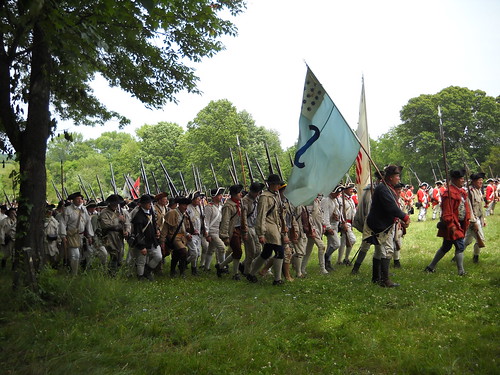
To have Men in Ranks, you need Men in Ranks.

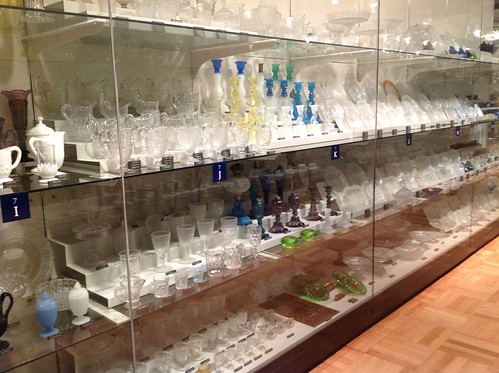
He’s not wrong, folks: there are times when size matters and Martha Stewart taught us about the impact of large groups of the same thing. You can see it working in a Met Museum open storage display of transferware or glass.

Mass Matters. Open storage at the Met, May 2013

Guys in uniforms, plates on shelves: comes to the same thing. When you get ‘em all together, they create a mass that gives an authentic presentation of force, while a handful of guys in super-accurate to the last rabbtre stitch might not—at least, not unless they’re a detachment from a light company or a scouting party, right? And what, then, of context?

So what’s happening? Are we cutting fine distinctions between groups that are actually very similar? Yes. “This new unit and uniform is totally different from your established unit: our buttons have a different number on the center.”

That raises my hackles. The more we divide, the less we conquer. It’s harder to win when you purposefully make it harder and more elite, and that’s happening as the units represented become more obscure, smaller, and more insular. It’s starting to look like show boating.

It may well be that the politics of the existing units are so awful that you have to splinter, and splinter again, but I also know units that have multiple impressions … of the same unit that show change over time. Is the sole reason this is not possible to replicate in other units the politics of these groups, or is there a badge of rank, a sense of accomplishment and uniqueness (dare I say a sense of elitism?) that comes from splintering to form ever smaller cadres of like-minded men?

“Most of all, being hardcore means turning inward, ignoring broader society in order to create a narrower one. In that narrower society, one’s ideological convictions can matter less than conviction itself—a sense, however vague, of shared purpose. In the New York hardcore scene, a wide range of characters—from Rastafarians to Republicans, street rats to suburbanites—came to see themselves as part of the same movement. That flexible spirit lives on in the genre’s famous suffix, which is now used to tag an array of movements, not all of them musical: rapcore, metalcore, grindcore, nerdcore, mumblecore, normcore.”

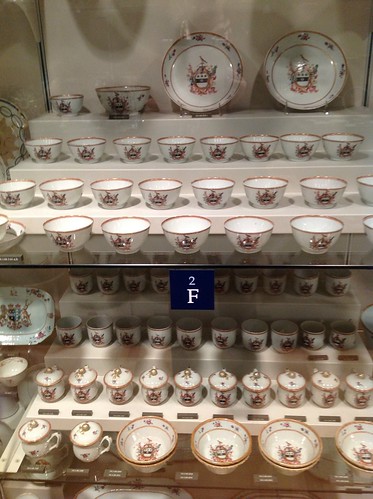
Ranks upon ranks of porcelain. Open storage, Met Museum May 2013

This is what we may have now: reenactor-core, instead of corps, if we fail to see ourselves as part of the same movement.

Groups, like egos and porcelain tea bowls, can be fragile. If we could handle each other with greater care, we might get more fun out of this business.

Ultimately, though, what this all makes me think of, as I lose patience watching the TWD mosh pit, is Woody Guthrie. The women may be ahead of the men, if only because there are so few of us, we must work together.

Share this:

  • Click to share on Facebook (Opens in new window) Facebook
  • Click to share on Pinterest (Opens in new window) Pinterest
  • Click to email a link to a friend (Opens in new window) Email
  • Click to share on X (Opens in new window) X
Like Loading...

Same Place, Different Day

17 Saturday Jan 2015

Posted by kittycalash in History, Living History, Museums, Philosophy, Reenacting

≈ 7 Comments

Tags

accuracy, authenticity, history event, history events, interpretation, living history, museum practice, rant, Reenacting

We were doing some preliminary planning for an event this fall, and we were considering recreating the 1803 funeral of Important White Guy. Our event is in October; the funeral was in September. Somebody asked me, “What does it matter when we do it?” and I didn’t respond nearly as gracefully or eloquently as I could have.

Why does it matter? Does it matter to anyone but me and my cohort?

It does, and here’s one reason why: When interpreting the funeral in late October, perhaps a member of the public will ask, “When did he die?” Can an interpreter really say “September 20” and not expect a slew of questions about how long the body was kept and why the funeral was delayed and wasn’t that a health hazard? Can the event orientation start out with “We’re doing it in October because that’s when we want to do it,” without fundamentally changing the event?

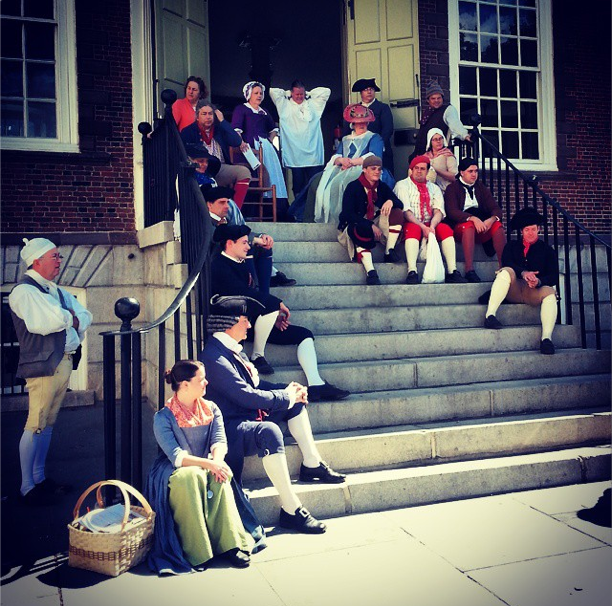
On the Colony House steps

August is hot. Can we riot in September? No!

Moving the recreation of a specific event by more than it takes to get to a weekend* seems dishonest to me: do you really want to celebrate your birthday 5 weeks after the actual date for someone else’s convenience? July 4th: Gosh, it’s not working for me this year. Let’s do that in August.

For a historical organization to suspend caring about accuracy for living history events but not for published articles, catalog records, or finding aids just contributes to the greater problem in and of living history.

When asked about the goal of a living history event, I have been told, “Well, we want families, right? So we should have some hands-on activities, you know, immersive, like candle dipping.”+

It took a bit, but at last I grasped the core of the angry-making: Kids like living history, therefore it is less sophisticated than other forms of history.

The right place for immersive string activities.

The right place for immersive string activities.

Living history is not as sophisticated, nor need it be as accurate, as traditional (written, orated, curated) historical presentations: I think that is the background assumption a lot of people make, both in the adminstration of traditional historical organizations and in the presentation on the field. It is a complete fallacy.

Living history done well and done right is as well-researched as a paper, exhibition, or article. It draws from primary sources both written and visual, it requires the absorption of countless secondary sources to help analyze the primary sources. It is as collaborative and negotiated a process as any museum exhibition, and like exhibitions, it uses material culture interpretation to deliver its messages, i.e. meet its educational and interpretive goals.

15316751814_946818c254_z

A good living history event is beautiful, but like a ballet, that beauty does not come easily. There are no shortcuts, and beauty does not equal superficial or stupid. It indicates sophistication. Part of that appeal is accuracy: the better, the more accurate and immersive the historical setting and action you create, the more visitors can learn without asking.

Lawn games

Lawn games

When I organize an event in our house at work (or even on a guided tour) one of my interpretive points is always “people saw the world differently– literally– and this event/house tour helps you see the world of 1800 the way people living then saw it.” Aesthetics were different, and were underpinned by ideas and opinions. But understanding those aesthetics and the opinions people held about race, gender, beauty, work and class takes actual research and analysis. It’s not all putting on a pretty dress and cavorting on the lawn. Facts matter. Accuracy matters.

Museums are some of the most trusted organizations. If we started juicing facts like every History channel show, we’d lose that trust, and rightly so. Our trustworthiness is grounded in our honesty and integrity.

Living history events are mobile museums, and every reenactor curates his or her own impression. To retain the trust and interest of the public, we have to be accurate.

*Events are moved to weekends because that’s when interpreters and audiences can come.

+This at a house that not only lacks a working kitchen earlier than 1960 in the staff area and was owned by a partner in a candle factory. I’m thinking “bought ’em in bulk,” here, not dipping.

Share this:

  • Click to share on Facebook (Opens in new window) Facebook
  • Click to share on Pinterest (Opens in new window) Pinterest
  • Click to email a link to a friend (Opens in new window) Email
  • Click to share on X (Opens in new window) X
Like Loading...

Peale’s Progress, or, High on History

08 Thursday Jan 2015

Posted by kittycalash in Events, History, Living History, Philosophy, Reenacting

≈ 2 Comments

Tags

18th century, authenticity, common soldier, Events, interpretation, living history, New Jersey, Philadelphia Associators, Reenacting, Revolutionary War

No, we didn’t go, and I have regrets. Six weeks before the event, I thought I was working on January 3rd, and by the time the schedule changed, it was too late. Instead, you can read about Drunktailor’s experience.

Reenactors portraying Philadelphia Associators take part in the real time tour of the Battle of Princeton, Princeton, NJ, January 3, 2015. Beverly Schaefer, Times of Trenton

Reenactors portraying Philadelphia Associators. Beverly Schaefer, Times of Trenton

The background is interesting, similar to the kind of events and projects we’ve been talking about here in RI: site- and time-specific events that combine commemoration, history, and experimental archaeology, or an emotional and social archaeology, if you will.

From event co-organizer Dave Niescior, quoted in the Rutgers-Camden News Now: “The goal is to gain a better understanding of the hardships endured by individuals who lived and made a critical moment in history.It is one thing to write ‘the troops marched overnight to Princeton,’ it is yet another to understand what that physically and mentally meant to the men who had to put one foot in front of the other all night long.” Co-organizer Matt White told NJ.com, “We’re trying to stage a number of vignettes to give people a sense of what was going on in the Continental Army in this period between late December and early January of 1776 and 1777.”

that’s cold. From Daily Reenactor

These and other collected images help convey a sense of the event,  which–as far as I can tell– did provide participants with the kind of transcendent experience I know I enjoy and hope to find at events.

This is the kind of event that I think proves a belabored (and elsewhere belittled) point: accuracy matters. It is just about ALL that matters.

On a now-defunct phone, I had an old video of the Young Mr with a now-deceased reenactor of whom I was quite fond, despite our wildly divergent politics. In it, Mr D shows his Charleville to the Young Mr on the front porch of an 18th century home and asks, “Do you know what this is?” The Young Mr shakes his head, and Mr D answers, “It’s a time machine.”

Although I remain committed to reducing the degree to which living history is musket-centric, there’s truth in that statement: Mr D had an original, period Charleville and a fairly well-cut uniform, considering his generous figure. Using, showing, and interpreting actual period pieces and well-made, correct replicas is the single best way to connect the present, and the public, to the past. Accuracy matters because it’s the literal key to the past: you have to cut the pattern right.

Accurate impressions rendered in a place of shared value will transport you to the past, and give you insights you did not expect. That is the point of these exercises: insight and understanding. It’s how to get high on history.

Share this:

  • Click to share on Facebook (Opens in new window) Facebook
  • Click to share on Pinterest (Opens in new window) Pinterest
  • Click to email a link to a friend (Opens in new window) Email
  • Click to share on X (Opens in new window) X
Like Loading...
← Older posts
Newer posts →

Archives

wordpress statistics

Creative Commons License
Kitty Calash blog by Kirsten Hammerstrom is licensed under a Creative Commons Attribution-NonCommercial-ShareAlike 4.0 International License.

Website Built with WordPress.com.

  • Subscribe Subscribed
    • Kitty Calash
    • Join 621 other subscribers
    • Already have a WordPress.com account? Log in now.
    • Kitty Calash
    • Subscribe Subscribed
    • Sign up
    • Log in
    • Report this content
    • View site in Reader
    • Manage subscriptions
    • Collapse this bar
 

Loading Comments...
 

    %d