• Home
  • Completed Costumes/Impressions
  • Emma and Her Dresses
  • Free Patterns and Instructions

Kitty Calash

~ Confessions of a Known Bonnet-Wearer

Kitty Calash

Tag Archives: Rhode Island Historical Society

Pockets of Evidence

02 Wednesday Apr 2014

Posted by kittycalash in Clothing, Reenacting, Research

≈ Comments Off on Pockets of Evidence

Tags

18th century clothes, 18th century clothing, Clothing, common dress, common people, Costume, living history, Metropolitan Museum of Art, Museums, Reenacting, Research, Rhode Island Historical Society, Wintherthur Museum

Or is it evidence of pockets?
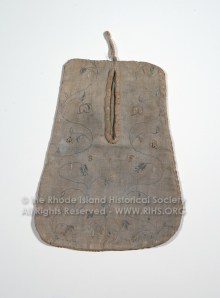
Pocket, 1770-1780 Rhode Island Linen, cotton and silk RIHS 1985.1.9

Pocket, 1770-1780
Rhode Island
Linen, cotton and silk
RIHS 1985.1.9

In any case, I thought it time to upgrade my pockets, since I have given so much attention to the rest of Bridget’s clothing. I have also been talking with a colleague about a pocket game activity, similar to the process I’ve used in thinking about Bridget: what is in your pocket? If I’m going to try that out in public, then I’d like not to be embarrassed about my pockets.

The first pocket I made was based completely on one in the RIHS Collection, and it annoyed the daylights out of me as it had exactly the same loop on top and twisted around under my petticoats, making the opening hard to find. I also realized that it was too small to be really correct for a woman’s pocket: those tend to be larger. Sew 18th Century has a really nice article on pockets here.
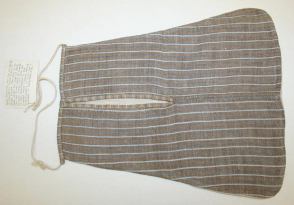
Pocket, 1789 American  linen  Gift of Miss Blanche Vedder-Wood, 1940  MMA Costume Institute C.I.40.159.4

Pocket, 1789
American
linen
Gift of Miss Blanche Vedder-Wood, 1940
MMA Costume Institute C.I.40.159.4

So I made a larger pocket based on this one at the Met, and made of a grey and cream striped linen with the slit bound in red calico. It’s dated to 1789, and technically that’s too late for my uses.

Pocket 1720-1730 block printed cotton and linen

Pocket
England, 1720-1730
Cotton; Linen
Winterthur Museum Collection 1960.0248

But the next one is too early.

Well, it has survived this long, and Wm Booth has that lovely shell print cotton, so what’s a sister to do? Pockets don’t take much fabric, so making a matched pair of printed pockets seems the thing to do.

Now the question is, what should be in those pockets?

Share this:

  • Click to share on Facebook (Opens in new window) Facebook
  • Click to share on Pinterest (Opens in new window) Pinterest
  • Click to email a link to a friend (Opens in new window) Email
  • Click to share on X (Opens in new window) X
Like Loading...

Gallery

What Cheer Day Photo Gallery

10 Thursday Oct 2013

Posted by kittycalash in Events, Living History, Museums, Thanks

≈ 2 Comments

Tags

John Brown House Museum, living history, Rhode Island, Rhode Island Historical Society, What Cheer Day

This gallery contains 19 photos.

Good Help is Hard to Find

06 Sunday Oct 2013

Posted by kittycalash in Events, Living History, Museums, Thanks

≈ 8 Comments

Tags

18th century, history, John Brown House Museum, living history, Providence, Rhode Island, Rhode Island Historical Society, What Cheer Day

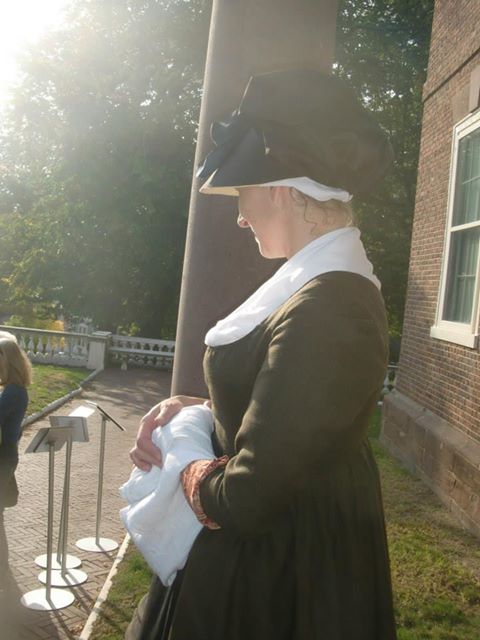
Esther helps Mrs Smith with her bonnet

Esther helps Mrs Smith with her bonnet

Esther Hudson here has a terrible fascination for knittin, and an abundant fascination with sheep.I fear sometimes for her sanity, as she spends much of the evening sketchin cats on her slate and showing em to me. Cats, sheep, and knittin are much of her conversation and I wonder if she will ever be settled in a home of her own. I durst not send her away, as her father is at sea, and knowing what might befall her, given her simple ways, I think it best to keep her close. She is fond, as you can see, of dressin, but refuses utterly to quarter a fowle. She will beat a fine pound cake, but the coarser tasks of the kitchen she finds distasteful, preferrin to dress the ladies’ hair. Of her future, I do sometimes despair.

Mrs Smith and Miss Smith

Mrs Smith and Miss Smith

My cousin, Miss Eliza Smith, has donned her new dress to come up to town from her beloved Newport to see about a position. The family with whom she has found employment these many years has suffert in that city’s decline since the late war, and she seeks a new future in Providence. She writes a fine letter, and with excellent references, Miss Smith would be well suited to manage a household for Mrs Brown’s youngest daughter, the recently married Mrs Mason. Miss Smith seems also to steady Esther, whose conversation grows more sensible when she is not with me. Perhaps after speaking with Mrs Mason, Esther, Eliza and I can slip away to enjoy some of the newly pickt apples she has brought up from Rhode Island.

Mrs Smith, ready for some ale

Mrs Smith at day’s end

At the end of a long day filled with visitors– every stage has stopt at our house, some mistaking it, I think, for that questionable establishment operated by ‘Mrs’ Mary Bowen on South Main Street–I was ready to remove my soild apron (thankfully Esther has a spare) and venture down the hill to seek refreshment with my frinds. I may chanst to hear some news of the Ann & Hope, bound for Canton, and on which my son is a sailor. Or perhaps, before the light fails, I may read a bit of Mr Defoe’s most moral tale, Moll Flanders, and think in gratitude that my late husband’s family has seen fit to give me employ. I cant read at home, for if Mrs Brown catchs me readin that book agin, I will surely be trouble.

(Top photo thanks to the Providence Journal; bottom two thanks to Sharon Ann Burnston, our Mrs Brown)

Share this:

  • Click to share on Facebook (Opens in new window) Facebook
  • Click to share on Pinterest (Opens in new window) Pinterest
  • Click to email a link to a friend (Opens in new window) Email
  • Click to share on X (Opens in new window) X
Like Loading...

Places!

04 Friday Oct 2013

Posted by kittycalash in Events, Living History, Museums

≈ Comments Off on Places!

Tags

18th century, history, John Brown House Museum, living history, Rhode Island Historical Society, What Cheer Day

places_pleaseI don’t think we can be very much more ready. It’s a bit of madness, really, when the actors are also the stage managers, press agents, prop masters, and set designers, but that’s how these things work. (The local paper says we’re presenting a play; it’s somewhere between a reenactment in the larger, looser sense and improv theatre, but never mind.) I have only myself to blame, and Mister Mason and his interest in Sleep No More, for all this. Aware of Mister Mason’s interest, I should have realized what might happen when I said,  “Can’t we just occupy the house for a day?” with all the fluidity of the Occupy movement in mind.

My compatriots, I apologize.

Share this:

  • Click to share on Facebook (Opens in new window) Facebook
  • Click to share on Pinterest (Opens in new window) Pinterest
  • Click to email a link to a friend (Opens in new window) Email
  • Click to share on X (Opens in new window) X
Like Loading...

Chemisettes

16 Monday Sep 2013

Posted by kittycalash in Events, Making Things, Museums, Research

≈ 1 Comment

Tags

1800 event, 18th century clothing, bib and tucker, fashion, John Brown House Museum, patterns of fashion, Rhode Island, Rhode Island Historical Society, style, What Cheer Day

The Shooting Star: Snowy in his “best bib and tucker.”

Chemisette or tucker? By the time The Shooting Star was published in 1941-42, “bib and tucker” had wandered away from their original meanings. Tuckers were worn under women’s and girl’s bodices, taking on the role of neck handerchiefs or fichus, and what some people like to call “modesty pieces,” though the phrase always makes me think of the front panel of desks.

Janet Arnold includes chemisettes in Patterns of Fashion I, and you can buy a very nice one indeed from Cassidy at her Etsy store. (Reviewed here, and modeled, too!) But can you have one in Rhode Island in 1800? That is, of course, the question.

Hannah Weaver Peckham, RIHS 1958.3.2

Hannah Weaver Peckham, RIHS 1953.8.2

Turns out you probably can. Scrolling through the miniatures gallery, there was Hannah Weaver Peckham in her best tucker, and Miss Rhodes, while later, is also sports a chemisette or tucker. (Mrs Peckham looks a bit cranky, doesn’t she? Perhaps her busk is poking her.)

What you’d call it remains an open question.

The 1933 Oxford dictionary we have in the office defines “tucker” as “A piece of lace or the like, worn by women within or around the top of the bodice of the 17-18th C.”

Phoebe Smith Rhodes, RIHS  1918.3.6

Phoebe Smith Rhodes, RIHS 1918.3.6

The same dictionary tells me “chemisette” is 1807, from the French, diminutive of chemise. “1. A bodice, more or less like the upper part of a chemise. 2. An article, usually of lace or muslin, made to fill in the open front of a woman’s dress 1844.”

While I think that one could, in Rhode Island in 1800, wear a garment that filled in the upper part of a bodice, I’m not sure what one wold call that garment. The simplest thing to do is to wear a white kerchief  like Phoebe Smith Rhodes. Have I ever settled for the simplest thing? Not if I can help it.

Share this:

  • Click to share on Facebook (Opens in new window) Facebook
  • Click to share on Pinterest (Opens in new window) Pinterest
  • Click to email a link to a friend (Opens in new window) Email
  • Click to share on X (Opens in new window) X
Like Loading...
← Older posts
Newer posts →

Archives

wordpress statistics

Creative Commons License
Kitty Calash blog by Kirsten Hammerstrom is licensed under a Creative Commons Attribution-NonCommercial-ShareAlike 4.0 International License.

Website Built with WordPress.com.

  • Subscribe Subscribed
    • Kitty Calash
    • Join 621 other subscribers
    • Already have a WordPress.com account? Log in now.
    • Kitty Calash
    • Subscribe Subscribed
    • Sign up
    • Log in
    • Report this content
    • View site in Reader
    • Manage subscriptions
    • Collapse this bar
 

Loading Comments...
 

    %d